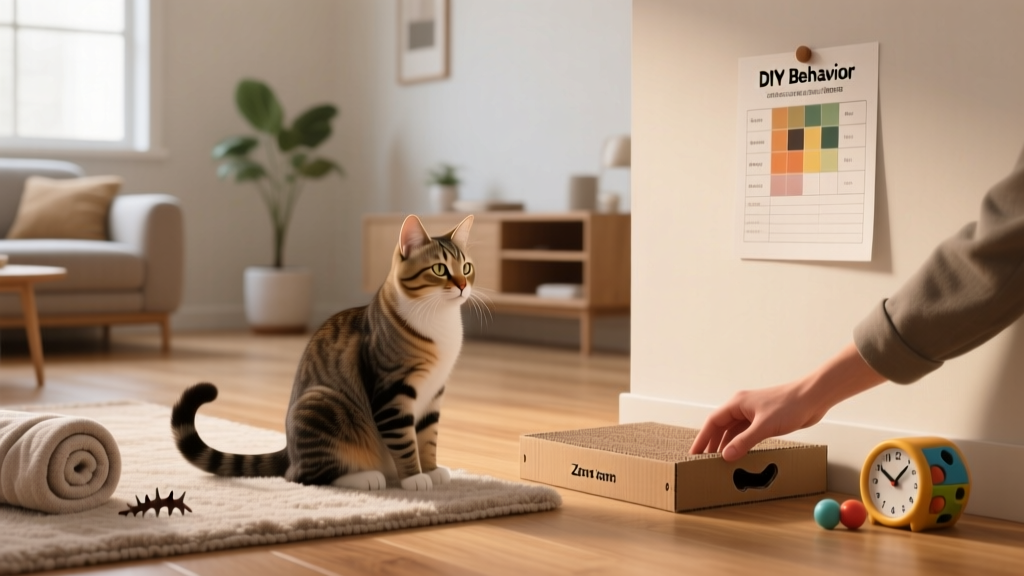
How to Understand Cat's Behavior Affordable
Why Understanding Your Cat’s Behavior Affordably Isn’t Just Smart — It’s Essential for Their Well-Being
If you’ve ever stared at your cat mid-purr while they stare blankly back — wondering whether that slow blink means love or exhaustion, or whether the sudden zoomies signal joy or stress — you’re not alone. How to understand cat's behavior affordable is one of the most searched yet under-served topics in pet care: millions of cat owners want deep insight into their feline companions but feel priced out of professional consultations, expensive behavior apps, or certified training programs. The truth? You don’t need a $200 session with a board-certified veterinary behaviorist to start decoding your cat’s world — though consulting one *is* wise for serious issues. In fact, according to Dr. Sarah Wooten, DVM and certified Fear Free® practitioner, '90% of everyday feline communication can be interpreted accurately using free observation tools, consistent journaling, and foundational knowledge — no paid subscription required.' This guide delivers exactly that: actionable, evidence-based, zero-cost strategies grounded in ethology, clinical feline behavior research, and real-world owner success stories — all designed to help you build trust, prevent miscommunication, and strengthen your bond — without touching your wallet.
1. Master the ‘ABC’ Framework: Antecedent-Behavior-Consequence (Free & Powerful)
Before jumping to labels like 'aggressive' or 'aloof,' shift your mindset from judgment to curiosity. The ABC framework — used by veterinary behaviorists and shelter enrichment specialists — helps you objectively record and interpret behavior *in context*. It takes less than 60 seconds per observation and requires only a notebook or notes app.
Here’s how it works:
- Antecedent (A): What happened *immediately before* the behavior? (e.g., doorbell rang, child approached sleeping spot, new food bowl placed nearby)
- Behavior (B): What did your cat *do* — precisely and neutrally? (e.g., flattened ears, tail thumping once, retreated under bed, purred while kneading) — avoid interpretations like 'angry' or 'happy'
- Consequence (C): What happened *right after*? (e.g., you stopped petting, visitor left, you offered treats, no response)
This isn’t just theory — it’s diagnostic gold. A 2022 study published in Journal of Feline Medicine and Surgery found that owners who consistently logged ABC data for just two weeks identified patterns in 83% of previously confusing behaviors (like nighttime yowling or litter box avoidance). One owner, Maria from Portland, tracked her senior cat’s sudden hissing at the vacuum cleaner using ABC. She discovered the antecedent wasn’t the noise itself — but the *shadow* the vacuum cast on the wall when first turned on. Once she dimmed the hallway light before use, the hissing stopped entirely. No vet visit. No gadget. Just attentive observation.
Pro tip: Start small. Pick *one* puzzling behavior this week (e.g., why your cat bites your hand during petting) and log 5–7 ABC entries. You’ll likely spot the trigger — often subtle — within days.
2. Decode Body Language Like a Shelter Behavior Technician (No Certification Required)
Cats communicate primarily through posture, ear position, pupil size, tail movement, and vocalization tone — not words or facial expressions like dogs. Misreading these signals leads to frustration on both sides. Fortunately, the core lexicon is compact, visual, and freely teachable.
Consider these high-impact, low-effort reads:
- Ears forward & relaxed: Content, alert, open to interaction
- Ears pinned flat sideways or backward: Fear, anxiety, or defensive readiness — not always aggression; often a plea for space
- Pupils dilated in bright light: Heightened arousal — could indicate fear, excitement, or pain (context matters!)
- Slow blink ('cat kiss'): A voluntary sign of trust and safety — reciprocate slowly to reinforce calm
- Tail held high with quiver: Intense affection and greeting — a huge compliment!
- Tail tucked tightly or low with rapid flick: Stress or agitation — stop interaction immediately
Dr. Mikel Delgado, certified applied animal behaviorist and researcher at UC Davis, emphasizes: 'People assume a wagging tail means happiness — but in cats, it almost always signals irritation building toward overstimulation. That’s why so many cats bite during petting: they’re giving clear warnings we ignore.'
Try this free exercise: Spend 10 minutes daily observing your cat *without interacting*. Note ear angles, tail base movement (not just tip), whisker direction, and blink rate. Use free resources like the ASPCA’s Feline Body Language Guide (online, no login) or Cornell’s Feline Health Center PDFs — all vet-reviewed and publicly available.
3. Build a 'Behavior Baseline' Using Your Phone Camera (Zero-Dollar Tech)
Your smartphone is the most powerful behavior-analysis tool you own — and it costs nothing extra. Recording short clips (15–30 seconds) of routine moments — eating, napping, greeting, playing — creates a personal reference library. Over time, you’ll notice subtle shifts that signal health changes or emotional states long before symptoms escalate.
Here’s how to maximize this free method:
- Record weekly 'baseline clips': Same time, same location (e.g., morning feeding at kitchen counter). Compare frame-by-frame: Is appetite consistent? Is gait smooth? Are eyes clear?
- Capture 'trigger moments' safely: If your cat hides when guests arrive, film from across the room — never force interaction for footage.
- Use slow-motion playback: Most phones offer this. Watch ear swivels, whisker twitches, and micro-expressions invisible to the naked eye.
Real-world impact: When Tom from Austin noticed his 12-year-old cat, Luna, began pausing mid-step and slightly lifting her right paw before walking — visible only in slow-mo — he compared it to her baseline clip from three months prior. Her gait had subtly changed. A vet visit confirmed early-stage arthritis — caught months earlier than typical because of video evidence. Treatment started sooner, mobility preserved longer, and costs were far lower than emergency intervention would have been.
Remember: Never post videos of your cat’s stress behaviors online for 'advice' — well-meaning strangers aren’t qualified diagnosticians. Instead, share clips privately with your vet during telehealth consults (many now accept video uploads as part of intake).
4. Leverage Community Wisdom — Ethically & Effectively
Online forums and local rescue groups are rich sources of affordable, experience-based insight — *if used wisely*. The key is filtering anecdote from evidence and avoiding harmful trends.
Smart, low-cost community engagement looks like this:
- Join moderated, vet-affiliated groups: Look for Facebook groups hosted by shelters with veterinary oversight (e.g., 'Friends of [City] Animal Services – Behavior Support') or Reddit’s r/CatAdvice (moderated by credentialed behavior consultants).
- Search before you post: Use keywords like 'cat tail puffing + adoption' or 'senior cat yowling + night' — many common issues have detailed threads with vet-approved solutions.
- Ask specific, ABC-informed questions: Instead of 'Why does my cat hate my baby?', try 'My 6-month-old cat flattens ears and backs away when baby reaches — antecedent is reaching hand, consequence is I pick him up. Is this fear or resource guarding?'
Avoid: 'What’s wrong with my cat?' posts (too vague), or seeking diagnoses for medical symptoms (e.g., 'my cat sneezes daily — is it allergies?'). Those require veterinary evaluation.
| Free Resource Type | What It Offers | Key Limitation | Vet-Recommended Use Case |
|---|---|---|---|
| ASPCA Feline Behavior Guides (PDF) | Downloadable, illustrated guides on litter issues, scratching, multi-cat dynamics | No personalized feedback | First-response tool for common household challenges |
| Local Humane Society Workshops | In-person or Zoom sessions on reading body language, enrichment basics | May require registration; limited slots | Hands-on learning with live Q&A from shelter behavior staff |
| Veterinary Telehealth Triage | Many clinics offer $25–$40 15-min video consults (often covered by pet insurance) | Not full diagnosis — triage only | When behavior change coincides with appetite/energy shifts |
| University Extension Programs | Free webinars from land-grant schools (e.g., Ohio State, UC Davis) on feline cognition | Scheduled dates only; recordings may lag | Deepening understanding of motivation and learning theory |
| Library-Accessed Journals | Free access via public library to peer-reviewed journals (e.g., via EBSCOhost) | Requires library card; academic language | Verifying claims made in blogs or social media |
Frequently Asked Questions
Why does my cat stare at me silently — is it judging me?
Not judging — likely communicating! A soft, unblinking stare followed by a slow blink is a sign of trust and affection. Cats rarely hold prolonged eye contact with beings they perceive as threats. If the stare feels intense and is paired with dilated pupils, flattened ears, or stiff posture, it may signal anxiety — observe context. But in most cases? Your cat is saying, 'I feel safe enough to look at you without looking away.' Try blinking slowly back — you might get a blink in return.
My cat brings me dead mice — is this a gift or a complaint?
It’s instinct-driven teaching — not a gift or complaint. In the wild, mother cats bring prey to kittens to teach hunting skills. Your cat sees you as a socially bonded, albeit inept, family member and is attempting to 'train' you. Punishing or ignoring doesn’t stop it — it’s deeply wired. The kindest, most effective response is to calmly accept the 'offering,' then immediately dispose of it (wear gloves), and redirect with interactive play using a wand toy — mimicking the hunt-catch-kill sequence. This satisfies the drive without encouraging wildlife killing.
Is it normal for my cat to suddenly sprint around the house at 3 a.m.?
Yes — and it’s usually healthy! Known as 'the zoomies,' this burst activity is natural feline energy release, especially in indoor-only cats who lack daytime hunting outlets. It peaks at dawn/dusk (crepuscular rhythm) and often follows naps. However, if new in an older cat (>10 years), accompanied by vocalization, disorientation, or accidents, consult your vet — it could indicate hyperthyroidism or cognitive decline. For younger cats, enrich their environment with puzzle feeders, vertical spaces, and scheduled play sessions to reduce nocturnal bursts.
How do I know if my cat’s hiding is normal stress or something serious?
Hiding for short periods (e.g., after moving furniture or during storms) is typical. Red flags include: hiding >24 hours continuously, hiding *while eating or using the litter box*, hiding paired with lethargy, loss of appetite, or vocalizing while concealed. According to the International Society of Feline Medicine, prolonged hiding is one of the top three subtle signs of underlying pain or illness — often missed because cats mask discomfort. When in doubt, record a brief video and share it with your vet during a telehealth check-in.
Can I train my cat to stop scratching furniture — without buying expensive posts?
Absolutely — and it starts with understanding *why* they scratch. It’s not destruction; it’s stretching, claw maintenance, and scent-marking (they have glands in their paws). Instead of fighting the behavior, redirect it: cover scratched areas temporarily with double-stick tape (cats dislike the texture), place a sturdy, upright cardboard scratcher *next to* the furniture (not across the room), and reward with treats *only* when they use it. Rubbing catnip on the scratcher boosts appeal. Consistency beats cost every time.
Common Myths About Affordable Cat Behavior Understanding
Myth #1: “Cats are aloof and don’t bond like dogs — so trying to understand them is pointless.”
False. Research using fMRI scans (published in Current Biology, 2023) confirms cats form secure attachments to caregivers comparable to human infants and dogs. They simply express it differently — through proximity, slow blinks, and following you room-to-room. Ignoring their signals doesn’t mean they lack attachment; it means we haven’t learned their dialect.
Myth #2: “If my cat hisses or swats, they’re ‘bad’ and need punishment.”
Completely dangerous and counterproductive. Hissing and swatting are distance-increasing signals — the cat is saying, “I’m overwhelmed and need space *now*.” Punishment erodes trust, increases fear, and can escalate to biting or chronic anxiety. The humane, effective response is immediate withdrawal and later identifying the trigger (via ABC logging) to prevent recurrence.
Related Topics (Internal Link Suggestions)
- Reading cat body language cues — suggested anchor text: "what does it mean when my cat’s tail puffs up"
- Low-cost cat enrichment ideas — suggested anchor text: "DIY cat toys that actually work"
- When to see a vet for behavior changes — suggested anchor text: "cat behavior red flags you shouldn't ignore"
- Multi-cat household harmony tips — suggested anchor text: "how to stop cats from fighting without separation"
- Senior cat behavior shifts explained — suggested anchor text: "is my old cat confused or just aging?"
Conclusion & Your Next Step
Understanding your cat’s behavior affordably isn’t about cutting corners — it’s about leveraging accessible science, compassionate observation, and community wisdom to deepen connection and safeguard well-being. You now have vet-backed frameworks (ABC logging), body language decoding skills, video-based tracking, and ethical resource navigation — all at $0 investment. The most powerful tool isn’t an app or gadget; it’s your consistent, curious attention. So this week, commit to one action: choose *one* behavior that puzzles you, open your notes app, and log five ABC entries. That single habit — repeated with kindness and patience — will transform confusion into clarity, and uncertainty into confidence. Your cat has been speaking all along. Now, you’re finally learning the language — and it didn’t cost a cent.