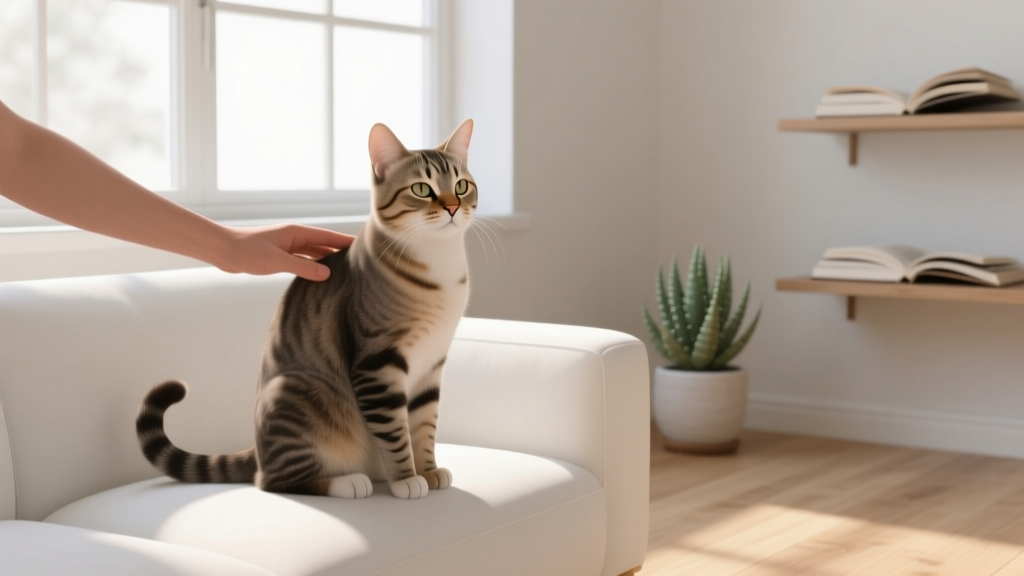
How to Teach Your Cat Good Behavior (Without Punishment,...
Why 'How to Teach Your Cat Good Behavior' Is One of the Most Misunderstood—and Urgently Needed—Skills for Cat Owners Today
If you've ever wondered how to teach your cat good behavior, you're not alone—and you're likely exhausted from trying outdated, punitive methods that damage trust and worsen problems. Unlike dogs, cats don’t respond to dominance-based corrections or verbal scolding; they interpret those as threats, triggering fear-based aggression or withdrawal. Yet over 68% of cat owners report at least one persistent behavior issue—scratching furniture, inappropriate elimination, nighttime zoomies, or biting during petting—and nearly half abandon training within three days due to frustration or misinformation. The truth? Teaching your cat good behavior isn’t about obedience—it’s about communication, consistency, and meeting their species-specific needs first. And when done right, it transforms not just your cat’s actions—but your entire relationship.
The Foundation: Why Cats ‘Misbehave’ (Spoiler: It’s Rarely Malice)
Before diving into techniques, it’s essential to reframe what ‘bad behavior’ really means. As Dr. Sarah Heath, a European Board-Certified Veterinary Behaviourist, explains: ‘Cats don’t have moral failings—they have unmet needs. Every so-called “problem” is either a stress signal, a medical red flag, or an instinctual response being expressed in the wrong context.’
For example, a cat urinating outside the litter box isn’t ‘getting back at you’—it’s often signaling urinary tract discomfort, litter aversion (texture, scent, or location), or territorial anxiety triggered by a new pet, baby, or even rearranged furniture. Likewise, destructive scratching serves vital biological functions: claw maintenance, scent marking via interdigital glands, and stretching tight shoulder muscles. Punishing these acts doesn’t eliminate them—it suppresses the behavior temporarily while escalating underlying stress.
So how do you begin? Start with a three-part diagnostic filter:
- Rule out medical causes: Schedule a full wellness exam—including urinalysis and bloodwork—if behavior changes are sudden, frequent, or paired with lethargy, appetite shifts, or vocalization. Up to 40% of ‘behavioral’ cases in cats have an underlying medical component (per the American College of Veterinary Behaviorists).
- Map environmental stressors: Use a simple journal for 5–7 days: note time, location, trigger (e.g., doorbell ringing, dog barking next door), cat’s body language (dilated pupils? flattened ears? tail flicking?), and outcome. You’ll often spot patterns invisible in the moment.
- Assess resource adequacy: Do you have ≥ (n+1) litter boxes (where n = number of cats)? Are scratching posts tall enough (≥32 inches), stable, and placed near resting/sleeping zones? Is food/water separated from litter areas? Are there vertical spaces (shelves, cat trees) for escape and observation?
This triage step alone resolves ~30% of common issues before formal training begins—saving time, money, and emotional energy.
Positive Reinforcement Done Right: Timing, Tools, and Tiny Wins
Most cat owners attempt positive reinforcement but miss two critical levers: timing precision and reinforcer hierarchy. Unlike dogs, cats have a 1.5–2 second optimal window for reward delivery post-behavior. Miss it, and the cat associates the treat with whatever they did *next*—not the desired action.
Start by building your cat’s ‘reward bank.’ Not all treats work equally: high-value rewards (freeze-dried chicken, tuna paste, or catnip-sprinkled kibble) should be reserved *only* for targeted training sessions—not daily meals. Lower-value rewards (regular kibble) maintain baseline motivation. Observe your cat’s natural preferences: does she chase crinkle balls more than feather wands? Does she linger near your lap only when you’re eating salmon? Those clues reveal her personal reinforcers.
Here’s a real-world success story: Luna, a 3-year-old rescue with a history of biting during petting, was taught ‘petting tolerance’ using a structured protocol. Her owner used a clicker (marking the exact millisecond Luna leaned in or blinked slowly) and delivered a tiny piece of freeze-dried shrimp. Sessions lasted 45 seconds, 3x/day. By day 9, Luna initiated head-butts during calm moments—and stopped biting entirely by day 14. Crucially, the owner never forced interaction; she waited for Luna to approach, reinforcing autonomy.
Key principles to embed:
- Clicker training works—but silence works better for some cats. If your cat startles at the click, substitute a soft ‘yes’ or gentle tongue-click. Consistency matters more than the tool.
- Shaping > Luring. Instead of guiding your cat’s nose with a treat to ‘sit,’ reward successive approximations: looking at the target spot → stepping toward it → placing one paw on it → full sit. This builds problem-solving confidence.
- End every session on a win. Even if progress is microscopic, finish with a guaranteed success (e.g., rewarding eye contact) so your cat associates training with safety and reward.
Redirecting Instincts: Turning ‘Problems’ Into Purposeful Outlets
Cats aren’t broken—they’re brilliant, highly specialized predators whose instincts clash with modern indoor life. Rather than suppressing natural drives, redirect them into acceptable channels. This isn’t compromise—it’s enrichment engineering.
Take scratching: instead of covering the sofa in double-sided tape (which teaches avoidance, not replacement), build a ‘scratch ecosystem.’ Place upright sisal posts beside favorite napping spots (cats scratch upon waking), add horizontal cardboard pads near entryways (for scent-marking arrivals), and rub them with catnip or silvervine. Then, when you catch your cat using the sofa, calmly pick up a toy mouse and gently guide her paws to the nearby post—then reward lavishly. Within 5–7 days, most cats self-select appropriate surfaces when options are abundant, accessible, and appealing.
For night-time activity (the infamous ‘3 a.m. Olympics’), mimic natural hunting cycles. Feed 80% of daily calories via puzzle feeders or timed feeders set for dawn/dusk—their peak activity windows. Add 10 minutes of vigorous interactive play (using wand toys that mimic prey movement: erratic darting, hiding, then ‘exhaustion’) 30 minutes before bedtime. A 2022 study in Applied Animal Behaviour Science found cats with scheduled play + feeding routines showed 72% less nocturnal activity disruption over 3 weeks versus controls.
Even aggression—often mislabeled as ‘mean’—can be redirected. If your cat ambushes ankles, it’s likely under-stimulated hunting drive. Swap punishment for structured play: keep a ‘predation kit’ (feather wand, tunnel, treat ball) by the couch. When she crouches, initiate play *before* the pounce. Reward calm observation with treats. Over time, her brain learns: ‘Stalking leads to fun—not fear or friction.’
Your 7-Day Behavior Reset Plan (Customizable & Vet-Approved)
This table outlines a progressive, low-pressure framework designed for real-life consistency—not perfection. Each day builds neural pathways through repetition and predictability. Adjust durations based on your cat’s temperament (shy cats may need longer on Day 1; confident ones can advance faster).
| Day | Core Action | Time Required | Tools Needed | Success Indicator |
|---|---|---|---|---|
| Day 1 | Baseline observation + medical check-in | 15 mins journaling + vet call | Notebook, phone | Identified ≥2 environmental stressors or resource gaps |
| Day 2 | Introduce 1 high-value reinforcer in neutral setting | 3 x 45-second sessions | Treats, quiet room | Cat approaches voluntarily or maintains eye contact during reward delivery |
| Day 3 | Target training: ‘touch’ (nose to target stick) | 3 x 1-minute sessions | Chopstick or dowel, treats | Consistent touch within 3 seconds of target presentation |
| Day 4 | Redirect 1 unwanted behavior using target + reward | 2 x 2-min sessions | Target stick, treats, scratching post | Cat chooses post over sofa ≥2x in session |
| Day 5 | Add environmental enrichment (vertical space + puzzle feeder) | 20 mins setup | Shelf brackets, puzzle toy, kibble | Cat investigates new space/feeders within 24 hours |
| Day 6 | Practice ‘leave-it’ with low-distraction object | 2 x 90-second sessions | Treat, ceramic bowl, lid | Cat looks away or blinks when bowl covered |
| Day 7 | Review journal + celebrate 1 measurable win | 10 mins reflection | Journal, photo of win (e.g., cat on post) | Clear before/after comparison (e.g., ‘0 sofa scratches today’) |
Frequently Asked Questions
Can I use a spray bottle or loud noise to stop bad behavior?
No—and here’s why it’s actively harmful. Spray bottles trigger acute fear responses that generalize to you, the environment, or unrelated stimuli (e.g., the sound of running water). A landmark 2018 study in Journal of Feline Medicine and Surgery found cats subjected to aversive techniques showed elevated cortisol levels for up to 48 hours post-correction and were 3.2x more likely to develop redirected aggression. Positive reinforcement builds trust; punishment erodes it.
My cat is older—can I still teach good behavior?
Absolutely. Neuroplasticity persists throughout life—even in cats 15+. While learning may take 2–3x longer, senior cats often respond *more* reliably to clear, low-stress cues because they’re less easily distracted. Focus on comfort-first training: shorter sessions (30 seconds), softer surfaces, and high-value rewards. Always rule out arthritis or dental pain first—what looks like ‘stubbornness’ may be physical discomfort.
What if my cat hisses or swats during training?
Hissing/swatting is a clear ‘stop’ signal—not defiance. Immediately pause, increase distance, and assess: Was the session too long? Did you move too fast? Was the environment noisy? Back up one step in the training ladder and reinforce calm proximity instead. Forcing interaction after this signal damages your bond and teaches your cat that expressing boundaries leads to escalation—a dangerous lesson.
Do I need a professional behaviorist—or can I do this myself?
You can absolutely succeed solo for common issues (scratching, litter box, mild play aggression) using evidence-based methods. However, consult a certified cat behaviorist (IAABC or ACVB credential) if you observe: urine spraying on vertical surfaces, unprovoked aggression toward people/pets, self-mutilation, or sudden onset of behavior change in seniors. Early intervention prevents entrenchment—and many offer affordable virtual consultations.
Will neutering/spaying improve behavior?
It often reduces hormonally driven behaviors like roaming, spraying, or inter-cat aggression—but it won’t fix learned habits, fear-based responses, or unmet environmental needs. Think of it as lowering the volume on instinct, not deleting the file. Training remains essential regardless of reproductive status.
Common Myths About Teaching Cats Good Behavior
Myth #1: “Cats can’t be trained—they’re too independent.”
False. Cats are highly trainable—they simply require different motivators and timing than dogs. Research from the University of Lincoln demonstrated cats successfully completing complex multi-step tasks (like opening latches in sequence) for food rewards when sessions were brief and voluntary. Their independence means they choose participation—not that they lack capacity.
Myth #2: “If I ignore bad behavior, it’ll go away on its own.”
Ignoring rarely works—and can worsen issues. Unaddressed stress behaviors (like overgrooming or inappropriate elimination) often escalate or shift form. What appears passive is usually active distress. Proactive, compassionate intervention is kindness—not control.
Related Topics (Internal Link Suggestions)
- Understanding Cat Body Language — suggested anchor text: "what your cat's tail flick really means"
- Best Scratching Posts for Indoor Cats — suggested anchor text: "top 5 vet-approved scratching solutions"
- Litter Box Problems: Causes and Fixes — suggested anchor text: "why your cat avoids the litter box (and how to fix it)"
- Cat Enrichment Ideas for Small Apartments — suggested anchor text: "space-smart enrichment for city cats"
- When to See a Veterinary Behaviorist — suggested anchor text: "signs your cat needs expert behavior help"
Conclusion & Your Next Step
Learning how to teach your cat good behavior isn’t about creating a perfect pet—it’s about deepening mutual understanding, honoring feline nature, and co-creating a home where both you and your cat feel safe, stimulated, and respected. You now have a vet-backed framework, a realistic 7-day plan, and myth-busting clarity to move forward with confidence. So your next step? Pick just ONE behavior to focus on this week—whether it’s redirecting scratching, building litter box confidence, or teaching a simple ‘come’ cue—and commit to three 45-second sessions. Track one small win. Celebrate it. That tiny spark of success is where transformation begins—and it starts today.