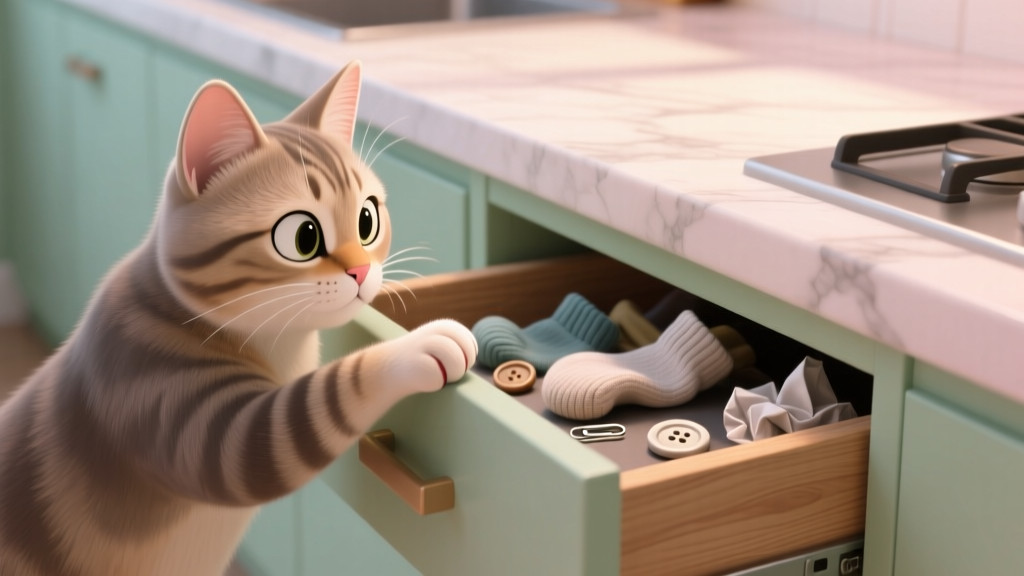
Cat Paw Reaching Into the Drawer: Investigation Mode
You’re folding laundry or hunting for a spare charger, and you feel it: a soft tap-tap on the drawer front. You slide it open an inch—just enough—and suddenly a striped paw snakes inside like a tiny burglar’s hand. Your cat’s whiskers flare, eyes go wide, and that paw starts “fishing” around with intense focus. Socks are prodded. A pen is hooked and dragged. Something mysterious in the back corner must be investigated immediately.
If your cat has a habit of reaching into drawers, cabinets, laundry baskets, or any barely-opened crevice, you’re not alone. This is classic “investigation mode”—a mix of curiosity, hunting instincts, and a very feline belief that all hidden spaces belong to them. The good news: most of the time, it’s normal, healthy behavior. The even better news: understanding it can make your home feel less like a crime scene and more like a well-run enrichment center.
Why Cats Do This (Science, Evolution, and a Bit of Cat Logic)
Cats are both predators and, historically, potential prey. That combo shaped a brain that’s obsessed with information gathering: What’s in there? Is it safe? Could it move? Could it be eaten? Could it be used for a nap?
In the wild, small cats survive by investigating tight spaces—burrows, brush piles, rock crevices—because those places hide both opportunity and risk. Mice don’t politely wander into open areas; they disappear into cracks. The cat that can reach into a hole and flush prey out has an advantage.
Drawers mimic those natural “mystery spaces” perfectly:
- They hold concentrated smells. Fabric and paper trap scent, and cats experience the world largely through smell. Your drawer is a perfume library of “you,” other pets, food traces, and novelty.
- They’re semi-enclosed. Cats love boundaries. A drawer is like a portable cave with a lid.
- They offer intermittent rewards. Sometimes a drawer contains a toy, a hair tie, a dangling tag, or a crinkly wrapper. Random rewards are powerful—your cat keeps checking because “sometimes it pays off.”
- They invite paw-first exploration. Cats often test a space with their paw before putting their head in. It’s safer and more controlled, especially if something might move.
Also, cats have excellent tactile sensitivity in their paws. Between paw pads, toe joints, claws, and whiskers (which often come forward during close inspection), they’re basically equipped with a built-in “probe” tool. Your dresser drawer is just the latest research project.
A Detailed Breakdown: Different Contexts for Drawer-Reaching
“Cat paw in drawer” can look similar from a distance, but the motivation can change depending on the setup and your cat’s personality. Here are the most common versions.
1) The Treasure Hunter
You once stored a wand toy in that drawer. Or the cat found a loose pom-pom in there weeks ago. Now the drawer is a slot machine: maybe today is jackpot day.
What you’ll see: Focused pawing, sniffing, repeated visits, and a confident, upbeat posture. They may chirp quietly or flick their tail with excitement.
2) The Scent Collector
Your cat is drawn to drawers with your socks, workout clothes, or bedding because the scent is intense and comforting. Some cats will paw around, then settle in if they can fit.
What you’ll see: Slow, deliberate pawing; deep sniffs; possibly kneading if they get access to fabric. Often happens when you’ve been away or after you change sheets.
3) The Sound Engineer
Drawers make interesting noises: sliding wood, rattling items, thunks. Cats are strongly motivated by sound, especially if it resembles prey movement.
What you’ll see: Quick paw taps that seem aimed at making something shift. Your cat may pause, ears swiveling, as if “listening for a response.”
4) The Boundary Tester (a.k.a. “Can I Open This?”)
Some cats learn mechanics. If a drawer is loose, they’ll hook a claw under the edge and pull. If it moves even slightly, they’ll keep experimenting.
What you’ll see: Paw under the lip, pulling motions, repeated attempts, sometimes with the head pressed close and whiskers forward. These cats often figure out cabinets too.
5) The Secret Nap Seeker
Dark, snug, and lined with clothing? That’s basically a luxury cat bed with a privacy door.
What you’ll see: Investigating paw turns into climbing in, circling, and settling. You might later find a warm “cat imprint” in your neatly folded shirts.
6) The Stress Checker
When cats feel uncertain, they often increase scanning and investigating behaviors. A drawer can become a comfort ritual—something familiar they can control.
What you’ll see: More frequent drawer-checking than usual, sometimes paired with hiding, clinginess, or increased alertness to sounds.
What Drawer-Reaching Says About Your Cat’s Mood
Think of this behavior as a little emotional “status update.” Here are common clues:
- Curious and confident: Tail held neutral or up, relaxed body, steady paw movements, ears forward. This is a cat enjoying exploration.
- Playful and hunting-focused: Butt wiggles, laser focus, quick paw strikes, tail tip twitching. They’re in prey mode, even if the prey is a lint ball.
- Comfort-seeking: Slow movements, rubbing the drawer edge, kneading, lingering in your clothing. Often tied to bonding and scent security.
- Frustrated: Repetitive pawing that escalates, vocalizing, biting the drawer edge, or yanking harder and harder. This can happen if they believe something is trapped inside—or they’re bored and need a better outlet.
- Uneasy or hypervigilant: Startling easily, scanning the room, crouched posture, ears rotating. The drawer may be a coping behavior, especially after a change in the home.
Your best tool is context: Did something change recently? New pet, visitors, renovations, schedule changes? Or is it simply your cat noticing that you opened a drawer and created a brand-new “cave entrance” to inspect?
Related Behaviors You Might Also Notice
Drawer-reaching rarely travels alone. Cats who love investigating hidden spaces often also:
- Reach under doors (especially bathroom doors) to “catch” the mystery on the other side.
- Fish under furniture for toys, dust bunnies, or anything that slides.
- Open cabinets by pulling handles or pushing doors with their head.
- Pat your hand or phone when you’re holding something interesting and not sharing.
- Probe bags and boxes with a paw before stepping in—quality control inspection.
These are all variations of the same theme: “I must gather data, and I have paws for that.”
When It’s Normal… and When It Might Be a Concern
Normal: Most drawer-reaching is healthy curiosity and enrichment. It’s especially common in young cats, high-energy cats, and cats who are smart enough to get bored quickly.
Potential concerns:
- Obsessive repetition with agitation: If your cat paws at the same drawer for long periods, seems unable to disengage, or becomes distressed when blocked, it may signal stress, under-stimulation, or a compulsive pattern.
- Sudden increase in “restless investigating”: If the behavior ramps up abruptly along with yowling, pacing, or clinginess, consider changes in the environment or health issues that can cause restlessness.
- Risky targets: Drawers with strings, rubber bands, hair ties, needles, medication, essential oils, or small swallowable objects are a hazard. Cats can ingest items quickly and quietly.
- Drawer slams or pinches: Cats can catch toes or paws in closing drawers, especially if someone else in the house isn’t expecting a cat to be “helping.”
If you see compulsive intensity, new anxiety signs, appetite changes, litter box changes, or sudden behavior shifts, a vet visit (and possibly a behavior consult) is worth it. Behavior is communication, and sometimes it’s a health-related message.
How to Respond (and How to Encourage It in a Safe Way)
You don’t need to shut down your cat’s curiosity—just give it safer channels and set a few boundaries.
1) Cat-proof the high-risk drawers
Use childproof latches on drawers that contain anything dangerous or valuable. At minimum, keep choking hazards, strings, dental floss, meds, and sharp items in secured containers. If your cat is a committed “drawer scientist,” assume they will eventually get it open.
2) Create a “Yes Drawer”
Pick one drawer or a low cabinet that’s safe and make it your cat’s approved investigation zone. Stock it with:
- a crinkly paper bag (handles removed)
- a kicker toy
- a fabric item that smells like you (old T-shirt)
- a cardboard scratch pad or small towel for kneading
Open it occasionally as a controlled enrichment moment. You’ll be amazed how quickly cats learn which spaces are “theirs.”
3) Add hunting-style play elsewhere
Many drawer-reachers are hunting-motivated. Give that instinct a job: short daily play sessions with wand toys, treat puzzles, and “hunt the kibble” games can reduce the urge to seek stimulation in your furniture.
4) Reward disengagement
If your cat is pawing at an off-limits drawer, calmly redirect with a toy or toss a treat away from the drawer to reset their focus. When they move away, reward with attention or play. Avoid scolding—cats don’t interpret it as “don’t do that,” they interpret it as “the drawer is now dramatic and exciting.”
5) Protect toes and tails
Make a household habit: pause before closing drawers and do a quick “cat check.” Investigation mode can include stealthy body placement right behind you.
Fun Facts and Research-ish Nuggets (Because Cats Are Nerdy Too)
- Cats use their paws like sensory tools. Paw pads are sensitive to texture and vibration, which helps a cat assess what’s inside a space without committing their face first.
- Whiskers often move forward during close investigation. This is part of the cat’s “sensory array” switching into analysis mode—like bringing antennae online.
- Variable rewards make behaviors stick. If your cat occasionally finds something interesting in a drawer (a toy, a scent, a moving object), they’re more likely to check again—similar to how intermittent reinforcement strengthens habits in many animals.
- Cats are excellent at learning physical cause-and-effect. Some cats truly enjoy manipulating objects and mechanisms. Drawers are basically giant puzzle feeders, minus the snacks (unless you store snacks in there… in which case, good luck).
FAQ: Common Questions About Cats Reaching Into Drawers
1) Is my cat being “naughty” by digging in drawers?
No—your cat is being a cat. Drawer-reaching is usually curiosity plus enrichment seeking. If it’s causing problems, focus on management (secure drawers) and offering acceptable alternatives rather than punishment.
2) Why does my cat do it more when I’m watching?
Your attention can be part of the reward. Also, cats are social learners in their own way—if you open drawers often, your cat may see it as an interesting event. Some cats also enjoy the mini “interaction” of you responding.
3) My cat pulls clothes out of the drawer. Is that stress?
Sometimes it’s comfort seeking (your scent), sometimes it’s play, and sometimes it’s frustration or boredom. Look for other stress signs: hiding more, appetite changes, overgrooming, aggression, or litter box issues. If those are present, address stressors and consult your vet.
4) How do I stop the behavior without hurting our bond?
Use a two-part plan: secure off-limits drawers (so the behavior can’t “pay off”), and provide a “Yes Drawer” or other enrichment options. Reward your cat for choosing approved activities.
5) Could my cat be looking for food?
Absolutely. Cats have strong scent memories. If treats were ever stored in that drawer—or if it smells like food—your cat may be running a routine check. If your cat seems constantly hungry, talk to your vet to rule out medical causes and to confirm feeding amounts.
6) My cat reaches into drawers and then bites the edge—why?
That can be frustration (“I can’t get what I want”), play, or an attempt to manipulate the drawer. Provide more active play and puzzle toys, and make sure nothing tempting is trapped inside that keeps the cycle going.
Drawer-reaching is one of those wonderfully small cat behaviors that reveals a lot: curiosity, problem-solving, hunting instinct, and a desire to interact with your world. When you treat it as communication instead of mischief, it becomes easier to guide—without squashing your cat’s personality.
Does your cat have a favorite drawer to “inspect,” or a signature move (the slow hook, the dramatic double-paw, the stealthy sock heist)? Share your stories and photos with the catloversbase.com community—we’d love to hear what your tiny investigator has been up to.