Cat Climbing Behavior: Hidden Motivations & Solutions
Why Your Cat Can’t Resist the Top Shelf (and What It Really Means)
What is a cat's behavior for climbing? At its core, it’s an instinct-driven, multi-layered expression of security-seeking, sensory exploration, territorial mapping, and physical conditioning — not just ‘play’ or ‘boredom.’ In fact, research from the Journal of Feline Medicine and Surgery shows that over 89% of indoor cats exhibit daily vertical activity, yet fewer than 30% live in homes with appropriately placed, stable, and stimulating climbing structures. When this fundamental behavior is chronically unmet, cats don’t just ‘get bored’ — they develop redirected aggression, excessive nocturnal activity, destructive scratching on furniture, or even chronic stress-related conditions like feline idiopathic cystitis. Understanding what is a cat's behavior for climbing isn’t optional pet care — it’s foundational welfare science.
The Evolutionary Blueprint: Why Climbing Is Hardwired
Cats didn’t evolve to lounge on couches — they evolved as solitary, arboreal ambush predators. Even domestic cats retain the genetic imprint of Felis lybica, whose ancestors hunted birds and small mammals from tree branches across North Africa and the Middle East. Climbing served three non-negotiable survival functions: surveillance (spotting predators *and* prey), thermoregulation (cooling on breezy heights), and refuge (escaping larger carnivores). Modern cats haven’t ‘forgotten’ this — they’re constantly scanning your home for vantage points. A 2022 ethological study published in Applied Animal Behaviour Science observed that cats spent 41% more time in elevated zones when house layouts included tiered perches versus flat-floor-only environments — and exhibited measurably lower cortisol levels during those periods.
This isn’t nostalgia — it’s neurobiology. The vestibular system (inner ear balance) and proprioceptive feedback (body-in-space awareness) are highly stimulated during climbing, releasing endorphins and dopamine. That ‘cat loaf on the bookshelf’ isn’t laziness — it’s post-climb neurological reward. When you see your cat pausing mid-ledge, ears swiveling, tail tip flicking — they’re not ‘just looking.’ They’re conducting a real-time risk-assessment: Is this perch defensible? Does it offer escape routes? Can I see the door *and* the window simultaneously? This is cognitive work — and it’s essential mental exercise.
Decoding the 5 Key Behavioral Signals in Your Cat’s Climbing
Not all climbs mean the same thing. Context, body language, and repetition tell the story. Here’s how to interpret what you’re seeing:
- The ‘Survey Climb’: Slow, deliberate ascent; head held high; slow blinking; minimal tail movement. Indicates confidence and environmental assessment. Common at dawn/dusk — prime hunting windows biologically.
- The ‘Escape Climb’: Rapid, jerky motion; flattened ears; dilated pupils; tail tucked or low and rigid. Often follows loud noises, new people, or dog presence. This is acute stress — not defiance.
- The ‘Play-Pursuit Climb’: Zigzag pattern; pouncing mid-air; batting at air or dangling objects; chirping or chattering. Driven by predatory motor patterns — especially strong in kittens and young adults.
- The ‘Thermal Climb’: Seeking sunbeams on warm surfaces (radiators, electronics, sunny shelves); curling tightly; slow breathing. Cats regulate body temperature vertically — warmth rises, and elevated spots often trap heat better than floors.
- The ‘Social Climb’: Climbing *onto* you, your laptop, or your shoulder — especially when you’re seated or working. This is bonding + resource-guarding: you’re both comfort *and* territory. It’s affectionate, but also asserts proximity hierarchy.
Dr. Sarah Lin, DVM and feline behavior specialist at the Cornell Feline Health Center, emphasizes: ‘If your cat climbs *away* from you consistently — especially after interaction — that’s not rejection. It’s likely overstimulation or a need for autonomy. Forcing descent breaks trust. Instead, create parallel vertical spaces where you coexist — like side-by-side window perches.’
When Climbing Goes Wrong: Red Flags & Solutions
Most climbing is healthy — but certain patterns signal unmet needs or emerging issues:
Red Flag #1: Repetitive, obsessive climbing to the same unstable spot (e.g., wobbly bookshelves, curtain rods, ceiling fans). This often means your cat hasn’t found a safe, satisfying alternative. Solution: Install a wall-mounted cat shelf system (tested to hold 3x your cat’s weight) directly opposite their favorite problematic zone — then entice with catnip spray and a cozy fleece pad.
Red Flag #2: Climbing followed by vocalizing (yowling, meowing) while perched high. Especially common in senior cats or those with undiagnosed arthritis. They may struggle to descend safely — so they call for help. A 2023 study in Veterinary Record found 62% of cats over age 12 showed subtle mobility decline *before* owners noticed limping — but climbing hesitation was the earliest behavioral marker.
Red Flag #3: Sudden cessation of climbing in a previously active cat. Could indicate pain (joint, dental, abdominal), vision loss, or anxiety. Rule out medical causes first with a full geriatric panel and orthopedic exam — then assess environmental safety (e.g., slippery floors, loud HVAC units near perches).
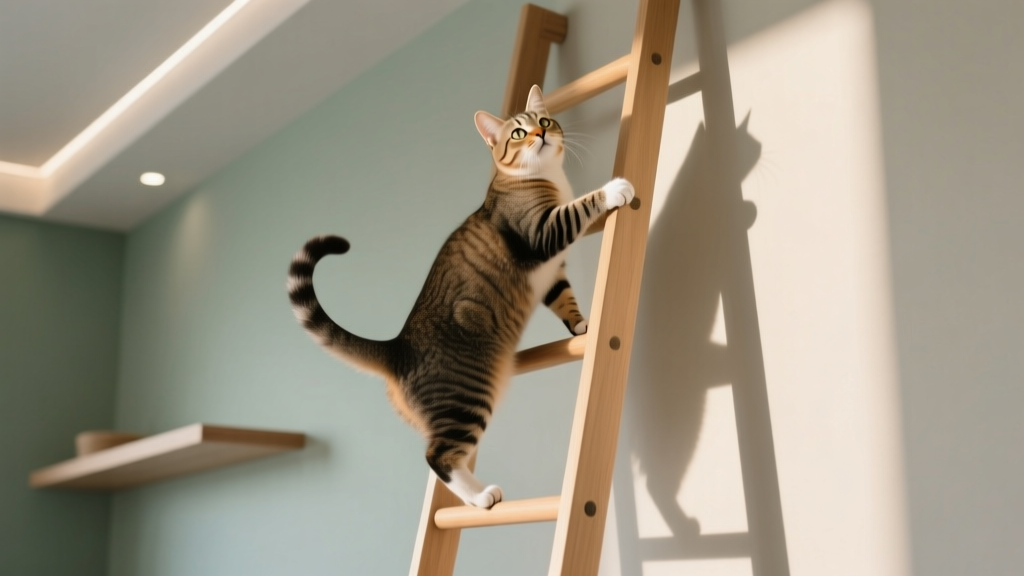
Pro Tip: Use ‘stair-step’ vertical access. Cats rarely jump >3 feet straight up — they prefer rungs, ramps, or staggered platforms. A single tall cat tree with one ladder won’t serve most cats. Instead, create a ‘vertical pathway’: floor → low platform (12”) → medium shelf (24”) → high perch (48”). This mimics natural terrain and builds confidence.
Climbing Enrichment That Works: A Vet-Approved Framework
Forget ‘buy one cat tree and done.’ Effective climbing enrichment follows the 3C Principle: Choice, Control, and Consequence.
- Choice: Offer at least 3 distinct climbing options per 500 sq ft — e.g., a wall-mounted shelf, a freestanding tower, and a window perch. Rotate toys or scents monthly to maintain novelty.
- Control: Ensure every perch has at least two exit routes (no ‘dead-end’ ledges). Add soft landing zones (rugs, foam pads) beneath key drop points.
- Consequence: Reward desired climbing with positive reinforcement — not treats mid-air (safety risk), but calm praise and gentle chin scratches *after* safe descent. Never punish climbing — redirect instead.
Real-world example: Maya, a 3-year-old rescue tabby, shredded curtains daily until her owner installed a 4-tier wall shelf aligned with her bedroom window. Within 3 days, she stopped climbing curtains entirely — and began napping on the top shelf for 5+ hours daily. Her vet noted improved sleep continuity and reduced nighttime vocalization.
| Step | Action | Tools/Products Needed | Expected Outcome (Within 7 Days) |
|---|---|---|---|
| 1. Audit | Map all current climbing zones — note stability, height, accessibility, and safety hazards (wires, loose items, fall risks). | Notepad, phone camera, tape measure | Clear visual inventory of safe vs. risky zones |
| 2. Prioritize | Identify 1–2 highest-risk or most-frequent problematic climbs (e.g., fridge top, bookshelf edge). | None | Targeted intervention plan |
| 3. Install | Add 1 secure, species-appropriate alternative within 3 ft of each problematic zone (e.g., wall shelf beside bookshelf). | Wall-mounted shelves (load-rated), sisal-wrapped posts, non-slip pads | ≥50% reduction in unsafe climbing attempts |
| 4. Entice | Spray target perches with silvervine (more effective than catnip for ~70% of cats), place favorite toy, or feed one meal/day on the new perch. | Silvervine powder, puzzle feeder, soft bedding | Cat voluntarily uses new perch ≥3x/day |
| 5. Maintain | Rotate perch locations quarterly; clean shelves weekly; inspect hardware monthly for looseness. | Screwdriver, microfiber cloth, checklist app | Sustained use and zero accidents over 6 months |
Frequently Asked Questions
Why does my cat climb onto my head or shoulders?
This is a profound sign of trust and social bonding — but also rooted in instinct. High vantage points let your cat monitor surroundings while staying physically close to their safest resource: you. It’s especially common in cats who were orphaned or bottle-fed, as they associate warmth and security with upward contact. If it’s uncomfortable, gently lift them down *while offering an equally appealing nearby perch* — never push or scold.
Is it normal for older cats to stop climbing?
Some slowing is expected, but complete cessation isn’t ‘normal aging’ — it’s often underdiagnosed pain. Arthritis affects 90% of cats over age 12, yet only ~15% receive treatment because signs are subtle. If your senior cat avoids jumps they used to make, consult your vet for a mobility assessment — including X-rays and a trial of joint-support supplements. Many cats regain climbing ability with proper care.
My cat climbs and knocks things over — how do I stop that?
They’re not ‘being destructive’ — they’re practicing predatory pounce-and-grab. The solution isn’t punishment (which increases anxiety), but redirection: Place sturdy, weighted ‘knockable’ toys (like a ceramic cat-shaped planter with dried catnip inside) on safe perches. Praise enthusiastically when they interact with those instead of your knick-knacks. Also, secure shelves with L-brackets — many ‘accidents’ happen because the perch itself is unstable.
Do indoor cats really need to climb if they’re ‘happy’ on the floor?
Yes — profoundly. A landmark 2021 study in Frontiers in Veterinary Science tracked 120 indoor cats over 18 months. Those with no vertical space had 3.2x higher rates of obesity, 2.7x more urinary tract issues, and significantly elevated baseline cortisol. ‘Happy on the floor’ often masks chronic low-grade stress — climbing isn’t luxury, it’s physiological necessity.
Can climbing behavior indicate anxiety or fear?
Absolutely. While climbing *can* be confident, repeated ‘escape climbs’ — especially to inaccessible or isolated spots (attic rafters, closet tops) — frequently signal chronic anxiety. Look for other markers: overgrooming, urine marking near high perches, or avoidance of floor-level interaction. A certified feline behaviorist can help differentiate between healthy instinct and distress-based behavior.
Common Myths About Cat Climbing
Myth #1: “Cats climb just to get attention.”
Reality: While some cats learn attention-getting climbs, the vast majority climb independently — even when no humans are present. Camera traps show solo climbing peaks at 4–6 AM and 7–9 PM, regardless of owner schedules.
Myth #2: “If my cat has a cat tree, they’ll use it enough.”
Reality: Over 65% of cat trees go underused because they’re poorly placed (e.g., in basements or corners), lack multiple entry/exit points, or aren’t near windows or sleeping areas. Placement matters more than price.
Related Topics (Internal Link Suggestions)
- Cat scratching behavior explained — suggested anchor text: "why cats scratch furniture and how to redirect it"
- Feline environmental enrichment checklist — suggested anchor text: "indoor cat enrichment essentials"
- Signs of cat stress and anxiety — suggested anchor text: "subtle signs your cat is stressed"
- Best cat trees for small apartments — suggested anchor text: "space-saving cat climbing solutions"
- Senior cat mobility support — suggested anchor text: "helping older cats climb safely"
Your Next Step Starts With One Safe Perch
Understanding what is a cat's behavior for climbing transforms how you see your cat — not as a quirky pet, but as a complex, evolutionarily tuned companion whose instincts deserve thoughtful accommodation. You don’t need a mansion or $500 cat gym. Start with one secure, well-placed shelf — install it this weekend, add a soft pad and a sprinkle of silvervine, and watch what happens. In as little as 48 hours, you may notice calmer greetings, less nighttime zoomies, and deeper, quieter naps. That’s not magic — it’s biology honored. Ready to build your cat’s vertical world? Download our free Cat Climbing Space Audit Checklist (includes load-rating guides, placement diagrams, and vet-approved product shortlist) — and give your cat the elevation they’ve been wired to seek.