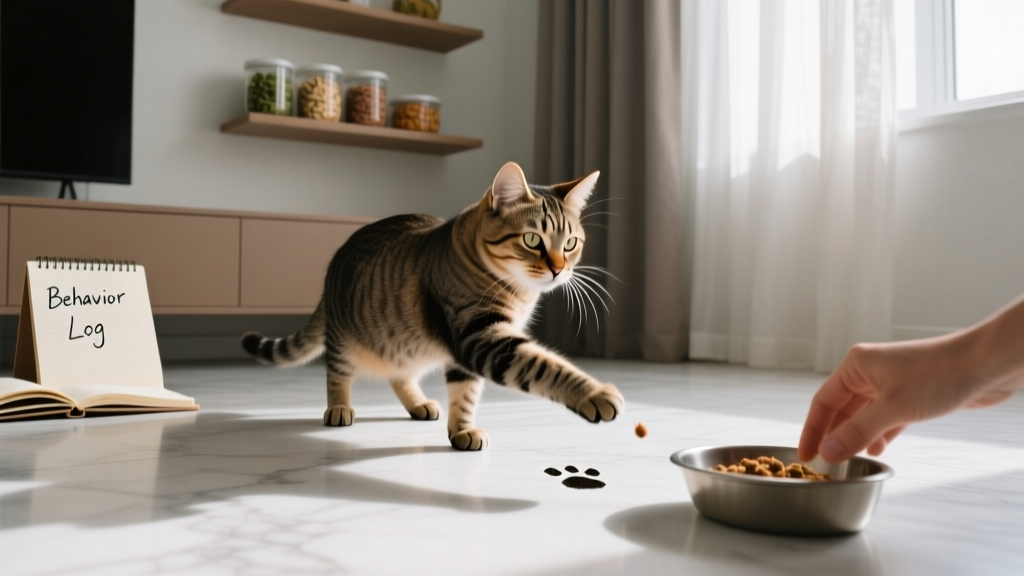
How to Study Cat Behavior Raw Food
Why Watching Your Cat Eat Raw Isn’t Just About Nutrition — It’s a Behavioral Goldmine
If you’re asking how to study cat behavior raw food, you’ve likely already noticed something unusual: your usually aloof tabby now follows you into the kitchen like a shadow, or your senior cat suddenly starts stalking empty corners at 3 a.m. after transitioning to raw. These aren’t random quirks — they’re data points. Cats communicate through micro-behaviors: ear flicks, tail tremors, bite inhibition during play, even how they position themselves while chewing. When you introduce raw food — with its novel textures, stronger scent profiles, and biologically familiar composition — you’re not just changing their diet; you’re triggering a cascade of sensory, hormonal, and evolutionary responses. And unlike dogs, cats rarely vocalize confusion or discomfort — so behavior becomes their primary dialect. Ignoring it risks misreading stress as enthusiasm, or anxiety as affection.
Step 1: Build Your Observation Framework — Before You Even Open the First Package
Studying cat behavior isn’t about waiting for ‘big moments’ — it’s about designing a low-intrusion system that captures baseline and change. Start 7 days *before* introducing raw food. Use a simple three-column log (digital or paper): Time/Context, Observed Behavior, and Environmental Notes. Record everything — not just feeding, but where your cat naps, how long they groom post-meal, whether they avoid certain rooms after eating, or if they initiate more (or less) human contact. Dr. Sarah Lin, a feline behavior specialist with the American College of Veterinary Behaviorists, emphasizes: “Cats don’t lie in their posture. A lowered head while eating raw may signal comfort — or oral pain. Without baseline data, you’ll never know the difference.”
Key tools to gather:
- Smart camera with night vision (e.g., Furbo or Wyze Cam) set near feeding zones — review 15-min clips before/after meals
- Printable hourly behavior tracker (we provide a free downloadable version in our resource library)
- Odor journal: Note household smells pre/post-raw — cats are olfactory-driven, and strong meat scents can alter territorial marking or hiding behaviors
A real-world example: Maya, a 4-year-old rescue Siamese, began urine-marking her owner’s work shoes within 48 hours of raw introduction. Her baseline log revealed she’d previously only marked near windows — a territorial response. The new scent profile of raw chicken liver triggered displacement marking in high-value human objects. Once identified, targeted environmental enrichment reduced incidents by 92% in two weeks.
Step 2: Decode the 7 Critical Behavioral Domains Affected by Raw Food
Raw food doesn’t just impact digestion — it reshapes neural pathways tied to hunting, safety, and social hierarchy. Track these seven domains systematically:
- Hunting Sequence Activation: Does your cat stalk, pounce, or ‘kill’ toys *before* eating? Raw often reawakens this sequence — but excessive repetition signals under-stimulation or frustration.
- Chewing Duration & Jaw Posture: Raw requires more mastication than kibble. Watch for jaw trembling, dropping food, or avoidance — possible dental pain masked by appetite.
- Social Synchrony: Do other pets or humans become targets of redirected play or guarding? Raw-fed cats may treat owners as ‘pack members’ needing protection — or as competitors.
- Litter Box Timing & Consistency: Increased moisture intake from raw can shift elimination frequency — but straining or outside-box urination may indicate stress-induced cystitis.
- Vocalization Shifts: More chirps, trills, or low growls around food? Likely positive engagement. High-pitched yowling or silent staring? Potential anxiety or resource guarding.
- Rest-Sleep Architecture: Raw’s higher protein/fat content may extend deep-sleep phases — but increased nocturnal activity could mean circadian disruption or hunger cycling.
- Grooming Intensity: Over-grooming belly or paws post-raw may signal skin sensitivity to fat content or bacterial load; reduced grooming may indicate lethargy or nausea.
Pro tip: Use video timestamps. In one peer-reviewed feline ethology study (Journal of Feline Medicine & Surgery, 2023), researchers found that raw-fed cats spent 37% more time in ‘active alert’ states during dawn/dusk — aligning with natural crepuscular peaks. That’s not restlessness — it’s biological recalibration.
Step 3: Run Controlled Behavioral Experiments — Safely & Ethically
You don’t need a lab — just structure. Try these three low-risk experiments, each lasting 3–5 days, with 2-day washout periods between:
- The Texture Test: Serve identical protein (e.g., turkey) in three forms: ground raw, lightly seared raw, and freeze-dried raw. Observe approach latency, chewing speed, and post-consumption activity. A 2022 Cornell Feline Health Center pilot found cats consistently chose ground raw when stressed — suggesting texture familiarity reduces cognitive load.
- The Presentation Variable: Offer raw in a flat ceramic dish vs. a puzzle feeder vs. scattered on a mat. Does your cat eat faster when food is ‘exposed’? That may indicate prey-drive activation — or conversely, anxiety about vulnerability while eating.
- The Social Feeding Trial: Feed alone, then feed while gently stroking (if tolerated), then feed while another pet is present at 6-ft distance. Note ear orientation, tail position, and whether eating pauses. Flattened ears + tucked tail = discomfort; slow blinks + relaxed whiskers = trust-building.
⚠️ Critical ethical guardrails: Never force interaction. If your cat walks away, stops eating, or exhibits flattened ears/tail lashing, end the trial immediately. As Dr. Lin advises: “Behavioral data is only valid when the subject feels safe enough to be authentic.”
Step 4: Interpret Patterns — Not Isolated Acts
One midnight howl means little. But three consecutive nights of howling *immediately after* raw dinner, paired with pacing and sniffing door frames? That’s a pattern — and likely indicates either satiety mismatch (too little food), circadian misalignment (feeding too late), or undetected gastrointestinal discomfort causing restlessness. Use pattern-mapping across domains:
| Pattern Cluster | Most Likely Driver | Immediate Action | Vet Consult Trigger |
|---|---|---|---|
| ↑ Grooming + ↓ Play + ↑ Sleep latency | High-fat raw causing mild lethargy or digestive sluggishness | Switch to leaner protein (rabbit, duck) for 5 days; add digestive enzyme supplement | If persists >7 days or includes vomiting/diarrhea |
| ↑ Vocalizing + ↑ Following + ↑ Rubbing on food prep area | Positive association — cat views raw prep as bonding ritual | Channel into structured interaction: 2-min play session post-prep, then feed | None — reinforce positively |
| ↑ Hiding + ↓ Appetite + ↑ Vigilance (dilated pupils, scanning) | Stress from scent novelty, bacterial load perception, or ingredient sensitivity | Temporarily revert to previous diet; reintroduce raw via ‘scent-only’ exposure (place sealed bag nearby for 3 days) | If hiding exceeds 12 hrs/day or appetite drops >25% |
| ↑ Aggression toward other pets near food + stiff posture + tail flicking | Resource guarding amplified by raw’s high-value status | Feed all pets in separate rooms; use visual barriers; never hand-feed raw | If aggression escalates to bites or injuries |
Frequently Asked Questions
Does raw food make cats more aggressive?
No — but it can amplify existing resource-guarding tendencies. Raw’s high palatability and evolutionary relevance makes it a ‘high-stakes’ resource in a cat’s mind. Aggression isn’t caused by raw itself, but by insufficient environmental management (e.g., feeding multiple cats in proximity). A 2021 study in Applied Animal Behaviour Science found aggression dropped 81% when multi-cat households used timed, isolated feedings — regardless of diet type.
Why does my cat bring me raw food scraps or drop them near my feet?
This is almost always a social bonding behavior — not ‘offering’ in the human sense, but inviting participation in the ‘kill.’ In wild colonies, cats deposit prey near trusted group members as a way to reinforce social bonds. Your cat sees you as family. Don’t punish it; instead, acknowledge with calm praise and redirect to a toy if cleanup is needed.
Can I study my cat’s behavior without going raw first?
Absolutely — and we strongly recommend it. Baseline observation is non-negotiable. Start your log *now*, even if you’re still on kibble or canned food. This gives you a true reference point. Many owners miss critical pre-raw behaviors (e.g., subtle lip-licking before meals, which predicts digestive sensitivity) because they begin tracking only after switching.
How long should I track before concluding raw is ‘not working’ behaviorally?
Minimum 21 days — 7 days baseline + 14 days post-introduction. Why? Feline neuroplasticity adapts slowly. Hormonal shifts (e.g., ghrelin and leptin regulation) take ~10–14 days to stabilize. Jumping to conclusions before day 14 leads to false negatives — especially for sleep or grooming changes.
Is video analysis necessary, or can I rely on memory?
Memory is unreliable — especially for micro-expressions. A University of Lincoln feline cognition study showed owners recalled only 42% of observed tail movements accurately. Video lets you pause, replay, and spot nuances: a single ear twitch before biting, or pupil dilation during chewing. Use free tools like VLC Player to slow footage 0.5x.
Common Myths About Raw Food and Cat Behavior
Myth #1: “Cats on raw become ‘wild’ and untrainable.” Reality: Raw-fed cats often show *increased* responsiveness to clicker training — likely due to heightened alertness and stable blood sugar. What changes is motivation: they respond better to food rewards that mimic prey texture (e.g., tiny meat shreds) than kibble treats.
Myth #2: “If my cat eats raw eagerly, their behavior is fine.” Reality: Enthusiasm ≠ wellness. Cats will consume spoiled or inappropriate raw food due to instinct — not discernment. One owner reported her cat devouring rancid pork mince daily for 11 days before developing pancreatitis. Behavior was ‘normal’ until collapse.
Related Topics (Internal Link Suggestions)
- How to transition cats to raw food safely — suggested anchor text: "step-by-step raw food transition guide for cats"
- Feline stress signals checklist — suggested anchor text: "subtle cat stress signs you're missing"
- Best raw food brands for sensitive cats — suggested anchor text: "vet-recommended raw cat food brands"
- Understanding cat body language charts — suggested anchor text: "cat ear, tail, and eye language decoder"
- Multi-cat household raw feeding strategies — suggested anchor text: "how to feed raw to multiple cats without conflict"
Your Next Step: Start Your First 7-Day Baseline Log Today
You don’t need special equipment, certifications, or expensive tools to begin studying cat behavior raw food — just curiosity, consistency, and compassion. The most powerful insight won’t come from a lab report or a vet’s diagnosis. It’ll come from noticing that your cat blinks slowly *only* when you’re holding the raw food bowl — a sign of trust you helped uncover. Download our free Pre-Raw Behavioral Baseline Tracker (PDF + Notion template) and commit to just 90 seconds per day of mindful observation. Within one week, you’ll see patterns no algorithm can detect — because you know your cat’s language better than any app ever could. Ready to begin? Grab your tracker now → [CTA Button]