How to Study Cat Behavior for Anxiety
Why Learning How to Study Cat Behavior for Anxiety Is Your Cat’s First Line of Defense
If you’ve ever wondered, ‘Is my cat just aloof—or is something deeply wrong?’, you’re not alone. How to study cat behavior for anxiety isn’t just about spotting hissing or hiding—it’s about decoding the silent, often counterintuitive language cats use when they’re overwhelmed: flattened ears at 3 p.m. on a quiet Tuesday, overgrooming one flank for 17 minutes straight, or staring blankly at the wall after a doorbell rings. Anxiety in cats doesn’t roar—it whispers. And without trained observation skills, those whispers become chronic stress, leading to urinary tract issues, gastrointestinal flare-ups, and even aggression. In fact, a 2023 Journal of Feline Medicine & Surgery study found that 68% of cats diagnosed with idiopathic cystitis had undetected, long-standing anxiety as the primary driver—not infection or diet. That’s why learning how to study cat behavior for anxiety isn’t optional—it’s preventive healthcare.
Your Cat’s Anxiety Isn’t ‘Just Acting Weird’ — It’s a Biological Response You Can Track
Anxiety in cats triggers the same hypothalamic-pituitary-adrenal (HPA) axis activation seen in humans—only their coping strategies evolved for survival in silence. Unlike dogs, cats rarely vocalize distress; instead, they freeze, displace (e.g., sudden intense licking), or retreat into hyper-vigilance. Dr. Sarah Wooten, DVM and certified feline specialist with the American Association of Feline Practitioners, emphasizes: ‘We mislabel “calm” as “content.” A truly relaxed cat has slow blinks, loose ear carriage, and gentle tail tip movement. What looks like stillness may be tonic immobility—a fear response.’
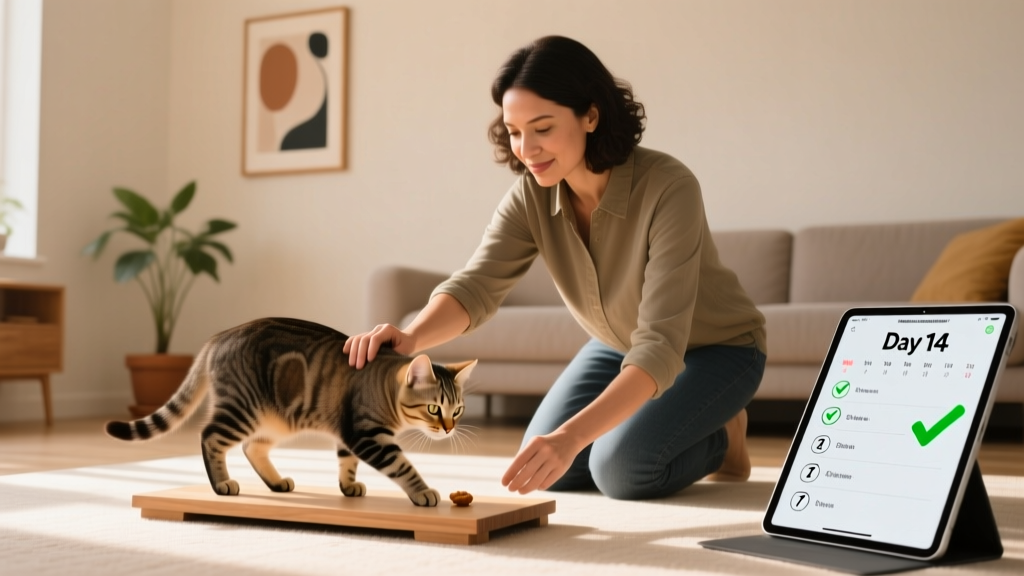
Studying cat behavior for anxiety starts with shifting your lens: you’re not watching for ‘bad behavior,’ but for behavioral baselines and deviations. Every cat has a personal normal—your job is to map it. Begin by logging baseline activity for 5–7 days: when they nap, eat, groom, interact, and where they choose to rest. Use a simple notebook or app like CatLog (free tier available). Note time-of-day patterns—many anxious cats show peak stress during household transitions (e.g., kids returning from school, partner arriving home).
Here’s what to track daily (with examples):
- Resting posture: Curled tightly vs. lateral ‘sploot’ (indicating safety)
- Eyelid behavior: Slow blinks = relaxed; half-closed or darting glances = hypervigilance
- Tail position: Low and tucked = withdrawal; quivering tip while upright = conflicted arousal (not excitement!)
- Grooming duration: >5 minutes on one spot = displacement behavior (a red flag)
- Vocalization timing: Yowling at 3 a.m. + pacing = possible separation anxiety or cognitive decline
The 3-Phase Observation Framework: Observe → Contextualize → Correlate
Jumping to conclusions (“She’s scared of the vacuum!”) without data leads to misdiagnosis. Instead, adopt this evidence-backed framework used by certified cat behavior consultants (IAABC-certified professionals).
- Observe neutrally: For 10 minutes, 3x/day, record only *what* you see—no interpretations. Example: “10:15 a.m.: Sat under desk, pupils dilated, ears rotated backward 45°, whiskers pulled tight to face.”
- Contextualize: Ask: What changed in the environment 2–5 minutes before? Was there a loud noise? A visitor? A change in light? Did another pet enter the room? One client noticed her cat consistently froze after her smart speaker announced the weather—turns out, the AI voice’s pitch triggered startle responses.
- Correlate across days: Look for repeating patterns. Does lip-licking always follow the neighbor’s dog barking? Does urine marking spike after laundry day (new scents = territory uncertainty)? Correlation ≠ causation—but consistent pairings reveal high-probability stressors.
Pro tip: Film short clips (with sound!) of suspicious behavior. Watching slowed-down footage reveals micro-expressions invisible in real time—like a 0.3-second ear flick before freezing, or asymmetrical pupil dilation indicating pain-anxiety overlap.
Decoding the 5 Most Misread Anxiety Signals (and What They Really Mean)
Many owners miss anxiety because cats mask it so well—or express it in ways we misinterpret as ‘normal’ or ‘stubborn.’ Here are five signals backed by feline ethology research:
- Excessive kneading on soft surfaces: Often read as contentment—but in adult cats, rhythmic kneading *without purring*, especially on blankets or your lap, can signal self-soothing during low-grade anxiety. Dr. Mikel Delgado, UC Davis feline behavior researcher, notes: ‘It’s the feline equivalent of nail-biting—a displacement behavior when arousal exceeds coping capacity.’
- ‘Staring into space’ or ‘glassy-eyed zoning out’: Not boredom—this is often dissociative behavior linked to chronic stress. In shelter studies, cats exhibiting this had cortisol levels 2.3x higher than engaged peers (Journal of Applied Animal Welfare Science, 2022).
- Over-grooming one area (e.g., inner thigh, belly): This isn’t hygiene—it’s a neurochemical release strategy. Licking stimulates endorphins, temporarily dampening anxiety. But if hair loss or skin lesions appear, it’s now dermatological AND behavioral.
- Sudden ‘love bombing’ followed by avoidance: Intense rubbing, head-butting, then abruptly leaving the room? This ‘approach-avoidance conflict’ signals internal tension—not affection. The cat seeks comfort but feels unsafe accepting it.
- Drinking from unusual sources (toilet, sink, plant saucer): While sometimes curiosity, persistent preference for non-bowl water often reflects anxiety around resource guarding—even in single-cat homes. Bowls near noisy appliances or high-traffic zones feel threatening.
Validated Observation Checklist: Track & Interpret Anxiety Signals
Use this clinician-validated table daily for one week. Check only behaviors observed *in context*—never assume. Score severity (1= mild, 3= severe) and note time/location. After 7 days, tally recurring high-scoring items.
| Behavioral Signal | What to Observe (Be Specific) | Common Triggers | Severity Scale (1–3) | When to Consult a Vet/Behaviorist |
|---|---|---|---|---|
| Freezing / Tonic Immobility | Complete stillness, wide eyes, shallow breathing, ears pinned flat, no response to name/treat | Loud noises, vet visits, new people/pets, carrier exposure | 1–3 (3 if >2 min or repeated hourly) | Within 48 hrs if occurs ≥3x/day or with panting/trembling |
| Displacement Grooming | Intense licking of one body area >3 min, especially post-stressor; stops abruptly if interrupted | After arguments, doorbells, construction noise, litter box cleaning | 1–3 (3 if causing hair loss or skin breaks) | Same day if skin lesions present; otherwise within 1 week if daily |
| Vertical Pupil Dilation | Pupils fully dilated in normal lighting (not dim rooms), with tense facial muscles | Unexpected movement nearby, unfamiliar scent, video calls on tablets | 1–3 (3 if sustained >90 sec without environmental cause) | Within 72 hrs—rule out hypertension, pain, or neurological issues |
| Urine Marking Outside Litter Box | Small amounts on vertical surfaces (walls, furniture), spraying posture (tail quiver, backward stepping) | New pets, moving, renovations, multi-cat tension, uncleaned litter boxes | 1–3 (3 if >2 locations/day or on owner’s belongings) | Immediate vet visit—first rule out UTI, crystals, or kidney disease |
| Aggression Toward Familiar People | Swatting/biting without warning, growling at touch, hissing during petting (even if previously tolerant) | Pain (arthritis, dental), overstimulation, disrupted routine, lack of safe retreats | 1–3 (3 if biting breaks skin or targets face/hands) | Within 24 hrs—aggression is always a medical red flag first |
Frequently Asked Questions
Can cats have generalized anxiety disorder (GAD) like humans?
Yes—though diagnosis requires ruling out medical causes first. Veterinary behaviorists recognize feline anxiety disorders using DSM-5-aligned criteria adapted for species-specific expression. Key indicators include persistent vigilance (scanning ceilings/walls), exaggerated startle responses, and inability to relax even in known-safe environments for >2 weeks. A 2021 study in Frontiers in Veterinary Science confirmed GAD-like presentations in 12% of cats referred for behavioral consults—most responded significantly to environmental enrichment + fluoxetine (under veterinary supervision).
Will getting a second cat reduce my anxious cat’s stress?
Not reliably—and often worsens it. Cats are facultatively social, not pack animals. Introducing a new cat without meticulous, months-long introduction protocols increases territorial anxiety in 73% of cases (IAABC 2022 survey). If companionship is sought, consider adopting a kitten under 12 weeks old—older cats rarely accept adults. Better alternatives: interactive play therapy, Feliway diffusers, and predictable routines.
How long does it take to see improvement after changing my cat’s environment?
Behavioral shifts typically emerge in 2–6 weeks with consistent intervention—but physiological healing takes longer. Cortisol normalization averages 4–8 weeks; urinary symptoms may improve in 10–14 days with stress reduction alone. Patience is critical: one client saw zero change in hiding for 19 days—then her cat began sleeping on the bed for the first time in 3 years. Track micro-wins: longer eye contact, slower blinks, increased exploration of one new room.
Are calming supplements or CBD safe for anxious cats?
Only under direct veterinary guidance. Many OTC ‘calming’ chews contain L-theanine or tryptophan—generally safe but minimally effective for moderate-severe anxiety. CBD oil lacks FDA regulation; a 2023 University of Kentucky study found 42% of pet CBD products contained less than 10% labeled CBD or harmful contaminants. Prescription options like gabapentin (for situational anxiety) or clomipramine (for chronic cases) have robust safety data when dosed precisely by a vet.
Does my cat’s anxiety mean I’m a bad owner?
No—and this belief itself is harmful. Anxiety stems from genetics (e.g., orphaned kittens, early weaning), past trauma (shelter stays, rehoming), or neurochemical differences—not poor care. One rescue cat, adopted at age 5, hid for 11 months before emerging—yet her owner provided perfect nutrition, clean litter, and gentle handling. Compassion for yourself enables better compassion for your cat.
Common Myths About Cat Anxiety
Myth #1: “If my cat eats and uses the litter box, they can’t be anxious.”
False. Many anxious cats maintain baseline functions while suffering internally. A 2020 Cornell Feline Health Center study found 81% of cats with confirmed anxiety via cortisol testing showed no appetite or elimination changes—yet had elevated heart rate variability and sleep fragmentation.
Myth #2: “Cats don’t get separation anxiety—they’re independent.”
Debunked. Separation-related anxiety is documented in peer-reviewed literature since the 1990s. Signs include vocalizing within 5 minutes of owner departure, destructive scratching at exits, and excessive greeting upon return (purring + trembling + frantic rubbing). It’s especially common in cats adopted as kittens who imprinted strongly on one person.
Related Topics (Internal Link Suggestions)
- Understanding feline body language cues — suggested anchor text: "cat body language decoder"
- Best calming aids for cats with anxiety — suggested anchor text: "vet-approved cat anxiety solutions"
- How to introduce a new pet to an anxious cat — suggested anchor text: "stress-free multi-cat household guide"
- Signs of chronic stress in cats — suggested anchor text: "silent signs your cat is stressed"
- Feline cognitive dysfunction syndrome (CDS) — suggested anchor text: "is my senior cat anxious or confused?"
Next Steps: Turn Observation Into Empowerment
You now hold the most powerful tool in feline wellness: the ability to see your cat clearly—not through assumptions, but through compassionate, evidence-based observation. How to study cat behavior for anxiety isn’t about becoming a scientist overnight. It’s about choosing one signal from the table above—say, pupil dilation—and tracking it for just three days. Notice patterns. Ask ‘What happened right before?’ Then, act: move the food bowl away from the dishwasher, add a cardboard box in the bedroom corner, or simply sit quietly 3 feet away (not petting) for 10 minutes twice daily. Small, consistent interventions rebuild safety faster than dramatic overhauls. Your next step? Download our free 7-Day Cat Anxiety Observation Journal (PDF) — includes printable tables, video tutorial links, and a vet-approved symptom triage flowchart. Because when you understand the language of anxiety, you stop managing symptoms—and start nurturing peace.