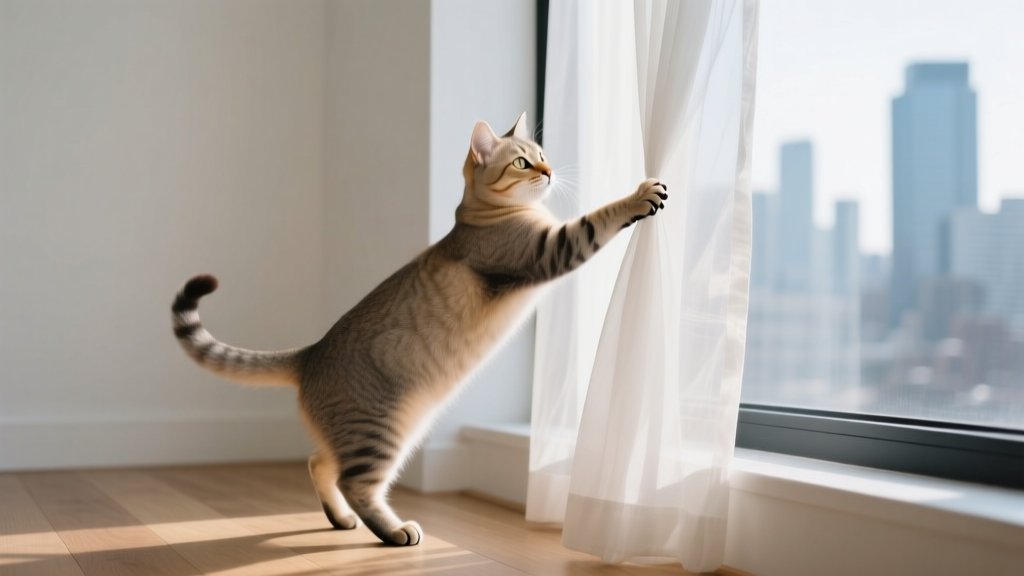
Cat Paw Grabbing at Curtains: Climbing Practice
You’re folding laundry or making coffee when you hear it: that soft shhk-shhk of tiny claws snagging fabric. You turn, and there’s your cat—front paws up, eyes bright, hind legs doing a little bunny-hop as they “climb” your curtains like a fuzzy rock climber in training. Maybe they freeze mid-act when you catch them, tail flicking as if to say, “What? These were already like this.”
If you’ve lived with a cat long enough, you’ve probably witnessed some version of curtain paw-grabbing. It’s one of those behaviors that feels equal parts ridiculous and infuriating—especially if those curtains were not cheap. The good news: it’s usually normal, deeply feline, and surprisingly informative once you understand what’s driving it.
The scientific (and evolutionary) reason cats grab and climb
Cats are built for vertical life. Even domestic cats share much of their anatomy and instinct with wild felines who climb to hunt, escape threats, rest safely, or scout territory. Those powerful hind legs, flexible spine, and hooked claws aren’t just for dramatic hallway sprints—they’re for gripping and scaling surfaces.
Curtains offer a tempting combination cats rarely get in the human home:
- Texture that “catches”: Fabric grabs claws easily, providing instant feedback and traction.
- Vertical movement: Curtains sway, which triggers a cat’s prey-chase instincts and movement sensitivity.
- Height potential: Many cats feel safer and more in control when they can climb or perch up high.
- A satisfying “resistance”: That tug-and-hang feeling is like a mini workout for shoulders, core, and paws.
From a feline psychology perspective, this is an expression of predatory play, territorial exploration, and physical conditioning rolled into one. In other words: your cat isn’t trying to redecorate. They’re practicing being a cat.
What “curtain grabbing” looks like in different contexts
Not all curtain attacks mean the same thing. The details matter—time of day, your cat’s body language, and what happens before and after.
1) The energetic “parkour” climb
Scenario: You wake up to zoomies. Your cat sprints from room to room, ricochets off a chair, then launches onto the curtains for a second like they’re tagging a checkpoint.
What’s going on: This is usually play + energy release. Many cats do a “vertical sprint” when they have pent-up energy. Curtains are a convenient climbing surface, especially if there aren’t enough approved vertical outlets (cat trees, shelves, window perches).
2) The slow, deliberate paw-hook and pull
Scenario: Your cat sits calmly, reaches out, hooks a claw, and gently drags the curtain toward them—almost like they’re testing it. Sometimes they repeat this with intense concentration.
What’s going on: This often reads as curiosity + tactile exploration. Cats “investigate” with paws the way humans use hands. The slight movement of fabric is rewarding, and the sound/feel of it can be oddly compelling.
3) The “I want to look outside” scramble
Scenario: A bird lands on the sill or a neighbor cat appears. Your cat suddenly climbs the curtain to get a better view, sometimes with chirps or a vibrating tail.
What’s going on: That’s hunting arousal. Your cat wants height and a better angle. If the windowsill is crowded, slippery, or inaccessible, the curtain becomes the ladder.
4) The attention-seeking curtain shake
Scenario: You’re on a work call. Your cat paws the curtain, makes it sway, glances at you, and does it again. It’s very “I’m not touching you… I’m touching this.”
What’s going on: Cats repeat behaviors that work. If curtain pawing reliably makes you react—talking, chasing, picking them up—your cat may be using it as a learned attention button.
5) The kitten climbing practice (classic)
Scenario: A kitten launches upward with pure optimism and zero planning, clinging like a tiny burrito with legs.
What’s going on: Kittens are developing coordination, strength, and confidence. Vertical exploration is part of normal development. Curtains, unfortunately, are often the first “climbing wall” they discover.
What it reveals about your cat’s mood and feelings
Curtain grabbing is a behavior with emotional “flavors.” Here’s how to read the vibe.
- Bright eyes, bouncy body, playful pounces: Your cat is in play mode—excited, energetic, curious.
- Tail flicking sharply, tense shoulders, quick scanning: Could be overstimulation or frustration (often linked to seeing prey outside but not being able to reach it).
- Slow movements, focused pawing, sniffing fabric: More like investigation—your cat is calm but mentally engaged.
- Pawing + looking back at you repeatedly: Likely attention-seeking or a bid for interaction.
- Sudden curtain climbing after a change (new pet, move, schedule shift): Sometimes a sign your cat is trying to regain control through activity and self-soothing.
Cats often use movement as emotional regulation. When life feels a little too quiet, too boring, or too intense, doing something physical can help them reset.
Related behaviors you might notice
If your cat is a curtain-grabber, you may also see:
- Climbing door frames (especially during zoomies)
- Scaling screens (window screens are the “budget curtains” of the cat world)
- Batting blinds cords or tugging tassels
- Ambushing ankles when you walk by (play/hunt energy seeking an outlet)
- High perching on the fridge, cabinets, or the top of a bookshelf
- “Curtain lurking”—hiding behind drapes to pounce out like a tiny theater villain
- Scratching near windows where outdoor stimulation is strongest
These behaviors tend to cluster around the same needs: hunting practice, climbing needs, and enrichment.
When it’s normal vs. when it’s a concern
Normal: Most curtain pawing is just a cat being a cat—especially in kittens, young adults, or high-energy breeds and mixes. If your cat is otherwise eating well, sleeping normally, and interacting in their usual way, curtain grabbing is typically an enrichment issue, not a medical one.
Potentially concerning: Consider digging deeper if you notice any of the following:
- Sudden new behavior in an older cat who never did this before (could reflect stress, pain, cognitive changes, or a shift in environment).
- Compulsive intensity: repeated climbing/pawing for long periods, difficulty disengaging, or doing it to the point of injury.
- Signs of anxiety: hiding more, startling easily, overgrooming, changes in appetite or litter box habits.
- Physical issues: limping, torn claws, vocalizing when jumping, or falling more often.
If curtain climbing is paired with major behavior changes, a vet visit is a smart first step. Pain (even subtle joint discomfort) can sometimes lead to odd activity patterns—either increased restlessness or awkward climbing choices. And if stress is involved, your vet can help rule out medical triggers before you tackle behavior.
How to respond (and how to redirect without drama)
The goal isn’t to “stop your cat from being a cat.” It’s to give them a better option that meets the same need—climb, scratch, hunt, explore—without turning your living room into shredded spaghetti fabric.
1) Provide a better vertical outlet (make it irresistible)
- Cat tree near the window: Put the “approved” climbing structure right where the action is.
- Wall shelves/perches: Even one or two steps up can satisfy the urge.
- Window hammock: Great for the “I must see the birds” crowd.
Pro tip: Sprinkle a little catnip (if your cat responds to it), use silvervine, or place a favorite blanket on the perch to increase adoption.
2) Meet the play need before it explodes into curtain parkour
Many cats climb curtains at predictable times: dawn, dusk, after you get home, or right before dinner. That’s your opening.
- Do 5–10 minutes of interactive play (wand toy, feather, ribbon-style toy used safely).
- End with a small snack or meal to complete the hunt-catch-eat sequence.
3) Don’t accidentally reward it
If curtain grabbing reliably makes you jump up, shout, chase, or scoop your cat up, you may be teaching them: “Touch curtain = human reacts.” Instead:
- Stay calm, reduce big reactions.
- Redirect to a toy or perch (“come here!” plus a wand toy moving away from the curtain).
- Reward the alternative: praise, treats, or play when they choose the cat tree.
4) Make curtains less climbable (while you train new habits)
- Tie up curtains during high-energy times.
- Switch fabrics: smoother materials can be less satisfying to grip than textured weaves.
- Use a furniture-safe deterrent near the base area if needed (only if it doesn’t scare your cat intensely; fear-based approaches can backfire).
5) Check the nails (and protect the paws)
Regular nail trims can reduce fabric damage and prevent torn claws. If your cat is new to trims, start slow—one nail at a time—and pair with treats. Scratching posts (vertical and horizontal) also keep claws healthy and give your cat a legal way to do claw maintenance.
Fun facts and research-leaning tidbits
- Cats prefer vertical territory in multi-cat homes because height offers control and reduces conflict. Even in a one-cat home, vertical space can increase confidence.
- Play is practice: stalking, pouncing, climbing, and grabbing are rehearsal behaviors for hunting skills. Your indoor cat is still running ancient software.
- Paws are sensory tools: a cat’s paw pads and whiskers help them interpret texture, vibration, and movement. Curtains provide a high-feedback surface—sound, sway, resistance, all in one.
FAQ: Cat paw grabbing at curtains
Why does my cat grab the curtains when I’m on the phone or busy?
Because it works. If your cat has learned that curtain pawing reliably gets your attention, it becomes a go-to strategy. Try pre-emptive play before busy times, and reward calmer bids for attention (sitting nearby, using a cat bed, touching a toy).
Is curtain climbing a sign my cat is bored?
Often, yes—especially if it happens daily and your cat has few enrichment outlets. Boredom in cats usually shows up as “creative mischief”: climbing, knocking objects down, ambushing feet, or over-grooming. Add vertical spaces, rotate toys, and schedule short interactive play sessions.
My kitten is obsessed with climbing curtains. Will they grow out of it?
Some do, especially with better alternatives available. Many kittens calm down as they mature, but the habit can stick if it’s been rehearsed for months. Redirect early: place a tall cat tree near the curtains and actively reward using it.
Should I punish my cat for climbing the curtains?
Punishment tends to teach cats that humans are unpredictable, not that curtains are off-limits. It can increase anxiety and make the behavior sneakier. Calm redirection and rewarding the alternative works better long-term—and preserves trust.
How do I stop curtain damage if my cat won’t use a cat tree?
Make the cat tree more strategic (next to the exact window your cat cares about), more stable, and more appealing (treats, catnip, feeding nearby). Some cats prefer shelves or a window hammock over a traditional tree. It’s not stubbornness; it’s preference and payoff.
Can stress make curtain climbing worse?
Yes. Stress can increase restless behavior, repetitive actions, and “busy paws.” If curtain grabbing escalates after changes (new pet, visitors, construction, moving), support your cat with predictable routines, safe hiding spots, vertical escape routes, and, if needed, guidance from a vet or qualified behavior professional.
When you see your cat hanging off the curtains like a tiny mountaineer, it helps to remember: this is athleticism, curiosity, and instinct wearing a very inconvenient costume. Give your cat a better climbing mission, and you’ll usually see the curtain obsession fade—without squashing their joyful, acrobatic spirit.
Has your cat ever scaled the curtains like they were auditioning for an action movie? Share your funniest (or most baffling) curtain-climbing stories with the Cat Lovers Base community at catloversbase.com—we’re collecting the best “why are you like this?” moments.