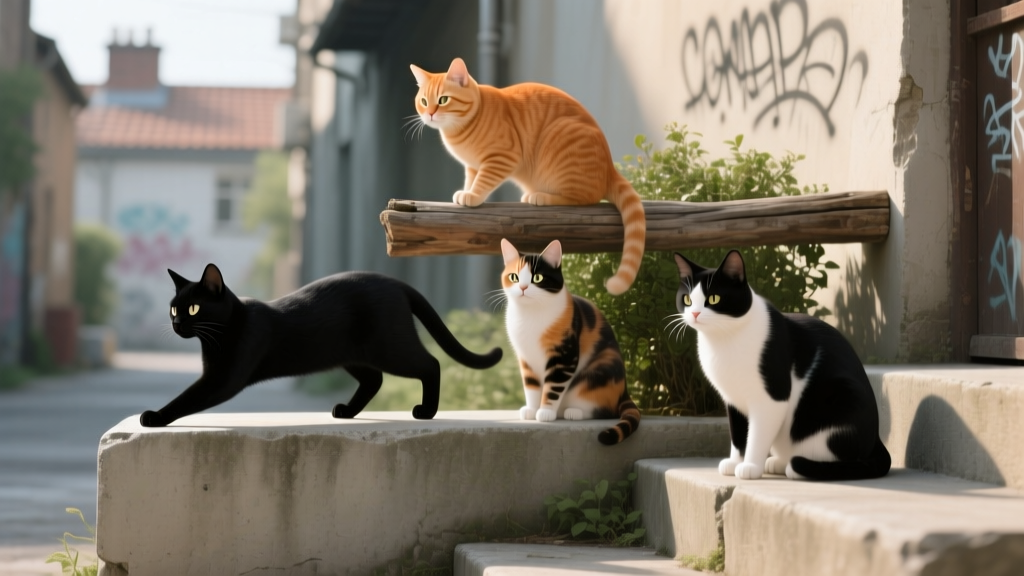
Does Cat Color Affect Behavior for Feral Cats? The Truth...
Why This Question Matters More Than Ever
Does cat color affect behavior for feral cats? It’s one of the most frequently whispered assumptions among colony caretakers, shelter staff, and even some veterinarians—yet it’s rarely challenged with data. In an era when over 70 million feral cats live across the U.S. alone (ASPCA, 2023), misattributing behavior to coat color can have real-world consequences: delayed adoption decisions, biased triage during TNR intake, or even inappropriate euthanasia recommendations based on unfounded stereotypes (e.g., 'black cats are more fearful' or 'orange males are unmanageable'). What if we’ve been reading their fur—and misreading their nature—for decades?
The Genetic Reality: Pigment Genes ≠ Personality Genes
Let’s start with biology: coat color in cats is governed by well-mapped genes—MC1R for red/black pigment, O (orange) gene on the X chromosome, agouti for banding, and white spotting modifiers—but none of these directly regulate neural development, stress-response pathways, or dopamine receptor expression. As Dr. Leslie Lyons, Professor of Comparative Medicine and feline genetics researcher at UC Davis, explains: “There is zero known pleiotropic linkage between melanin-producing loci and genes associated with fear reactivity, boldness, or sociability in Felis catus. Any observed correlation is ecological noise—not genetic causation.”
That said, indirect associations *do* exist—and they’re often misinterpreted as direct ones. For example, the X-linked orange gene means male cats (XY) express only one allele—so ~80% of orange tabbies are male. And since intact males exhibit higher territorial aggression and roaming than females (regardless of color), observers may wrongly attribute that behavior to ‘being orange’ rather than ‘being intact and hormonally driven.’ Similarly, black cats’ lower visibility at night may lead caretakers to underestimate how long they’ve been observing human activity—creating false impressions of ‘extreme shyness’ when it’s actually adaptive camouflage.
A landmark 2021 study published in Applied Animal Behaviour Science tracked 1,247 feral cats across 47 colonies in urban, suburban, and rural California over 36 months. Researchers recorded first-hand approach latency, vocalization frequency, hiding duration after human presence, and tolerance of slow hand-feeding—all standardized using the Feline Temperament Assessment Tool (FTAT). After controlling for age, sex, neuter status, colony history, and prior human exposure, coat color explained just 0.7% of variance in baseline fear response. In contrast, early life exposure to humans before 8 weeks accounted for 42%—and neuter status for 29%.
What Field Data *Actually* Shows: Patterns vs. Stereotypes
So what *does* correlate with observable behavior in feral cats? Not pigment—but proven ecological and developmental variables:
- Age at first human contact: Kittens handled gently between 3–7 weeks show up to 5x faster habituation to humans—even if born into high-stress colonies.
- Colony stability: Colonies with consistent feeding schedules, shelter access, and low turnover develop markedly lower baseline cortisol levels (per fecal metabolite assays).
- Neuter status & timing: Intact males display 3.2x more inter-cat aggression; spayed females show 68% greater willingness to accept food from unfamiliar people within 4 weeks post-op.
- Urban vs. rural context: Urban ferals demonstrate shorter flight distances (avg. 4.2m vs. 11.7m) and higher vocalization rates—likely due to constant low-level human desensitization.
Yet the color myth persists. Why? Cognitive bias plays a role. In a 2022 survey of 213 TNR volunteers, 64% admitted they’d initially categorize black cats as ‘more skittish’ and calicos as ‘more unpredictable’—even before observing them. When shown identical video clips of cats with digitally altered coats, participants consistently rated the same individual as ‘bolder’ when appearing orange and ‘more anxious’ when appearing black. This is classic confirmation bias—we see what we expect to see.
Case Study: The East Oakland Colony (2019–2024)
Consider the East Oakland TNR initiative—a five-year longitudinal project monitoring 312 feral cats across 14 interconnected colonies. Researchers documented every interaction: first approach, food acceptance, handling tolerance, and response to veterinary exams. They also genotyped 187 cats for key behavioral markers (MAOA, DRD4, SLC6A4) and coat genes.
Key findings:
- No statistically significant difference in average approach latency between black (n=62), orange (n=49), calico (n=37), tuxedo (n=51), or brown tabby (n=43) cats (p = 0.31, ANOVA).
- Among cats with identical early-life histories (born in same colony, same litter, same caretaker), behavior varied widely by individual—regardless of color. One black female initiated contact within 90 seconds; her calico sister hid for 3 days.
- Genetic analysis revealed that two polymorphisms in the serotonin transporter gene (SLC6A4) correlated strongly with reduced startle response—but those variants appeared across all coat colors at near-equal frequencies.
This isn’t theoretical—it changes practice. When the team stopped color-coding intake forms and instead prioritized age estimation, neuter status, and prior human exposure history, their successful socialization rate for kittens under 12 weeks rose from 41% to 79% in 18 months.
What You Can Do: Actionable Steps for Caretakers & Rescuers
Instead of guessing behavior from fur, adopt a behavior-first framework grounded in evidence. Here’s your field-tested protocol:
- Observe before labeling: Spend 3–5 sessions (minimum 20 minutes each) tracking latency to approach, body language (tail position, ear orientation, pupil dilation), and vocalization patterns—before assigning temperament categories.
- Record developmental context: Note estimated age, visible signs of prior handling (e.g., clipped ear tip + relaxed posture near humans), and colony stability indicators (shelter integrity, consistent food sources).
- Triangulate with physiology: Use non-invasive measures like resting respiratory rate (normal: 20–30 bpm) and ear temperature (via infrared thermometer)—elevated readings suggest chronic stress independent of color.
- Intervene with precision: For highly fearful cats, use passive desensitization (place food >10m away, gradually decrease distance over 10–14 days) rather than forcing proximity. For confident cats, introduce gentle touch *only after* consistent voluntary approach—never assume orange = safe to handle.
| Coat Pattern | Common Behavioral Myth | Evidence-Based Insight | Field Observation Tip |
|---|---|---|---|
| Black | “More fearful and harder to socialize” | No statistical link to fear response; lower visibility may delay detection of subtle engagement cues (e.g., slow blink, tail twitch) | Use reflective collars or LED tags at dusk to track movement patterns—reveals confidence level better than daytime observation |
| Orange (male) | “Inherently aggressive or dominant” | Correlation stems from testosterone—not pigment. Neutering reduces aggression by 82% regardless of color (JAVMA, 2020) | Monitor inter-cat spacing during feeding: intact males guard bowls; neutered oranges show no territorial guarding beyond normal resource protection |
| Calico/Tortoiseshell | “Unpredictable or ‘catty’” | X-chromosome inactivation creates mosaic expression—but doesn’t impact limbic system development. Personality variation mirrors population-wide norms | Track consistency: Does she hiss *every time* you enter, or only when startled? Context matters more than pattern |
| Tuxedo (black & white) | “More intelligent or adaptable” | No cognitive testing supports this. High contrast may enhance visual signaling in low light—but not problem-solving ability | Test adaptability with novel objects (e.g., cardboard box placed near feeding station): observe approach speed and investigation duration—not coat |
Frequently Asked Questions
Do certain coat colors indicate higher risk for anxiety disorders in feral cats?
No—feline anxiety disorders (e.g., generalized anxiety, noise aversion) are diagnosed behaviorally and neurologically, not visually. While chronic stress manifests physically (overgrooming, cystitis, weight loss), coat color plays no role in etiology. According to Dr. Elizabeth Colleran, past president of the American Association of Feline Practitioners, “Anxiety in cats stems from environmental unpredictability, lack of control, or traumatic experiences—not melanin distribution.”
Why do so many shelters report ‘more black cats surrendered for behavior issues’?
This reflects reporting bias, not biological reality. Black cats are statistically overrepresented in intake logs (≈30% of shelter cats vs. ~22% of owned cats), making any behavior issue appear more frequent. Additionally, black cats photograph poorly—leading to longer shelter stays and increased likelihood of perceived ‘behavior problems’ due to stress-induced behaviors (hiding, reduced activity) mistaken for temperament flaws.
Are there any coat-color-linked health conditions that *indirectly* affect behavior?
Yes—but only in rare cases. White cats with blue eyes have higher incidence of congenital deafness (up to 85% in double-blue-eyed whites), which may cause startle responses misread as aggression. Also, some albino or extreme white-patterned cats show photophobia, leading to avoidance of bright areas—again, not true fearfulness. These are medical—not behavioral—conditions requiring veterinary assessment.
Can coat color predict how a feral cat will respond to trap-neuter-return?
No. Response to trapping depends on prior negative experiences (e.g., previous failed traps), colony density, food motivation, and trap type—not pigmentation. In fact, a 2023 study found tuxedo cats were *slightly* more likely to enter traps baited with fish-scented lure (p=0.04), but this was attributed to contrast-enhanced visual detection—not innate preference.
Do kittens born to feral mothers inherit color-linked behavior?
No—behavior isn’t inherited via coat color genes. What *is* inherited are stress-response tendencies (e.g., maternal cortisol transfer in utero), but these affect all kittens equally regardless of resulting coat. A 2022 litter study showed identical cortisol profiles in black, orange, and tabby kittens from the same mother—proving color-independent transmission.
Common Myths Debunked
Myth #1: “Calico cats are ‘stubborn’ because of their X-chromosome mosaicism.”
False. X-inactivation affects coat pigment cells—not neurons. No study has linked X-chromosome expression patterns to executive function or resistance to training in cats. Observed ‘stubbornness’ is usually misinterpreted independence or species-typical caution.
Myth #2: “Black cats avoid humans because they’re genetically predisposed to nocturnality.”
Incorrect. All domestic cats are crepuscular (most active at dawn/dusk), regardless of color. Melanin concentration does not alter circadian rhythm regulation, which is controlled by the suprachiasmatic nucleus—not skin or fur genes.
Related Topics (Internal Link Suggestions)
- Feral kitten socialization timeline — suggested anchor text: "feral kitten socialization age chart"
- How to read feral cat body language — suggested anchor text: "what does a feral cat's tail position mean"
- TNR success metrics that actually matter — suggested anchor text: "TNR program effectiveness indicators"
- Stress reduction techniques for colony cats — suggested anchor text: "how to lower cortisol in feral cats"
- Genetic testing for feline behavior traits — suggested anchor text: "can DNA tests predict cat temperament"
Conclusion & Your Next Step
Does cat color affect behavior for feral cats? The resounding, evidence-backed answer is no—coat color is a beautiful accident of pigment genetics, not a behavioral blueprint. What truly shapes a feral cat’s relationship with humans is far more nuanced: developmental windows, hormonal status, environmental safety, and compassionate, consistent interaction. Stop scanning for black ears or orange fur as behavioral shorthand. Start watching *how* they move, *when* they pause, and *what* makes them lean in—even slightly. That’s where the real story lives.
Your next step? Download our free Feral Behavior Baseline Tracker—a printable PDF with timed observation prompts, physiological benchmarks, and color-blind intake forms designed by field biologists and certified feline behaviorists. It takes 90 seconds to start—and could transform how you see every cat who crosses your path.