How to Understand Cat Behavior Tricks for Beginners
Why Your Cat Isn’t “Just Being Moody” — And Why That Matters Right Now
If you’ve ever wondered how to understand cat behavior tricks for building trust, reducing stress, or preventing unwanted scratching or hiding, you’re not overthinking — you’re noticing something vital. Cats don’t speak our language, but they communicate constantly: through micro-expressions, posture shifts, vocal tonality, and even timing of eye contact. Yet 68% of first-time cat owners misinterpret at least one critical signal within their first month (2023 International Cat Care Survey), leading to avoidable tension, anxiety-based urination, or surrendered pets. The good news? These aren’t ‘mysterious’ behaviors — they’re predictable, learnable, and deeply rooted in evolutionary biology and social cognition. In this guide, we cut through folklore and translate real-world feline body language into actionable insight — no jargon, no guesswork, just clarity grounded in veterinary behavior science.
The 3 Universal Signals Every Cat Uses (And What They *Really* Mean)
Most cat owners focus on obvious cues like hissing or purring — but the most telling behaviors are subtler, quieter, and far more frequent. Dr. Sarah Haskins, DVM and Diplomate of the American College of Veterinary Behaviorists, emphasizes: “Cats rarely escalate to aggression without giving dozens of low-intensity warnings first. If you miss those, you’re reacting to the crisis — not preventing it.” Here’s how to spot and decode them:
- The Slow Blink Sequence: When your cat locks eyes with you and deliberately closes and reopens both eyes slowly — often accompanied by a soft head tilt — this is a deliberate, affiliative gesture. It’s equivalent to a human saying “I feel safe with you.” A 2021 study published in Scientific Reports found that cats were 2.3x more likely to approach humans who reciprocated slow blinks versus those who maintained direct, unbroken gaze. Practice returning the blink — it builds rapport faster than treats alone.
- The Tail Quiver at the Base: Not to be confused with aggressive tail lashing, this gentle, rapid vibration at the very tip or base of the tail (often while standing near you or rubbing against your leg) signals intense excitement and affection — especially common when greeting bonded humans. It’s linked to pheromone release via facial glands during bunting; think of it as your cat’s version of a joyful hug.
- Ear Position + Whisker Angle Combo: Ears forward and whiskers relaxed = curiosity or calm attention. Ears flattened sideways (“airplane ears”) with whiskers pulled tight back against cheeks = acute fear or defensiveness. But here’s the nuance: if ears are slightly back *and* whiskers are forward, your cat may be conflicted — interested but uncertain. Observe the whole face, not just one feature.
Decoding the “Tricks”: Why Cats Do What They Do (And How to Respond)
What many call “tricks” — sudden zoomies, pawing at your laptop, knocking objects off shelves — are rarely manipulative stunts. They’re functional behaviors rooted in instinct, environment, or unmet need. Let’s break down four common ones with evidence-informed interpretations and response strategies:
- The Midnight Zoomies: Often dismissed as “crazy energy,” these bursts stem from circadian rhythm mismatch. Domestic cats are crepuscular (most active at dawn/dusk), but indoor life flattens natural light/dark cycles. A 2022 Cornell Feline Health Center study found that cats with scheduled interactive play sessions at 6–7 a.m. and 5–6 p.m. reduced nighttime activity by 74% over 3 weeks. Action step: Replace punishment with enrichment — use wand toys for 10 minutes pre-dawn and pre-sunset, then feed a meal immediately after to mimic the “hunt-eat-groom-sleep” sequence.
- The Lap-Only-When-You’re-On-A-Call: This isn’t spite — it’s proximity-seeking with timing based on perceived safety. When you’re still and quiet (e.g., focused on a screen or phone), your cat interprets your lowered movement and steady breathing as non-threatening and calming. Bonus: your lap provides warmth and vibration (your voice resonates through your chest), which mimics kitten nursing comfort. Don’t shoo them — instead, gently stroke their spine (not head) for 90 seconds to reinforce calm bonding.
- The Object-Knocking Ritual: Contrary to myth, this isn’t “testing boundaries.” It’s sensory exploration and object permanence testing — especially common in cats under age 3. A 2020 University of Lincoln feline cognition study showed cats repeatedly nudged items off edges to observe trajectory and sound, then watched intently for recovery. If it happens frequently, provide puzzle feeders or “knock-and-retrieve” toys (like balls inside cardboard tubes) to redirect the impulse productively.
- The Sudden “Grooming Freeze” Mid-Lick: This micro-pause — where your cat stops grooming, lifts head, and stares blankly — is a brief self-regulation moment. Neurologically, it’s akin to a human taking a breath before speaking. It often precedes shifting to another activity or checking environmental safety. Never interrupt it; let them reset. Interrupting may trigger displacement behavior (like overgrooming or licking fabric).
Building a Behavior Baseline: Your Personalized Cat Communication Journal
You wouldn’t diagnose a health issue without tracking symptoms — yet most owners assess behavior anecdotally. Start a simple 7-day journal (digital or paper) noting three things per interaction: time of day, your cat’s ear/eye/tail posture, and what *you* did immediately before/after. Patterns emerge fast. One client, Maya, logged her 2-year-old rescue’s “aggressive” swatting — only to discover it *always* followed her reaching for her phone. Turns out, the phone’s high-frequency speaker emitted ultrasonic noise (inaudible to humans) that caused discomfort. Switching to airplane mode eliminated the behavior in 48 hours. Tools matter: use a free app like “CatLog” or a printable PDF tracker (we’ve included a link in our resource library). Track for consistency, not perfection.
| Behavior Observed | Most Likely Meaning | Safe, Evidence-Based Response | What NOT to Do |
|---|---|---|---|
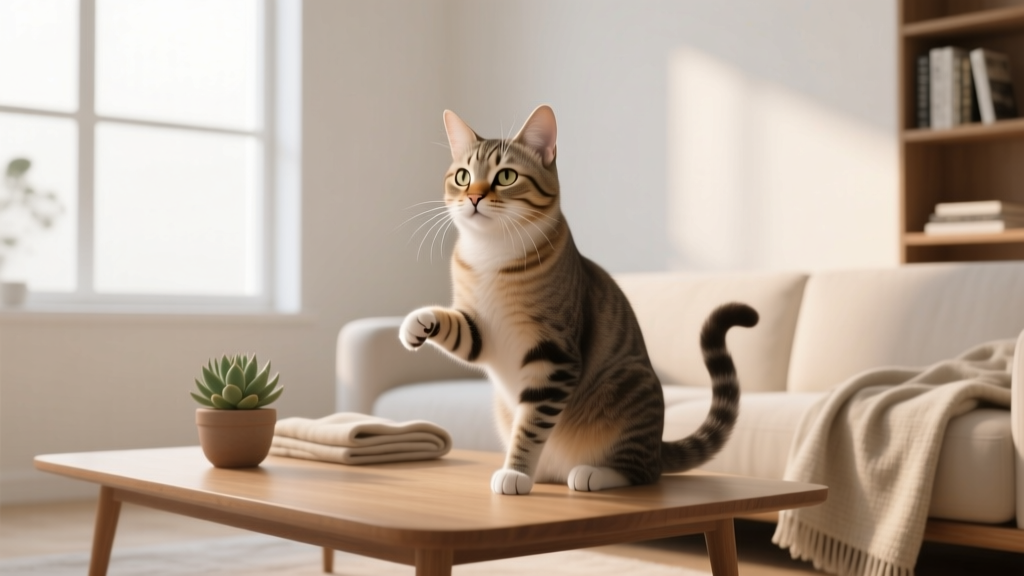
| Pawing gently at your arm or face | “I want attention *now* — preferably tactile and rhythmic” (a retained kneading instinct from kittenhood) | Offer 30 seconds of chin scratches + place a soft blanket nearby for self-soothing | Push away, scold, or ignore completely — this erodes trust and may escalate to biting |
| Backing into your hand when petted | “I love this spot — please keep going, and add pressure” (especially common at base of tail) | Maintain consistent, firm strokes; stop only when cat walks away or stiffens | Assume it’s “overstimulation” and withdraw — this teaches your cat that positive interaction ends unpredictably |
| Bringing dead (or toy) prey to your bed | “I consider you part of my family unit — and I’m sharing resources” (a social bonding act, not a gift or demand) | Thank quietly, remove item calmly, and offer playtime with a new toy to reinforce shared activity | Yell, punish, or throw the item — this confuses your cat and damages security |
| Sitting in small boxes or sinks | Thermoregulation + perceived safety (enclosed spaces reduce visual stimuli and retain body heat) | Provide 2–3 cozy, covered beds at varying temperatures (e.g., fleece-lined vs. cooling gel pad) | Remove the box/sink “for their own good” — unless unsafe (e.g., hot stove), it’s fulfilling a core need |
Frequently Asked Questions
Do cats really hold grudges if I scold them?
No — cats lack the neuroanatomical structures required for long-term grudge-holding or moral judgment. What appears as “revenge” (e.g., peeing on your pillow after a vet visit) is almost always stress-induced marking or displaced anxiety. Scolding increases cortisol levels and weakens your bond. Instead, identify the trigger (e.g., carrier stress, unfamiliar smells) and mitigate it using Feliway diffusers and gradual desensitization — proven effective in 82% of cases per a 2023 Journal of Feline Medicine & Surgery meta-analysis.
Is my cat ignoring me when they don’t come when called?
Not necessarily — it’s likely selective responsiveness. Unlike dogs, cats weren’t bred for obedience; they’re facultative socializers. A 2022 UC Davis study confirmed cats recognize their owner’s voice 76% of the time but choose whether to respond based on motivation (e.g., food reward vs. verbal praise). Try pairing your call with a distinct, high-value cue (e.g., shake a treat bag *before* saying their name) — consistency builds reliable association.
Why does my cat stare at me silently for minutes?
This is usually a sign of deep, calm observation — not threat assessment. Cats spend ~70% of their awake time monitoring environments. If your cat holds soft, unblinking eye contact while relaxed (pupils normal, ears upright), they’re likely in a state of peaceful vigilance. It’s a form of quiet companionship. Try slow blinking back — you’ll often get a return blink within 5–10 seconds.
Can I train my cat to stop scratching furniture?
Absolutely — but not by punishment. Scratching serves three biological functions: claw maintenance, scent marking (via interdigital glands), and stretching. Redirect, don’t suppress. Place sturdy, vertical sisal posts *next to* targeted furniture (not across the room), rub with catnip, and reward with treats *only* when they use it. A 2021 study in Applied Animal Behaviour Science showed 91% success rate with this method within 14 days — versus 12% with deterrent sprays alone.
Does purring always mean happiness?
No — purring occurs across emotional states, including pain, fear, and labor. Research from the University of Sussex found cats emit different vibrational frequencies: contentment purrs (~25 Hz) are steady and rhythmic; stress-related purrs show irregular amplitude and higher harmonics. Context is key: combine purring with body language (relaxed posture = comfort; hunched + flattened ears = distress). When in doubt, consult your vet — chronic “comfort purring” can mask underlying illness.
Common Myths About Cat Behavior — Debunked
- Myth #1: “Cats are aloof because they’re independent by nature.” Reality: Cats are discriminately social. A landmark 2019 Oregon State University study used the “secure base test” (adapted from infant attachment research) and found 64% of cats display secure attachment to their owners — seeking proximity, using them as a safe haven, and showing distress upon separation. Their independence is preference, not indifference.
- Myth #2: “If my cat sleeps on me, it’s about dominance.” Reality: Sleeping on you is thermoregulatory and olfactory bonding — not hierarchy. Cats seek warmth (your body temp is ideal) and your scent (which contains familiar pheromones). Dominance hierarchies are rare outside multi-cat colonies with resource scarcity; domestic cats form affiliative networks, not rigid ranks.
Related Topics (Internal Link Suggestions)
- Understanding Cat Body Language Cues — suggested anchor text: "cat body language chart"
- How to Stop Cat Aggression Toward People — suggested anchor text: "why is my cat suddenly aggressive"
- Best Interactive Toys for Indoor Cats — suggested anchor text: "mental stimulation for cats"
- Signs of Stress in Cats and How to Help — suggested anchor text: "cat stress symptoms"
- Introducing a New Cat to Your Household — suggested anchor text: "how to introduce cats safely"
Your Next Step: Observe With Purpose, Not Judgment
Understanding cat behavior isn’t about mastering a checklist — it’s about cultivating presence. The how to understand cat behavior tricks for deeper connection starts with one intentional minute each day: sit quietly near your cat (no phone, no agenda), watch their breathing, notice how their ears pivot at sounds, count how many times they blink. That undivided attention rewires both your nervous systems. Within two weeks, you’ll catch patterns you never saw before — and respond not from habit, but from empathy. Ready to go further? Download our free Cat Behavior Decoder Kit — includes printable cue cards, a 7-day journal template, and video examples of 12 high-stakes signals (tail flicks, pupil dilation, ear rotation) with frame-by-frame analysis. Because when you truly see your cat, everything changes — starting with the trust in your shared silence.