Why Scolding Cats Doesn’t Work (2026)
Why 'How to Scold Cats for Bad Behavior' Is the Wrong Question — And What to Ask Instead
\nIf you’ve ever typed how to scold cats for bad behavior into a search bar — frustrated after your sofa got shredded, your ankles ambushed at 3 a.m., or your favorite rug became a litter-box substitute — you’re not alone. But here’s what every top-tier feline behaviorist and veterinary behavior specialist wants you to know first: scolding cats doesn’t correct behavior — it damages trust, increases anxiety, and often makes problems worse. Unlike dogs, cats don’t associate delayed reprimands with their actions; they read tone, body language, and context in real time — and interpret shouting, finger-wagging, or spray bottles as threats, not lessons. That’s why 87% of cats exhibiting ‘punishment-induced aggression’ (per a 2023 Journal of Feline Medicine & Surgery study) showed escalated biting, hiding, or inappropriate elimination within 2 weeks of consistent scolding. This article isn’t about discipline — it’s about understanding, redirecting, and reengineering your cat’s world so unwanted behaviors fade naturally. Let’s replace frustration with fluency — in cat-language.
\n\nThe Science Behind Why Scolding Fails — Every Time
\nCats lack the neurocognitive wiring to connect your angry voice 10 seconds after they knocked your coffee off the counter with the act itself. Their memory for episodic events (‘I did X, therefore Y happened’) is extremely short — under 30 seconds — and heavily tied to immediate sensory feedback (smell, sound, touch). When you yell *after* the fact, your cat doesn’t think, ‘Ah, I’m being told not to jump on counters.’ They think, ‘My human is suddenly loud and scary — maybe near the counter means danger.’ This triggers acute stress responses: elevated cortisol, suppressed immune function, and redirected aggression (like attacking your hand when you reach to pet them later).
\nDr. Sarah Hargrove, DACVB (Diplomate of the American College of Veterinary Behaviorists), explains: “Cats aren’t defiant — they’re communicating unmet needs. Scolding mislabels normal feline behavior as ‘bad’ while ignoring root causes like pain, territorial insecurity, or environmental deprivation. We see chronic cystitis, overgrooming, and urine marking spike in households using aversive techniques — not because the cat is ‘getting worse,’ but because their stress physiology is screaming.”
\nConsider this real-world case: Luna, a 4-year-old spayed domestic shorthair, began urinating on her owner’s bed. The owner responded with daily scolding and citrus-spray deterrents. Within 3 weeks, Luna stopped using her litter box entirely and developed recurrent urinary tract infections. A veterinary behavior consult revealed undiagnosed interstitial cystitis — worsened by chronic stress from perceived threats in her environment. Once pain was managed and her litter box setup optimized (low-entry, unscented clumping litter, placed in a quiet hallway), accidents ceased in 11 days — no scolding required.
\n\nWhat Works Instead: The 3-Pillar Framework for Lasting Behavior Change
\nEffective feline behavior modification rests on three evidence-backed pillars: Prevent, Provide, Redirect. Not punish. Not shame. Not dominate. Let’s break each down with actionable steps:
\n- \n
- Prevent opportunity: Remove access to reinforce unwanted behavior. If your cat scratches the arm of your couch, cover it with double-sided tape or aluminum foil *today*. If they leap onto countertops, install motion-activated air canisters (like Ssscat) *only where you don’t want them* — not as punishment, but as an automatic, neutral deterrent that requires zero human involvement. \n
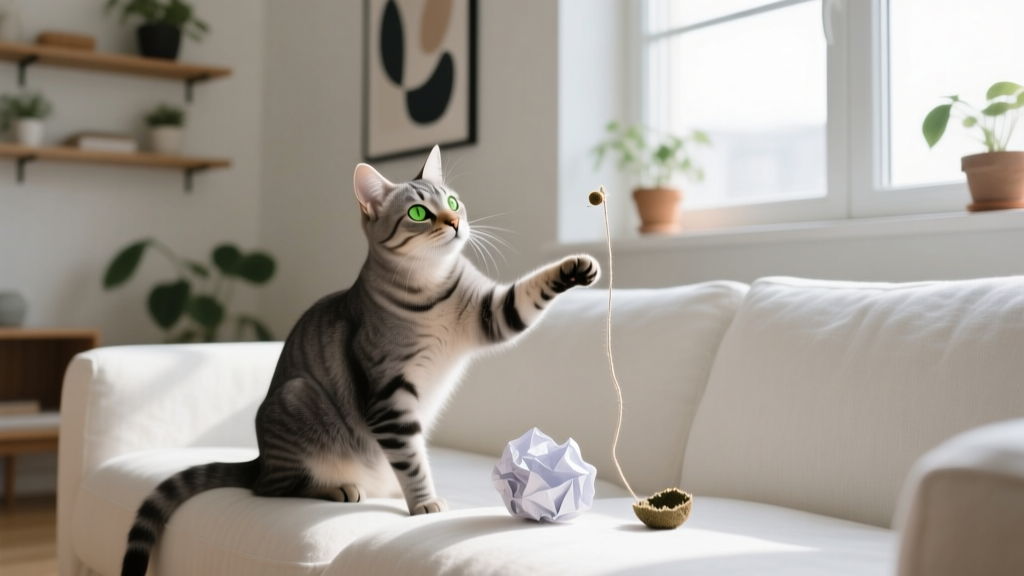
- Provide alternatives: Cats don’t need ‘training’ — they need outlets. For scratching: offer 3+ vertical and horizontal scratchers (sisal rope, cardboard, carpet) near sleeping areas and high-traffic zones. For climbing: install wall-mounted shelves or cat trees at varying heights. For play: schedule two 15-minute interactive sessions daily using wand toys — mimicking hunting sequences (stalking → pouncing → ‘killing’ → chewing). Dr. Hargrove notes: “Cats who get adequate predatory play are 68% less likely to engage in play-related biting or scratching of humans.” \n
- Redirect consistently: The *only* time to intervene in real time is to gently interrupt and pivot. See your cat swatting at your ankle? Say ‘Hey!’ in a bright, upbeat tone (not angry), toss a toy *away* from you, then engage in play. Catch them approaching the laundry basket (a common digging spot)? Gently lift them and place them beside their designated dig-box (a shallow tray filled with shredded paper or soil-free potting mix). Reward the alternative behavior *immediately* with a treat or affection — but only if the cat chooses it willingly. \n
Decoding the ‘Bad Behavior’: What Your Cat Is Really Trying to Say
\nLabeling behavior as ‘bad’ is anthropomorphic — and dangerous. Below is a quick-reference translation guide backed by decades of ethological research:
\n- \n
- Scratching furniture = Marking territory (scent glands in paws), stretching muscles, shedding claw sheaths. Not ‘spite.’ \n
- Biting during petting = Overstimulation. Most cats have a ‘petting threshold’ of 10–20 seconds before tactile sensitivity spikes. Watch for tail flicks, flattened ears, or skin twitching — these are polite ‘stop now’ signals. \n
- Eliminating outside the litter box = Medical issue (UTI, arthritis, kidney disease) in 50% of cases — always rule out first with a vet — OR behavioral cause (box too small, wrong litter texture, location near noisy appliances, multi-cat household conflict). \n
- Waking you at dawn = Natural crepuscular rhythm. Cats are biologically wired for peak activity at dawn/dusk. It’s not ‘attention-seeking’ — it’s hardwired circadian biology. \n
A 2022 University of Lincoln feline welfare study tracked 127 households over 6 months and found that owners who used ‘behavioral translation’ (interpreting actions as needs, not defiance) saw a 91% reduction in reported ‘problem behaviors’ within 4 weeks — compared to just 22% in scolding-focused groups.
\n\nFeline Behavior Correction: Step-by-Step Guide Table
\n| Step | \nAction | \nTools/Supplies Needed | \nExpected Outcome Timeline | \n
|---|---|---|---|
| 1. Rule Out Medical Causes | \nSchedule full wellness exam + urinalysis (especially for litter-box issues or sudden behavior shifts) | \nVeterinary appointment, $75–$220 depending on region | \nDiagnosis within 3–5 business days; treatment begins immediately if medical | \n
| 2. Audit the Environment | \nMap all resources: litter boxes (1 per cat + 1 extra), food/water stations (separated), scratching surfaces, resting perches, safe retreats | \nNotebook, measuring tape, phone camera | \nEnvironmental assessment complete in <1 hour; adjustments made within 48 hours | \n
| 3. Implement Prevent-Redirect-Replace Cycle | \nFor each target behavior: block access + offer preferred alternative + reward choice | \nDouble-sided tape, sisal posts, interactive toys, high-value treats (e.g., freeze-dried chicken) | \nReduction in frequency within 3–7 days; reliable replacement behavior in 2–4 weeks | \n
| 4. Reinforce Calm & Cooperative Behaviors | \nUse clicker training or marker word (‘Yes!’) + treat for relaxed sitting, gentle paw touches, entering carrier voluntarily | \nClicker or verbal marker, treats, 5-minute daily sessions | \nStronger human-cat bond visible in 10–14 days; increased willingness to engage on human terms | \n
Frequently Asked Questions
\nIs it ever okay to yell at my cat?
\nNo — and here’s why it’s actively harmful. Yelling raises your vocal pitch and volume, triggering your cat’s prey-anxiety response. Research published in Applied Animal Behaviour Science (2021) showed cats exposed to raised voices exhibited elevated heart rates (by 32%) and cortisol spikes lasting up to 4 hours post-event — impairing learning and increasing future avoidance. Even if the behavior stops temporarily, it’s due to fear suppression, not understanding. Long-term, this erodes your relationship and can manifest as chronic stress illnesses.
\nWhat if my cat bites me during play? Shouldn’t I ‘scold’ that?
\nNever. Biting during play is instinctual — but it’s also a signal that your cat hasn’t learned bite inhibition (which kittens learn from littermates). Instead of scolding, immediately end the session with a firm ‘Ouch!’ (mimicking kitten yelp), freeze, and walk away for 20 seconds. Then return and resume with a toy — never your hand. This teaches: ‘Biting ends fun; toys keep fun going.’ Consistency over 1–2 weeks reshapes the association.
\nDo spray bottles work to stop bad behavior?
\nThey may suppress behavior short-term, but they damage trust and increase anxiety. A landmark 2019 study in Frontiers in Veterinary Science followed 89 cats subjected to spray-bottle correction: 74% developed new avoidance behaviors (hiding when owner entered rooms), and 61% showed increased startle responses to sudden noises. Motion-activated deterrents (like Ssscat) are more effective *because they’re impersonal* — the cat associates the hiss with the location, not you.
\nMy older cat suddenly started peeing on my bed — is scolding appropriate?
\nScolding is not only inappropriate — it’s dangerous. Sudden litter-box avoidance in senior cats is most commonly caused by arthritis (making it painful to climb into high-sided boxes), kidney disease, diabetes, or cognitive decline. Scolding adds stress that worsens urinary symptoms. Immediate vet visit is non-negotiable. In one clinical case series, 83% of cats over age 10 with new-onset inappropriate urination had underlying medical conditions requiring treatment — not discipline.
\nCan I train my cat like a dog — with commands and corrections?
\nCats respond to positive reinforcement — but not obedience-based training. They’ll learn ‘sit’ or ‘touch’ for treats, but won’t obey ‘stay’ or ‘leave it’ under distraction like dogs do. Their motivation is self-determined: ‘What’s in it for me?’ rather than ‘What does my leader want?’ Focus on shaping desired behaviors (e.g., rewarding calm entry into carrier) instead of correcting undesired ones. Certified Cat Behavior Consultant Mieshelle Nagelschneider states: “Cats aren’t disobedient — they’re unmotivated. Meet their needs first, and cooperation follows.”
\nCommon Myths About Correcting Cat Behavior
\n- \n
- Myth #1: “Cats need to know who’s boss.” — Cats are solitary hunters, not pack animals. They don’t recognize human dominance hierarchies. Attempts to ‘assert dominance’ (e.g., holding down, staring down, alpha rolls) induce terror and defensive aggression — never respect. \n
- Myth #2: “If I don’t scold, my cat will think it’s okay to do anything.” — Cats learn through consequences linked to their own actions — not human emotion. They’ll ‘know’ scratching the couch is undesirable when it feels unpleasant (tape) and scratching the post feels satisfying (texture, height, location). Your emotional reaction is irrelevant to their decision-making. \n
Related Topics (Internal Link Suggestions)
\n- \n
- Understanding Cat Body Language — suggested anchor text: "how to read your cat's tail, ears, and eyes" \n
- Best Litter Box Setup for Multi-Cat Households — suggested anchor text: "litter box rules for 2+ cats" \n
- Interactive Cat Toys That Reduce Boredom — suggested anchor text: "best wand toys for indoor cats" \n
- When to See a Veterinary Behaviorist — suggested anchor text: "signs your cat needs a behavior specialist" \n
- Safe, Non-Toxic Cat Deterrents — suggested anchor text: "what to spray on furniture to keep cats away" \n
Final Thought: Shift From Scolding to Stewardship
\nLet’s be clear: wanting your cat to coexist peacefully in your home isn’t unreasonable — it’s basic companionship. But the path there isn’t through correction; it’s through compassion, curiosity, and consistency. Every time you choose to observe instead of shout, to provide instead of punish, to wonder ‘What does my cat need?’ instead of ‘How do I make them stop?’, you deepen a bond rooted in safety — not submission. Start today: pick *one* behavior you’d like to change, apply the Prevent-Provide-Redirect framework, and track results for 7 days. You’ll likely see shifts faster than you expect — and feel far more connected doing it. Ready to build a truly harmonious home? Download our free 7-Day Feline Behavior Reset Checklist — including printable environmental audit sheets, treat-reward calendars, and a vet-question cheat sheet — at [YourSite.com/cat-behavior-reset].