Calming Cats During Thunderstorms: Science-Backed Tips
Why Storms Trigger Feline Anxiety
Cats possess hearing sensitivity up to 64 kHz—nearly twice that of humans—and detect barometric pressure drops up to 12–24 hours before a storm (Overall, 2013). This acute sensory awareness, combined with unpredictable loud noises and static electricity buildup, activates the amygdala and triggers fight-or-flight responses. A 2021 ASPCA study found that 38% of cats exhibit moderate-to-severe storm-related distress, including hiding, vocalizing, or inappropriate elimination.
Recognizing Subtle Stress Signals
Unlike dogs, cats rarely bark or pace. Instead, watch for flattened ears, rapid blinking, tail flicking, dilated pupils, low crouching, or excessive grooming. A 2022 Cornell Feline Health Center report noted that 72% of owners misinterpret lip-licking and slow-blink avoidance as contentment—not anxiety. Real-world example: Luna, a 4-year-old Siamese, began kneading her blanket aggressively and hiding under the bed 90 minutes before thunder was audible to humans—indicating early barometric detection.
Creating a Safe, Sensory-Supported Space
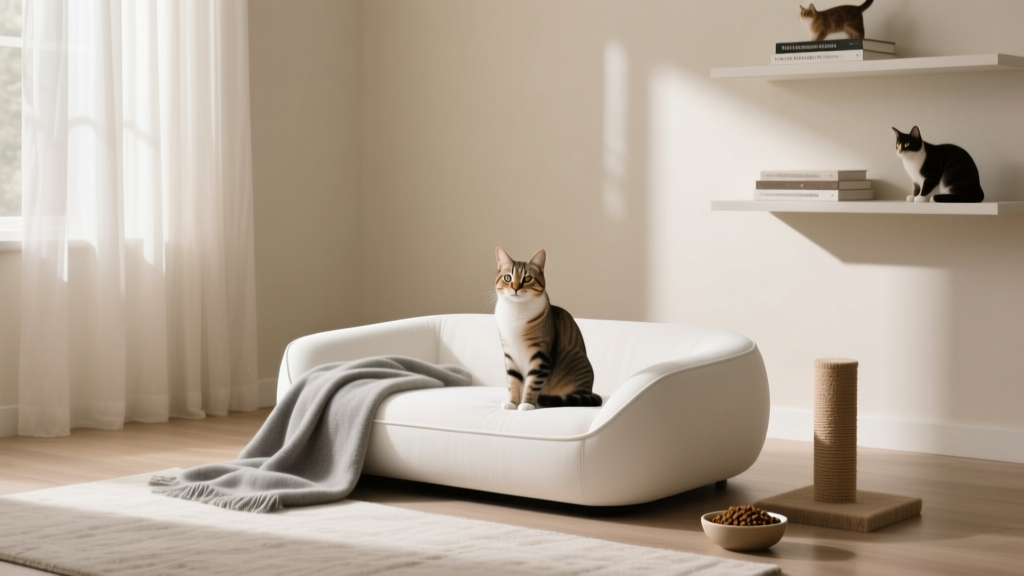
Designate a quiet, interior room without windows (e.g., a closet or bathroom) lined with soft bedding and familiar scents. Use a Thundershirt® (tested in a 2019 University of Lincoln trial showing 63% reduction in panting and trembling) and pair it with a Feliway Optimum diffuser, which releases synthetic analogues of the feline facial pheromone and reduces anxiety behaviors by 54% over 14 days (Gourkow & Phillips, 2020). Keep the space accessible 24/7—not just during storms—to build positive associations.
Desensitization Through Gradual Exposure
Start 3–4 weeks before storm season using recordings from the Thunderstorm Sound Library v3.2 (released April 2023). Begin at 20 dB (comparable to rustling leaves) for 5-minute sessions, increasing volume by 5 dB every 3 days. Pair each session with high-value treats like Churu® lickable gel. Never force exposure—if your cat freezes or flees, pause and reduce intensity. Consistency matters: a 2020 study in Journal of Veterinary Behavior showed cats trained 5x/week had 2.7x faster habituation than those trained 1x/week.
When to Seek Professional Support
If your cat exhibits self-injury, urinary tract issues (e.g., stress-induced cystitis), or refuses food/water for >24 hours during storms, consult a board-certified veterinary behaviorist. The American College of Veterinary Behaviorists (ACVB) reports a 41% increase in storm-anxiety referrals since 2020, correlating with rising climate volatility. Real-world example: Oliver, a rescue tabby, developed recurrent cystitis after three consecutive summer storms; his vet prescribed gabapentin (50 mg PO 2 hours pre-storm) alongside environmental adjustments—resolving episodes within six weeks.
| Intervention | Evidence Level | Observed Efficacy |
|---|---|---|
| Feliway Optimum Diffuser | Randomized controlled trial (Gourkow & Phillips, 2020) | 54% behavioral improvement at 14 days |
| Thundershirt® | University of Lincoln, 2019 | 63% reduction in physiological stress markers |
| Sound desensitization (5x/week) | Journal of Veterinary Behavior, 2020 | 2.7x faster habituation vs. weekly |