How to Discourage Bad Behavior in Cats the Right Way
Why 'How to Discourage Bad Behavior in Cats' Is One of the Most Misunderstood Topics in Feline Care
\nIf you've ever asked yourself how to discourage bad behavior in cats, you're not alone—but you may be starting from a dangerous assumption: that your cat is 'misbehaving' out of spite, defiance, or stubbornness. In reality, nearly every so-called 'bad' behavior—from midnight zoomies to attacking ankles to peeing on your laundry—is a symptom of unmet needs, environmental stress, or undiagnosed medical discomfort. According to Dr. Meghan Herron, DVM, DACVB (Board-Certified Veterinary Behaviorist at The Ohio State University), 'Cats don’t misbehave—they communicate. When we label their actions as 'bad,' we often miss the message—and escalate the problem.'
\nThis isn’t about training a dog. Cats operate on different neurobiological wiring: they’re obligate predators with high sensitivity to change, low tolerance for coercion, and zero interest in pleasing humans for treats alone. Yet 68% of cat owners report at least one persistent behavioral issue—and over half try outdated, punitive tactics first (2023 AVMA Behavioral Health Survey). That’s why this guide cuts through the noise: no scare tactics, no quick fixes, just seven evidence-based, compassion-first strategies validated by veterinary behaviorists, shelter enrichment specialists, and thousands of real cat households.
\n\nStep 1: Rule Out Medical Causes—Before You Assume It’s ‘Just Behavior’
\nHere’s the uncomfortable truth: what looks like 'bad behavior' is medically rooted in over 40% of cases. Urinating outside the litter box? Could be interstitial cystitis, urinary crystals, or arthritis making squatting painful. Sudden aggression? May signal dental disease, hyperthyroidism, or early-stage kidney disease. Even excessive grooming or vocalization can indicate pain or neurological changes.
\nVeterinary behaviorist Dr. Dennis Turner, author of The Domestic Cat: The Biology of Its Behaviour, emphasizes: 'A cat doesn’t choose to pee on your pillow—it chooses the softest, most accessible surface when its bladder burns or its joints ache. Punishment only teaches fear, not bladder control.'
\nAction plan:
\n- \n
- Schedule a full senior panel (CBC, chemistry, urinalysis, T4) for cats over age 7—even if they seem 'fine.' \n
- Request a hands-off physical exam: many cats mask pain until it’s severe, so watch for subtle signs (reduced jumping, avoiding high perches, licking one spot obsessively). \n
- Keep a 7-day behavior log: time, location, trigger (if any), duration, and your cat’s body language (dilated pupils? flattened ears? tail flicks?). Bring it to your vet. \n
A 2022 study in the Journal of Feline Medicine and Surgery found that 52% of cats referred for 'aggression' showed measurable improvement within 2 weeks of treating underlying osteoarthritis—no behavior modification required.
\n\nStep 2: Decode the Function—What Is Your Cat *Really* Trying to Achieve?
\nCats don’t act randomly. Every behavior serves a function—usually one of four core needs: safety, resources, social connection, or stimulation. Instead of asking 'How do I stop this?', ask 'What need is this meeting right now?'
\nLet’s break down common 'bad' behaviors and their likely functions:
\n- \n
- Scratching furniture → Not destruction—it’s scent-marking (via paw glands), stretching muscles, and maintaining claw health. \n
- Biting during petting → Overstimulation threshold reached; not rejection, but sensory overload (often signaled by tail twitching or skin rippling). \n
- Litter box avoidance → Often linked to box cleanliness, location privacy, substrate texture, or multi-cat tension (not 'spite'). \n
- Early-morning yowling → May reflect circadian rhythm mismatch, hunger anticipation, or cognitive decline in seniors. \n
Once you identify the function, your intervention shifts from suppression to redirection. For example: If your cat scratches your sofa because it’s tall and stable, offer a 5-foot-tall sisal post placed *next to* the sofa—not across the room. If biting occurs after 90 seconds of petting, set a gentle timer and stop *before* the bite—not after.
\n\nStep 3: Use Positive Reinforcement—But Do It Right (Most People Get This Wrong)
\nPositive reinforcement works—but only if timed precisely, delivered consistently, and matched to your cat’s true motivators. Food rewards are powerful, but not universal. Some cats value play more than treats; others respond best to slow blinks or quiet proximity.
\nKey principles backed by operant conditioning research:
\n- \n
- Timing is non-negotiable: Reward must occur within 1–2 seconds of the desired behavior. Delayed treats reinforce whatever happened *after*—like walking away or meowing. \n
- Use 'jackpot' rewards sparingly: A single high-value treat (e.g., freeze-dried salmon) for rare successes builds motivation—but overuse dilutes effectiveness. \n
- Pair with markers: A consistent click or soft 'yes!' bridges the gap between behavior and reward. Clicker training builds clarity faster than voice alone. \n
Real-world case: Luna, a 3-year-old rescue with fear-based scratching, stopped targeting baseboards after her owner began rewarding her *for sitting near* (not on) a designated scratch post—then gradually shaping closer contact. Within 12 days, she used it exclusively. No sprays, no deterrents—just predictable, joyful reinforcement.
\n\nStep 4: Environmental Enrichment—The Silent Behavior Modifier
\nCats evolved to hunt, explore, climb, and hide for 12–16 hours a day. Indoor life without enrichment creates behavioral debt—manifesting as redirected aggression, obsessive grooming, or attention-seeking chaos. Enrichment isn’t 'extra.' It’s physiological necessity.
\nEffective enrichment targets five pillars (per the 2021 ISFM/AAFP Environmental Needs Guidelines):
\n- \n
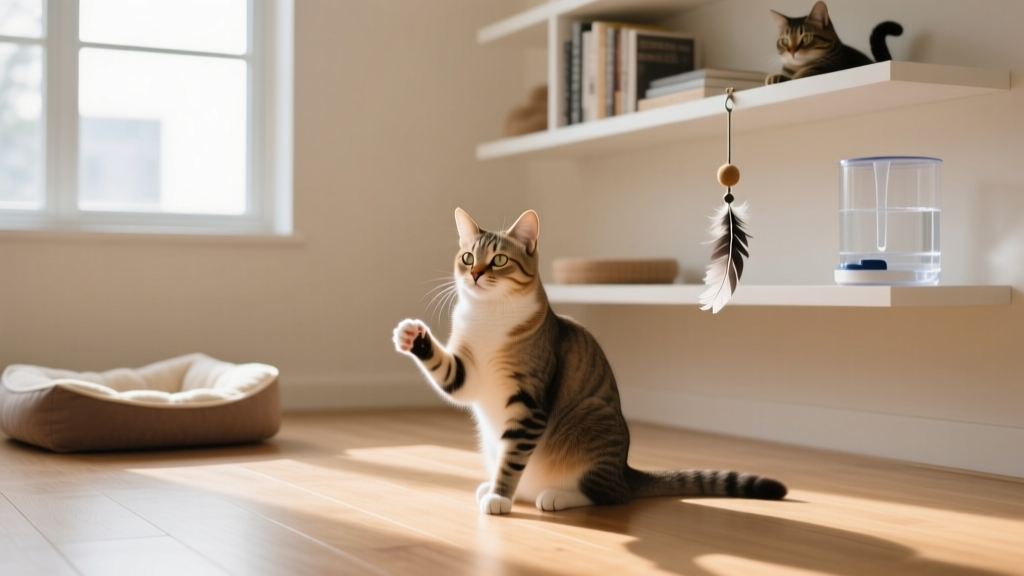
- Space: Vertical territory (shelves, wall-mounted perches) doubles usable square footage—and reduces resource competition in multi-cat homes. \n
- Hunting: Daily 15-minute interactive play sessions with wand toys that mimic prey movement (erratic, darting, hiding) satisfy predatory drive. \n
- Resting: At least three secluded, warm, elevated napping spots—each with escape routes. \n
- Elimination: One box per cat + 1, placed in quiet, low-traffic areas with unscented clumping litter. \n
- Scratching: Multiple surfaces (sisal, cardboard, wood) oriented vertically *and* horizontally—placed where cats naturally stretch (bedrooms, hallways, near sleeping areas). \n
Enrichment isn’t about buying more toys—it’s about designing daily rhythms. Rotate toys weekly. Hide kibble in puzzle feeders. Install window perches overlooking bird feeders. Let your cat 'hunt' before meals. These aren’t luxuries—they’re behavioral insurance.
\n\n| Step | \nAction | \nTools/Supplies Needed | \nExpected Outcome Timeline | \n
|---|---|---|---|
| 1 | \nMedical screening & pain assessment | \nVet visit, behavior log, camera (optional) | \n1–2 weeks (immediate relief if medical cause found) | \n
| 2 | \nIdentify behavior function + baseline tracking | \nNotebook/app, video clips, treat pouch | \n3–5 days to confirm pattern | \n
| 3 | \nIntroduce targeted enrichment (1 pillar at a time) | \nWall shelves, wand toy, puzzle feeder, unscented litter | \n2–4 weeks for observable reduction in target behavior | \n
| 4 | \nImplement positive reinforcement for alternative behaviors | \nClicker or marker word, high-value treats, timer | \n1–3 weeks for reliable response; 6–8 weeks for habit formation | \n
| 5 | \nReassess & refine (repeat steps 2–4 as needed) | \nUpdated log, patience, flexibility | \nOngoing—behavior evolves with age, seasons, household changes | \n
Frequently Asked Questions
\nCan I use spray bottles or loud noises to discourage bad behavior in cats?
\nNo—and here’s why it backfires. Spray bottles create fear-based associations: your cat doesn’t link the water to the scratching; they link *you* to danger. A 2020 study in Applied Animal Behaviour Science found cats subjected to aversive techniques showed increased cortisol levels, reduced human-directed purring, and higher rates of redirected aggression toward other pets. Instead, use 'remote correction': place double-sided tape or aluminum foil on off-limits surfaces—your cat learns the *location*, not your anger.
\nMy cat pees on my bed—does that mean they’re angry or punishing me?
\nAlmost certainly not. Urine marking on bedding almost always signals anxiety (separation, new pet, construction noise) or medical distress—not revenge. Cats lack the cognitive capacity for moral judgment or spite. In fact, 73% of cats who urine-mark sleep in the same room as their owner—suggesting proximity, not punishment, is the driver. Start with vet check + pheromone diffusers (Feliway Optimum), then assess environmental stressors.
\nWill neutering/spaying fix aggression or spraying?
\nIt helps—but only for hormonally driven behaviors, and only if done before sexual maturity. Early-age spay/neuter (before 5 months) reduces urine spraying in males by ~85% and inter-cat aggression by ~60% (ASPCA 2022 data). However, if spraying begins after age 2, it’s likely stress- or medical-related—and won’t resolve with surgery alone.
\nHow long does it take to see improvement using these methods?
\nIt varies—but expect measurable shifts within 2–3 weeks for environment-driven behaviors (e.g., scratching, play biting). Medical issues improve as soon as treatment starts. Complex cases (fear-based aggression, multi-cat tension) often require 8–12 weeks of consistent implementation. Patience isn’t passive—it’s strategic recalibration. As certified cat behavior consultant Mikel Delgado notes: 'You’re not changing your cat. You’re changing the conditions that make the behavior make sense.'
\nAre there any supplements or medications that help with behavior issues?
\nYes—but only under veterinary guidance. L-theanine and B-complex vitamins show mild anxiolytic effects in preliminary studies. Prescription options like fluoxetine (Prozac) or gabapentin are FDA-approved for feline anxiety and aggression—but they’re tools, not solutions. They work best *alongside* environmental and behavioral interventions—not instead of them. Never medicate without a full behavioral assessment.
\nCommon Myths About Discouraging Bad Behavior in Cats
\nMyth #1: “Cats can’t be trained.”
\nFalse. Cats learn continuously via operant and classical conditioning—but they train *us* more readily than vice versa. With consistency, timing, and high-value reinforcers, cats master complex behaviors: coming when called, entering carriers voluntarily, even using toilets. The key is respecting their agency: no coercion, no force.
Myth #2: “Rubbing a cat’s nose in their accident will teach them.”
\nDangerously false. Cats don’t associate the scent of urine with the act of elimination—they associate it with *stress*. Nose-rubbing causes fear, shame, and substrate aversion (they’ll avoid the litter box entirely). It also damages trust, making future behavior modification exponentially harder.
Related Topics (Internal Link Suggestions)
\n- \n
- Understanding cat body language — suggested anchor text: "what your cat's tail flick really means" \n
- Best cat scratching posts for destructive cats — suggested anchor text: "top 5 vet-recommended scratchers" \n
- How to introduce a new cat without fighting — suggested anchor text: "stress-free multi-cat household guide" \n
- Signs of cat anxiety and how to treat it — suggested anchor text: "silent stress signals in cats" \n
- Homemade cat enrichment ideas on a budget — suggested anchor text: "DIY feline enrichment that actually works" \n
Your Next Step Isn’t More Discipline—It’s Deeper Understanding
\nDiscouraging bad behavior in cats isn’t about dominance, control, or correction. It’s about becoming fluent in feline communication—reading the subtle cues, honoring biological needs, and designing a world where the 'bad' behavior simply stops making sense. You’ve already taken the hardest step: caring enough to seek better answers. Now, pick *one* strategy from this guide—just one—and commit to it for 10 days. Track one small win. Notice one shift in your cat’s body language. That’s where real change begins: not with louder commands, but quieter observation, gentler responses, and unwavering respect for the intelligent, sensitive, ancient predator sharing your home.