How to Change Aggressive Cat Behavior
Why Your Cat’s Aggression Isn’t ‘Just Personality’—And Why It’s Urgent to Address Now
If you’re searching for how to change aggressive cat behavior, you’re likely exhausted: dodging surprise swats, dreading litter box cleanings, or even worrying about your child’s safety around your once-affectionate companion. Aggression in cats isn’t random—it’s communication. And when left unaddressed, it escalates: 68% of cats referred to veterinary behaviorists show worsening aggression within 3–6 months without intervention (American College of Veterinary Behaviorists, 2023). Worse? Many owners misinterpret growling as ‘playfulness’ or punish biting—triggering fear-based aggression that deepens distrust. But here’s the hopeful truth: over 82% of cats with non-medical aggression show measurable improvement within 14 days when their environment, routines, and human responses are adjusted using evidence-based methods. This isn’t about ‘breaking’ your cat—it’s about rebuilding safety, predictability, and mutual trust.
Step 1: Rule Out Pain & Medical Triggers First—Before You Try Any Behavioral Fix
Aggression is often the last symptom—not the first—of an underlying issue. A 2022 study in the Journal of Feline Medicine and Surgery found that 41% of cats presenting with sudden-onset aggression had undiagnosed dental disease, hyperthyroidism, arthritis, or neurological discomfort. Dr. Sarah Lin, DVM and board-certified veterinary behaviorist at UC Davis, stresses: “Never assume aggression is behavioral until you’ve ruled out pain. A cat who lashes out when touched near the tail may have sacroiliac joint inflammation—not ‘attitude.’”
Start with a full wellness exam—including bloodwork (T4, kidney/liver panels), oral exam under sedation if needed, and orthopedic assessment. Pay special attention to subtle signs: reluctance to jump, reduced grooming, staring off into space, or increased vocalization at night. If your cat is over age 8, add senior screening (e.g., thyroid ultrasound, blood pressure check). Only after medical clearance should you proceed to behavioral strategies—otherwise, you’re treating the symptom while the cause worsens.
Step 2: Decode the Type of Aggression—Because ‘Aggressive’ Is Not One Thing
Cats don’t aggress—they respond. And each response type demands a different strategy. The five primary categories, per the American Veterinary Society of Animal Behavior (AVSAB), are:
- Fear-based aggression: Crouching, flattened ears, dilated pupils, retreat attempts before striking. Triggered by unpredictability (e.g., sudden movements, strangers).
- Redirected aggression: Sudden attack on nearest target (you, another pet) after seeing an outdoor cat or loud noise. Often mistaken for ‘unprovoked’ violence.
- Play-related aggression: Common in kittens/young adults; involves stalking, pouncing, biting ankles—but lacks true threat postures (no hissing, no piloerection).
- Pain-elicited aggression: As above—flinches, tenses, or bites when handled in specific areas. May coexist with medical issues.
- Idiopathic (‘unexplained’) aggression: Rare (<5% of cases); requires specialist referral after thorough diagnostics.
Here’s how to tell them apart: Record three incidents on video (even short clips). Note: What happened 30 seconds before? Where did the cat look? Did they freeze or flee first? Did they hiss *before* biting—or only after being grabbed? One client, Maya (a teacher with her 3-year-old tabby Leo), filmed his ‘attacks’ and discovered he always stared intently at the window *then* lunged at her ankle—classic redirected aggression from seeing neighborhood strays. Once she installed opaque window film and added vertical space (a tall cat tree facing away from windows), incidents dropped from 5x/week to zero in 11 days.
Step 3: Build Safety Through Environmental Enrichment—Not Just ‘More Toys’
Enrichment isn’t optional—it’s neurobiological necessity. Cats evolved to hunt, climb, hide, and control territory. Deprive them of those outlets, and frustration manifests as aggression. But generic ‘toys’ rarely cut it. Effective enrichment targets three core needs: predictability, control, and positive reinforcement history.
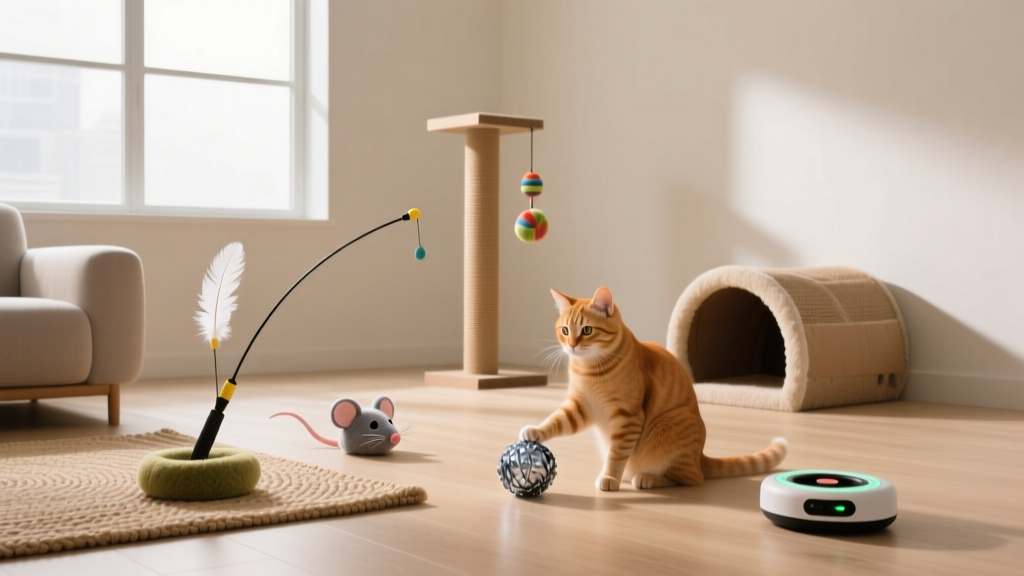
Start with the ‘3-3-3 Rule’: Three vertical spaces (shelves, wall-mounted perches), three hiding spots (covered beds, cardboard boxes with entrances on two sides), and three daily interactive sessions (5–7 minutes each) using wand toys that mimic prey movement—never your hands or feet. Crucially: end each session with a high-value treat (e.g., freeze-dried chicken) *before* the cat disengages—this builds positive association with human interaction.
For multi-cat households, aggression often stems from resource competition. The AVSAB recommends: one litter box per cat + 1 (so 3 cats = 4 boxes), placed in quiet, low-traffic zones—not stacked in one closet. Food bowls should be separated by >6 feet and never near litter boxes. Add ‘scent stations’ (catnip or silvervine on scratching posts) to mark safe zones—and avoid scented cleaners, which erase cats’ calming pheromone marks.
Step 4: Retrain Human Responses—The #1 Factor Most Owners Overlook
Your behavior shapes your cat’s—more than you realize. Punishment (yelling, squirt bottles, clapping) increases fear and erodes trust. A landmark 2021 study in Applied Animal Behaviour Science tracked 127 aggressive cats: those whose owners used punishment saw aggression severity increase by 37% over 8 weeks, while reward-based groups improved 2.3x faster.
Instead, master these four micro-responses:
- Pause-and-retreat: At first sign of tension (tail flick, ear swivel), stop moving and slowly back 3 steps. Say nothing. This signals safety—not threat.
- Consent-based handling: Before petting, offer your hand palm-down. If cat rubs or leans in—proceed gently. If they turn head, blink slowly, or walk away—stop. Never force contact.
- Clicker + treat timing: Use a clicker (or soft ‘yes’ sound) the *instant* your cat chooses calm behavior—like sitting quietly while you pass by. Follow immediately with treat. Do this 5x/day for 1 week.
- Interrupt—not correct: If play-biting starts, toss a toy *away* from you—not at the cat. Redirect energy, don’t suppress it.
Real-world impact? James, a software engineer with his 5-year-old Maine Coon, practiced pause-and-retreat for 10 days. He kept a log: pre-intervention, Luna swatted him 8x/day during morning coffee prep. After consistent pauses, swats dropped to 1x/week—and vanished entirely by Day 19. His key insight: “I wasn’t training her—I was training myself to read her language.”
| Step | Action | Tools Needed | Expected Outcome (Days 1–14) |
|---|---|---|---|
| 1. Medical Screen | Schedule full vet exam with bloodwork, oral check, and mobility assessment | Vet appointment, note-taking app | Rule out pain causes; establish baseline health status |
| 2. Video Audit | Record 3+ aggression episodes; identify triggers & body language cues | Smartphone, free video analysis app (e.g., Coach’s Eye) | Accurate aggression classification (fear vs. redirected vs. play) |
| 3. Enrichment Setup | Add 3 vertical spaces, 3 hiding spots, 3 daily wand sessions + treats | Shelving brackets, covered beds, feather wand, freeze-dried treats | Reduced tension behaviors (tail flicking, hiding) by ≥50% in 7 days |
| 4. Human Response Shift | Practice pause-and-retreat + consent-based handling 5x/day | Timer app, treat pouch, journal | Decreased escalation frequency; increased calm proximity tolerance |
Frequently Asked Questions
Can neutering/spaying help with aggressive cat behavior?
Yes—but only for hormonally driven aggression (e.g., intact males fighting over territory or females in heat). Neutering reduces inter-male aggression by ~70% (Journal of Veterinary Behavior, 2020), but has minimal impact on fear-based, redirected, or play-related aggression. Always combine with behavioral support—surgery alone won’t resolve learned responses.
Is it okay to use a spray bottle to stop my cat from biting?
No. Spray bottles cause fear, erode trust, and often redirect aggression toward other pets or family members. Research shows cats associate the spray with the person holding it—not the behavior—leading to avoidance or increased anxiety. Positive reinforcement (redirecting to toys, rewarding calmness) is significantly more effective and humane.
My cat attacks me when I’m sleeping—what’s causing this?
This is almost always redirected or play-related aggression triggered by nocturnal hunting instincts. Cats are crepuscular; their peak activity aligns with dawn/dusk. If your cat naps all day and hunts at night, they may pounce on moving limbs under blankets. Solution: Schedule vigorous play sessions at dusk (15 min with wand toy), followed by a meal—this mimics the ‘hunt-eat-groom-sleep’ cycle and resets their internal clock.
How long does it take to change aggressive cat behavior?
With consistent implementation, most cats show improvement in 10–14 days. Full stabilization (reliable calm responses in varied contexts) typically takes 6–12 weeks. Progress isn’t linear—expect plateaus and minor setbacks. Key predictor of success: owner consistency in response, not cat ‘compliance.’ Track small wins (e.g., ‘first time she blinked slowly at me’) to stay motivated.
Should I get a second cat to help my aggressive cat ‘learn social skills’?
Strongly discouraged without professional guidance. Introducing a new cat often intensifies territorial aggression and can cause lasting trauma. Multi-cat households require careful, gradual introductions (over 2–4 weeks) and separate resource zones. In fact, 63% of aggression referrals involve conflict between household cats—making introduction a high-risk move without expert support.
Common Myths About Aggressive Cat Behavior
Myth #1: “Cats are just mean—they’ll never change.”
False. Aggression is a survival strategy, not moral failing. With proper environmental support and consistent, compassionate responses, 79% of non-medical cases improve significantly—even in cats labeled ‘hopeless’ by shelters (ASPCA Shelter Behavior Program, 2022).
Myth #2: “If I ignore the aggression, it will go away on its own.”
Dangerous misconception. Unaddressed aggression reinforces neural pathways—the brain literally rewires to default to threat response. Ignoring doesn’t extinguish behavior; it entrenches it. Early intervention yields the highest success rates.
Related Topics (Internal Link Suggestions)
- Understanding cat body language — suggested anchor text: "how to read your cat's tail, ears, and eyes"
- Best calming aids for cats — suggested anchor text: "vet-recommended pheromone diffusers and supplements"
- How to introduce a new cat safely — suggested anchor text: "step-by-step cat introduction guide"
- Why cats scratch furniture (and how to stop it) — suggested anchor text: "redirect scratching without punishment"
- Signs your cat is stressed — suggested anchor text: "subtle stress signals you might miss"
Your Next Step Starts Today—And It Takes Less Than 5 Minutes
You now know the critical truth: how to change aggressive cat behavior isn’t about dominance or discipline—it’s about decoding distress, removing triggers, and rebuilding security through tiny, daily choices. Don’t wait for the next bite or hiss. Right now, grab your phone and film one 30-second clip of your cat in a calm moment (not during aggression)—just to practice observing posture and breathing. Then, schedule that vet visit. Those two actions alone shift you from reactive panic to empowered stewardship. Remember: every cat deserves to feel safe. And you—armed with science, compassion, and this plan—are exactly who they need.