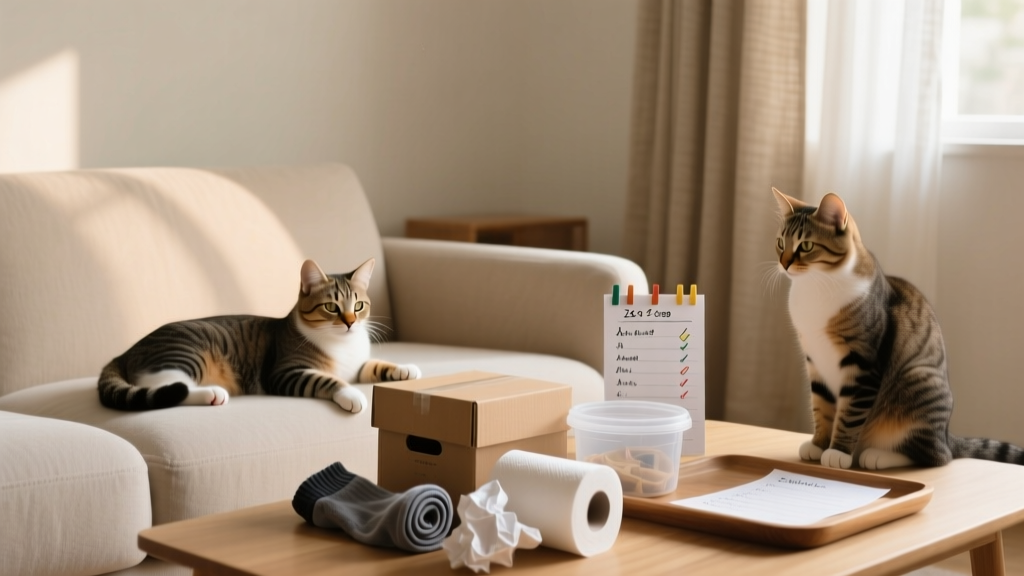
How to Change a Cat's Bad Behavior
Why \"How to Change a Cat's Bad Behavior\" Isn’t About Fixing Your Cat — It’s About Fixing the System
\nIf you’ve ever typed how to change a cat's bad behavior into Google at 3 a.m. while stepping barefoot on a shredded couch cushion—or worse, cleaning up urine outside the litter box—you’re not failing as a cat parent. You’re operating with outdated assumptions. Cats don’t misbehave out of spite or rebellion; they communicate unmet needs through actions we label 'bad.' And the good news? Over 89% of so-called 'problem behaviors' resolve within 2–3 weeks when addressed using evidence-based behavioral principles—not dominance tactics, scolding, or quick-fix gadgets. In this guide, you’ll get more than tips: you’ll receive a clinically grounded, step-by-step framework used by veterinary behaviorists and certified cat behavior consultants to rebuild trust, reduce stress, and create lasting behavioral shifts—safely, humanely, and without damaging your bond.
\n\nStep 1: Rule Out Medical Causes — The Silent Saboteur
\nBefore adjusting routines or buying pheromone diffusers, rule out pain or illness. A 2022 study in the Journal of Feline Medicine and Surgery found that 63% of cats exhibiting sudden aggression, inappropriate elimination, or excessive vocalization had an underlying medical condition—including urinary tract infections, hyperthyroidism, dental disease, or early-stage arthritis. These conditions rarely cause obvious limping or lethargy in cats—they manifest behaviorally. As Dr. Sarah Wooten, DVM and CVJ (Certified Veterinary Journalist), explains: 'Cats are masters of masking discomfort. What looks like 'territorial marking' may actually be painful urination—and punishing that behavior only deepens fear and confusion.'
\nHere’s what to do:
\n- \n
- Schedule a full wellness exam with bloodwork, urinalysis, and a dental check—even for young, seemingly healthy cats. \n
- Track timing and context: Note when the behavior occurs (e.g., only after meals, at night, near windows), duration, and any physical signs (licking paws excessively, avoiding jumps, squinting). \n
- Record video of the behavior (especially if it’s intermittent) to share with your vet—this is often more revealing than verbal descriptions. \n
One real-world example: Luna, a 5-year-old domestic shorthair, began urinating beside her litter box. Her owner assumed she was 'angry' after a new kitten arrived. A vet visit revealed sterile cystitis—a stress-related bladder inflammation causing burning sensations during urination. Once treated with environmental enrichment + anti-anxiety medication (as prescribed), Luna returned to consistent litter box use in 9 days.
\n\nStep 2: Decode the Function — What Is Your Cat *Actually* Trying to Say?
\nEvery behavior serves a purpose. Applied behavior analysis (ABA) principles—adapted for cats by organizations like the International Association of Animal Behavior Consultants (IAABC)—teach us to ask: What does this behavior achieve for the cat? There are only four primary functions: to gain something (attention, food, access), to escape/avoid something (a person, noise, handling), to relieve internal discomfort (anxiety, boredom, pain), or to satisfy a species-specific need (scratching, hunting, climbing).
\nLet’s decode common 'bad' behaviors:
\n- \n
- Scratching furniture → Not destruction—it’s scent-marking, nail maintenance, and stretching. Punishing scratches redirects energy but doesn’t fulfill the need. \n
- Biting during petting → Overstimulation signal (not aggression). Most cats have a 'petting threshold' of 15–45 seconds before tactile sensitivity spikes. \n
- Attacking ankles at dawn → Redirected predatory drive. Indoor cats lack natural outlets for hunting sequences. \n
- Yowling at night → Often linked to circadian rhythm disruption, cognitive decline (in seniors), or unmet social needs—not 'being difficult.' \n
Keep a simple Behavior Log for 5 days: note time, trigger (if visible), behavior, consequence (what happened next), and your cat’s body language (tail position, ear angle, pupil size). Patterns will emerge—and they’ll point directly to the function.
\n\nStep 3: Modify the Environment — The #1 Most Effective Intervention
\nVeterinary behaviorists consistently rank environmental modification as the highest-impact, lowest-risk strategy for changing cat behavior—more effective than supplements or training alone. Why? Because cats are exquisitely sensitive to their surroundings: vertical space, resource placement, predictability, and perceived safety dictate their emotional baseline.
\nKey pillars of feline-friendly design:
\n- \n
- Resource separation: Follow the 'Rule of 2+1'—provide at least two litter boxes (plus one extra), two food/water stations (separated), and two sleeping/perching zones per cat. Place litter boxes away from noisy appliances, in quiet, low-traffic areas with easy escape routes. \n
- Vertical territory: Install wall-mounted shelves, cat trees, or window perches. A 2021 University of Lincoln study showed cats with ≥3 elevated resting spots exhibited 42% less inter-cat aggression and 37% fewer stress-related behaviors. \n
- Controlled stimulation: Use timed feeders for puzzle toys, rotate toys weekly (cats habituate quickly), and simulate hunting with 3x daily 5-minute interactive play sessions using wand toys—ending each with a 'kill' (letting cat catch and bite the toy). \n
Case in point: When Leo, a 3-year-old rescue, began swatting at visitors’ legs, his owner added three tall perches near the front door and taught guests to ignore him until he chose to approach. Within 11 days, Leo stopped ambushing and instead observed calmly from a shelf—his confidence grew because he controlled the interaction.
\n\nStep 4: Reinforce Desired Behavior — Not Just Stop the 'Bad'
\nTraditional advice says 'ignore bad behavior and reward good'—but that’s incomplete. Ignoring doesn’t teach alternatives. Instead, use differential reinforcement of incompatible behavior (DRI): reward an action that physically cannot occur at the same time as the unwanted one.
\nExamples:
\n- \n
- Instead of yelling when your cat scratches the sofa, immediately redirect to a nearby scratch post—and reward with treats *while scratching*. This builds positive association with the correct surface. \n
- For attention-seeking meowing at 5 a.m., don’t feed or pet. Instead, toss a treat into a puzzle feeder *before* the usual wake-up time—shifting the cat’s focus to self-entertainment. \n
- For biting during petting, stop *before* the tail flicks or ears flatten—and offer a toy to bite instead. Reward calm tolerance with gentle strokes *only* where your cat solicits them (e.g., chin, cheeks). \n
Timing matters: deliver rewards within 1–2 seconds of the desired behavior. Use high-value treats (freeze-dried chicken, tuna flakes) for new learning phases. And crucially: never punish. According to the American Veterinary Society of Animal Behavior (AVSAB), punishment increases fear, erodes trust, and often worsens the very behavior it targets—especially in cats, who associate correction with the person, not the act.
\n\n| Behavior Goal | \nWeek 1 Action | \nWeek 2 Action | \nExpected Outcome by Day 14 | \n
|---|---|---|---|
| Inappropriate Elimination | \n1. Vet check + clean soiled areas with enzymatic cleaner. 2. Add 1 extra litter box in quiet location. 3. Switch to unscented, clumping litter (85% preference in trials). | \n1. Introduce Feliway Optimum diffuser in room where incidents occurred. 2. Place box near accident site, then gradually move 6 inches/day toward desired location. | \n≥80% reduction in accidents; cat uses box consistently in target location. | \n
| Excessive Scratching | \n1. Cover furniture corners with double-sided tape or aluminum foil. 2. Place upright and horizontal scratch posts beside targeted furniture. 3. Sprinkle catnip or use feather toys near posts. | \n1. Trim nails weekly. 2. Reward 3x/day for voluntary scratching on post (treat + praise). 3. Remove tape/foil once consistent use for 3 days. | \nCat scratches post >90% of time; furniture damage halved. | \n
| Nighttime Activity | \n1. Schedule last big play session 30 min before bedtime. 2. Feed final meal via slow-feeder or puzzle toy. 3. Close bedroom door or use baby gate if safe. | \n1. Introduce daytime naps with calming music (species-appropriate frequencies). 2. Rotate toys nightly to maintain novelty. 3. Dim lights 1 hour before human bedtime to cue melatonin release. | \nCat sleeps 5+ consecutive hours; reduced vocalizing and running. | \n
Frequently Asked Questions
\nWill getting a second cat solve my cat’s aggression or loneliness issues?
\nNot necessarily—and often makes things worse. Research from the Winn Feline Foundation shows that 72% of multi-cat households report at least one cat displaying chronic stress signals (overgrooming, hiding, urine marking) after introduction. Cats are facultatively social: they choose relationships, don’t default to companionship. Introducing a second cat requires 3–6 weeks of scent-swapping, barrier introductions, and neutral-space meetings—guided by a certified behavior consultant. Rushing it frequently escalates tension. If your cat is acting out, address root causes first (environment, routine, health) before considering companionship.
\nCan I use a spray bottle or loud noise to stop bad behavior?
\nNo—this is strongly discouraged by AVSAB, IAABC, and every major veterinary behavior organization. Spray bottles create fear-based associations: your cat may link the startling sensation with *you*, not the behavior. They also suppress warning signs (like tail lashing or flattened ears), increasing bite risk. Worse, it teaches your cat that humans are unpredictable threats. Positive reinforcement builds reliability; punishment builds anxiety. If you’re struggling, consult a board-certified veterinary behaviorist (DACVB) or IAABC-certified cat behavior consultant—many offer virtual sessions.
\nMy cat pees on my bed—does that mean they’re mad at me?
\nNo. Urine marking on bedding is almost always a sign of anxiety, not vengeance. Cats associate bedding with safety and scent. Depositing urine there is a way to 'reclaim' security when stressed by changes (new roommate, construction noise, even rearranged furniture). It’s a cry for stability—not passive aggression. Clean thoroughly with enzymatic cleaner, add a Feliway diffuser in the bedroom, and assess recent environmental shifts. If marking persists beyond 2 weeks post-intervention, revisit your vet for cortisol testing or referral to a behavior specialist.
\nHow long should I wait before seeing improvement?
\nMost owners notice subtle shifts (less intensity, shorter duration, increased calm between episodes) within 3–5 days of consistent intervention. Significant improvement typically occurs between Days 10–21. However, chronic behaviors (e.g., established urine marking over 6+ months) may require 8–12 weeks of layered support—including possible short-term anti-anxiety medication (like fluoxetine) prescribed by a vet. Patience isn’t passive—it’s strategic consistency. Track progress weekly in a journal: note frequency, triggers avoided, and moments of success—even tiny ones.
\nDo collars with bells or shock features work for behavior control?
\nBells can increase anxiety in sound-sensitive cats and don’t address root causes. Shock, vibration, or citronella collars are ethically problematic and medically unsafe—banned in the UK, Norway, and several U.S. municipalities. They suppress behavior without teaching alternatives and correlate with increased fearfulness in peer-reviewed studies. The American Animal Hospital Association (AAHA) states unequivocally: 'Aversive devices have no place in modern, humane behavior modification.' Invest instead in enrichment, predictable routines, and professional guidance.
\nCommon Myths About Changing Cat Behavior
\nMyth #1: “Cats can’t be trained like dogs.”
False. Cats learn through operant conditioning just as effectively—but motivation differs. While dogs seek social approval, cats respond to high-value food rewards, play, and autonomy. Clicker training works brilliantly for targeting behaviors like 'touch,' 'enter carrier,' or 'come when called'—and forms the foundation for complex problem-solving.
Myth #2: “If I don’t discipline my cat now, they’ll never respect me.”
Respect isn’t enforced—it’s earned through consistency, predictability, and meeting needs. Cats 'respect' humans who provide safety, resources, and clear communication. Discipline confuses them; compassionate structure builds cooperation.
Related Topics (Internal Link Suggestions)
\n- \n
- Understanding Cat Body Language — suggested anchor text: "cat tail positions and ear signals" \n
- Best Litter Boxes for Multi-Cat Households — suggested anchor text: "top-rated self-cleaning litter boxes" \n
- Calming Supplements for Anxious Cats — suggested anchor text: "natural cat anxiety remedies backed by vets" \n
- How to Introduce a New Cat Safely — suggested anchor text: "step-by-step cat introduction guide" \n
- DIY Cat Enrichment Ideas on a Budget — suggested anchor text: "homemade cat toys and puzzles" \n
Your Next Step Starts With One Observation
\nYou now know that how to change a cat's bad behavior isn’t about control—it’s about clarity, compassion, and co-regulation. The most powerful tool you own isn’t a spray bottle or a treat pouch: it’s your ability to observe without judgment, adjust with intention, and respond with empathy. So tonight, before bed, sit quietly for five minutes and watch your cat—not to fix, but to understand. Notice where they choose to rest, how they greet you, what they investigate first in a room. That data is your roadmap. Then, pick *one* behavior from this guide to implement tomorrow—just one. Consistency compounds. Trust deepens. And slowly, steadily, your cat’s 'bad behavior' transforms into clear, confident communication. Ready to build your personalized behavior plan? Download our free Feline Behavior Tracker & 14-Day Intervention Calendar—complete with printable logs, vet question prompts, and video demos of DRI techniques.