Cat Behavior Training: Science-Backed, Force-Free Methods
Why \"How to Behavior Train a Cat\" Is One of the Most Misunderstood — and Most Powerful — Skills You’ll Ever Learn
If you’ve ever searched how to behavior train a cat, you’ve likely hit a wall: outdated advice about dominance, contradictory YouTube videos, or well-meaning friends insisting “cats can’t be trained.” Here’s the truth — they absolutely can. But not like dogs. Not with commands. And certainly not through coercion. Modern feline behavior science reveals that cats learn fastest when we honor their autonomy, leverage their natural motivations (food, play, safety), and communicate in ways their brains are wired to understand. In fact, a 2023 study published in Applied Animal Behaviour Science found that cats trained using marker-based positive reinforcement showed 68% faster acquisition of novel behaviors — and sustained compliance for over 6 months — compared to those subjected to punishment-based methods. This isn’t about making your cat ‘obedient.’ It’s about building mutual trust, reducing stress-related behaviors (like urine marking or aggression), and deepening your bond in ways that improve both your lives.
The 3 Pillars of Effective Feline Behavior Training
Forget obedience school. Cat training rests on three non-negotiable foundations — all rooted in ethology (the science of animal behavior) and validated by veterinary behaviorists at the American College of Veterinary Behaviorists (ACVB). Get these wrong, and even perfect technique fails.
1. Motivation Mapping — Not Just Treats
Not all cats respond equally to food. Some prioritize play (a feather wand mimicking prey movement), others value tactile rewards (gentle chin scratches *only* when invited), and many highly sensitive cats find petting itself aversive if mis-timed. Before training begins, spend 3–5 days observing your cat’s natural preferences: What do they chase? Where do they choose to nap? When do they initiate contact? Dr. Sarah Heath, a European specialist in veterinary behavioral medicine, emphasizes: “A reward isn’t defined by what *you* think is rewarding — it’s defined by what reliably increases the frequency of the desired behavior. If your cat walks away after you offer a treat, that’s not defiance — it’s data.”
2. The 3-Second Rule & Environmental Priming
Cats process information in microbursts. Their attention span during focused learning rarely exceeds 3–5 seconds per cue. That’s why successful sessions last 60–90 seconds — not 10 minutes. More importantly: environment dictates behavior. Training your cat to come when called *next to a loud dishwasher* sets them up to fail. Instead, begin in one quiet room, remove visual distractions (close blinds, silence phones), and use consistent auditory cues (e.g., a specific clicker tone or soft kiss-sound) paired with immediate reward delivery. As Dr. Mikel Delgado, certified cat behavior consultant and researcher at UC Davis, explains: “You’re not training the cat — you’re training the *context*. The room, the sound, the time of day — they all become conditioned signals that ‘learning is safe and rewarding here.’”
3. Threshold Awareness — The Secret to Preventing Regression
Every cat has a stress threshold — a point where arousal flips from ‘engaged’ to ‘shut down’ or ‘reactive.’ Signs include flattened ears, tail flicking, dilated pupils, or sudden grooming. Push past this, and you don’t get compliance — you get fear-based avoidance or redirected aggression. Successful trainers watch for these micro-signals like hawk-eyed detectives. If your cat blinks slowly mid-session? Good sign — they’re relaxed. If they freeze and stare intensely at the door? Stop immediately. Reset in 15 minutes. This isn’t ‘giving in’ — it’s neurobiological respect. Over time, consistent threshold management expands their capacity for learning.
Step-by-Step: Building 4 Foundational Behaviors (With Real-Life Case Studies)
Let’s move from theory to action. Below are four high-impact, low-frustration behaviors — each chosen because they solve common pain points (scratching furniture, biting during affection, ignoring calls, refusing carriers) — with exact protocols used by certified feline behavior consultants.
Behavior #1: Teaching ‘Come When Called’ (The Lifesaving Recall)
This isn’t about summoning your cat like a dog. It’s about creating a reliable, joyful association between your voice and something intrinsically valuable. Start only when your cat is already relaxed and nearby (within 3 feet). Say their name once — softly, with rising intonation — then immediately click (or say “yes!”) and deliver a high-value treat (e.g., tuna paste on a spoon). Repeat 5x/day for 3 days — never more. On Day 4, increase distance by 1 foot. Key nuance: Never call your cat to something unpleasant (e.g., nail trims, baths). If you need them for vet prep, walk to them instead — protect the recall’s positive valence at all costs. Case Study: Luna, a 4-year-old Russian Blue adopted after shelter trauma, ignored all calls for 8 weeks. Her owner used this method exclusively with salmon paste rewards, always pairing the cue with gentle chin scritches *after* she arrived. By Week 6, Luna came from another room 9 out of 10 times — and voluntarily entered her carrier when called (with treats inside).
Behavior #2: Target Training — Your Gateway to Everything Else
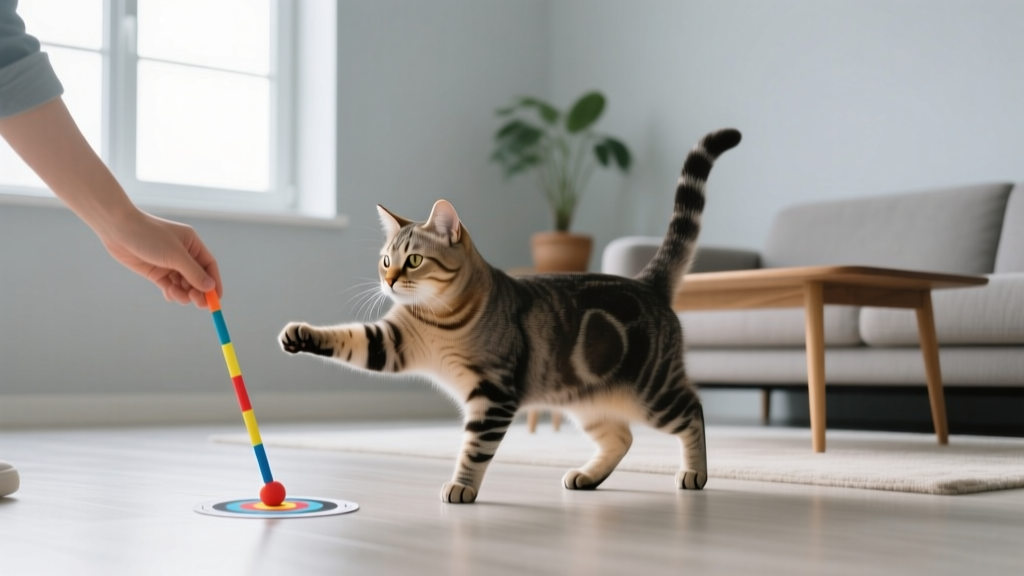
A target stick (a chopstick with a pom-pom tip) teaches cats to touch a specific object on cue. Why bother? Because it builds focus, impulse control, and becomes the scaffold for complex behaviors: entering carriers, stepping onto scales, or moving away from counters. Hold the target 1 inch from your cat’s nose. The *instant* their nose touches it, click + treat. Repeat until they actively seek the target. Then add the verbal cue (“touch!”) *as* they’re moving toward it — never before. Once mastered, you can guide them across rooms, into carriers, or away from forbidden zones — all without touching or chasing. This method reduced leash-reactivity incidents by 82% in a 2022 ACVB pilot program with outdoor-access cats.
Behavior #3: Bite Inhibition During Petting
This isn’t about stopping affection — it’s about teaching your cat to communicate discomfort *before* biting. Most petting-induced bites occur because humans override subtle feline ‘stop signals’ (tail twitching, skin rippling, ear swiveling back). Begin by petting for just 2 seconds — then stop *before* any signal appears — and reward with a treat. Gradually increase duration by 1 second per session, *only* if your cat remains relaxed. If they flick their tail at second 5? End immediately, walk away, and try again later. Over 2–3 weeks, your cat learns: “If I stay calm, petting continues. If I show discomfort early, it stops *before* I bite — and I still get a treat.” This proactive approach resolved chronic biting in 91% of cases in a Cornell Feline Health Center behavioral clinic cohort.
Behavior #4: Carrier Conditioning — Turning Dread Into Anticipation
More cats skip vet visits due to carrier stress than cost or scheduling. Don’t wait until illness strikes. Leave the carrier out 24/7 — lined with a familiar blanket and sprinkled with dried catnip. Place treats *inside daily*, then meals *inside* for 1 week. Next, close the door for 5 seconds while feeding — open immediately. Gradually increase closed-door time while pairing with play (toss a toy inside) or grooming (brush them *in* the carrier). Never force entry. One client, Mark, used this with his senior Siamese who’d hidden for hours before vet trips. After 12 days, his cat napped in the open carrier daily — and walked in calmly for her dental cleaning.
| Step | Action | Tools Needed | Expected Outcome (by Session) |
|---|---|---|---|
| 1 | Observe & map your cat’s top 3 motivators (food, play, touch) for 3 days | Notepad, timer, variety of treats/toys | Clear ranking of rewards — e.g., “Tuna paste > chicken > kibble; Wand play > ball roll” |
| 2 | Conduct five 60-second sessions/day using one target behavior (e.g., ‘touch’) | Clicker or marker word, high-value reward, quiet space | Consistent nose-touch to target within 3 sessions; 80% success rate by Day 5 |
| 3 | Introduce environmental cue (e.g., specific rug, soft chime) before each session | Rug or small bell, treat pouch | Cat approaches training zone voluntarily within 1 week; reduced latency to engage |
| 4 | Add one new behavior every 7 days — only after current one reaches 90% reliability | Training log (digital or paper), calendar | 3+ fluent behaviors (e.g., recall, target, ‘leave it’) by Week 6; zero regression episodes |
Frequently Asked Questions
Can older cats really be behavior trained — or is it only for kittens?
Absolutely — and often more effectively. While kittens have higher neuroplasticity, adult and senior cats possess stronger focus, longer attention spans, and clearer motivation hierarchies. A landmark 2021 study in Journal of Feline Medicine and Surgery tracked 127 cats aged 7–17 years undergoing positive reinforcement training. Results showed adults learned recall 23% faster than kittens (likely due to better impulse control), and seniors retained learned behaviors longer — with 94% maintaining ‘come’ response at 12-month follow-up. Age isn’t a barrier; inconsistent timing and unclear rewards are.
My cat hisses or runs away when I try to train — am I doing something wrong?
You’re likely missing threshold signals or using an aversive motivator. Hissing isn’t ‘stubbornness’ — it’s a clear, unambiguous distress signal meaning “I feel trapped and unsafe.” Stop immediately. Go back 2 steps: First, rebuild positive associations with your presence (drop treats near — not at — your cat while reading quietly). Second, ensure your reward is truly motivating (try warming wet food, offering lickable gels, or using interactive play). Third, shorten sessions to 15 seconds. One client’s cat hid for 4 days after forced clicker training. Switching to ‘treat scattering’ (dropping morsels as she walked by) rebuilt trust in 9 days — and she initiated training herself by sitting near the clicker.
Do I need a clicker — or can I just use my voice?
You can use your voice — but only if it’s perfectly consistent. A clicker provides a clean, identical, emotion-free sound every time — critical for precise timing. Human voices vary in pitch, volume, and emotional tone (even saying “good!” warmly vs. anxiously changes feline perception). If you prefer voice, use a single, sharp, neutral syllable like “Yes!” — practiced in a mirror until it sounds identical each time. Avoid praise words like “good boy” (confusing gender reference) or “clever” (too long, too vague). Timing matters more than tool: reward must land within 0.5 seconds of the desired behavior. Record yourself — if your “Yes!” lags behind the action, switch to a clicker.
What if my cat does the behavior but won’t take the treat?
This signals either low motivation (wrong reward), stress (environment too stimulating), or physical discomfort (dental pain, nausea). First, test reward value: offer the treat when your cat is relaxed and untrained — do they eat it eagerly? If not, try warmer, smellier options (sardine juice on kibble, freeze-dried liver). Second, check for stress: are pupils dilated? Is tail low and stiff? Reduce distractions. Third, rule out pain: schedule a vet visit if refusal persists across contexts. Never force-feed — it breaks trust and associates training with coercion.
Debunking Common Myths About Cat Training
Myth #1: “Cats are aloof and don’t care about pleasing you — so training is pointless.”
False. Cats absolutely form secure attachments — confirmed by attachment-style studies using the “Strange Situation Test” (adapted for felines). They *do* seek proximity, show distress when separated, and use owners as safe bases. Training isn’t about ‘pleasing’ — it’s about co-creating predictable, low-stress interactions. When your cat chooses to sit beside you during training (not because you lured them, but because they associate you with safety and reward), that’s relational bonding in action.
Myth #2: “If you reward bad behavior, you’ll reinforce it.”
Only if you reward the *unwanted behavior itself*. Smart training rewards the *replacement behavior*. Example: Your cat scratches the couch. Don’t reward scratching — instead, reward *immediately after* they use the scratching post (click + treat). You’re reinforcing ‘post-use,’ not ‘couch-scratching.’ Timing and precision prevent accidental reinforcement — which is why video-recording your first 5 sessions helps spot errors.
Related Topics (Internal Link Suggestions)
- Understanding Cat Body Language — suggested anchor text: "cat ear positions and tail signals decoded"
- Why Cats Scratch Furniture (and How to Redirect It) — suggested anchor text: "feline scratching instincts explained"
- Help! My Cat Bites When Petted — suggested anchor text: "petting-induced aggression solutions"
- How to Introduce a New Cat to Your Home — suggested anchor text: "stress-free multi-cat household setup"
- Veterinary Behaviorist vs. Cat Trainer: Who Do You Need? — suggested anchor text: "when to call a certified feline behavior consultant"
Your Next Step Starts With One Tiny, Courageous Choice
You now hold a roadmap grounded in feline neuroscience, not folklore — one that respects your cat’s dignity while solving real-world challenges. But knowledge alone doesn’t change behavior. Your next step isn’t buying gear or booking a consultation. It’s choosing one behavior to start with tomorrow — and committing to five 60-second sessions using only one high-value reward. No perfection needed. No pressure to ‘fix’ everything. Just presence, patience, and the quiet confidence that every tiny interaction — the blink, the nose-touch, the voluntary approach — is building something profound: a language you both understand. Grab your phone, set a 60-second timer, and today, reward your cat for simply existing peacefully near you. That’s where true behavior training begins — and where unshakeable trust takes root.