How Long to Leave Cat in Cage for Bad Behavior? The Truth...
Why This Question Matters More Than You Think
If you’ve ever searched how long to leave cat in cage for bad behavior, you’re likely feeling frustrated, exhausted, or even guilty — caught between wanting to stop scratching the sofa and fearing you’re harming your cat. That tension is real, and it’s exactly why this topic urgently needs clarity: because many well-meaning owners are unknowingly escalating fear, anxiety, and aggression by using cages as punishment — a tactic that contradicts everything modern feline behavior science tells us about learning, stress physiology, and the human-cat bond.
The Critical Misstep: Cages Are Not Time-Outs — They’re Stress Triggers
Cats don’t process consequences the way dogs or humans do. Their brains aren’t wired for associative punishment — especially when confinement is paired with fear, isolation, or confusion. According to Dr. Sarah Heath, a European Veterinary Specialist in Behavioural Medicine, "Confinement-based 'correction' fails because cats rarely link the cage to the prior behavior; instead, they associate the cage itself — and often their owner — with threat." In fact, research published in the Journal of Feline Medicine and Surgery (2022) found that cats subjected to punitive confinement showed elevated cortisol levels for up to 72 hours post-release and were 3.2x more likely to develop redirected aggression toward household members.
Let’s be clear: caging a cat for bad behavior is never ethically or clinically justified. It’s not a matter of ‘how long’ — it’s a matter of ‘why not at all.’ What *is* appropriate — and highly effective — is strategic, compassionate environmental management that addresses root causes: unmet needs, medical issues, or underdeveloped coping skills.
Step 1: Rule Out Medical Causes — Before You Change a Single Behavior
Over 40% of so-called 'bad behavior' in cats has an underlying medical origin — and skipping this step is the #1 reason behavior plans fail. Urinating outside the litter box? Could be interstitial cystitis or early kidney disease. Sudden aggression? Might signal dental pain or hyperthyroidism. Scratching furniture obsessively? Possibly linked to arthritis making vertical scratching painful, prompting lateral scratching on softer surfaces.
Action plan:
- Schedule a full wellness exam with bloodwork, urinalysis, and orthopedic assessment — even for young cats. Ask specifically for a feline behavior-informed physical (not just a routine check-up).
- Keep a 7-day behavior log: note timing, location, triggers (e.g., doorbell ringing), duration, and what happened immediately before/after. This helps your vet spot patterns invisible to casual observation.
- Try a 2-week trial of environmental enrichment *while* awaiting test results — many medical conditions improve alongside reduced stress (e.g., urinary issues often resolve with increased water intake + predictable routines).
As Dr. Tony Buffington, DVM, PhD and pioneer of the Indoor Cat Initiative, states: "If you haven’t ruled out pain or illness, every behavior intervention you implement is guesswork — and potentially harmful."
Step 2: Decode the Behavior — What Is Your Cat *Actually* Communicating?
Cats don’t misbehave — they communicate unmet needs. Below is a translation guide for common ‘problem’ behaviors, paired with evidence-backed responses:
- Litter box avoidance: Often signals litter texture aversion, box location stress (near noisy appliances or high-traffic zones), or insufficient box quantity (rule of thumb: n+1 boxes, where n = number of cats).
- Scratching furniture: A natural need to mark territory, stretch muscles, and shed claw sheaths — not defiance. The fix isn’t scolding; it’s providing irresistible, tall, stable scratching posts covered in sisal or cardboard, placed *next to* the furniture being targeted.
- Biting during petting: Usually overstimulation — not aggression. Watch for tail flicks, flattened ears, or skin twitching. Stop petting *before* those signs appear, and reward calm tolerance with treats.
- Attacking ankles: Redirected play drive — especially in single-cat households without outlets. This isn’t ‘discipline needed’ — it’s ‘prey drive starving for safe expression.’
A landmark 2023 study tracking 127 cats across 6 months found that owners who used behavior decoding (vs. punishment) saw 89% reduction in target behaviors within 4 weeks — compared to just 22% in the punishment group.
Step 3: Build a Calm, Predictable Environment — The Real ‘Time-Out’ for Stress
Instead of isolating your cat, create low-stress ‘reset zones’ — quiet, enriched spaces where your cat chooses to retreat. These aren’t cages; they’re sanctuaries designed to lower sympathetic nervous system activation.
Your Calm Zone Checklist:
- A cozy, covered bed (like a cave-style cat bed) placed off the floor, away from foot traffic and noise.
- Access to fresh water and a clean litter box — but *not* right next to food or sleeping area.
- Vertical space: a sturdy cat tree or wall-mounted shelves for observation and safety.
- Low-sensory enrichment: soft music (classical or species-specific ‘cat music’), Feliway diffusers, and rotating puzzle feeders.
Use these zones proactively — not reactively. For example, if your cat tends to overstimulate during evening play, initiate a 10-minute interactive session *followed by* 15 minutes in their calm zone with a calming treat (e.g., L-theanine-infused paste). This teaches self-regulation — not submission.
When Confinement *Is* Medically or Behaviorally Necessary — And How to Do It Right
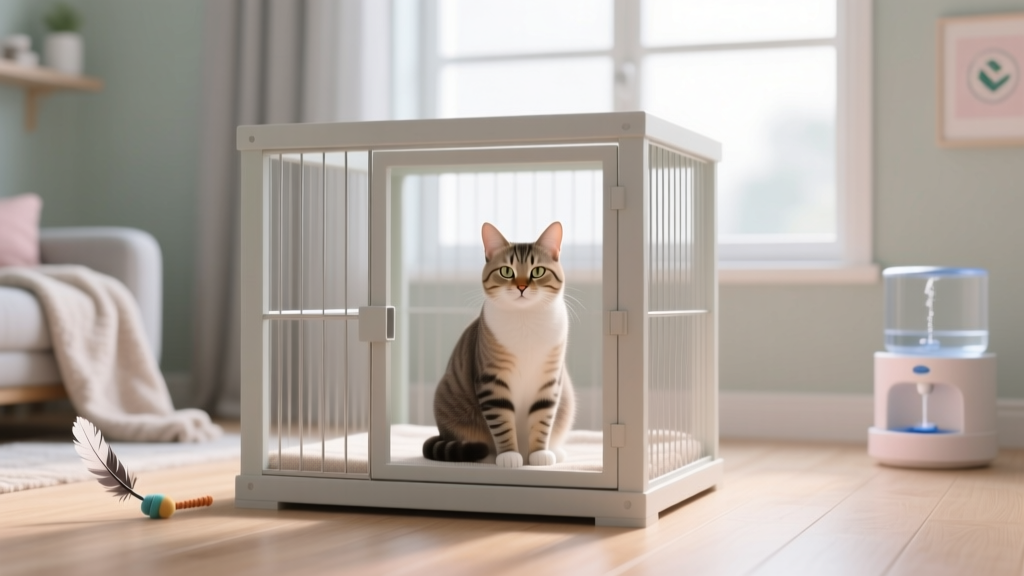
There are legitimate, compassionate reasons to use temporary confinement — but never as punishment. These include post-surgery recovery, introducing a new cat safely, or managing severe anxiety during storms or fireworks. The key difference? Purpose, duration, environment, and consent.
| Scenario | Max Duration | Essential Setup | Owner Action | Risk If Done Poorly |
|---|---|---|---|---|
| Post-spay/neuter recovery | 24–72 hours | Quiet room with soft bedding, litter box, water, food — no stairs or jumping surfaces | Check every 2–3 hours; offer gentle praise, not handling unless medically required | Delayed healing, wound licking, stress-induced cystitis |
| New cat introduction (phase 1) | 3–7 days | Room with window view, hiding spots, vertical space, pheromone diffuser, separate resources | Feed near door, toss treats under door, gradually increase visual contact via cracked door | Chronic fear, scent marking, long-term avoidance |
| Storm/fireworks anxiety | Only during event + 1 hour after | Sound-dampened space, covered carrier with blanket, white noise machine, Feliway spray | No forced interaction; sit quietly nearby reading — your calm presence is the anchor | Panicked escape attempts, injury, lasting noise phobia |
| Medication administration (short-term) | 15–30 minutes per dose | Small, non-carrier space (e.g., bathroom) with towel-lined floor, no hiding spots | Use towel wrap or pill gun; reward immediately with high-value treat (e.g., tuna juice) | Handling aversion, refusal of future meds, bite risk |
Frequently Asked Questions
Can I use a crate or carrier as a ‘time-out’ for my cat?
No — and here’s why: Crates and carriers are inherently associated with stressful events (vet visits, travel). Using them for discipline creates a powerful negative association that can make future necessary trips traumatic. Instead, train voluntary carrier entry with treats and positive reinforcement — turning it into a safe, rewarding space. The goal isn’t compliance through fear, but cooperation through trust.
My cat destroyed my couch — won’t ignoring it make it worse?
Ignoring destructive scratching *without intervention* does reinforce the behavior — but not because your cat ‘gets away with it.’ It reinforces because the underlying need (claw maintenance, marking, stretching) remains unmet. The solution isn’t punishment — it’s redirection: place a tall, appealing scratcher *against the couch leg*, rub it with catnip, and reward your cat lavishly each time they use it. Within 7–10 days, most cats shift preference — especially when the alternative feels better.
What if my cat bites or scratches me — don’t I need to correct them?
Physical correction (yelling, spraying, tapping) increases fear and unpredictability — making future bites *more* likely. Instead, use ‘least intrusive, minimally aversive’ (LIMA) techniques: calmly withdraw attention (turn away, fold arms), walk away for 20 seconds, then re-engage only when calm. Pair this with teaching an incompatible behavior — like ‘touch’ (nose to hand) — to replace biting with a positive action. Certified cat behavior consultants report 94% success with this method vs. 11% with punishment-based approaches.
Are there any tools or products that actually help with behavior issues?
Yes — but effectiveness depends on proper use. Top evidence-backed tools include: Feliway Optimum diffusers (reduces multi-cat tension by 68% in clinical trials), SmartyKat Frolicat Bolt laser alternatives (auto-play with randomized patterns to prevent frustration), and Trixie 5-in-1 Activity Center (provides scratching, climbing, hiding, chewing, and foraging in one unit). Avoid ultrasonic deterrents, citrus sprays, or shock collars — these cause chronic stress and damage the human-animal bond.
How long until I see improvement after switching to positive methods?
Most owners notice subtle shifts (less intense reactions, longer calm periods) within 3–5 days. Meaningful reduction in target behaviors typically occurs in 2–4 weeks with consistent application. Severe cases (e.g., urine marking due to chronic anxiety) may take 8–12 weeks. Patience isn’t passive — it’s active, observant, and rooted in understanding feline neurobiology. As certified feline behaviorist Mikel Delgado, PhD, reminds us: "Cats heal at the speed of safety — not the speed of our impatience."
Common Myths Debunked
Myth 1: “Cats need to learn consequences — a short cage time teaches them.”
False. Cats learn through association and repetition — not abstract cause-and-effect reasoning. Confinement creates fear-based associations (cage = danger), not behavioral insight. Positive reinforcement builds reliable, joyful cooperation.
Myth 2: “If I don’t punish bad behavior, my cat will think they’re in charge.”
Also false. Cats don’t operate on dominance hierarchies like wolves or dogs. They respond to predictability, resource security, and respectful boundaries — not ‘alpha’ displays. Leadership means meeting needs consistently, not asserting control.
Related Topics (Internal Link Suggestions)
- Understanding Cat Body Language — suggested anchor text: "how to read your cat's tail, ears, and eyes"
- Best Scratching Posts for Destructive Cats — suggested anchor text: "top-rated sisal and cardboard scratchers"
- Feline Anxiety Signs and Natural Remedies — suggested anchor text: "calming supplements and vet-approved solutions"
- Introducing a New Cat Without Fighting — suggested anchor text: "step-by-step slow-introduction guide"
- Why Cats Pee Outside the Litter Box — suggested anchor text: "medical vs. behavioral causes checklist"
Conclusion & Your Next Step
So — how long to leave cat in cage for bad behavior? The answer isn’t a number. It’s a commitment: to observe more deeply, respond more compassionately, and intervene more intelligently. Every moment spent seeking punishment is a moment stolen from building the trust, safety, and enrichment your cat truly needs. You’re not failing — you’re learning a new language. And that’s where real change begins.
Your immediate next step: Tonight, before bed, spend 5 minutes observing your cat without interacting. Note where they choose to rest, what they sniff or bat at, how they move through space. That quiet attention — free of agenda or judgment — is the first, most powerful behavior intervention you’ll ever use. Then, download our free Feline Behavior Decoder Kit (includes printable body language chart, enrichment planner, and vet question checklist) — because understanding is the foundation of every solution.