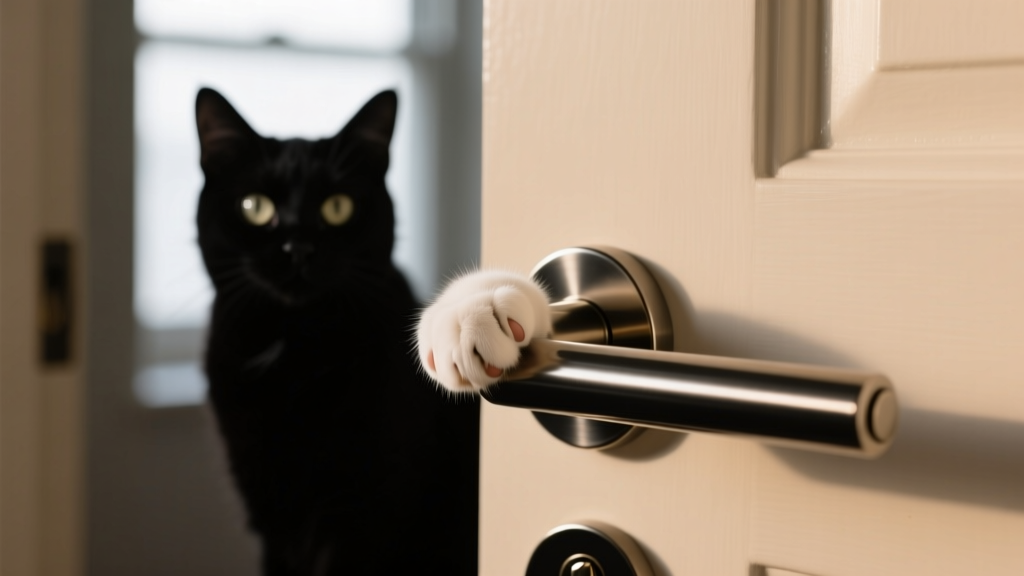
Cat Paw Resting on the Door Handle: Waiting
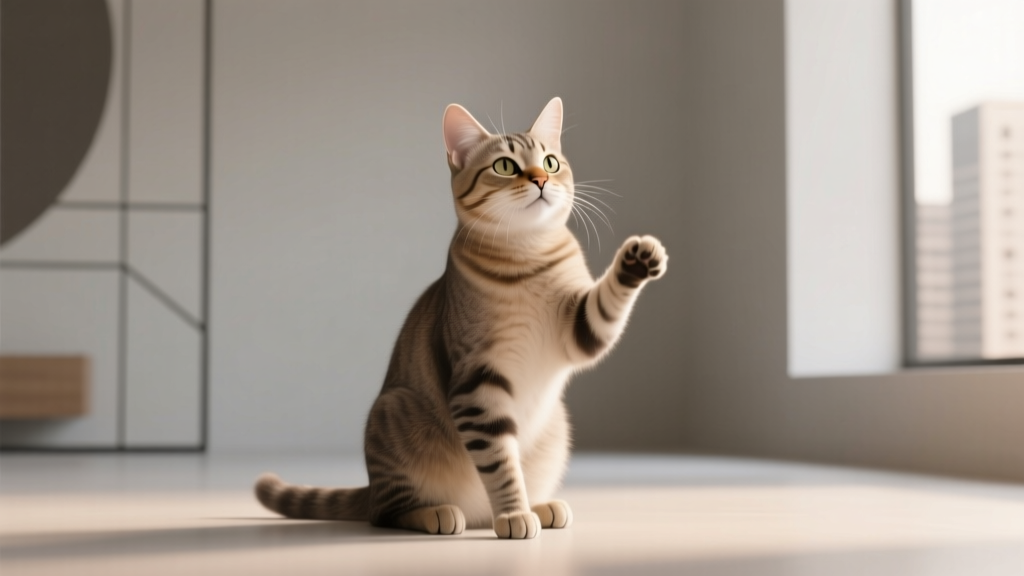
You’re in the kitchen, halfway through making coffee, when you notice it: a single paw perched on the door handle like your cat is posing for a tiny, very serious portrait. Maybe they’re standing on their back legs, maybe they’re sitting with one foreleg extended like a delicate little hook. They’re not yowling. They’re not scratching. They’re just… waiting.
If you’ve ever wondered, “Is my cat trying to open the door? Are they being dramatic? Are they auditioning for a role as the world’s smallest bouncer?” you’re in good company. That paw-on-the-handle moment is one of those quietly hilarious cat behaviors that also happens to be rich with meaning—about learning, communication, and what your cat expects from you.
Why Cats Do This (A Scientific & Evolutionary Look)
Cats are born problem-solvers. In the wild, survival depends on noticing patterns: which bush hides prey, which trail leads to shelter, which sound predicts danger. Your home is your cat’s “territory,” and doors are basically the most interesting obstacles in it. They change the environment. They control access to resources (you, food, litter, sunbeams, the best nap spot). So it makes sense that cats pay close attention to them.
From a behavioral science perspective, a paw on a handle is often a mix of:
- Operant learning: Your cat tries something, and it works (or you make it work). Over time, the “paw-to-handle” gesture becomes a reliable strategy.
- Object manipulation instincts: Cats use paws like hands. Even big cats bat at objects to test them. Domestic cats are excellent at “puzzle-solving” with their paws.
- Communication rituals: Cats prefer subtle signals. A quiet, still “request” can be more comfortable for them than vocalizing or scratching.
- Territory control: Doors divide territory. Waiting at a door can be about maintaining access and keeping tabs on what’s happening where.
Door handles are also textured, elevated, and attached to something that moves. For a curious cat, that’s irresistible—especially if they’ve ever seen a human hand touch it and then a door magically opens. Cats are excellent observers of cause and effect. If your cat has watched you open that door a thousand times, they’ll eventually experiment with the same “important spot.”
A Breakdown of the Behavior in Different Contexts
“Paw on the door handle” isn’t one single behavior; it’s a flexible little gesture that changes meaning based on the rest of your cat’s body language and the situation.
1) The Bathroom Sentinel
Scenario: You close the bathroom door. Within seconds, there’s your cat—quietly posted, paw on the handle, staring like they’re guarding the portal to Narnia.
Common meaning: social proximity + routine. Many cats follow their people room to room. Not because they’re clingy (though some are), but because you’re part of their safe territory and daily pattern. The paw on the handle is a calm “I’d like access, please.”
2) The Bedroom Doorman at 3 A.M.
Scenario: Your cat gently rests a paw on the handle, then pauses. No scratching. No chaos. Just a quiet request that somehow still feels very loud at 3 in the morning.
Common meaning: learned politeness. Some cats discover that scratching gets a negative reaction, but a soft paw-and-wait often gets the door opened. Congratulations: you may have trained a very courteous (and persistent) little negotiator.
3) The “I Smell Something Interesting” Pause
Scenario: Your cat stands at a closed door, paw on the handle, nose working overtime. Maybe the laundry room smells like warm towels. Maybe the guest room has a suitcase. Maybe another pet was in there.
Common meaning: curiosity + information gathering. Cats “read” the world through scent. A closed door blocks information. The paw placement may be part of stabilizing themselves while sniffing, or a quick test to see if the door gives.
4) The Exit Strategy (Front Door Edition)
Scenario: Your cat touches the handle when you’re putting on shoes or reaching for keys.
Common meaning: pattern recognition. Your cat has learned that “human touches handle” often equals “door opens” and potentially “interesting outdoor smells.” Some cats are also trying to prevent separation: “Wait—don’t disappear behind the big moving wall.”
5) The Multicat “Let Me In” Signal
Scenario: A cat is separated from another cat (or from you) by a door and chooses handle-resting instead of pawing under the door.
Common meaning: conflict avoidance or careful social checking. If there’s mild tension between cats, one may approach quietly and pause, using gentle signals rather than escalating with scratching or loud vocalizing.
What It Says About Your Cat’s Mood and Feelings
The paw on the handle is often a sign of calm intentionality. Your cat isn’t flailing; they’re making a point. Here are some emotional “translations,” using the rest of the body as your guide:
- Relaxed tail, soft eyes, quiet posture: “I’m patient. I’d like the door open when you can.”
- Tail tip twitching, ears rotating, focused stare: “I’m interested and a little keyed up. Something about this door matters right now.”
- Meow + paw on handle + pacing: “I’m requesting access urgently (food, litter, you, or a preferred spot).”
- Low body, crouch, ears slightly back: “I’m uncertain. I want information, but I’m cautious.”
- Repeated handle touching with quick retreats: “I’m testing the situation. I’m not fully confident.”
Many cats choose this behavior when they feel secure. It’s a controlled, “civilized” signal—more like tapping you on the shoulder than banging on the wall.
Related Behaviors You Might Also Notice
If your cat is a door-handle waiter, you may spot other “clever paw” habits:
- Paw under the door: A more urgent version of access-seeking, often paired with playfulness or frustration.
- Rattling the handle: Some cats graduate from resting to pulling, especially lever-style handles.
- Sitting directly in front of the door: A quiet blockade that says, “This is a checkpoint.”
- Touching you, then walking to the door: A classic “come with me” behavior—very common in social, confident cats.
- Scratching near the door frame: Sometimes communication, sometimes stress, sometimes a learned way to get attention.
- Waiting in the exact spot where the door opens: Because cats love routines and predictable “event locations.”
Normal vs. Concerning: When to Pay Closer Attention
Most of the time, paw-on-handle waiting is normal, even charming. It becomes a concern when it signals stress, unmet needs, or compulsive behavior.
Likely normal if:
- Your cat is otherwise relaxed, playful, eating normally, using the litter box normally.
- The behavior happens at predictable times (when you shower, when you leave, when a door is usually opened).
- Your cat can be redirected with play, food puzzle, or attention.
Worth investigating if:
- Your cat becomes frantic: constant pawing, yowling, panting, or aggression when blocked by a door.
- It’s paired with other stress signs: overgrooming, hiding more than usual, changes in appetite, litter box accidents.
- Your cat is trying to reach a resource (litter box, water, food) that might be inaccessible.
- The behavior suddenly appears or escalates—especially in an older cat (pain, cognitive changes, or anxiety can shift behavior).
If you suspect stress or a medical issue, a vet check is a smart first step. Pain and discomfort can make cats more restless, more clingy, or more insistent about certain spaces.
How to Respond (and When to Encourage It)
Your response teaches your cat what works. If you always open the door the moment the paw hits the handle, you may create a very determined door concierge. That’s not necessarily bad—just be intentional.
1) Decide what you want the door “rule” to be
If it’s fine for your cat to enter, you can reward calm waiting. If it’s a no-go room, you’ll need consistency and alternatives.
2) Reward calm, not chaos
If your cat escalates from waiting to scratching, only open the door during a quiet moment. Otherwise, the scratching becomes the successful strategy.
3) Offer an alternative “waiting station”
Place a cozy mat, small cat tree, or perch near the door. Then reinforce: when your cat sits on the mat, they get attention or a treat. You’re giving them a job that doesn’t involve the handle.
4) Enrich the environment if doors are a recurring obsession
Door-fixation can be boredom in a clever coat. Add:
- daily interactive play (wand toys that mimic prey)
- food puzzles
- window perches and bird-viewing spots
- scent enrichment (rotate safe smells like catnip, silvervine, or new cardboard boxes)
5) If it’s the front door, prioritize safety
Some cats pair handle-touching with door-dashing. Consider a double barrier (baby gate inside, or a small “airlock” routine), and reward your cat for sitting away from the door when you enter/exit.
6) Avoid punishment
Yelling or spraying can make doors feel even more emotionally charged. It can also teach your cat that approaching you near doors is risky—leading to sneakier behavior or anxiety.
Fun Facts & Research-Adjacent Nuggets
- Cats are excellent observational learners. They don’t just explore randomly; they watch what works for you and test versions of it. Door handles are a prime “human action hotspot.”
- Paws are sensory tools. Cat paw pads contain nerve endings that help them assess texture, vibration, and movement. Resting a paw on a handle may be a way of “feeling” for subtle shifts.
- Subtle communication is a cat specialty. Many cats prefer low-drama signals (a stare, a sit, a gentle touch) over loud ones. Paw-on-handle can be the polite equivalent of knocking.
- Lever handles are easier for cats than knobs. If your cat has ever successfully moved a lever handle, don’t be surprised if they keep practicing. Mastery is reinforcing all by itself.
FAQ
Why does my cat put their paw on the door handle and just stare?
Usually it’s a calm request for access or attention. Your cat has likely learned that the handle is the “important spot” that makes the door open, and staring is a gentle way to keep the request active without escalating.
Is my cat trying to open the door?
Sometimes, yes—especially with lever handles. Even when they can’t physically open it, the behavior can be a learned attempt: “This is where hands go, so this is where paws should go.”
My cat does this when I’m in the bathroom. Is that separation anxiety?
Not automatically. Many cats simply prefer proximity and routine. Anxiety is more likely if you see frantic vocalizing, destructive scratching, panting, or other stress signs, or if the behavior intensifies when you leave the house.
Should I open the door when my cat does it?
If it’s safe and allowed, opening the door can reinforce calm communication. If you don’t want your cat to enter, don’t reward the handle-touching—redirect instead to a “waiting spot” and reward that.
How do I stop my cat from obsessing over a closed door?
First, make sure no essential resource is behind it (litter box, food, water). Then increase enrichment and provide an alternative routine: a perch near the door, a puzzle feeder, or a short play session at the times your cat typically waits.
Could this be a sign my cat is bored?
It can be. Smart, social cats often turn doors into entertainment or a “project.” If the behavior happens frequently and your cat seems restless, adding structured play and foraging activities usually helps.
If your cat has a signature “door handle wait” pose—one paw up like a tiny hotel concierge, or a full-body lean like they’re trying to will it open—we want to hear about it. Share your cat’s quirky door habits and stories with the Cat Lovers Base community at catloversbase.com.