Cat Paw Reaching Into Cabinets: Curiosity Behavior
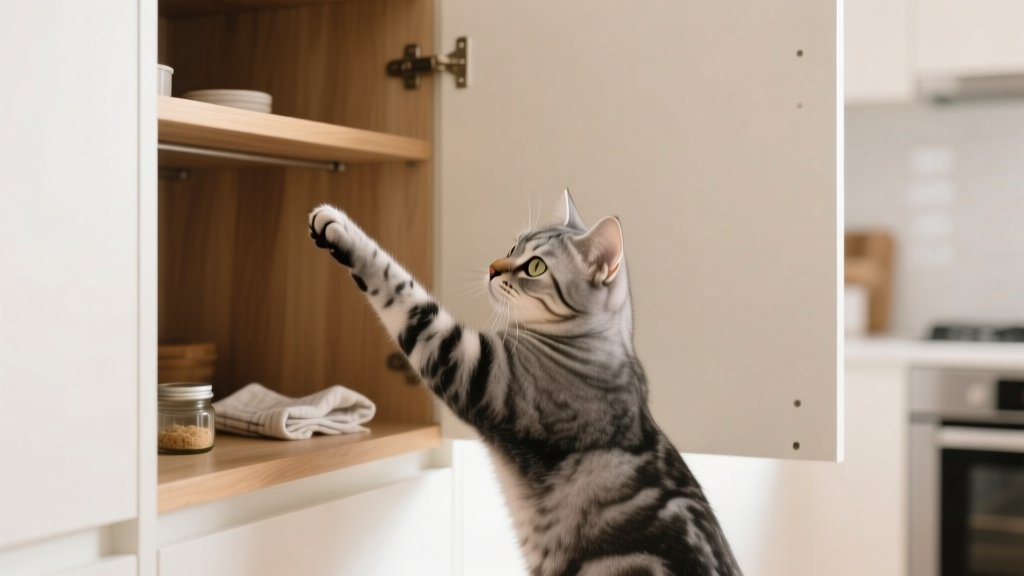
You’re making coffee, half-awake, and you hear it: a soft thunk… scrape… tap-tap from the kitchen. You turn around and there’s your cat—sitting like a tiny, furry locksmith—hooking a paw into the crack of a cabinet door and fishing around with complete confidence. Maybe they’re after the treat bag. Maybe they’re trying to “help” you unload groceries. Maybe they just discovered that cabinets contain an entire universe of smells, shadows, and forbidden crinkly things.
If you’ve ever watched a cat reach into a cabinet like they’re playing an invisible game of claw machine, you’ve seen a classic feline curiosity behavior. It’s funny, it’s a little chaotic, and it’s incredibly cat. The good news: most of the time, it’s normal—and it can tell you a lot about how your cat thinks and what they’re feeling.
Why Cats Do This (Science, Evolution, and a Little Cat Logic)
Cats are built to investigate. In the wild, a small opening in a rock pile or a gap under a log might hide a mouse, a lizard, or a nest of insects. Those meals don’t sit out in the open waiting to be politely eaten. They’re tucked away in crevices. The cat who could safely reach in, pull something out, and avoid getting bitten had a serious survival advantage.
That “reach in and retrieve” strategy is still in your housecat’s hardware. Cabinets, drawers, laundry baskets, under-sofa voids—your home is basically a giant field of modern-day hunting puzzles. The cabinet door crack is a perfect trigger: it looks like an animal burrow and smells like a mystery.
There’s also the fact that cats are both predators and prey animals. They feel safer investigating from a slight distance. A paw is the perfect tool: close enough to gather information, far enough to keep the face and body protected. Many cats will “test” something with their paw before they commit their whole head. That’s not just being cute—it’s risk management.
Finally, cats crave mental stimulation. Indoor environments can get predictable, and cabinets are one of the few places that constantly change: new groceries, new scents, new textures, new noises when something shifts. To a curious cat, a cabinet is basically rotating enrichment.
How the Behavior Shows Up in Real Life (And What’s Going On)
“Paw reaching into cabinets” isn’t one single behavior—it’s a family of related actions. The context matters. Here are the most common versions cat owners describe:
1) The “I Heard Something” Paw
Your cat hears a faint rattle—maybe the treat bag settling, a mouse in the wall, or the dishwasher clicking—and inserts a paw through the crack like a tiny sonar probe. Often the ears are forward, whiskers slightly ahead, and the cat is very still between paw movements.
What’s happening: investigation mode. Your cat is gathering sensory data: sound vibrations, smell, airflow, texture.
2) The “I Want That Specific Item” Paw
This is the cat who targets one cabinet because it contains the food, the catnip, the bread, or that one plastic bag that makes the best forbidden crinkle. The pawing is persistent, sometimes paired with staring at you as if you’re the staff member who refuses to open the exhibit.
What’s happening: goal-directed behavior. Your cat has learned that cabinet + pawing sometimes = reward.
3) The “I Can Open This” Paw (a.k.a. the Amateur Locksmith)
Some cats hook a claw under the edge and pull. Others slap the door repeatedly until it swings open. If your cat has ever opened a drawer and looked surprised by their own success, you’ve witnessed feline problem-solving in action.
What’s happening: experimentation and reinforcement learning. They try a behavior, something moves, and the movement itself is rewarding.
4) The “I’m Bored and Inventing Games” Paw
Sometimes the cabinet contains nothing interesting, but your cat paws anyway—especially at certain times of day (late evening is popular). They might bat at the hinge gap, pull out a dish towel, or push a bottle just enough to make it wobble.
What’s happening: self-entertainment. This is your cat creating a mini hunting game: stalk, probe, make something move.
5) The “Something Smells Weird in There” Paw
Cats notice changes. New cleaner? New food? A bag of onions? A mouse you didn’t know existed? Your cat may paw in a slow, careful way, with sniffing and backing up.
What’s happening: cautious exploration. Curiosity plus uncertainty.
What It Says About Your Cat’s Mood and Feelings
Think of cabinet-pawing as a window into your cat’s emotional state. Here’s how to read the vibe:
- Relaxed curiosity: soft body, tail neutral, ears forward, slow deliberate pawing. Your cat feels safe and engaged.
- Playful/aroused: quick paw jabs, crouched posture, tail tip twitching, maybe a little “butt wiggle.” This is hunting play energy.
- Frustration: repeated pawing with vocalizing, escalating intensity, checking your face, returning again and again. Your cat wants access and is annoyed they can’t get it.
- Anxiety/uncertainty: hesitant pawing with lots of sniffing, ears swiveling, sudden startle responses, retreating and returning. Something about the cabinet is intriguing but not fully trusted.
One of the sweetest interpretations? A cat who paws at cabinets while you cook is often doing a form of social monitoring. Cats like to be near their people, and the kitchen is a high-activity zone. Your cat may be mixing genuine curiosity with “I’m participating in the family routine.”
Related Behaviors You Might Also Notice
If your cat is a cabinet-pawer, you may also see:
- Fishing under appliances: reaching under the fridge or stove for lost toys (or imaginary prey).
- Drawer exploration: pulling drawers open, climbing into them, or pawing at drawer gaps.
- Batting objects off counters: not “spite,” but cause-and-effect play and attention-seeking.
- Box and bag obsession: confined spaces feel safe and exciting, like a den.
- Water bowl splashing: paw-based investigation of movement and reflections.
- “Checking” the same spot daily: cats build routines around surveillance of interesting locations.
When Cabinet Pawing Is Normal (and When It Might Be a Concern)
Normal: occasional or daily curiosity, especially around mealtimes, during evening zoomies, or when household changes happen (new groceries, moving items). Most cats will do some form of reaching behavior throughout life.
Potential concern:
- Sudden obsessive increase in pawing combined with agitation, pacing, or vocalizing—especially if your cat seems unable to settle.
- Signs of pain or discomfort: limping, over-grooming paws, sensitivity when you touch the leg, or repeated pawing paired with grimacing or withdrawal.
- Compulsive patterns: repetitive, trance-like pawing at the same spot for long periods, not responsive to play or food, and interfering with sleep or normal activities.
- Safety hazards: your cat is accessing cleaning chemicals, sharp tools, human medications, plastic bags, or foods toxic to cats (like onions/garlic).
If the behavior changes dramatically or comes with other symptoms (appetite changes, hiding, aggression, restlessness at night), it’s worth checking in with your veterinarian to rule out medical causes and then considering behavior support if needed.
How to Respond (And How to Channel It in a Cat-Friendly Way)
You don’t have to “stop” curiosity. In fact, curiosity is a sign of a mentally healthy cat—when it’s safe and well-directed. Here’s how to handle it like a seasoned cat roommate:
1) Cat-proof the tempting cabinets
- Use childproof latches on cabinets with cleaners, medications, or breakables.
- Store toxic foods securely (onions, garlic, chocolate, xylitol-containing items).
- Avoid leaving plastic bags accessible; they’re a suffocation risk and very rewarding to paw at.
2) Don’t accidentally train the behavior you dislike
If your cat paws at the treat cabinet and you immediately open it, you’ve just taught: “Pawing works.” If you don’t want the habit to grow, pause. Ask for an alternative behavior first (sit, touch your hand, go to a mat). Then reward. Same treats, smarter system.
3) Offer a legal “fishing” outlet
- Puzzle feeders or treat balls that require paw work.
- Snuffle mats for cats who like foraging.
- Interactive wand play followed by a small snack—this completes the hunt cycle (stalk → chase → catch → eat).
4) Create “approved cabinets”
Some cats do best when they have a sanctioned place to explore. Dedicate a low-risk cabinet or drawer with safe items: a cardboard box, a paper bag (handles removed), a kick toy, a crinkly cat-safe mat. Rotate items weekly to keep it novel.
5) Add vertical and sensory enrichment nearby
A cat tree or shelf in the kitchen area can reduce cabinet obsession by giving your cat a better vantage point. Curiosity often increases when cats don’t have enough observational control over a busy space.
6) If it’s attention-seeking, give attention on your terms
Some cats paw cabinets because it reliably makes humans talk, laugh, or rush over. Try preemptive attention: a 5-minute play session before you start cooking, or a small scatter of kibble in a puzzle feeder while you prep food.
Fun Facts and Research Tidbits
- Cats use their paws like sensory tools. Paw pads contain nerve endings that help them detect texture, vibration, and movement—handy for “mystery gaps” like cabinet cracks.
- Problem-solving is rewarding in itself. Many cats will repeat an action simply because it creates an interesting effect (a door swings, an item slides, a sound happens).
- Curiosity varies by individual. Genetics, early kitten experiences, and day-to-day stress levels all influence how bold or cautious a cat is when exploring.
- Your reaction matters. Cats are excellent at noticing what changes the environment—including what makes you get up from the couch.
FAQ: Cat Pawing Into Cabinets
Why does my cat only paw at cabinets at night?
Many cats get a second wind in the evening because they’re naturally crepuscular (most active at dawn and dusk). If daytime is quiet and nighttime is when you’re finally home, the kitchen becomes a hotspot for attention, smells, and activity. A short play session and a food puzzle in the evening can help.
Is my cat being naughty or trying to annoy me?
Cats don’t do spite. Cabinet pawing is usually curiosity, learned reward (“this gets me treats”), or boredom. The behavior may be inconvenient, but the motivation is normal cat logic: investigate + interact + possibly obtain something interesting.
My cat can open cabinet doors—how do I stop it?
Use childproof latches or magnetic locks on risky cabinets. Then provide an alternative outlet (puzzle feeder, “approved cabinet,” daily play). If your cat is highly persistent, reduce reinforcement by not opening the cabinet in response to pawing.
Does cabinet pawing mean my cat is hungry?
Sometimes, especially if it’s focused on the food cabinet and happens around meal times. But cats also paw cabinets for novelty and play. If hunger seems intense—begging escalates, weight loss, restlessness—talk to your vet to rule out medical issues and to review feeding amounts.
Could my cat be hearing mice in the walls?
It’s possible. Cats can detect tiny sounds and vibrations we miss. If your cat fixates on one specific spot and seems to “listen” more than play, consider checking for pests—especially if the behavior is new.
Should I punish my cat for this?
Skip punishment. It can increase stress and make your cat sneakier without addressing the need driving the behavior. Focus on safety (locking up hazards), redirecting to appropriate paw-based activities, and rewarding calm alternatives.
Cabinet pawing is one of those behaviors that reminds us cats are brilliant little hunters living in a human world full of tantalizing puzzles. With a bit of cat-proofing and some well-placed enrichment, you can keep the curiosity while protecting your dishes, your pantry, and your sanity.
Does your cat have a favorite cabinet, drawer, or “secret treasure spot” they insist on investigating? Share your funniest cabinet capers and clever-cat stories with fellow cat people on catloversbase.com.