Cat Paw Resting on Your Foot Under the Table
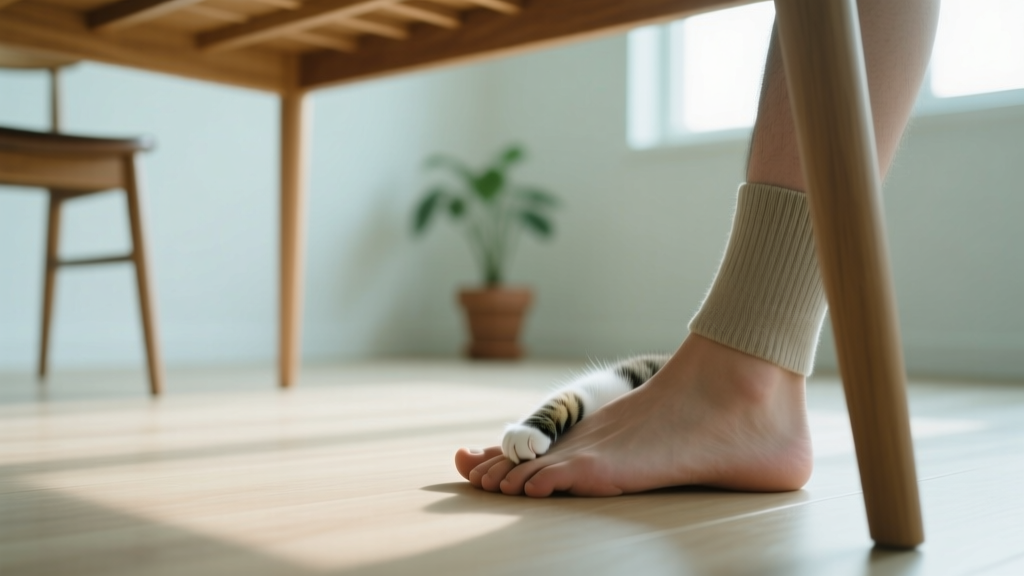
You’re eating dinner, working at your laptop, or chatting with a friend. Under the table, your cat appears like a quiet little submarine—no fanfare, no meow. Then you feel it: a gentle touch. One paw. Light pressure. Sometimes it stays there like a warm paperweight; other times it taps and retreats, as if your cat is testing the connection.
If you’ve ever frozen mid-bite thinking, Is my cat… holding my foot?—you’re not alone. This tiny gesture is one of the most charming (and oddly intimate) cat behaviors. It can mean a few different things depending on context, but it usually comes down to a mix of bonding, safety, and good old-fashioned feline strategy.
Why Cats Do This (A Scientific & Evolutionary Angle)
Cats are both predators and prey in evolutionary terms. That dual identity shaped their social behavior: they’re capable of close bonds, but they’re also cautious about positioning, escape routes, and what’s happening around them.
Under a table is a naturally appealing spot for a cat because it functions like a “micro-shelter.” In the wild, cats choose locations that offer cover overhead and good visibility at ground level—think low shrubs, rocky ledges, and tucked-away spaces. A dining table or desk creates that same “protected cave” feeling, with the added bonus of being near you, their favorite large mammal.
Touch is also a major part of feline communication. Cats rely heavily on scent and body contact to maintain social ties. A paw placed on your foot can serve as:
- A physical anchor (“You’re here. Good.”)
- A social signal (“We’re together.”)
- A security check (“You’re still safe and predictable.”)
- A gentle request (“Attention, please.”)
In multi-cat colonies, friendly cats engage in affiliative behaviors like rubbing, grooming, and sleeping near each other. While paw-resting isn’t as commonly discussed as head-bunting, it fits the same theme: low-key contact that reinforces connection without demanding a big interaction.
Different Contexts: What’s Happening When the Paw Appears?
The meaning often changes based on the scene. Here are common “under-the-table paw” scenarios cat owners recognize instantly.
1) The Quiet Dinner Paw
Your cat settles under the table while you eat and places a paw on your foot like a bookmark. This is usually calm, social proximity. Your cat wants to be included in the “family zone” without climbing into your plate situation.
What to watch for: relaxed body, slow blinks, tail loosely wrapped, ears neutral.
2) The “Don’t Move” Paw During Work
You’re at your desk. Your cat slides under, touches your foot, and holds it. Suddenly you feel mildly obligated to stay still forever. Many cats do this when they want your presence to remain consistent—especially if you’ve been getting up a lot.
Translation: “I’ve scheduled us for together-time. Please stop walking away.”
3) The Tap-Tap Paw
A few light taps, sometimes with claws sheathed, sometimes with a tiny pinch that makes you look down quickly. This can be attention-seeking or play solicitation, especially if the taps come with a swishing tail or a crouchy posture.
Tip: If your cat seems playful, redirect to a wand toy rather than wiggling your foot (more on that below).
4) The Paw During Visitors
Guests are over. Your cat hides under the table, then reaches out to touch your foot like a lifeline. This is often a comfort behavior—your cat is using you as a familiar “safe base.”
You might also notice: pupils slightly dilated, ears turning toward noises, body tucked.
5) The Paw During Stressful Noises
Vacuum. Thunder. Delivery person. Your cat appears under the table and plants a paw on you. This can be self-soothing. Many cats seek gentle contact when they’re uneasy, but still want to stay partly concealed.
6) The Post-Meal Paw
Some cats appear after eating, place a paw on your foot, and purr. This is often contentment: “That was excellent. I am pleased with our household management.”
What It Means About Your Cat’s Mood and Feelings
The paw itself is just one piece of a full-body message. Pair it with posture, tail, ears, and facial expression to decode the vibe.
- Affection & bonding: gentle pressure, relaxed body, maybe purring. Your cat likes you and feels safe close to you.
- Social claiming: paw + cheek rub afterward, or paw placed firmly as you shift position. This can be “You’re my person” energy, often fueled by scent marking.
- Attention-seeking: repeated taps, staring up at you, meowing, leading you somewhere afterward. Your cat wants interaction, food, or play.
- Reassurance-seeking: paw from a hidden spot, tense body, scanning environment. Your cat is asking for comfort without fully exposing themselves.
- Play/hunting practice: paw darts out to “catch” your foot movements. This is playful, but it can become a habit you’ll regret if it escalates into ambushing ankles.
One of the sweetest interpretations: for many cats, resting a paw is the feline equivalent of sitting close on the couch. Cats aren’t always big on prolonged full-body cuddles, so they compromise with “contact points.” A paw on your foot is a small, controlled dose of closeness.
Related Behaviors You Might Also Notice
If your cat is a foot-toucher, you may see other “connection-maintenance” habits too:
- Following you from room to room but not necessarily sitting on you
- Sleeping near your shoes (highly scented “you” objects)
- Leaning against your leg like a casual drive-by hug
- Gentle pawing at your face in the morning (less charming at 5 a.m.)
- Head-butting or cheek rubbing to leave facial pheromones
- “Guarding” you in the bathroom because apparently privacy is a myth
These behaviors often come from the same emotional place: social attachment and a desire to be near your predictable, comforting presence.
When It’s Normal vs. When It Might Be a Concern
Most of the time, a paw on your foot is perfectly normal—cute, even flattering. But behavior is always worth evaluating in context, especially if something changes suddenly.
Normal (and adorable) signs
- Your cat is relaxed and calm
- The behavior is occasional or part of a routine
- Your cat disengages easily when you move
- No aggression, no panic, no compulsive repetition
Potential concern signs
- Sudden clinginess: If your cat abruptly becomes far more touch-seeking or follows you constantly, consider a health check. Cats sometimes seek comfort when they don’t feel well.
- Stress indicators: hiding more than usual, flattened ears, wide pupils, decreased appetite, overgrooming, or litter box changes.
- Escalating ankle attacks: if pawing turns into stalking, pouncing, or biting feet, this can signal under-stimulation or misdirected play.
- Pain cues: if your cat seems reluctant to jump, limps, or reacts when touched, the “under table” behavior could be a way of staying close while avoiding movement.
If you’re seeing significant changes in behavior, appetite, mobility, or litter box habits, it’s always wise to consult a veterinarian. For behavior concerns (especially stress or aggression), a qualified cat behavior professional can help you pinpoint triggers and create a plan.
How to Respond (and Encourage the Good Version of This Behavior)
Your response can shape whether “paw on foot” stays sweet or morphs into a foot-hunting hobby.
1) Reward calm contact
If your cat gently rests a paw and stays relaxed, reinforce it. You can:
- Speak softly
- Offer a slow blink
- Give a gentle chin scratch (if your cat enjoys it)
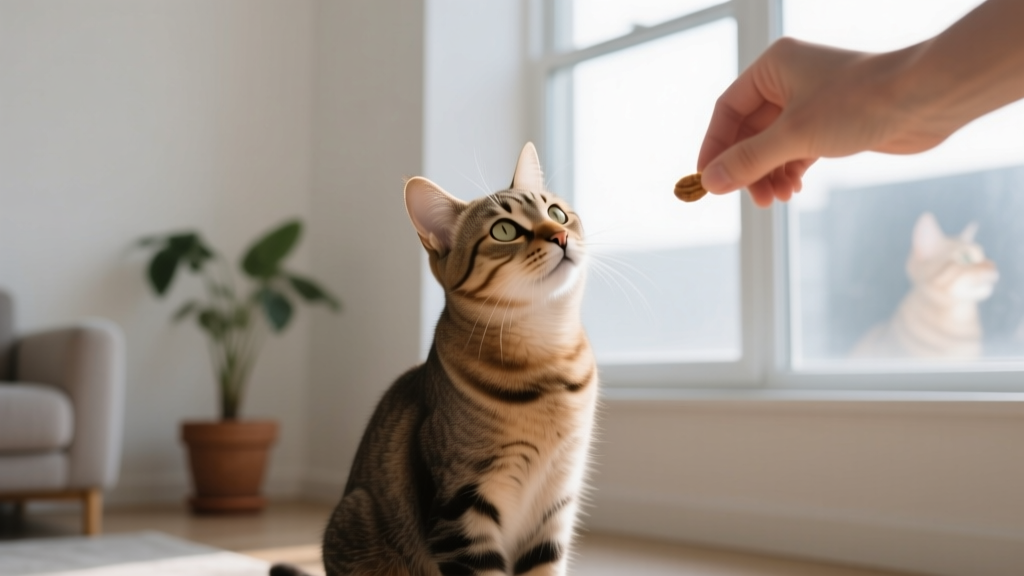
- Drop a treat after calm behavior (not mid-tap-tap demand)
2) Don’t turn your foot into prey
Wiggling toes might feel like bonding, but it teaches your cat that feet are toys. If your cat is already a bit “ankle ambushy,” keep feet still and redirect with an actual toy.
3) Provide better outlets for paw behavior
If the pawing is persistent or energetic, your cat may need more appropriate ways to use their paws:
- Daily interactive play (wand toys, feather teasers)
- Food puzzles or treat balls
- A scratcher near social areas
- Clicker training (yes, cats can love it)
4) If your cat is anxious, be the “safe base”
If the paw appears during visitors or loud noises, avoid forcing interaction. Let your cat choose closeness. You can also:
- Create hiding spots (covered beds, boxes, cat trees)
- Use predictable routines
- Consider feline pheromone diffusers in high-stress households
5) Respect the consent line
Some cats want contact without petting. If you reach down and your cat flinches, turns away, or flicks their tail, they may be saying, “Foot contact only, please.” Honoring that boundary builds trust.
Fun Facts & Research Nuggets
- Cats bond through proximity. Research on cat-human relationships suggests many cats show attachment by choosing to be near their person, not necessarily by cuddling like a dog might.
- Touch is a scent strategy, too. While paws aren’t the primary scent-marking tool like cheeks, contact helps mix group scent and maintain social familiarity in a shared space.
- Under-table behavior matches natural preferences. Cats commonly prefer areas with overhead cover and a clear view—tables, beds, and couches create “safe architecture.”
- Some cats prefer “one-point contact.” A paw, a tail draped across your ankle, or leaning on a leg can be a cat’s ideal balance of closeness and control.
FAQ: Cat Paw on My Foot Under the Table
Why does my cat touch my foot and then run away?
That’s often a playful “tag” or a quick attention ping. If your cat looks energized (tail swishing, crouching, darting), they may be inviting play. Redirect to a wand toy so your feet don’t become the main event.
Is my cat trying to claim me when they put their paw on my foot?
Sometimes, yes—in a friendly way. Cats can be socially possessive of their favorite people, especially in multi-pet homes. It’s more “you’re part of my group” than “you belong to me,” but it can look a bit proprietary.
My cat only does this when guests come over. What does that mean?
Likely reassurance-seeking. Your cat may feel unsure and uses you as a familiar anchor while staying under cover. Offer calm support and give your cat the choice to approach or stay hidden.
Should I pet my cat when they rest a paw on my foot?
If your cat seems relaxed and enjoys petting, sure. If they keep contact but tense up when you reach down, they might prefer closeness without hands. Try a slow blink or a gentle voice instead.
Why does my cat do this to me but not other people?
Cats form individual relationships. You may be the person who feeds them, plays with them most, keeps the calmest energy, or simply moves in ways that feel predictable. The paw-on-foot gesture can be a sign you’re their chosen “safe human.”
Can this be a sign my cat is anxious or unwell?
It can be, especially if it’s new or paired with other changes (hiding more, appetite shifts, litter box issues, irritability, reduced movement). If you notice a sudden behavior change, a vet check is a smart first step.
A Small Paw, A Big Message
A cat resting a paw on your foot under the table is one of those quiet, blink-and-you’ll-miss-it love languages. Sometimes it’s affection. Sometimes it’s “stay here with me.” Sometimes it’s a polite request for attention delivered with maximum subtlety (for a cat, anyway).
Next time you feel that gentle paw, take a second to look at the whole picture—tail, posture, context, mood. Respond in a way that reinforces calm connection, and you’ll deepen the trust behind that tiny touch.
Does your cat do the under-the-table paw? Tell us when it happens and what your cat does next—share your story with the Cat Lovers Base community on catloversbase.com.