Cat Paw Pushing the Interior Door: Room Entry
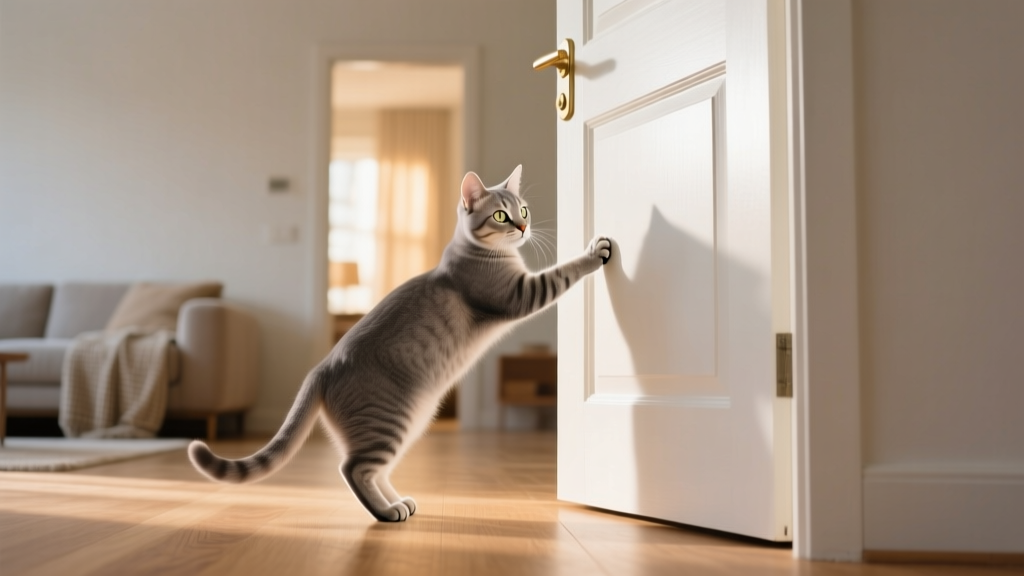
You’re in the bathroom. Or on a work call. Or finally, blissfully, under a blanket with a book. And then it happens: a soft thunk… scrape… thunk from the other side of the interior door. A paw appears underneath like a tiny, determined locksmith. The door wiggles in its frame. Your cat doesn’t meow at first—she just pushes, as if she’s politely (but firmly) reminding you that doors are a suggestion, not a rule.
If you’ve ever wondered why your cat paw-pushes doors to enter rooms—sometimes with surgical patience, other times with dramatic urgency—you’re watching a behavior that’s part problem-solving, part social attachment, part territory management, and part “excuse me, I live here.”
Why Cats Push Doors: The Science and the “Cat Logic”
Cats are both predators and prey in evolutionary terms, which shaped them into animals that prefer control over their environment. Control means knowing what’s happening, where it’s happening, and whether it affects them. A closed interior door disrupts that. It changes airflow and scents, blocks line of sight, and prevents access to information.
From a behavioral perspective, door-pushing is often driven by:
- Curiosity and information gathering: Cats are wired to investigate novelty. A door closing changes the “map” of the home.
- Territorial access: Your home is your cat’s territory too. Closed doors create “no-go zones,” which can feel unsettling.
- Social bonding and monitoring: Many cats keep tabs on their favorite humans. Separation can trigger mild frustration or a desire to reunite.
- Learning and reinforcement: If pawing the door has worked before (you opened it), the behavior is reinforced and will likely repeat.
There’s also a physics component: many interior doors latch lightly or sit in a frame that flexes. To a clever cat, that’s an interactive puzzle. Cats are excellent at testing boundaries with small, repeated actions. They don’t need brute force—just persistence.
Different Door-Pushing “Scenes” (and What’s Going On)
Not all door-pushing is the same. Context changes the meaning. Here are the most common scenarios cat owners recognize immediately.
1) “You’re in the bathroom and I must supervise”
This is legendary cat behavior. Bathrooms are scent-rich, echo-y, and full of interesting objects. But the bigger reason is often social: you went behind a barrier. Many cats interpret closed doors as a change in togetherness—especially if you’re their preferred person.
What it looks like: Quiet pawing, sitting close to the crack, occasional soft meows, or a patient paw sliding under the door like a little fishing expedition.
2) “You’re in the bedroom and I disagree with bedtime boundaries”
If you close the door at night, your cat may paw it as a protest or negotiation attempt. Cats form routines quickly. If your cat is used to sleeping with you or accessing the room, being excluded can feel like a rule change with no memo.
What it looks like: Pawing that escalates into raking, repeated thumps, or a cycle of paw-push, pause, paw-push—like a tiny drummer practicing restraint.
3) “The door moved and now it’s suspicious”
If a normally open door is suddenly closed (guest room, office, closet), your cat may push it simply because it’s different. Cats are sensitive to environmental change. A closed door can signal “something happened in there.”
What it looks like: Sniffing the seam, pawing at the bottom corner, moving away and returning to re-check.
4) “I heard something (and I’m on the case)”
Cats have excellent hearing. If there’s a sound—your voice on a call, a running shower, a crinkling bag—your cat might push the door to investigate or to rejoin the action.
What it looks like: Fast pawing, alert ears, body low and forward, sometimes accompanied by chirps.
5) “I want what’s on the other side (food, play, a warm spot)”
Sometimes it’s delightfully simple: the thing they want is behind the door. A cat who knows the treat jar lives in the office will absolutely attempt entry when snack thoughts arise.
What it looks like: Direct approach, immediate pawing, glancing up at the handle, then back at you like, “So. Are you opening it or am I?”
What Door-Pushing Says About Your Cat’s Mood
Think of door-pushing as a message with volume knobs: speed, intensity, and sound. Here’s a quick translation guide.
- Slow, gentle pawing: Curious, calm, mildly persistent. “I’d like access, please.”
- Paw under the door + quiet waiting: Social interest and proximity-seeking. “I want to be near you.”
- Rapid pawing + scratching + vocalizing: Frustration, impatience, or strong motivation (attention, food, routine disruption).
- Pawing followed by zooming away: Arousal and play energy. The door is part of a game.
- Pawing with tense posture (tail flicks, ears sideways): Stress or agitation—especially if the cat is shut away from resources or startled by something.
Also pay attention to what happens when you open the door. Does your cat stroll in and settle? Does she race to a resource (litter box, food)? Does she rub against you? The “next move” often tells you more than the pawing itself.
Related Behaviors You Might Notice
If your cat is a door-pusher, you may see a whole suite of “access and control” behaviors:
- Cabinet opening: Many cats learn that paws are multifunction tools.
- Handle fascination: Some cats watch humans use handles and try to replicate the motion.
- Carpet scratching by the door: Often frustration or an attempt to create noise that works.
- Doorframe cheek-rubbing: Scent marking near “territory borders.”
- Patrolling and checking rooms: Especially at dusk and dawn when cats are naturally more active.
Normal vs. Concerning: When to Pay Closer Attention
Most door-pushing is normal, even endearing. But it can hint at unmet needs or stress when it becomes intense, sudden, or paired with other changes.
Usually normal
- Door-pushing at predictable times (morning, bedtime) that stops once the cat gains access.
- Occasional curiosity about newly closed rooms.
- Playful pawing that doesn’t escalate into damage or distress.
Potential concern
- Sudden increase in door-pawing along with hiding, aggression, or appetite changes (possible stress or fear trigger).
- Desperate pawing to reach the litter box, food, water, or a safe resting place (resource access problem).
- Nighttime escalation with yowling, restlessness, and pacing—especially in older cats (possible cognitive changes, pain, hyperthyroidism, or other medical issues).
- Compulsive pattern (repetitive, hard to interrupt, continuing even after the door opens) which may signal anxiety.
If you suspect discomfort or medical changes—especially in senior cats—check in with your veterinarian. Behavior is often a health signal in disguise.
How to Respond (Without Accidentally Training a Door Menace)
You have two goals: meet your cat’s needs and avoid reinforcing nuisance behavior.
1) Offer “yes spaces” and predictable access
If the door blocks a resource, adjust the setup. Keep litter boxes, food, and water accessible without barriers. For cats who hate closed doors, consider leaving certain interior doors open whenever possible or using a doorstop to prevent full closure.
2) Teach an alternative behavior
If your cat paws at your office door during meetings, teach a replacement routine:
- Place a cozy bed or perch outside (or inside) the room.
- Reward calm waiting or sitting quietly with treats delivered before pawing escalates.
- Use a puzzle feeder or lickable treat to create a positive “meeting time” ritual.
3) Don’t reward the exact behavior you want to reduce
If you always open the door immediately after loud pawing, your cat learns: “Noise works.” Instead, wait for a brief pause—one second of quiet—then open the door. You’re not ignoring your cat; you’re reinforcing calm communication.
4) Add enrichment to reduce frustration
Cats who door-push intensely often need more stimulation. Daily play sessions (even 5–10 minutes, twice a day) can lower the urge to create their own entertainment. Think: wand toy hunts, chasing, stalking, then a small snack to complete the “hunt-eat-groom-sleep” cycle.
5) Make doors less “fun” if needed
If the pawing is damaging carpet or keeping you up, consider practical adjustments:
- Use a draft stopper to block the under-door “paw gap.”
- Add a clear floor protector mat near the doorway.
- Use white noise to reduce the reward of hearing you react.
- Check door latches—some doors wiggle easily and become irresistible.
Fun Facts and Research-Adjacent Nuggets
- Cats are skilled observational learners: Many cats learn door mechanics by watching humans. If your cat stares at the handle and then paws the door seam, she’s likely attempting a “close enough” version of what you do.
- Persistence is part of feline problem-solving: Cats often use repeated, low-effort actions to test whether something changes. Door-pushing is a perfect example of “small experiment, big payoff.”
- Closed doors disrupt scent flow: Cats rely heavily on scent information. Blocking airflow can make a room feel like an unknown zone—especially if you spend time there and your scent is strong.
- Some cats prefer visual access: Even if they don’t want to enter, they may want the option. That’s why a cat might push the door, peek in, and then walk away like nothing happened.
FAQ: Cat Pawing at Interior Doors
Why does my cat only paw the door when I’m inside?
Because you’re the main event. Many cats are socially attached and want proximity or at least information. Your presence behind a barrier can trigger “reunite and monitor” behavior, especially if your cat is bonded to you.
Is my cat anxious if she paws at doors?
Not automatically. Mild door-pushing is usually normal curiosity or routine-seeking. It may be anxiety-related if it’s intense, persistent, paired with vocal distress, or happens alongside other stress signs (hiding, overgrooming, appetite changes).
How do I stop door scratching at night?
First, make sure all resources are accessible (litter box, water) and your cat isn’t shut away from necessities. Then build a bedtime routine: active play 30–60 minutes before sleep, a small meal, and a comfortable sleep spot. If you open the door, do it during quiet moments—not during scratching—so you reward calm, not chaos.
Why does my cat stick her paw under the door?
It’s a combination of exploration and contact-seeking. The gap under the door is a sensory portal—your cat can reach, feel air currents, and sometimes touch you. It’s also a clever way to test whether the door will move.
Could my cat be doing this because she’s bored?
Absolutely. Smart, high-energy cats often invent “jobs,” and door management becomes one of them. If door-pawing spikes when you’re busy or the household is quiet, add enrichment: climbing options, window perches, foraging toys, and short interactive play sessions.
Should I just leave all doors open?
If it’s safe and practical, leaving some doors open can reduce conflict. But it’s also reasonable to keep boundaries. The key is consistency and meeting needs—cats handle “some doors are always closed” better than “today it’s open, tomorrow it’s not,” especially if that room contains favorite resources or your cat’s preferred person.
Door-pushing is one of those classic cat behaviors that’s equal parts cute, clever, and occasionally inconvenient. When you view it as communication—“I want access,” “I want you,” “I want to check my territory”—you can respond in ways that support your cat’s security without turning your home into a 24/7 doorman service.
Does your cat paw-push doors gently like a polite guest, or attack them like a tiny battering ram? Share your best “door drama” stories (and what finally worked) with the Cat Lovers Base community at catloversbase.com.