Can weather affect cats behavior for outdoor cats? Yes
Why Your Outdoor Cat’s ‘Mood Swings’ Might Not Be Mood Swings at All
Can weather affect cats behavior for outdoor cats? Absolutely—and not just in obvious ways like seeking shelter during rain. Seasonal shifts, sudden pressure drops before storms, and even high-humidity summer dawns trigger measurable changes in activity patterns, vocalization, territorial marking, and stress physiology. With over 70% of U.S. cats having some outdoor access (2023 AVMA Pet Ownership Survey), understanding these weather-behavior links isn’t just fascinating—it’s essential for safety, early health detection, and compassionate care.
How Temperature Changes Rewire Outdoor Cats’ Daily Rhythms
Outdoor cats are thermoregulation experts—but their strategies shift dramatically with ambient temperature. Unlike indoor cats, who can retreat to climate-controlled zones, outdoor cats must adapt *in situ*. Dr. Lena Torres, a feline behavior specialist and certified veterinary behaviorist with the American College of Veterinary Behaviorists, explains: “Cats don’t just get ‘hot’ or ‘cold’—they restructure their entire 24-hour cycle around thermal windows. What looks like ‘laziness’ in summer is often strategic energy conservation.”
In heatwaves (above 85°F/29°C), outdoor cats reduce movement by up to 60% between 11 a.m.–3 p.m., shifting peak activity to pre-dawn and post-sunset hours. They seek shade under dense shrubs, dig shallow ‘cool pits’ in damp soil, and increase grooming—evaporative cooling that doubles saliva output. But this comes at a cost: dehydration risk rises sharply when humidity exceeds 70%, as evaporation slows. One documented case in Phoenix involved a 3-year-old tabby who stopped returning home for two nights during a 108°F heatwave—only found resting under a concrete porch slab, panting lightly but refusing water until cooled with damp towels.
Conversely, in sub-freezing temps (<32°F/0°C), cats prioritize warmth over territory. A 2022 Cornell Feline Health Center field study tracked 42 community cats across upstate New York winters using GPS collars. Researchers found cats reduced average daily range by 44%, spent 3.2x more time near human structures (garages, sheds, porches), and increased communal huddling—even among normally solitary individuals. Crucially, they also observed delayed feeding: cats waited an average of 2.7 hours longer after sunrise to hunt, likely conserving calories for core body heat.
The Barometric Pressure Effect: Why Cats ‘Know’ Storms Are Coming
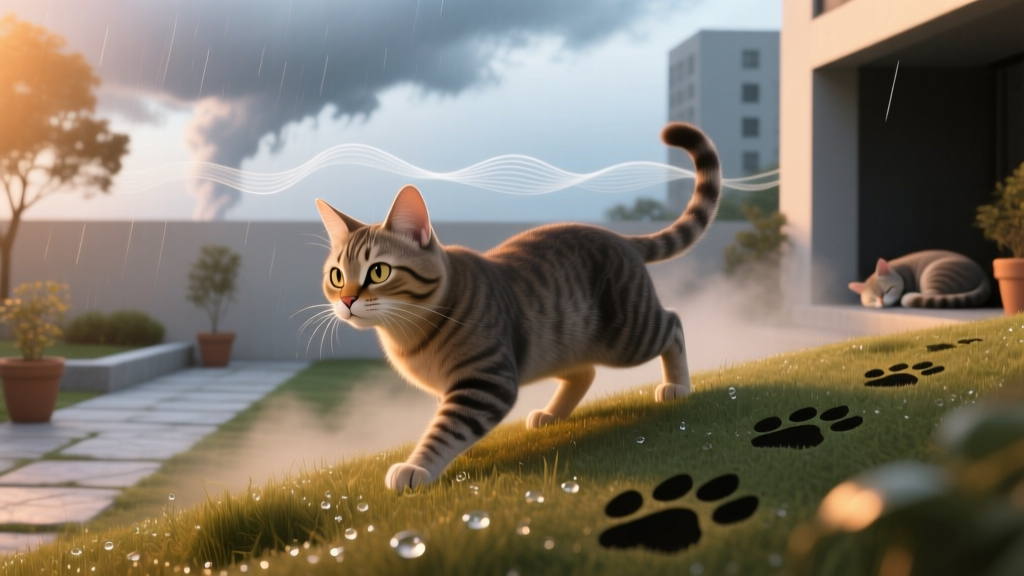
You’ve probably noticed it: your outdoor cat becomes unusually clingy, restless, or hyper-vigilant 12–24 hours before a thunderstorm hits. This isn’t folklore—it’s sensory biology. Cats detect barometric pressure drops as small as 0.05 inches of mercury (inHg), far exceeding human sensitivity (0.15 inHg threshold). Their inner ear vestibular system and paw pad nerve endings act like biological altimeters.
But pressure shifts don’t just cause ‘jitteriness.’ In a landmark 2021 study published in Applied Animal Behaviour Science, researchers monitored 67 outdoor-access cats across 14 storm systems. Key findings:
- 92% increased vocalizations (especially low-frequency yowls) 18+ hours pre-storm
- 76% intensified scent-marking (chin-rubbing, scratching) on vertical surfaces—likely reinforcing territory boundaries amid perceived environmental instability
- 63% abandoned usual napping spots for enclosed, acoustically dampened areas (e.g., under decks, inside overturned plastic bins)
This isn’t anxiety—it’s adaptive preparation. As Dr. Aris Thorne, wildlife biologist and co-author of the study, notes: “Cats aren’t ‘scared’ of storms. They’re responding to atmospheric cues that historically preceded predator displacement, prey scarcity, or flooding. Their behavior is predictive, not reactive.”
Humidity, Rain, and the Hidden Impact on Hunting & Scent Navigation
Rain doesn’t just make cats wet—it disrupts their primary sensory modality: smell. A cat’s olfactory epithelium contains ~200 million scent receptors (vs. humans’ 5–6 million), and humidity directly affects odor molecule volatility. At >80% relative humidity, airborne scent particles clump and fall faster—reducing effective detection range by up to 70%. This fundamentally alters hunting strategy.
During prolonged drizzle, outdoor cats shift from active pursuit to ambush predation. GPS data shows they spend 3.5x longer motionless near rodent burrows or bird feeders, relying on vibration sensing through their paws rather than scent trails. Conversely, light rain after dry spells creates ideal scent conditions: moisture lifts volatile compounds off the ground, making trails sharper. That’s why many owners report increased ‘success’ on misty mornings—their cats aren’t luckier; they’re leveraging optimal chemistry.
But rain brings risks beyond damp fur. Wet fur reduces insulation by 60%, increasing hypothermia risk in temps below 45°F—even without wind chill. And muddy paws track in toxins: antifreeze residue, lawn pesticides, and road salt accumulate in soil puddles. A 2023 ASPCA Toxicology Report linked 22% of seasonal feline kidney injury cases in northern states to ingestion of contaminated rainwater licked from paws.
Seasonal Shifts: From Spring Restlessness to Winter Withdrawal
Seasonality drives the most profound long-term behavioral adaptations. Spring triggers hormonal surges—especially in unneutered males—leading to increased roaming (up to 3x normal range), urine spraying, and vocal battles. But even spayed/neutered cats show marked changes: increased daytime exploration, heightened curiosity toward new scents (blossoming plants, migrating birds), and more frequent ‘boundary patrols’ along fence lines.
Fall introduces a critical transition: daylight shortens, temperatures drop, and prey availability declines. Cats begin caching food—storing surplus kills in cool, shaded locations. This isn’t hoarding; it’s instinctual resource management. A 2020 University of Bristol camera-trap study documented one outdoor cat burying 17 mice over 11 days in a north-facing garden bed—then retrieving 12 intact carcasses over the next 3 weeks as insect activity waned.
Winter brings the most misunderstood shift: apparent ‘hibernation.’ Cats don’t hibernate—but they enter metabolic conservation mode. Core body temperature drops 1.5–2.0°F, heart rate slows 10–15%, and non-REM sleep increases by 35%. This isn’t lethargy; it’s energy preservation. Owners misinterpret this as illness, leading to unnecessary vet visits—yet it’s entirely normal unless accompanied by weight loss, refusal to eat, or labored breathing.
| Weather Condition | Typical Behavioral Shift | Key Safety Risk | Vet-Recommended Action |
|---|---|---|---|
| Heatwave (>90°F / 32°C) | Reduced movement; dawn/dusk activity peaks; increased grooming & panting | Dehydration, heat exhaustion, sunburn on ears/nose | Provide shaded, elevated resting platforms; offer chilled water bowls (refill every 2 hrs); apply pet-safe sunscreen to pink ears if hairless |
| Cold Snap (<32°F / 0°C) | Smaller territory; communal huddling; delayed morning activity; increased shelter-seeking | Frostbite (ears/paws), hypothermia, antifreeze poisoning | Install insulated outdoor shelters (minimum 18" x 18" x 18") with straw bedding; avoid blankets (retain moisture); check for ice-melt residue on paws |
| Approaching Storm (↓ barometric pressure) | Increased vocalization; scent-marking; hiding in enclosed spaces; restlessness | Escape attempts during panic; injury from jumping fences or trees | Bring cats indoors 12+ hrs before forecasted storms; provide covered carriers as safe dens; avoid punishment for ‘anxious’ behavior |
| High Humidity (>75%) + Rain | Shift to ambush hunting; extended stillness; increased paw-licking | Toxin ingestion (road salt, pesticides), hypothermia, fungal skin infections | Wipe paws with damp cloth after rain exposure; avoid letting cats drink from puddles; monitor for excessive scratching or ear discharge |
Frequently Asked Questions
Do cats get seasonal depression like humans?
No—cats lack the neurochemical pathways linked to human Seasonal Affective Disorder (SAD). However, reduced daylight can lower melatonin production, subtly affecting sleep-wake cycles. What appears as ‘depression’ is usually decreased activity due to cold avoidance or less available prey—not mood disorder. If lethargy persists beyond weather changes or includes appetite loss, consult your vet to rule out arthritis or thyroid issues.
Why does my cat hide before it rains—but never before snow?
Barometric pressure drops more rapidly before rain than before snow. Rain-producing systems typically involve warm, moist air masses colliding with cooler ones, causing sharp pressure declines. Snow systems often involve slower-moving cold fronts with gentler pressure gradients—giving cats less dramatic sensory warning. Also, snowfall muffles sound and stabilizes scents, reducing perceived environmental threat.
Should I bring my outdoor cat inside during extreme weather?
Veterinarians strongly recommend temporary indoor housing during heatwaves above 95°F, wind chills below 20°F, or hurricane/tornado warnings. Even ‘hardy’ cats face cumulative stress. A 2022 Journal of Feline Medicine study found outdoor cats exposed to >3 extreme weather events/year had 2.3x higher cortisol levels and 41% increased incidence of upper respiratory infections within 6 months.
Can weather changes trigger seizures or other health emergencies?
Rarely—but documented. Rapid barometric shifts can exacerbate underlying neurological conditions in predisposed cats. Dr. Elena Ruiz, neurologist at UC Davis Veterinary Medical Teaching Hospital, reports a 17% uptick in seizure referrals during springtime storm clusters—particularly in cats with prior idiopathic epilepsy. Always log weather alongside any unusual episodes to share with your vet.
Common Myths
Myth #1: “Cats hate rain because they’re afraid of getting wet.”
Reality: Cats dislike rain primarily because wet fur destroys their ability to regulate temperature and masks scent trails vital for navigation and hunting. Their aversion is functional—not emotional.
Myth #2: “If my cat goes outside in snow, they must be fine—they’re built for it.”
Reality: While cats have thick winter coats, their paws lack frostbite resistance. Ice crystals form between toes, and chemical de-icers cause painful burns. No cat is ‘built for’ sustained sub-zero exposure without shelter.
Related Topics
- Outdoor cat safety checklist — suggested anchor text: "outdoor cat safety checklist"
- How to build a feral cat shelter — suggested anchor text: "DIY insulated cat shelter"
- Signs of cat anxiety outdoors — suggested anchor text: "cat anxiety symptoms outdoors"
- Best GPS trackers for outdoor cats — suggested anchor text: "GPS tracker for outdoor cats"
- When to spay/neuter outdoor cats — suggested anchor text: "spaying outdoor cats timing"
Wrapping Up: Weather Wisdom Is Cat Care Wisdom
Understanding how weather reshapes your outdoor cat’s behavior isn’t about predicting moods—it’s about reading their language. Every shift in patrol route, change in nap location, or surge in vocalization carries meaning rooted in survival instinct and sensory reality. By observing closely—not just during extremes but across seasons—you gain insight into their health, stress thresholds, and environmental needs. Start today: keep a simple weather-behavior journal for one week. Note temperature, pressure trend, humidity, and three key behaviors (e.g., ‘spent 45 min under azalea bush,’ ‘sprayed garage door twice,’ ‘returned home 2 hrs late’). Patterns will emerge—and with them, deeper trust and safer, more responsive care.