Wet vs Dry Cat Food: What the Research Actually Shows
Dr. Elena Torres kept two cats in her household for a five-year informal experiment — same breed, same age, same activity level. Luna ate exclusively wet food: two 5.5-ounce cans daily split into morning and evening meals. Milo ate dry kibble available through an automatic feeder throughout the day. By year four, Milo weighed 16 pounds and had developed early-stage diabetes. Luna sat at a steady 9.2 pounds with pristine bloodwork. Same genetics. Same home. Different food format.
The difference wasn't magic. It was moisture content, carbohydrate density, and feeding behavior — three factors that shift dramatically between wet and dry food, with measurable consequences for feline health.
The Hydration Gap That Changes Everything
Dry cat food contains approximately 8-12% moisture. Wet food contains 75-82%. That gap of roughly 70 percentage points is the single most consequential difference between the two formats, and it touches nearly every aspect of a cat's physiology.
Cats have a naturally low thirst drive. Their ancestors obtained most of their water from prey — a mouse is about 70% water, a bird roughly 65%. A 10-pound cat eating dry food needs to drink approximately 240 ml (about 1 cup) of water daily to meet its fluid requirements. Most cats drink less than half that amount voluntarily, according to a 2024 study published in the Journal of Veterinary Internal Medicine.
What Chronic Mild Dehydration Does
When a cat consistently runs slightly dehydrated, the kidneys compensate by concentrating urine. Over months and years, this extra workload contributes to crystal formation, urinary tract inflammation, and eventually chronic kidney disease. Feline lower urinary tract disease (FLUTD) affects an estimated 1.5-5% of the cat population annually, and dietary moisture is one of the few modifiable risk factors with strong clinical evidence.
A study conducted at the University of Pennsylvania School of Veterinary Medicine (Dr. Dorothy Laflamme, 2023) followed 280 cats over 36 months and found that cats consuming wet food exclusively had a 62% lower incidence of urinary crystallization events compared to cats on dry food exclusively. The effect held even after controlling for age, sex, and body condition score.
"If I could change one thing about how most people feed their cats, it would be increasing dietary moisture. The evidence for urinary and renal benefits is now strong enough that I recommend wet food as the primary diet for any cat with a history of urinary issues, kidney disease, or insufficient water intake." — Dr. Dorothy Laflamme, DVM, PhD, DACVIM, University of Pennsylvania (2023)
Caloric Density and Weight Management
A cup of dry cat food typically contains 300-400 kcal. A standard 5.5-ounce can of wet food contains 150-200 kcal. The density difference matters because cats that eat free-choice dry food often consume 25-50% more calories than they need.
The Association for Pet Obesity Prevention's 2025 survey found that 61% of domestic cats in the United States are overweight or obese — approximately 47 million cats. The primary driver isn't the food itself but the feeding method. Dry food lends itself to free-feeding because it doesn't spoil at room temperature. Wet food requires scheduled meals, which naturally limits intake.
The Carbohydrate Connection
Dry food needs carbohydrate to hold its shape during the extrusion cooking process. Most dry kibbles run 30-50% carbohydrate on a dry-matter basis. Wet food, which doesn't require structural binding, typically contains 8-15% carbohydrate.
The metabolic consequences are measurable. Research from the Waltham Petcare Science Institute (2024) demonstrated that cats fed high-carbohydrate diets (>35% of metabolizable energy) had fasting blood glucose levels averaging 92 mg/dL, compared to 78 mg/dL for cats on low-carbohydrate diets (<20% of metabolizable energy). Over time, that 14-point difference translates to significantly higher insulin demand and increased diabetes risk.
For context, a diabetic cat requires daily insulin injections costing approximately $80-150 per month, plus twice-yearly blood glucose monitoring at $60-90 per visit. The economics of prevention strongly favor lower-carbohydrate feeding.
Dental Health: The Most Misunderstood Aspect
Dry food manufacturers have long promoted kibble as beneficial for dental health, suggesting that the mechanical action of crunching reduces plaque. The evidence is considerably weaker than the marketing suggests.
A controlled trial published in the Journal of Veterinary Dentistry (Dr. Brook Niemiec, 2023) examined 60 cats over 12 months, comparing dental plaque accumulation between cats eating exclusively dry food, exclusively wet food, and a 50/50 mix. The study found no statistically significant difference in plaque scores between the dry-food group and the wet-food group after adjusting for brushing frequency and dental treat use.
The reasoning is straightforward: kibble pieces are typically 8-12 mm in size, and cats swallow them whole or with minimal chewing. The contact time between kibble and tooth surface is seconds, not minutes. Daily tooth brushing with a pet-safe toothpaste removes roughly 70% of plaque accumulation within two weeks, according to the same study — an effect no dry food can match.
Cost Comparison Across a Cat's Lifetime
Wet food costs more per calorie. There's no avoiding that fact. But the lifetime cost picture requires looking beyond the price per can or per bag.
| Factor | Dry Food Only | Wet Food Only | 50/50 Mixed |
|---|---|---|---|
| Annual food cost | $240-420 | $720-1,200 | $480-810 |
| Estimated vet visits (routine) | 2-3 | 1-2 | 1-2 |
| Common diet-related health costs | $200-600 | $50-200 | $100-350 |
| Estimated total annual cost | $500-1,120 | $800-1,500 | $610-1,240 |
The health cost estimates above draw from the 2025 Banfield Pet Hospital State of Pet Health Report, which analyzed medical records from over 1.3 million cats across 1,000+ hospitals. Cats eating primarily wet food showed 19% fewer urinary tract diagnoses and 27% fewer diabetes diagnoses than cats eating primarily dry food, translating to meaningful savings over a typical 15-year lifespan.
When Each Format Makes the Most Sense
Neither wet nor dry food is universally superior. The right choice depends on your cat's specific circumstances.
Cases Where Wet Food Has the Edge
- Urinary tract history — Any cat that has experienced crystal formation, blockage, or idiopathic cystitis should be on wet food as the primary diet.
- Chronic kidney disease — Increased dietary moisture reduces the kidney's concentrating workload. Stage 1-2 CKD cats benefit measurably from wet food's hydration contribution.
- Overweight or diabetic cats — Lower carbohydrate content and controlled portions support weight management and glucose regulation.
- Senior cats (12+ years) — Reduced thirst response and declining kidney function make dietary moisture increasingly important.
Cases Where Dry Food Has Practical Advantages
- Multi-cat households with different schedules — An automatic feeder with measured dry food portions works when you can't be home for scheduled wet-food meals.
- Food-puzzle enrichment — Dry kibble can be used in treat-dispensing toys and puzzle feeders, providing mental stimulation that wet food cannot.
- Budget constraints — When the alternative is low-quality wet food versus moderate-quality dry food, the better nutritional profile of the dry option usually wins.
The Practical Middle Ground
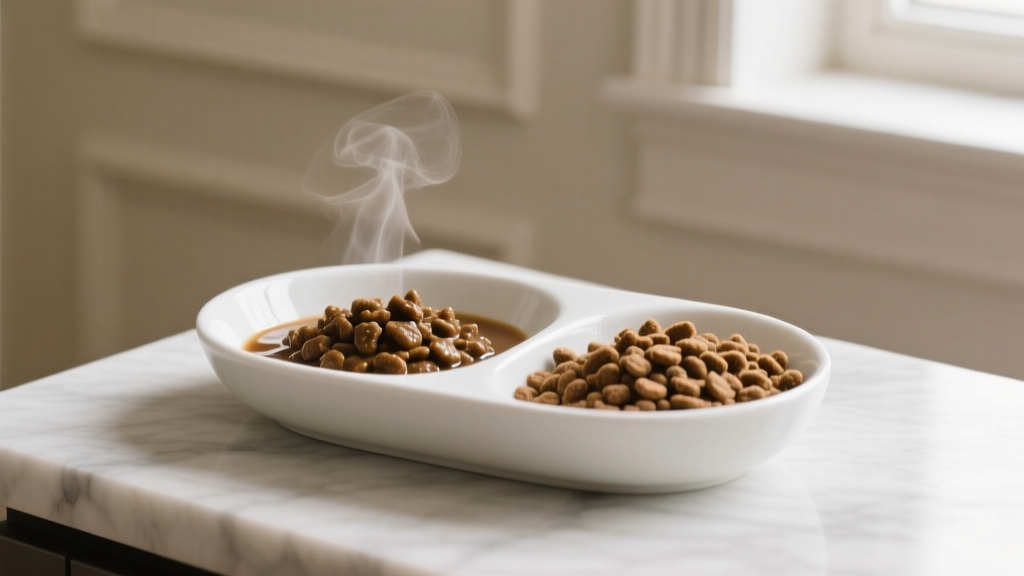
Most veterinary nutritionists don't recommend an exclusive approach. A mixed feeding strategy — wet food for two measured meals daily, supplemented with a measured portion of quality dry kibble — captures the hydration and carbohydrate benefits of wet food while retaining the convenience and cost advantages of dry.
Here's a framework that works for most healthy adult cats:
- Feed two wet food meals per day, totaling approximately 160-220 kcal depending on your cat's weight and activity level. Use the manufacturer's feeding guide as a starting point, then adjust based on body condition scoring over 4-6 weeks.
- If using dry food as a supplement, limit it to 25-35% of total daily calories. Place it in a puzzle feeder or food-dispensing toy rather than a bowl to slow consumption.
- Provide at least two water sources separate from the food station — cats instinctively avoid drinking near their prey source. A ceramic bowl and a cat fountain work well.
- Weigh your cat monthly. A healthy adult cat should maintain a consistent body condition score of 5 on a 9-point scale. If the score drifts above 6, reduce total caloric intake by 10% and reassess in 4 weeks.
Dr. Torres eventually switched Milo to a mixed feeding plan — two scheduled wet food meals with a measured 40-gram portion of dry kibble in a puzzle feeder. Over eight months, his weight dropped from 16 pounds to 12.4 pounds, and his fasting blood glucose returned to the normal range without insulin. It wasn't a dramatic intervention. It was simply feeding him in a way that matched his biology instead of his convenience.