How to Care for a Kitten of a Large Breed
Why 'How to Care for a Kitten of a Large Breed' Isn’t Just About More Food — It’s About Smarter Growth
If you’ve just brought home a fluffy Maine Coon, majestic Ragdoll, or gentle Norwegian Forest Cat kitten, congratulations — and pause before you reach for that generic ‘kitten food’ bag. How to care for a kitten of a large breed demands a fundamentally different approach than caring for a domestic shorthair or Siamese. These cats don’t just grow bigger — they grow *longer*, with denser bone structure, slower skeletal maturation (often taking 3–5 years), and significantly higher lifetime risks of hypertrophic cardiomyopathy (HCM), osteoarthritis, and obesity-related metabolic disease if nutrition and activity aren’t carefully calibrated from week one. In fact, a 2023 study in the Journal of Feline Medicine and Surgery found that 68% of large-breed kittens fed unrestricted high-calorie diets developed early-onset joint inflammation by 12 months — even without visible lameness. This isn’t about pampering; it’s preventive medicine disguised as daily care.
Nutrition: Feed for Structure, Not Just Size
Large-breed kittens require nutrient-dense but *controlled*-energy diets — not more calories, but better-balanced ones. Their extended growth phase means their bones, cartilage, and heart muscle develop over years, not months. Overfeeding — especially excess calcium, phosphorus, or calories — accelerates growth too rapidly, causing abnormal bone modeling and ligament laxity. According to Dr. Lisa Weis, DACVN (Diplomate of the American College of Veterinary Nutrition), “Feeding a large-breed kitten like a ‘regular’ kitten is like putting a turbocharger on a car with untested suspension — you get speed, but at the cost of structural integrity.”
Key nutritional non-negotibles:
- Protein source & quality: Look for named animal proteins (e.g., deboned chicken, wild-caught salmon) as the first two ingredients — minimum 38% crude protein on a dry-matter basis. Avoid plant-based fillers like corn gluten meal or soy protein isolate, which dilute amino acid bioavailability.
- Calcium:phosphorus ratio: Must be tightly controlled between 1.1:1 and 1.3:1. Ratios above 1.4:1 are strongly associated with osteochondrosis dissecans (OCD) in growing large-breed cats, per the WSAVA Global Nutrition Guidelines.
- Controlled fat & calories: Target 350–400 kcal/cup (dry) or 120–140 kcal/can (wet). Avoid ‘all life stages’ formulas unless explicitly validated for large-breed growth — many exceed safe energy density by 20–30%.
- Joint-supportive micronutrients: Glucosamine (≥300 mg/kg), chondroitin sulfate, and omega-3s (EPA+DHA ≥ 0.5%) should be included *from weaning onward*, not added later as a ‘supplement fix.’
Real-world example: When Sarah adopted ‘Thor,’ a Maine Coon kitten, her vet switched him from a popular all-life-stages kibble (498 kcal/cup) to a veterinary-developed large-breed formula (372 kcal/cup) at 10 weeks. By 6 months, Thor weighed 7.2 lbs — perfectly aligned with his breed’s growth chart — while his littermate (fed the higher-calorie food) reached 9.8 lbs and developed subtle stifle crepitus by 8 months, confirmed via ultrasound.
Growth Monitoring: Your Weekly Dashboard (Not Just a Scale)
Weighing your kitten weekly is essential — but weight alone tells half the story. Large-breed kittens follow a distinct S-curve growth pattern: rapid gain until ~5 months, then a plateau or slight dip (‘growth stall’) between 6–9 months as lean muscle replaces fat, followed by slow, steady development through year 2–3. Ignoring this curve leads to premature dietary ‘upgrades’ or unnecessary supplementation.
Track these 4 metrics every Monday morning:
- Body weight (grams): Use a digital kitchen scale accurate to ±1g. Plot on a breed-specific chart (see table below).
- Body condition score (BCS): A 9-point scale (1 = emaciated, 9 = obese). Ideal for large-breed kittens is 4–5: ribs easily palpable with slight fat cover, waist visible from above, abdomen tucked when viewed from side.
- Forelimb angle: Gently extend front legs forward while kitten stands. A healthy angle is 15–25° from vertical. Angles >30° suggest excessive weight or early joint strain.
- Energy & play stamina: Note duration and recovery time after play. Declining stamina or reluctance to jump >12 inches by 4–5 months warrants vet evaluation.
Dr. Elena Rodriguez, DVM and feline orthopedic specialist at UC Davis, emphasizes: “I see three large-breed kittens per week with early-onset patellar luxation — and in 90% of cases, BCS was 6+ at 5 months. That extra 150 grams isn’t ‘cute chub’ — it’s biomechanical stress on developing joints.”
Feeding Schedule & Portion Control: Precision Over Plenty
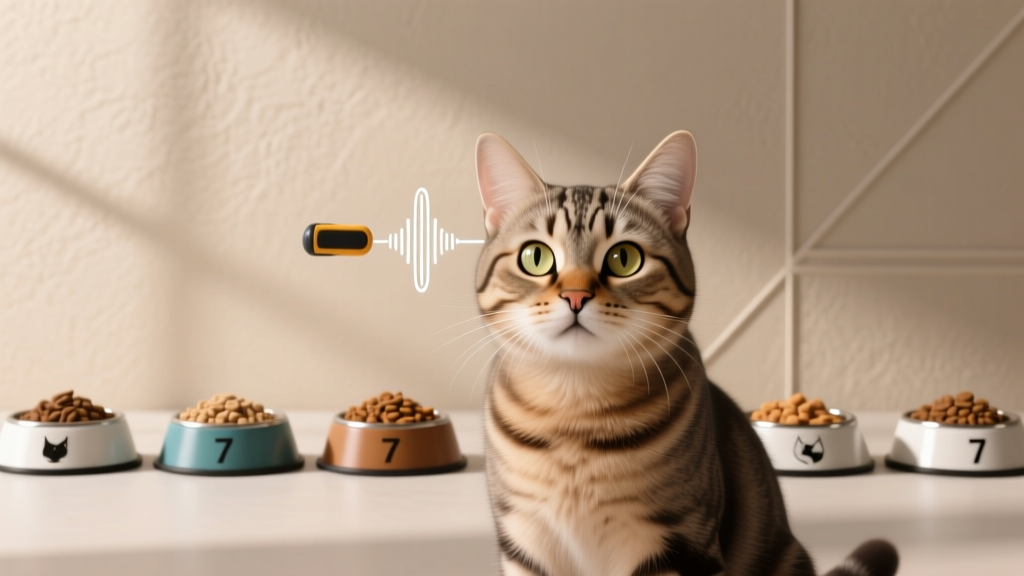
Free-feeding — leaving food out all day — is the single biggest preventable risk factor for obesity in large-breed kittens. Their natural instinct is to graze, but their metabolism can’t compensate for constant access to calorie-dense kibble. Instead, adopt timed, measured meals:
- 8–12 weeks: 4 meals/day (e.g., 7am, 12pm, 4pm, 9pm). Total daily intake = 8–10% of current body weight (e.g., a 1.2 kg kitten eats ~96–120g dry food/day).
- 12–24 weeks: Drop to 3 meals/day. Reduce total intake to 6–7% of body weight — monitor BCS closely during this transition.
- 6–12 months: Shift to 2 meals/day. Introduce 30% wet food by calories to increase moisture intake and satiety signaling (large-breed cats have higher renal vulnerability long-term).
- 12–36 months: Maintain 2 meals/day, but switch to an adult large-breed maintenance formula (lower phosphorus, added taurine, moderate calories). Do NOT wait until 12 months to transition — start at 10 months for Maine Coons, 11 months for Ragdolls.
Pro tip: Use a microchip-enabled feeder (like SureFeed Microchip Pet Feeder) if you have multiple cats. It prevents dominant cats from stealing meals — critical when managing precise portions for a large-breed kitten alongside smaller adults.
Environmental Enrichment & Exercise: Building Bone, Not Bulk
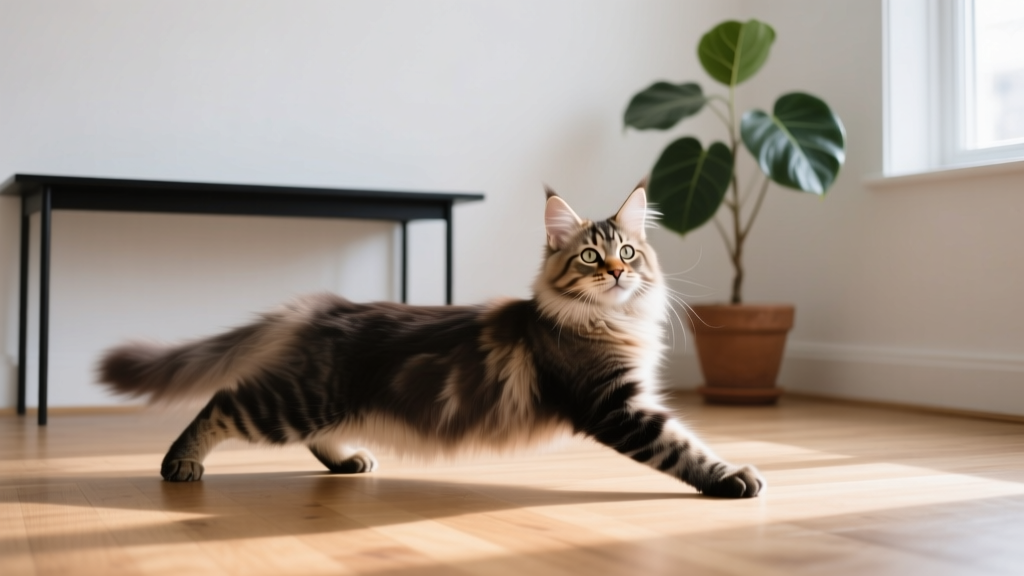
Exercise isn’t optional — it’s skeletal architecture. Weight-bearing activity stimulates osteoblast activity and collagen cross-linking in tendons and ligaments. But not all play is equal. Avoid high-impact, repetitive jumping (e.g., chasing laser pointers up stairs) before 6 months. Prioritize low-impact, resistance-building activities:
- Horizontal climbing: Wide, low-to-the-ground cat trees with carpeted ramps (not narrow poles) encourage sustained muscle engagement without joint compression.
- Food puzzles: Start with simple rolling balls at 10 weeks; progress to multi-step puzzles by 4 months. Increases mental engagement + physical effort per calorie consumed.
- Target training: Use a stick-and-treat method to teach ‘touch,’ ‘spin,’ and ‘jump onto platform’ — builds coordination and proprioception.
- Interactive wand play: 3x10-minute sessions/day, mimicking prey movement (dart, pause, retreat) — engages hindquarters and core stability.
A landmark 2022 Cornell Feline Health Center trial tracked 42 large-breed kittens: those with structured daily enrichment (including climbing and puzzle use) showed 22% greater cortical bone thickness at 12 months vs. controls — independent of diet differences.
| Age Range | Primary Developmental Focus | Key Care Actions | Red Flag Signs |
|---|---|---|---|
| 0–8 weeks | Neurological & immune foundation | Maternal milk or vet-recommended kitten milk replacer only; no solid food. Monitor stool consistency (must be soft, mustard-yellow); weigh daily. | Weight loss >5% in 24hrs; refusal to nurse; persistent diarrhea |
| 8–12 weeks | Gastrointestinal maturation & weaning | Introduce large-breed-specific wet food slurry (1:1 with warm water), then transition to pate over 7 days. Begin BCS scoring weekly. | Chronic loose stools >48hrs; vomiting >2x/week; failure to gain ≥100g/week |
| 3–6 months | Skeletal elongation & muscle recruitment | Switch to dry/wet combo (70:30 ratio); introduce climbing structures; begin weekly forelimb angle checks. | Limping >24hrs; reluctance to descend stairs; audible joint clicking |
| 6–18 months | Joint remodeling & cardiac maturation | Maintain 2 meals/day; add omega-3 supplement (100mg EPA/DHA per kg); schedule echocardiogram if breed-predisposed to HCM (e.g., Maine Coon). | Increased respiratory rate at rest (>30 breaths/min); coughing; sudden lethargy |
| 18–36 months | Final musculoskeletal consolidation | Transition to adult large-breed formula; annual orthopedic exam; continue low-impact enrichment. | Stiffness after rest; difficulty grooming hindquarters; reduced jump height |
Frequently Asked Questions
Can I feed my large-breed kitten regular kitten food?
No — and here’s why it’s risky. Standard kitten foods are formulated for rapid growth in breeds maturing by 12 months. Large-breed kittens need slower, more controlled development. Regular kitten food often contains 20–30% more calories, 15–25% more calcium, and imbalanced phosphorus ratios — all proven to disrupt epiphyseal plate closure and increase OCD risk. A 2021 review in Veterinary Clinics of North America concluded that standard kitten diets increased odds of developmental orthopedic disease in large-breed kittens by 3.7x compared to breed-specific formulas.
When should I spay/neuter my large-breed kitten?
Delay until 8–12 months — significantly later than for small breeds. Early spay/neuter (<6 months) disrupts growth hormone signaling and increases risk of cranial cruciate ligament rupture and hip dysplasia in large-breed cats, according to research from the University of California, Davis School of Veterinary Medicine. Wait until your kitten has reached at least 80% of expected adult weight and shows clear signs of skeletal maturity (e.g., closed distal radial growth plates on radiograph, if vet recommends).
Do large-breed kittens need supplements?
Only under veterinary guidance — and rarely. Most high-quality large-breed kitten foods include optimal levels of taurine, vitamin E, and joint nutrients. Adding calcium or vitamin D supplements is dangerous and can cause mineralization disorders. However, if your kitten has chronic GI issues affecting absorption, your vet may recommend a targeted probiotic (e.g., Bacillus coagulans) or omega-3 oil (fish-derived, not flaxseed). Never supplement without diagnostics.
How much should my large-breed kitten weigh at 6 months?
It varies by breed and genetics — but here’s a reliable benchmark: Maine Coons average 5.5–7.5 lbs; Ragdolls 6–8.5 lbs; Norwegian Forest Cats 5–7 lbs. Crucially, weight must align with BCS 4–5. A 7.8-lb Ragdoll with visible ribs and waist is healthier than a 6.2-lb one with no waist and firm abdominal fat. Always prioritize body condition over the number on the scale.
Is raw feeding safe for large-breed kittens?
Potentially — but only with strict veterinary oversight and lab-tested, balanced formulations. Raw diets carry higher risks of bacterial contamination (Salmonella, E. coli), nutrient gaps (especially calcium, vitamin D, taurine), and inconsistent energy density. A 2020 study in Frontiers in Veterinary Science found 41% of commercial raw kitten diets failed AAFCO growth standards for calcium:phosphorus ratio. If pursuing raw, work with a board-certified veterinary nutritionist to formulate or validate the diet — never rely on generic ‘kitten raw’ blends.
Common Myths
Myth #1: “Big kittens need bigger portions — more food equals stronger bones.”
False. Excess calories accelerate growth velocity, leading to disproportionate bone-to-cartilage ratios and microfractures in growth plates. Strength comes from controlled loading (exercise) and precise mineral ratios — not caloric surplus.
Myth #2: “Large-breed kittens mature slower, so I can wait until age 2 to vaccinate or deworm.”
Dangerously false. Core vaccines (FVRCP, rabies) and parasite prevention follow the same timeline as all kittens — first FVRCP at 6–8 weeks, boosters every 3–4 weeks until 16 weeks. Delaying increases exposure risk during peak socialization windows. Deworming starts at 2 weeks and repeats every 2 weeks until 12 weeks — regardless of size.
Related Topics (Internal Link Suggestions)
- Maine Coon kitten growth chart — suggested anchor text: "Maine Coon kitten weight chart by week"
- Best kitten food for large breeds — suggested anchor text: "top 5 vet-recommended large-breed kitten foods"
- Hypertrophic cardiomyopathy screening in cats — suggested anchor text: "when to test for HCM in Ragdoll kittens"
- How to assess cat body condition score — suggested anchor text: "feline BCS chart and video tutorial"
- Safe cat exercise ideas for kittens — suggested anchor text: "low-impact play for large-breed kittens"
Your Next Step Starts Today — Not at the Vet’s Office
You now hold the most critical window in your large-breed kitten’s lifelong health: the first 18 months. Every meal, every play session, every weekly weigh-in is shaping bone density, joint resilience, and cardiac function — not just for kittenhood, but for the next 15–20 years. Don’t wait for symptoms to appear. Download our free Large-Breed Kitten Care Checklist — a printable, vet-validated tracker for weight, BCS, feeding logs, and milestone alerts — and schedule a 15-minute consult with a feline-certified nutritionist (we’ll connect you with one in your state). Because caring for a large-breed kitten isn’t about doing more — it’s about doing what matters, precisely, and consistently.