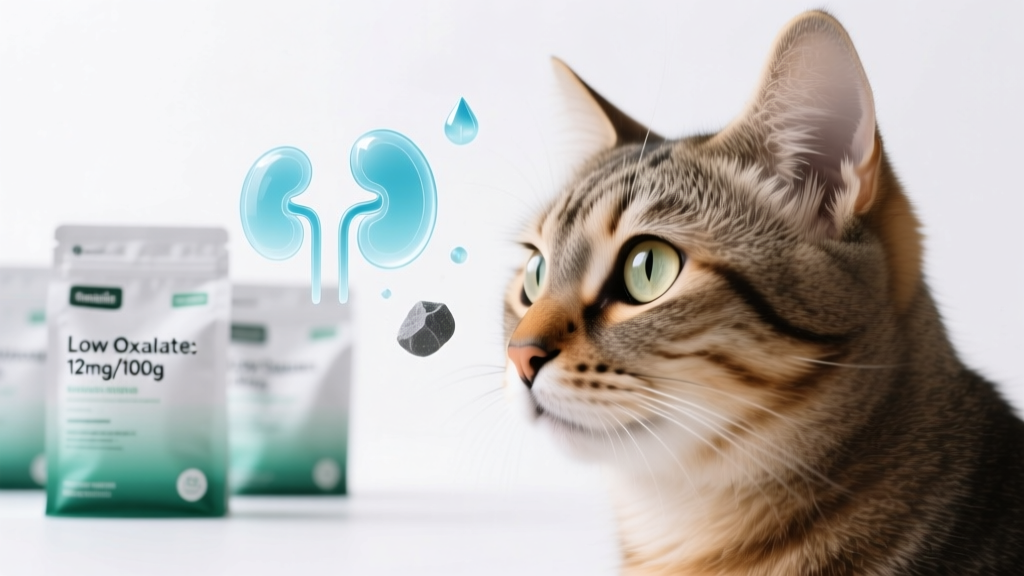
Cat Food Oxalate Levels and Urinary Stone Prevention
1. Why this topic matters for cat health
Urinary stones are one of the most frustrating (and painful) health problems cat owners face. They can cause frequent urination, blood in the urine, straining, litter box accidents, and in severe cases a life-threatening urethral blockage—especially in male cats. While there are multiple types of urinary stones, calcium oxalate (CaOx) stones have become increasingly common in cats over the last few decades.
Many owners naturally look for a single culprit—often “oxalates in food.” The reality is more nuanced. Diet can influence urinary stone risk, but CaOx formation depends on several interacting factors: urine concentration, urine pH, calcium and oxalate availability, hydration, and individual biology. Understanding how oxalate levels fit into the bigger picture helps you make smarter food choices and avoid strategies that accidentally increase risk.
2. Scientific background: feline nutritional needs and obligate carnivore biology
Cats are obligate carnivores. Their metabolism is adapted for a prey-based diet that is:
- High in protein (animal-derived amino acids)
- Moderate in fat
- Very low in carbohydrate
- High in moisture (whole prey is roughly 65–75% water)
This matters for urinary health because cats have a naturally low thirst drive compared with many other species. In the wild, they get most of their water from prey. In a home setting, cats eating mostly dry food may produce more concentrated urine, which can increase the likelihood that minerals crystallize and aggregate into stones.
Also relevant: cats efficiently conserve water through their kidneys. When total water intake is low, urine becomes more concentrated (higher urine specific gravity), raising saturation of stone-forming compounds. That is a major lever in preventing several urinary problems, including CaOx stones.
3. Detailed analysis: oxalate, urine chemistry, and stone risk
What are calcium oxalate stones?
Calcium oxalate stones form when urine becomes supersaturated with calcium and oxalate, allowing crystals to form and clump together. CaOx stones tend to form in more acidic to neutral urine, but pH is only one piece of the puzzle. Unlike struvite stones, which often can be dissolved with diet, CaOx stones typically cannot be dissolved reliably with food; they often require physical removal (surgery, cystoscopy, or other veterinary procedures). That makes prevention especially valuable.
Where does urinary oxalate come from?
Urinary oxalate has two main sources:
- Dietary oxalate (oxalate naturally present in ingredients)
- Endogenous production (oxalate created in the body from metabolism, including from certain precursors)
In cats, as in other mammals, diet is not the only driver. Some cats may be predisposed due to genetics, intestinal absorption differences, or underlying medical issues.
Does “oxalate in cat food” predict stone risk?
Not perfectly. Here’s why:
- Urine concentration (hydration) often outweighs small differences in ingredient oxalate content.
- Calcium availability matters—calcium can bind oxalate in the gut, reducing absorption. Both too much and too little dietary calcium may affect risk depending on context.
- Urine pH influences which minerals precipitate, but pushing urine pH too far in either direction can trade one risk for another.
- Mineral balance (calcium, phosphorus, magnesium, sodium) and urinary inhibitors (like citrate) influence crystallization.
- Processing and formulation change the final nutrient profile. You can’t reliably estimate risk just by reading “spinach” or “sweet potato” on a label.
Veterinary nutrition uses the idea of urine relative supersaturation (RSS) to estimate stone risk. Some therapeutic diets are formulated and tested to reduce RSS for specific stone types. This is more meaningful than focusing on one ingredient.
Key dietary factors linked to CaOx stone prevention
| Factor | Why it matters | Practical goal |
|---|---|---|
| Water intake | Dilutes urine, lowers mineral supersaturation | Increase total moisture and encourage drinking |
| Urine pH | Extremes can favor different crystal types | Aim for a veterinarian-guided target; avoid DIY acidifiers |
| Calcium & oxalate handling | Affects how much oxalate is absorbed and excreted | Feed a complete, balanced diet; avoid unbalanced homemade mineral profiles |
| Sodium (sometimes) | Can increase thirst and urine volume; not right for every cat | Use only when guided by a vet, especially with heart/kidney disease |
| Protein and mineral composition | Impacts urine chemistry and overall health | Choose diets formulated for urinary health when indicated |
High-oxalate ingredients: what to know (and what not to assume)
In human nutrition, foods like spinach, beet greens, rhubarb, and certain nuts are classic high-oxalate items. Cat foods may include small amounts of plant ingredients for fiber, texture, or micronutrients. While it’s reasonable to be cautious about diets heavily reliant on high-oxalate plants, ingredient lists alone don’t tell you the final oxalate load or how it affects a specific cat.
If your cat has a known CaOx history, it’s reasonable to ask your veterinarian about diets that have been evaluated for CaOx risk (often via RSS testing), rather than trying to “ingredient police” without data.
4. Practical recommendations for cat owners
Prioritize hydration (the most consistently helpful lever)
- Use more wet food: Canned or pouch diets typically deliver far more water than dry kibble.
- Add water to food: Many cats accept a tablespoon or two of water mixed into wet food (increase gradually).
- Try a water fountain: Some cats drink more with circulating water.
- Offer multiple water stations: Quiet locations away from litter boxes can help.
Choose diets with urinary expertise when there’s a stone history
If your cat has had CaOx stones or recurrent CaOx crystals, ask your vet about:
- Veterinary therapeutic urinary diets designed to reduce CaOx risk (often by managing urine concentration and mineral balance)
- Wet formulations of those diets to maximize water intake
These diets are not “one-size-fits-all.” Your vet will consider stone type, urine pH, other lab values, and any concurrent diseases.
Keep treats and toppers from undermining the plan
For cats on a urinary prescription diet, treats can change urine chemistry more than you’d expect.
- Keep treats to <10% of daily calories unless your vet says otherwise.
- Ask your clinic for compatible treat options if your cat is on a therapeutic diet.
5. Comparing options: approaches and products
| Approach | Pros | Cons / cautions | Best fit for |
|---|---|---|---|
| Therapeutic urinary wet diet (vet-guided) | Formulated and often tested for urinary metrics; high moisture | Higher cost; requires consistency; may not suit all medical conditions | Cats with CaOx history, recurrent lower urinary issues |
| Over-the-counter wet food + hydration strategy | Improves water intake; broad choices | Not specifically formulated for CaOx risk; treat/topping variability | Healthy cats; prevention-focused owners |
| Dry food only + “drink more water” | Convenient; often cheaper | Many cats still produce concentrated urine; higher dehydration risk | Situations where wet food is impossible (work with your vet) |
| Homemade diet (properly formulated) | Full control over ingredients; can be tailored | High risk of mineral imbalance without a board-certified veterinary nutritionist | Cats needing customized plans when professionally formulated |
6. Common mistakes and misconceptions to avoid
- Myth: “Avoiding oxalate ingredients prevents CaOx stones.”
CaOx risk is driven by urine concentration, mineral balance, and individual factors. Ingredient lists don’t reveal urinary RSS or actual oxalate exposure. - Mistake: Using urinary acidifiers without veterinary oversight.
Over-acidifying urine can reduce struvite risk but may increase CaOx risk in some cats. Supplements like DL-methionine should only be used when prescribed. - Myth: “All urinary problems are caused by crystals.”
Many cats with feline idiopathic cystitis (FIC) have sterile inflammation without infection or stones. Stress reduction and hydration may be central. - Mistake: Switching foods repeatedly without a plan.
Constant changes can cause GI upset and make it hard to see what’s working. Use measured transitions and follow-up urine checks. - Myth: “If the urine pH is ‘perfect,’ stones can’t form.”
Stones can form even with acceptable pH if urine is concentrated or supersaturated with minerals.
7. How to implement changes safely (transition tips)
Cats can be sensitive to diet changes. A gradual transition reduces vomiting, diarrhea, and food refusal.
- Typical transition timeline: 7–10 days (longer for picky cats).
- Mixing method:
- Days 1–3: 75% old food / 25% new food
- Days 4–6: 50/50
- Days 7–9: 25/75
- Day 10+: 100% new food
- For increasing moisture: add 1 teaspoon of water to meals, then slowly increase to 1–2 tablespoons if tolerated.
- Monitor: appetite, stool quality, urination frequency, and litter box behavior.
If your cat has a history of urinary obstruction, severe straining, or blood in the urine, treat it as urgent and contact a veterinarian immediately.
8. Special considerations (age, health conditions, activity level)
Kittens
- Feed a complete and balanced growth diet; don’t use adult urinary diets unless your vet specifically recommends it.
- Encourage hydration early (wet food meals can help).
Adult cats prone to urinary issues
- Focus on water intake and consistent feeding routines.
- Ask your vet whether periodic urinalysis (and imaging if indicated) is appropriate based on history.
Senior cats
- Senior cats may have concurrent conditions (kidney disease, arthritis, dental disease) that affect food choice and water intake.
- Some seniors drink more, some less—so don’t assume. Objective checks (urine concentration, bloodwork) help guide decisions.
Chronic kidney disease (CKD)
- CKD nutrition priorities (phosphorus control, adequate calories, manage protein appropriately) can conflict with some urinary strategies.
- Never select a urinary diet for a CKD cat without veterinary guidance; a tailored plan may be needed.
Overweight, low-activity cats
- Obesity is associated with multiple urinary and metabolic issues.
- Use measured portions and discuss a safe weight-loss plan with your vet (crash diets can be dangerous for cats).
9. FAQ: cat food oxalates and stone prevention
1) Can I test my cat’s urine pH at home to prevent stones?
Home pH strips can be inconsistent and don’t measure the full risk picture. A veterinary urinalysis evaluates pH along with urine specific gravity, crystals, and other markers. If your cat has a stone history, work with your vet on a monitoring schedule.
2) Should I avoid foods with spinach, sweet potato, or other plant ingredients?
Not automatically. Small amounts of plant ingredients don’t necessarily create a high urinary oxalate risk. If your cat has confirmed CaOx stones, ask your veterinarian about diets formulated and evaluated for CaOx prevention rather than choosing based on a single ingredient.
3) Is wet food always better for urinary stone prevention?
Wet food usually helps because it increases water intake and dilutes urine. That said, the “best” choice depends on your cat’s medical history and the diet’s overall formulation. Some cats need a specific therapeutic diet, ideally in wet form if possible.
4) Are calcium oxalate stones caused by too much dietary calcium?
Not necessarily. CaOx stones are influenced by multiple factors, and calcium intake that is too low or poorly balanced can also create problems. Stick with complete and balanced diets, and let your veterinarian guide any mineral adjustments.
5) Can supplements like cranberry prevent calcium oxalate stones?
Cranberry is more commonly discussed for urinary tract health in other contexts, but it’s not a proven prevention tool for CaOx stones in cats. Supplements can also alter urine chemistry in unintended ways. Ask your vet before adding any urinary supplement.
6) If my cat had struvite crystals before, will the same diet prevent calcium oxalate stones?
Not always. Strategies that reduce struvite risk (such as more acidic urine) may increase CaOx risk in some cats. That’s why confirming stone type (and re-checking urine) matters. Your vet can tailor the diet to your cat’s current risk profile.
Best next step: if your cat has had urinary stones, crystals, or recurring urinary signs, schedule a veterinary visit to discuss urinalysis, imaging when appropriate, and a diet plan matched to the specific stone type and overall health needs.
For more practical, science-based feeding advice, explore the cat nutrition guides on catloversbase.com.