Cat Food Mineral Balance: Calcium to Phosphorus Ratio
1. Why this topic matters for cat health
Calcium (Ca) and phosphorus (P) are “macro-minerals,” meaning cats need them in relatively large amounts compared to trace minerals. They’re also tightly linked: change one, and you affect the other. The calcium-to-phosphorus (Ca:P) ratio influences bone strength, tooth health, muscle and nerve function, energy metabolism, and—most critically—how the body regulates these minerals through hormones and the kidneys.
For cat owners trying to “feed the best diet,” Ca:P balance is one of the most common hidden problems behind:
- Poor skeletal development in kittens
- Bone demineralization or fragility in adults when diets are unbalanced
- Nutrition-related secondary hyperparathyroidism (a serious condition triggered by chronic mineral imbalance)
- Worsening of kidney disease risk factors when phosphorus is excessive over time
Even when calories and protein look great, mineral balance can make or break the long-term safety of a diet—especially with homemade, raw, or “all-meat” feeding approaches.
2. Scientific background: feline nutritional needs and obligate carnivore biology
Cats are obligate carnivores. In the wild, they eat prey animals—muscle meat plus organs and bones. That last part matters: bones supply calcium, while muscle meat is naturally higher in phosphorus. A “meat-only” diet doesn’t mimic prey mineral balance, which is a major reason Ca:P issues show up in home-prepared diets.
Key biological points that shape Ca:P requirements:
- Bone is a mineral bank: About 99% of body calcium and ~80% of phosphorus are stored in the skeleton. When dietary balance is off, the body may withdraw minerals from bone to keep blood levels stable.
- Hormonal control is powerful: Parathyroid hormone (PTH), vitamin D metabolites, and calcitonin regulate calcium and phosphorus absorption, excretion, and bone remodeling.
- Kidneys are central: Healthy kidneys excrete excess phosphorus. When kidney function declines, phosphorus control becomes harder, so dietary phosphorus becomes more important.
- Growth increases risk: Kittens build bone rapidly. Both deficiency and excess can cause developmental skeletal problems.
From a nutrition science standpoint, Ca:P isn’t just a number—it’s a reflection of how well a diet supports a cat’s physiology across life stages.
3. Detailed analysis: what the Ca:P ratio means and what science supports
What is the Ca:P ratio?
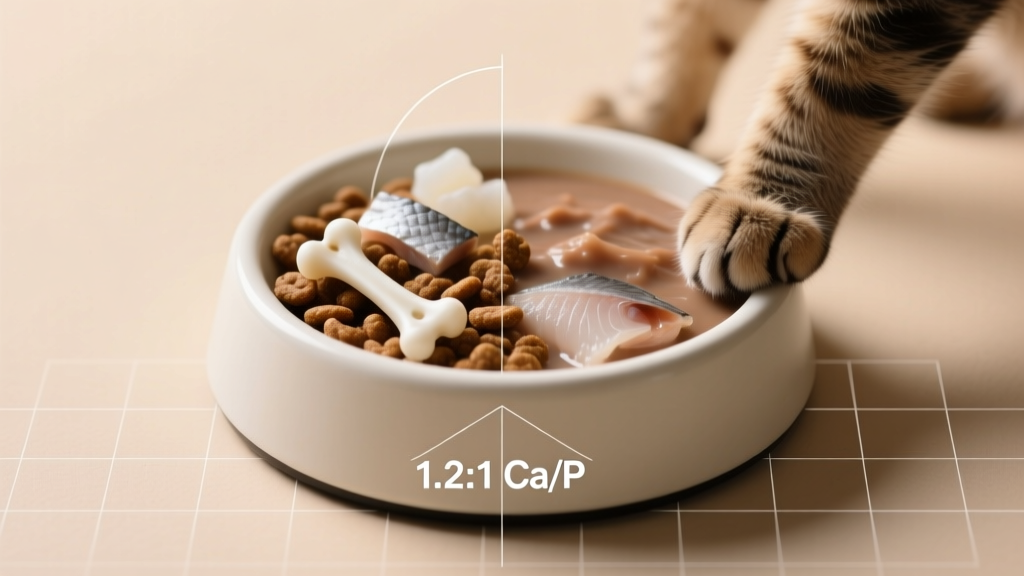
The Ca:P ratio expresses calcium relative to phosphorus in the diet (for example, 1.2:1 means 1.2 parts calcium for each 1 part phosphorus). Balance matters because calcium and phosphorus interact during absorption and metabolism.
What ratios are generally recommended?
For complete and balanced cat foods (commercial diets formulated to meet recognized standards), Ca:P typically falls in a controlled range. Across veterinary nutrition references and regulatory standards, a practical target for many healthy cats is:
- Ideal target range: about 1.1:1 to 1.5:1
- Common formulation target: around 1.2:1 to 1.3:1
Extremes are where problems begin. Too little calcium relative to phosphorus is particularly risky with meat-heavy diets. Too much calcium can also cause issues—especially for kittens and in poorly formulated “supplement-heavy” homemade recipes.
Why “meat-only” is a classic Ca:P problem
Muscle meat is naturally phosphorus-rich and calcium-poor. Feeding meat without a correctly measured calcium source can flip the ratio dramatically (very low Ca relative to P). Over time, the cat may maintain blood calcium by pulling calcium from bones, driving high PTH levels and weakening the skeleton.
This imbalance is a known pathway to nutritional secondary hyperparathyroidism, which can present as:
- Lameness, pain, reluctance to jump
- Fractures with minor trauma
- Weakness, tremors
- “Rubber jaw” in severe cases (bone demineralization)
Phosphorus quality matters: total phosphorus vs. highly available inorganic phosphorus
Not all phosphorus is equal. Phosphorus comes from:
- Organic phosphorus naturally present in meats and organs
- Inorganic phosphate additives used in some foods for processing, texture, and palatability
Inorganic phosphates can be more readily absorbed. For cats—especially those with kidney concerns—highly available phosphate sources may contribute to higher phosphorus burden. If your cat has kidney disease or is at risk, your veterinarian may recommend focusing not just on Ca:P ratio, but also on lowering total dietary phosphorus and avoiding high-phosphate additive-heavy formulations.
Calcium sources: bone, bone meal, eggshell, and supplements
When balancing Ca:P, the calcium source matters:
| Calcium source | Pros | Cons / cautions | Best use |
|---|---|---|---|
| Edible bone (ground in formulated raw) | Prey-model concept; also provides phosphorus and other minerals | Hard to dose precisely at home; bone content varies; constipation risk in some cats | Commercially formulated raw diets; professionally formulated homemade raw |
| Bone meal | Convenient; provides both Ca and P | Quality varies; can oversupply minerals if mismeasured | Recipes formulated by a veterinary nutritionist |
| Eggshell calcium (calcium carbonate) | Provides calcium without adding phosphorus | Can throw off other minerals if used without a complete recipe; must be finely ground and accurately measured | Home-cooked diets when a recipe specifically calls for it |
| Calcium carbonate/citrate supplements | Precise dosing | Easy to “overcorrect”; may affect absorption of other nutrients if misused | Veterinarian-guided therapeutic plans |
How to evaluate Ca:P in commercial cat food
Many labels don’t list phosphorus, and calcium may be listed only as a minimum (“min”) value. That makes exact Ca:P tricky from the packaging alone. Better approaches:
- Check the manufacturer’s full nutrient profile (often available online or via customer support). Ask for:
- Calcium and phosphorus values
- Whether values are “as fed” or “dry matter basis” (DMB)
- Look for “complete and balanced” statements tied to AAFCO (US) or FEDIAF (EU/UK) standards.
- Be cautious with “supplemental feeding only” foods (toppers, broths, some boutique raw products) unless they’re part of a balanced plan.
4. Practical recommendations for cat owners
- Choose complete and balanced foods for your cat’s life stage (kitten vs adult vs senior). This is the simplest way to avoid Ca:P problems.
- Avoid meat-only diets unless formulated by a board-certified veterinary nutritionist (or your vet provides a proven, complete recipe).
- If you feed homemade, use a recipe designed for cats with precise mineral supplementation. “A pinch of calcium” is not safe nutrition.
- For kidney concerns, consult your vet early. Managing phosphorus often matters more than tweaking Ca:P at home.
- Don’t add calcium casually to “fix” a perceived issue. Over-supplementation can create new imbalances.
5. Comparing approaches: wet vs dry, commercial vs homemade, raw vs cooked
| Approach | Ca:P control | Pros | Cons / watch-outs | Best for |
|---|---|---|---|---|
| Commercial wet (complete & balanced) | Usually well-controlled | Higher moisture; good palatability; easier portion control | Need to confirm for special diets (kidney, growth) | Most cats; especially those needing hydration support |
| Commercial dry (complete & balanced) | Usually well-controlled | Convenient; stable; cost-effective | Lower moisture; may not fit some medical needs | Healthy cats where intake and urinary health are monitored |
| Commercial raw (formulated complete) | Can be controlled if truly complete | Often uses bone; may suit owner preferences | Food safety; must verify “complete & balanced” and life stage | Owners committed to strict handling and reputable brands |
| Homemade cooked/raw | Highly variable unless formulated | Ingredient control; can tailor for allergies (with guidance) | Highest risk for Ca:P errors and nutrient gaps | Cats requiring custom plans under veterinary supervision |
| Toppers/treats as a major calorie source | Often unbalanced | Improves appetite short-term | Can dilute mineral balance and vitamins | Occasional use only (generally <10% calories unless vet-directed) |
6. Common mistakes and misconceptions to avoid
- Myth: “Cats need lots of calcium, so more is better.”
Reality: Too much calcium can interfere with mineral balance and can be risky for growing kittens. Balanced intake matters more than high intake. - Myth: “Feeding boneless chicken and organ meat is basically a natural prey diet.”
Reality: Without bone or a precisely measured calcium source, the Ca:P ratio is typically far too low. - Mistake: Using human multivitamins or random mineral powders.
Human products can have inappropriate doses and may contain ingredients unsafe for cats. - Mistake: Relying on label minimums to calculate Ca:P.
“Min calcium” and “min/max phosphorus” (if listed) don’t guarantee the actual ratio in the batch. Ask for typical analysis or DMB values. - Myth: “Grain-free automatically means healthier minerals.”
Grain content is not a reliable indicator of mineral balance. Formulation quality matters more than marketing categories.
7. How to implement changes safely (transition tips)
Switching foods abruptly can cause vomiting, diarrhea, or food refusal. Mineral balance changes don’t require sudden shifts; slow and steady is safer.
- Transition over 7–10 days for most cats:
- Days 1–3: 75% old, 25% new
- Days 4–6: 50% old, 50% new
- Days 7–9: 25% old, 75% new
- Day 10: 100% new
- Go slower for cats with sensitive digestion or a history of food aversion.
- Do not “wait out” refusal in cats. Prolonged fasting can be dangerous (risk of hepatic lipidosis). Contact your vet if your cat won’t eat for ~24 hours (or sooner for kittens or medically fragile cats).
- Track stool quality, appetite, water intake, and weight. Any rapid weight loss or persistent GI upset warrants a veterinary call.
8. Special considerations: age, health conditions, activity level
Kittens and pregnant/nursing cats
- Require diets formulated for growth/reproduction.
- Incorrect Ca:P (too low or too high) can disrupt bone development.
- Avoid improvised homemade diets unless formulated by a veterinary nutritionist.
Senior cats
- Some seniors develop reduced kidney function over time.
- Ask your vet about routine labs (including kidney values and urine testing). If kidney disease is present, phosphorus management becomes a priority.
Chronic kidney disease (CKD)
- Many CKD management plans focus on lowering dietary phosphorus and using therapeutic kidney diets when appropriate.
- Do not add calcium supplements to “bind phosphorus” without veterinary guidance; inappropriate use can contribute to mineral disturbances.
Urinary tract issues (FLUTD/crystals)
- Urinary health is influenced by moisture, urine pH, and mineral excretion (including magnesium, calcium, and phosphorus).
- Follow your vet’s diet plan. “Balancing Ca:P” alone won’t prevent urinary crystals and may backfire if you self-formulate.
Highly active cats vs. indoor cats
- Activity changes calorie needs more than Ca:P needs.
- Focus on correct portions and body condition score; keep the diet complete and balanced rather than trying to manipulate minerals for energy.
FAQ
1) What Ca:P ratio should I look for in cat food?
For most healthy cats eating complete and balanced diets, a Ca:P ratio around 1.1:1 to 1.5:1 is commonly used, with many quality foods landing near 1.2:1–1.3:1. If your cat has a medical condition (especially kidney disease), your veterinarian may prioritize total phosphorus and overall formulation rather than ratio alone.
2) My cat eats only chicken breast. Can I just add a calcium supplement?
Adding calcium without a complete recipe is risky. You may improve Ca:P but still miss essential nutrients (taurine, vitamins A/D/E, iodine, trace minerals, fatty acids). If you want to feed homemade, ask your veterinarian for a veterinary nutritionist-formulated recipe and supplement plan.
3) Do wet foods have better mineral balance than dry foods?
Both wet and dry can be properly balanced if they’re labeled complete and balanced and made by a reputable manufacturer. Wet foods often help with hydration, which can benefit many cats, but mineral quality depends on the specific formula—not the format.
4) Is high phosphorus always bad?
Healthy cats can handle normal phosphorus levels in balanced diets, but excessive phosphorus—especially from highly absorbable phosphate additives—may be less ideal long-term and is a major concern in cats with kidney disease. If you’re worried about phosphorus, ask your vet and request the food’s typical phosphorus values from the manufacturer.
5) Can too much calcium harm my cat?
Yes. Over-supplementation can cause mineral imbalances and may be especially problematic for kittens or cats on already complete diets. Calcium should not be “topped up” unless a veterinarian is supervising a therapeutic or homemade plan.
6) How can I tell if my cat’s diet is mineral-imbalanced?
Clinical signs can be vague (poor growth, lameness, constipation, weakness) and many conditions mimic each other. The most reliable approach is prevention (complete and balanced diets) and veterinary monitoring. If you’re feeding homemade or your cat has health issues, discuss lab work and diet review with your vet.
Best next step: If you’re considering a diet change—especially homemade, raw, or therapeutic—bring the exact food label (or recipe and supplement list) to your veterinarian for guidance tailored to your cat’s age, weight, and health status.
For more practical, science-based feeding help, explore additional feline nutrition guides on catloversbase.com.