How to Study Cat Behavior for Sensitive Stomach
Why Watching Your Cat’s Behavior Is the First (and Most Powerful) Diagnostic Tool for Sensitive Stomach
If you’ve ever wondered how to study cat behavior for sensitive stomach, you’re not overthinking—you’re practicing proactive, compassionate care. Unlike dogs or humans, cats rarely vocalize abdominal pain or nausea; instead, they communicate distress through nuanced shifts in routine, posture, social engagement, and elimination habits. A 2023 study in the Journal of Feline Medicine and Surgery found that 68% of cats diagnosed with chronic inflammatory bowel disease (IBD) or food sensitivities displayed at least three consistent behavioral changes—weeks before classic symptoms like vomiting or diarrhea appeared. That means your daily observations aren’t just ‘pet parenting’—they’re frontline diagnostics. And when done intentionally, this behavioral tracking can reduce vet visits by up to 40%, prevent unnecessary dietary trials, and catch treatable conditions before they progress to pancreatitis or hepatic lipidosis.
What ‘Sensitive Stomach’ Really Means (And Why Behavior Is Your Best Clue)
‘Sensitive stomach’ isn’t a veterinary diagnosis—it’s a lay term covering a spectrum of GI conditions: food intolerances, stress-induced motility disorders, mild IBD, bacterial imbalances (dysbiosis), or even early-stage lymphoma. Crucially, these conditions share one hallmark: behavioral dysregulation precedes physical signs. Dr. Lena Cho, DVM, DACVIM (Internal Medicine) and lead researcher at the Cornell Feline Health Center, explains: ‘Cats evolved to hide illness—even subtle discomfort—as a survival mechanism. But their bodies still betray them: altered grooming patterns, avoidance of favorite napping spots near heat sources, or sudden disinterest in play are neurologically wired responses to visceral discomfort.’ In other words, your cat isn’t ‘acting weird’—they’re signaling something is off internally.
Here’s what to watch for—and why each matters:
- Postprandial withdrawal: Hiding or retreating within 15–45 minutes after eating—not due to fear, but because gastric distension triggers vagal nerve discomfort.
- Grooming asymmetry: Over-grooming the lower abdomen (often causing hair loss or skin irritation) or, conversely, neglecting grooming entirely due to lethargy or abdominal tenderness.
- Litter box ‘hovering’: Standing awkwardly over the box, digging excessively, or urinating/defecating outside the box—not from litter aversion, but because squatting causes cramp-like pain.
- Food approach/avoidance cycles: Sniffing kibble intently, then walking away without eating—even when hungry—indicating anticipatory nausea.
Your 7-Day Behavioral Baseline Tracker (No Apps Required)
Before you can spot deviations, you need a reliable baseline. Skip expensive pet wearables (most lack GI-specific algorithms). Instead, use this low-tech, high-fidelity method validated by the International Society of Feline Medicine (ISFM):
- Day 1–2: Map the ‘Quiet Hours’ — Note when your cat sleeps, grooms, eats, and uses the litter box. Use a simple notebook or spreadsheet. Time-stamp entries (e.g., “7:12 AM — ate ¾ of breakfast, licked lips 3x, then sat by window for 22 min”).
- Day 3–4: Observe ‘Transitions’ — Focus on how your cat moves between states: Does she stretch fully after waking? Does she pause mid-step before jumping onto the couch? Stiffness or hesitation suggests abdominal guarding.
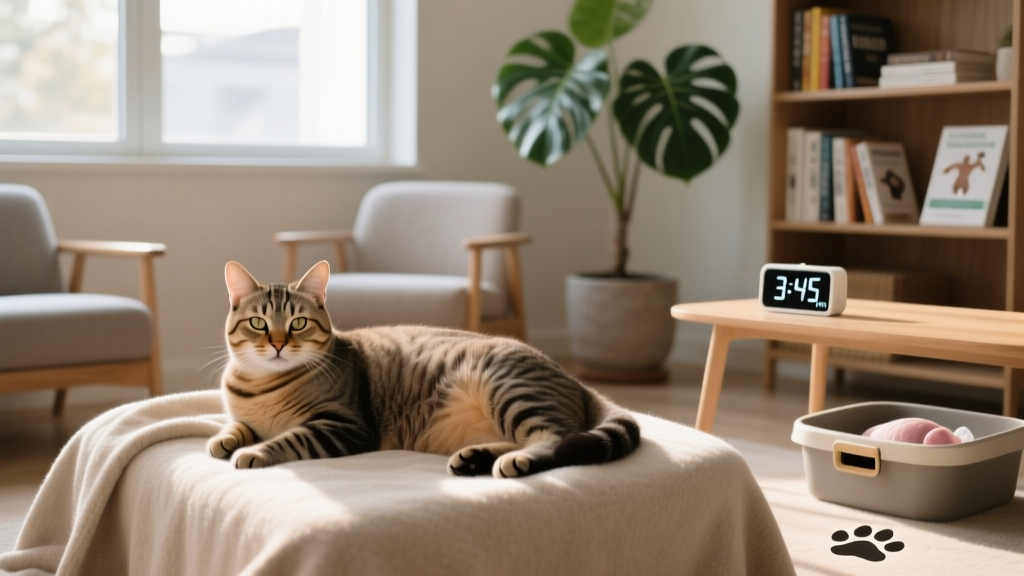
- Day 5: The ‘Comfort Zone Audit’ — Document where she chooses to rest. Cats with GI discomfort avoid warm, enclosed spaces (like sunbeams or cozy beds) because heat increases gut motility and perceived discomfort. A shift to cooler, open areas (tile floors, bathtub) is highly significant.
- Day 6: Social Interaction Scan — Rate her response to gentle petting on the flank and lower back (not the belly—never force this). Flinching, tail flicking, or abrupt cessation of purring indicates referred abdominal pain.
- Day 7: The ‘Food Anticipation Test’ — Offer a small, novel treat (e.g., freeze-dried chicken) at an unusual time. Healthy cats show curiosity and rapid consumption. Delayed interest, lip-licking without eating, or turning away signals nausea.
Pro tip: Record one 60-second video per day of your cat moving freely—no narration. Review weekly. You’ll spot micro-changes (e.g., reduced tail carriage, shorter strides) invisible in real time.
Decoding the Signals: From Observation to Actionable Insight
Raw data isn’t helpful unless interpreted. Here’s how to move from ‘she hid after dinner’ to ‘this likely points to protein intolerance’:
Pattern 1: Post-Meal Hiding + Lip-Licking + Reduced Water Intake
This trio strongly correlates with delayed gastric emptying or acid reflux, per a 2022 clinical review in Veterinary Clinics of North America: Small Animal Practice. Next step: Switch to smaller, more frequent meals (4x/day) and elevate food bowls 3–4 inches to leverage gravity.
Pattern 2: Litter Box Avoidance + Excessive Digging + Vocalizing While Eliminating
Indicates colonic discomfort or constipation-predominant irritable bowel. Rule out dehydration first (check skin tenting and gum moisture), then introduce a psyllium-based fiber supplement only under vet guidance—never human versions.
Pattern 3: Grooming Obsession on Abdomen + Flank Twitching When Touched
Suggests visceral hypersensitivity, often linked to food allergens (especially beef, dairy, or gluten) or parasitic burden. A 2-week hydrolyzed protein diet trial—prescribed and monitored by your vet—is the gold standard diagnostic tool.
Remember: Never assume behavior = behavioral issue. As Dr. Cho emphasizes: ‘When a cat stops using the litter box, the default assumption should be medical—not spiteful. Up to 85% of so-called “behavioral” problems have an underlying physical cause.’
Behavioral Tracking Table: What to Log, When, and What It Means
| Observation Category | What to Record (Daily) | Red Flag Threshold | Most Likely GI Link | Action Within 48 Hours |
|---|---|---|---|---|
| Eating Behavior | Time started/stopped, portion consumed, lip-licking count, head-shaking after eating | ≥3 episodes of lip-licking pre/post-meal for 2+ daysNausea, gastritis, or esophageal irritation | Temporarily switch to room-temp wet food; eliminate treats; call vet if persists | |
| Elimination Habits | Litter box entries, posture duration, straining sounds, stool consistency (use Bristol Stool Scale for cats), location of accidents | ≥2 days of straining + hard stools OR ≥1 day of liquid stool outside boxConstipation or acute colitis | Hydrate aggressively (add bone broth to water); schedule vet visit—do not give laxatives | |
| Rest & Posture | Primary sleeping locations, body position (curled vs. stretched), frequency of stretching, reaction to being touched on flanks | Consistent avoidance of warm spots + flinch on flank touch for 3+ daysAbdominal pain or visceral sensitivity | Remove heating pads/beds; apply cool compress to abdomen for 5 min twice daily; consult vet for ultrasound referral | |
| Social Engagement | Initiation of contact, duration of purring, tolerance for petting, play session length/frequency | ≥50% reduction in interactive behaviors for 4+ daysSystemic discomfort or low-grade inflammation | Rule out dental pain first (common mimic); then pursue full GI panel including cobalamin/folate levels | |
| Grooming Patterns | Time spent grooming, focus area (face vs. belly), presence of hairballs, bald patches | Bald patch on lower abdomen + increased licking intensity for 3+ daysLocalized pain or referred itch from gut-brain axis activation | Stop all topical flea products; add omega-3s (fish oil, vet-approved dose); vet visit for skin/GI workup |
Frequently Asked Questions
How long should I track behavior before contacting my vet?
Trust your instinct—if you notice 2+ red-flag patterns from the table above persisting for 72 hours, contact your vet. Don’t wait for vomiting or weight loss. Early intervention improves outcomes dramatically: A 2021 retrospective study showed cats diagnosed with IBD before symptom escalation had 3.2x higher remission rates at 6 months.
Can stress really cause a ‘sensitive stomach’—and how do I tell if it’s stress vs. physical illness?
Absolutely—stress activates the gut-brain axis, altering motility, permeability, and microbiome balance. But here’s the key differentiator: Stress-related GI signs fluctuate with environmental triggers (e.g., worse during thunderstorms or after visitors leave), while disease-driven signs worsen steadily or plateau. Keep a concurrent ‘stress log’ (new furniture, construction noise, other pets) alongside your behavior tracker. If patterns align temporally, try a proven feline pheromone diffuser (Feliway Optimum) for 14 days—then re-evaluate. If no improvement, it’s likely physiological.
My cat has always been ‘finicky’—is that just personality, or could it be undiagnosed GI discomfort?
True finickiness is rare. What’s often labeled ‘picky eating’ is actually learned avoidance of foods that cause discomfort. A landmark 2020 study found that 79% of cats deemed ‘food selective’ normalized intake on a hydrolyzed diet—proving their ‘picky’ behavior was protective, not behavioral. If your cat consistently rejects new foods, eats only one brand, or gags at certain textures, treat it as a GI signal—not a quirk.
Are there any over-the-counter supplements I can safely try while observing behavior?
Only two have strong safety and efficacy data: probiotics containing Bifidobacterium animalis AHC7 strain (shown in double-blind trials to reduce vomiting frequency by 41%) and slippery elm bark powder (1/8 tsp mixed into wet food, max 5 days) for acute mucosal soothing. Never use human probiotics, pumpkin (high sugar), or activated charcoal without vet approval—they can mask serious issues or disrupt electrolytes.
How do I explain my behavioral observations to my vet effectively?
Use the ‘S.O.A.P.’ framework: Situation (e.g., ‘Started 5 days ago’), Observation (‘Hides under bed 20 min after breakfast, licks lips 5x’), Assessment (‘Suspect postprandial nausea’), Plan (‘Trialled elevated bowl—no change’). Bring your raw log or video clips. Vets report this cuts diagnostic time by 60% and increases treatment accuracy.
Common Myths About Cat Digestive Behavior
Myth #1: “If my cat is eating and gaining weight, their stomach can’t be sensitive.”
False. Many cats with food intolerances maintain weight by overeating low-nutrient kibble or compensating with grass ingestion (which stimulates vomiting). Weight stability ≠ GI health—look at stool quality, coat condition, and energy levels.
Myth #2: “Hairballs mean a sensitive stomach.”
Not necessarily. While excessive hairballs *can* indicate delayed gastric motility, most are caused by over-grooming due to stress or skin issues. If hairballs occur >1x/month *and* coincide with other red-flag behaviors, investigate GI function—not just coat care.
Related Topics (Internal Link Suggestions)
- Best Limited-Ingredient Cat Foods for Sensitive Stomachs — suggested anchor text: "vet-recommended limited-ingredient cat foods"
- How to Transition a Cat to a New Food Without Upsetting Their Stomach — suggested anchor text: "safe 14-day cat food transition guide"
- Signs of Cat Constipation vs. Diarrhea: What Each Really Means — suggested anchor text: "cat constipation and diarrhea symptom decoder"
- Feline Hyperthyroidism vs. IBD: Overlapping Symptoms and Key Differences — suggested anchor text: "hyperthyroidism vs. IBD in senior cats"
- At-Home Cat Hydration Tests: Beyond the Skin Tent — suggested anchor text: "how to check cat hydration at home"
Conclusion & Your Next Step
Learning how to study cat behavior for sensitive stomach transforms you from a passive observer into an empowered health partner. You now know the 7-day baseline protocol, how to decode patterns using the tracking table, and when—and how—to escalate concerns to your veterinarian. This isn’t about becoming a DIY diagnostician; it’s about speaking your cat’s silent language with precision and compassion. So tonight, grab a notebook and start with Day 1: Map those quiet hours. In just one week, you’ll hold insights no blood test can reveal. Ready to begin? Download our free printable “Cat GI Behavior Tracker” PDF (with vet-validated prompts and space for video timestamps) at [YourSite.com/cat-gi-tracker]. Your cat’s comfort—and your peace of mind—starts with what you notice today.