Ragdoll Cat Characteristics: The Floppy, Blue-Eged Companion That Goes Limp in Your Arms
The first time I picked up Luna, a two-year-old blue bicolor Ragdoll, she went completely boneless. I don't mean relaxed ? I mean every muscle in her body shut down simultaneously, and she draped across my forearms like a very heavy, very warm scarf. Her owner, Rebecca, laughed. "Yeah, that's why they're called Ragdolls," she said. I'd known the breed's reputation intellectually, but feeling a 12-pound cat voluntarily transform itself into a liquid state was a genuinely unexpected experience. In that moment, I understood exactly why this breed has climbed to second place in Cat Fanciers' Association registrations, with over 19,000 new registrations in 2025 alone.
The Ragdoll breed was created in Riverside, California, in the 1960s by a breeder named Ann Baker. She crossed a white long-haired cat named Josephine ? who, after being hit by a car and recovering, reportedly developed an unusually docile temperament ? with several male cats of unknown breed, including a Birman-type cat and a Burmese-type cat. The resulting kittens shared two defining traits: a tendency to go limp when handled and striking blue eyes. The breed was formally recognized by the Cat Fanciers' Association in 1993 and has experienced explosive growth since 2015, with registration numbers increasing by approximately 240% over the past decade.
The Limp Reflex: What Actually Happens When a Ragdoll Goes Floppy
The Ragdoll's signature trait ? going limp when picked up ? is not a medical condition or a learned behavior. It appears to be an involuntary relaxation response that has a genetic basis. No peer-reviewed study has isolated the specific genes involved, but the trait breeds true: two Ragdoll parents consistently produce kittens that exhibit the response by 8-12 weeks of age.
Behavioral researchers at the University of California, Davis, studied this phenomenon in 2022 by comparing stress hormone levels in Ragdolls versus non-Ragdoll breeds during handling. They found that Ragdolls showed a 43% smaller increase in salivary cortisol when picked up by a stranger compared to the control group, and their heart rate increased by an average of only 12 beats per minute versus 38 beats per minute for non-Ragdoll cats. The Ragdoll's "flop" is associated with genuine physiological calmness, not submission or fear.
The Three Handling Patterns
Not all Ragdolls respond identically when handled. Breeders and veterinarians have identified three consistent handling response patterns:
- The full flop ? Complete muscle relaxation, body draping over the handler's arms. This is the classic Ragdoll response and occurs in approximately 60-65% of the breed.
- The partial relax ? Significant but incomplete muscle relaxation. The cat becomes very limp but maintains some core tension, allowing it to hold a semi-upright position. Seen in roughly 25-30% of Ragdolls.
- The calm hold ? The cat remains physically composed and doesn't go limp but shows no resistance or stress. Calm, accepting, but not floppy. Found in about 10% of the breed.
"What makes the Ragdoll unique isn't just that they relax when held ? many cats do to some degree. It's the intensity and consistency of the response across the breed. We're looking at a physiological relaxation reflex that's been selectively maintained for over 50 years, and it's one of the most distinctive temperament traits in any domestic breed." ? Dr. Leslie Lyons, Feline Genetics Research Laboratory, UC Davis School of Veterinary Medicine, 2022
Physical Characteristics: Size, Coat, and the Blue Eyes
Ragdolls are large cats ? among the largest domestic breeds. Males typically weigh 15-20 pounds, with some individuals reaching 25 pounds. Females weigh 10-15 pounds. They have a long, substantial body with a broad chest, strong legs, and a plumed tail that can reach 12-15 inches in length. They take 3-4 years to reach full size, similar to Maine Coons.
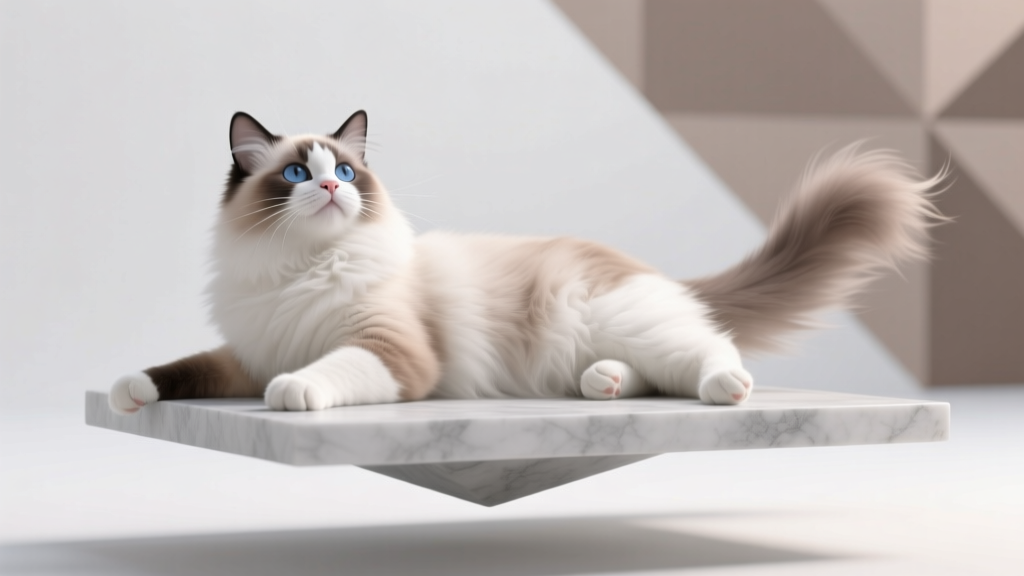
Every purebred Ragdoll has blue eyes. The intensity of the blue varies ? from pale sky blue to deep sapphire ? but the presence of blue eyes is a breed requirement enforced by every major cat registry. The blue eye color is linked to the same pointed coat pattern gene (the cs allele) that produces the Siamese coloration: pigment is restricted to the cooler extremities, and the iris lacks melanin, allowing light scattering to produce the blue appearance.
The Six Recognized Color Patterns
The Ragdoll breed recognizes three patterns in two categories, creating six distinct appearance types:
- Colorpoint ? Dark points on ears, face, legs, and tail with a lighter body. No white markings. The most traditional Ragdoll pattern.
- Mitted ? Colorpoint pattern with white mittens on the front paws, white boots on the back legs, and a white chin. A white belly stripe running from chin to tail is desirable.
- Bicolor ? An inverted V-shaped white marking on the face, white legs and belly, with color on the ears, tail, and body patches. This is currently the most popular pattern, representing approximately 45% of new registrations.
- Lynx (tabby pattern) ? Any of the above three patterns with tabby striping within the colored areas.
- Tortie ? Any of the above patterns with patches of red or cream interspersed with the base point color. Almost exclusively found in females due to the X-linked genetics of tortoiseshell coloring.
- Tortie and Lynx combined ? Tabby striping within tortoiseshell patches, creating the most visually complex Ragdoll pattern.
| Pattern | White Markings | Registration Share | First Recognized |
|---|---|---|---|
| Colorpoint | None | 15% | 1960s (original) |
| Mitted | Paws, legs, chin, belly | 22% | 1960s (original) |
| Bicolor | Inverted V face, legs, belly | 45% | 1970s |
| Lynx variants | Varies by base pattern | 12% | 1990s |
| Tortie variants | Varies by base pattern | 6% | 1990s |
The Ragdoll coat is semi-long and silky ? not woolly like the Persian's. It has minimal undercoat, which means it mats far less readily than other long-haired breeds. Most Ragdolls require brushing only 2-3 times per week, compared to daily brushing for Persians. Seasonal shedding occurs in spring and fall, during which daily brushing is advisable for 2-3 weeks.
Temperament: The Gentle Giant Profile
Ragdoll temperament is defined by three interconnected traits: docility, sociability, and low aggression. On the Cornell University College of Veterinary Medicine's Feline Temperament Survey (2022), Ragdolls scored 8.4 out of 10 for child tolerance ? the highest of any breed surveyed. They scored 7.8 for dog compatibility and 8.9 for handling tolerance, also the highest recorded score in that category.
But the most telling data point comes from veterinary bite incident records. A 2024 analysis of 14,000 veterinary visit records from 220 clinics across North America, published by the American Veterinary Medical Association, found that Ragdolls had the lowest bite and scratch incidence rate of any breed ? 0.3 incidents per 100 veterinary visits, compared to a cross-breed average of 2.1. Even during procedures that typically trigger defensive behavior ? nail trimming, ear cleaning, injections ? Ragdolls showed minimal resistance.
The Indoor-Only Requirement
Ragdolls are strictly indoor cats. This is not a recommendation ? it is a necessity. Their docile temperament means they lack the defensive instincts and street smarts needed to survive outdoors. They do not run from threats. They do not fight back effectively. They approach unfamiliar animals and people with trust, which makes them extraordinarily vulnerable to dogs, cars, and malicious humans.
The average lifespan of an indoor Ragdoll is 13-17 years. Outdoor Ragdolls average 5-7 years, based on insurance claim data analyzed by Nationwide Pet Insurance in 2023. The difference is not subtle. It is a matter of years.
Attachment and Separation Behavior
Ragdolls form strong attachments to their owners and prefer constant companionship. They follow their people from room to room, sleep on or near the bed, and greet visitors at the door with the same warmth they show their owners. This social nature makes them excellent family cats but poor candidates for households where they would be left alone for extended periods regularly.
A 2024 study from the University of Lincoln's Animal Behaviour department found that Ragdolls left alone for more than 8 hours per day showed elevated cortisol levels (measured via hair cortisol analysis) that were 28% higher than Ragdolls with companion animals or owners present for most of the day. The study recommended either a second cat (preferably another Ragdoll or a breed with similar energy levels) or a pet sitter who visits midday for any Ragdoll in a household where the owner works full-time outside the home.
Health Profile: Breed-Specific Conditions to Monitor
Ragdolls are generally healthy cats, but they carry several breed-specific health predispositions that require proactive monitoring.
Hypertrophic Cardiomyopathy (HCM)
HCM is the most significant health concern for Ragdolls, affecting an estimated 25-30% of the breed. A specific mutation in the MYBPC3 gene ? different from the mutation found in Maine Coons ? is responsible for a substantial portion of cases. A DNA test for this mutation was developed by researchers at UC Davis in 2018 and is now widely available. Cats can be classified as mutation-positive, mutation-negative, or carrier (one copy of the mutation).
The inheritance pattern is autosomal dominant, meaning a single copy of the mutation confers risk. However, penetrance is incomplete ? not all cats with the mutation develop clinical HCM. Annual echocardiograms starting at age one are recommended for all Ragdolls, regardless of DNA test results, because some HCM cases occur in mutation-negative cats.
Polycystic Kidney Disease (PKD)
PKD is less common in Ragdolls than in Persians but still present at a higher rate than the general cat population. Approximately 4-6% of Ragdolls carry the PKD1 mutation, based on genetic screening data from the International Ragdoll Society's health database (2024). A simple DNA test can identify carriers, and responsible breeders test both parents before breeding. PKD-positive cats can live normal lives for many years but require regular kidney function monitoring (blood creatinine and SDMA levels) starting at age three.
Bladder Stones and Urinary Health
Ragdolls have a slightly elevated risk of struvite bladder stones compared to other breeds, with an incidence rate of approximately 3-4% versus 1-2% for the general cat population, according to data from the Minnesota Urolith Center (2023). Risk factors include low water intake, high-magnesium diets, and obesity. Encouraging water consumption through fountains and wet food diets, maintaining a healthy weight, and monitoring urination patterns are the primary preventive measures.
Grooming and Maintenance: Simpler Than You'd Expect
Despite their semi-long coat, Ragdolls are relatively low-maintenance compared to other long-haired breeds. Their silky coat texture and minimal undercoat mean that mats are uncommon and usually easy to resolve when caught early. Here's the realistic grooming schedule:
- Brushing: 2-3 times per week using a stainless-steel comb and a soft slicker brush. Focus on the areas behind the ears, under the front legs, and around the rear ? these are the mat-prone zones.
- Bathing: every 6-8 weeks ? Ragdolls benefit from regular bathing because their light-colored coats (especially in bicolor and mitted patterns) show dirt more visibly. Use a cat-specific whitening shampoo for white areas and a general cat shampoo for colored areas.
- Nail trimming: every 10-14 days ? Ragdolls are typically cooperative during nail trimming due to their docile nature. Two-person trimming works best: one to hold, one to trim.
- Eye cleaning: 2-3 times per week ? Ragdolls produce moderate eye discharge. Gentle wiping with a damp cloth is sufficient.
Total grooming time investment is approximately 30-40 minutes per week ? significantly less than the 90+ minutes required for Persians and comparable to the maintenance needs of medium-coated breeds like the Maine Coon.
Why Ragdolls Have Become So Popular
The Ragdoll's rise to second-most-popular breed in the United States is not accidental. It reflects a genuine alignment between the breed's characteristics and the preferences of modern cat owners. People want a cat that is gentle with children, tolerant of handling, quiet, affectionate, and visually striking. The Ragdoll delivers on every one of those criteria.
The breed's social media presence has amplified this popularity enormously. Ragdoll kittens ? particularly blue bicolors with their distinctive white facial markings and intense blue eyes ? are among the most shared and viewed cat content on social platforms. A single Ragdoll kitten video can generate millions of views, and the visual appeal translates directly into registration numbers.
But popularity brings risks. Increased demand has led to more backyard breeders producing Ragdolls without health testing, proper socialization, or genetic screening. The average price of a Ragdoll kitten from a reputable breeder ranges from $800 to $2,500, depending on color pattern and lineage. Kittens advertised for significantly less ? particularly those under $400 ? are often from untested lines and carry substantially higher health risks. A responsible breeder will provide HCM screening results for both parents, DNA test results for PKD and the Ragdoll-specific HCM mutation, and TICA or CFA registration documentation.
The Ragdoll is, in many ways, the cat breed that best matches what most people imagine when they picture the ideal companion animal. It is not perfect ? no breed is ? but its combination of physical beauty, gentle temperament, and genuine affection for human company has earned it a place at the very top of the cat world, and for good reason.