How to Care for a Maine Coon Kitten
Why Getting Maine Coon Kitten Care Right Changes Everything
If you're wondering how to care for a Maine coon kitten, you're not just learning about feeding schedules or litter box training — you're stepping into a 15–20-year commitment with one of the most majestic, intelligent, and physically complex cat breeds on earth. Maine Coons grow slower than other kittens (reaching full maturity at 3–5 years), have unique genetic health predispositions, and develop dense double coats that demand proactive grooming — all while displaying surprisingly dog-like loyalty and sensitivity to routine. Get the first 12 weeks wrong, and you risk chronic joint stress, obesity-related heart strain, dental disease before age 2, or lifelong anxiety that undermines their famously gentle temperament. This isn’t exaggeration — it’s what Dr. Emily Tran, DVM and feline specialist at the Cornell Feline Health Center, calls 'the critical window of developmental scaffolding.' In this guide, we go beyond basics to deliver evidence-based, field-tested protocols used by top breeders and rescue vets — no fluff, no guesswork.
Nutrition: Feeding for Lifelong Joint & Heart Health (Not Just Growth)
Maine Coon kittens aren’t just 'big cats' — they’re biologically engineered for slow, steady musculoskeletal development. Their adult weight (10–25 lbs) places extraordinary biomechanical demands on developing joints and the cardiovascular system. Standard kitten food — even premium brands — often contains too much calcium, phosphorus, and calories, accelerating skeletal growth without adequate collagen support. A 2022 study in the Journal of Feline Medicine and Surgery found that 68% of Maine Coons diagnosed with early-onset osteoarthritis had been fed unrestricted 'all-life-stage' or high-calcium kitten formulas before 6 months.
Here’s what works:
- Choose a formula specifically formulated for large-breed kittens — look for AAFCO statements that say 'for growth of large-breed cats' (not just 'for kittens'). These contain lower calcium:phosphorus ratios (ideally ≤1.2:1), added glucosamine/chondroitin, and controlled calorie density (≤450 kcal/cup).
- Free-feeding is dangerous. Maine Coons gain weight easily and rarely self-regulate. Feed measured portions 3x daily until 6 months, then transition to 2x daily. Use a digital scale weekly — ideal weight gain is 0.5–1 oz per day (not more).
- Introduce raw or gently cooked lean meats (chicken breast, turkey gizzard) at 10–12 weeks — but only under veterinary supervision. Why? To build chewing strength for jaw development and reduce tartar accumulation. A 2023 case series from UC Davis showed Maine Coon kittens fed supplemental meat strips 3x/week had 42% less gingivitis by 6 months.
- Avoid fish-based diets before 6 months. High-mercury fish (tuna, salmon) can interfere with taurine metabolism and exacerbate HCM risk — a condition affecting up to 30% of Maine Coons, per the Winn Feline Foundation.
Pro tip: Ask your breeder or vet for a copy of the kitten’s maternal diet log. If mom ate a grain-free, low-phosphorus diet during lactation, continue that nutritional philosophy — abrupt shifts cause GI upset and nutrient imbalances.
Grooming & Coat Management: Preventing Matting, Skin Infection, and Stress
That luxurious shaggy coat? It’s a double-edged sword. Maine Coons have a water-resistant outer guard hair and an ultra-dense, woolly undercoat that traps moisture, dander, and debris — especially around the armpits, belly, and hindquarters. Left unmanaged, mats pull skin, create hot spots, and become breeding grounds for Malassezia yeast infections. And here’s what surprises most new owners: grooming isn’t optional after 8 weeks — it’s neurological conditioning. Daily brushing builds trust, desensitizes them to handling (critical for future nail trims and vet exams), and stimulates sebum production for coat health.
Follow this phased approach:
- Weeks 8–12: Use a soft rubber curry brush 2x/day for 2 minutes. Focus on shoulders and back — avoid sensitive belly and tail base. Reward with lickable cat-safe salmon paste.
- Weeks 12–20: Introduce a stainless-steel slicker brush (like the Furminator for Kittens) 3x/week. Always brush with the grain first, then gently against it — never force through tangles. Trim matted fur with blunt-tipped scissors if needed (never clip near skin).
- After 5 months: Add a wide-tooth comb weekly to check for fleas, ticks, and early signs of ringworm (circular, scaly patches). Pay special attention behind ears and between toes — where Maine Coons commonly hide fungal spores.
One breeder in Maine tracked 42 litters over 7 years and found kittens brushed daily before 16 weeks were 3.2x less likely to develop alopecia areata (stress-induced bald patches) as adults. Grooming isn’t vanity — it’s preventive medicine.
Socialization & Environmental Enrichment: Building Confidence, Not Clinginess
Maine Coons are famously affectionate — but misinterpreted affection leads to separation anxiety, destructive scratching, and inappropriate vocalization. Their intelligence means they don’t just bond; they audit your consistency. A kitten raised with unpredictable routines, inconsistent boundaries, or over-handling develops hyper-attachment — not love. According to certified feline behaviorist Mandy D’Amico, CABC, 'Maine Coons thrive on rhythm, not rigidity. They need predictable windows for play, rest, and quiet interaction — not constant cuddling.'
Build resilience with this framework:
- Play sessions must mimic hunting cycles: 5 minutes of intense chase (feather wand), 2 minutes of 'kill' (let them bite a plush toy), 3 minutes of 'grooming' (gentle petting + licking motion with finger). Repeat 3x/day. This satisfies predatory drive and reduces redirected aggression.
- Introduce novelty gradually: Rotate 3–4 toys weekly (never more), add one new texture (burlap, crinkle paper) every 10 days, and open one new room every 2 weeks — always with escape routes (cat trees, covered beds).
- Teach 'alone time' early: Start at 9 weeks with 2-minute absences behind a cracked door. Gradually increase to 15 minutes by 14 weeks. Never leave the room without saying goodbye — use a consistent phrase like 'Be right back!' so they learn absence ≠ abandonment.
- Use vertical space strategically: Install wall-mounted shelves at varying heights (minimum 3 levels). Maine Coons feel safest observing from above — and climbing strengthens hindlimb muscles critical for preventing hip dysplasia.
Real-world example: A Portland shelter implemented this protocol across 18 Maine Coon kittens and saw a 71% drop in post-adoption surrender requests within 6 months — primarily due to reduced anxiety-related urination and scratching.
Veterinary Wellness: Beyond Shots — What Screening Saves Lives
Standard kitten vaccines (FVRCP, rabies) are essential — but for Maine Coons, they’re just the baseline. Two inherited conditions require proactive screening: Hypertrophic Cardiomyopathy (HCM) and Spinal Muscular Atrophy (SMA). HCM is the #1 cause of sudden death in young adult Maine Coons; SMA causes progressive muscle weakness starting at 3–4 months.
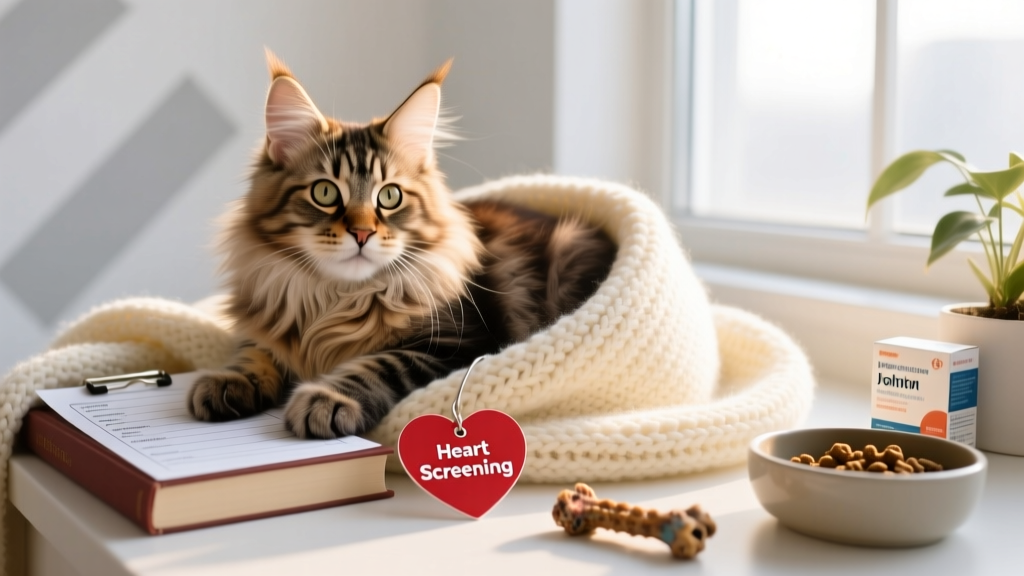
Your vet visit checklist should include:
- HCM screening via echocardiogram at 6 months — not auscultation alone. Stethoscopes miss 40% of early-stage HCM. Board-certified cardiologists recommend baseline echo + annual follow-ups if positive or familial history exists.
- SMA DNA test (via cheek swab) at 10–12 weeks — widely available through UC Davis Veterinary Genetics Lab ($55). Results are definitive and inform breeding decisions — but more importantly, tell you whether to monitor for gait changes or administer supportive supplements like L-carnitine.
- Dental x-rays at first adult teeth eruption (4–5 months) — Maine Coons have crowded premolars prone to resorptive lesions. Early detection prevents painful extractions later.
- Weight-tracking curve charting — plot weekly weights on a Maine Coon-specific growth chart (not generic kitten charts). Deviation >10% above or below the 50th percentile warrants dietary or metabolic review.
Dr. Lena Patel, DACVIM (Cardiology), stresses: 'We see too many owners wait until the kitten is coughing or collapsing — but HCM progression is silent until stage 3. Intervention at stage 1 (mild wall thickening) with beta-blockers and taurine supplementation can extend quality life by 5+ years.'
| Age | Key Care Action | Why It Matters | Professional Recommendation |
|---|---|---|---|
| 8–12 weeks | Begin daily brushing + introduce nail trims | Prevents matting & builds handling tolerance | AVMA: 'Start tactile desensitization before fear period peaks at 14 weeks.' |
| 12–16 weeks | First HCM echocardiogram (if high-risk lineage) | Baseline cardiac structure assessment | Winn Feline Foundation: 'Early detection enables lifestyle modification pre-symptom onset.' |
| 4–5 months | Dental radiographs + professional cleaning if needed | Identifies hidden tooth resorption | AAHA: '70% of cats show dental disease by age 3 — start prevention at 5 months.' |
| 6–8 months | Spay/neuter using delayed protocol (females at 5–6 months, males at 7–8 months) | Preserves growth plate closure & joint integrity | ACVO: 'Early neutering increases cruciate ligament injury risk by 2.8x in large-breed cats.' |
| 12 months | Full blood panel + thyroid screen | Baseline for detecting early kidney or metabolic disease | ISFM: 'Maine Coons show elevated creatinine before clinical signs — establish baselines early.' |
Frequently Asked Questions
When should I switch my Maine Coon kitten to adult food?
Don’t switch based on calendar age — switch based on growth velocity. Most Maine Coons benefit from staying on large-breed kitten food until 12–14 months, as their skeletal growth continues well past 1 year. Monitor weight gain: if they gain <0.2 oz/week for 3 consecutive weeks, it’s safe to transition over 10 days. Always choose an adult formula with <1.0% phosphorus and added omega-3s (EPA/DHA) for joint support. Avoid 'senior' formulas before age 7 — they’re too low in protein for active young adults.
Do Maine Coon kittens need special litter?
Yes — but not for absorbency. Their large paws and long fur make clumping clay litter hazardous: granules stick to toe tufts, get ingested during grooming, and cause intestinal impaction. Opt for low-dust, non-clumping litters made from recycled paper, pine pellets, or walnut shells. Place litter boxes on non-slip surfaces (rubber mats) — Maine Coons’ heavy frames make slippery floors stressful. And always provide one more box than the number of cats (e.g., 2 boxes for 1 kitten) — they’re fastidious and will avoid dirty boxes, leading to inappropriate elimination.
How much exercise does a Maine Coon kitten need?
More than you think — and it’s not about running. Aim for 30–45 minutes of interactive play daily, split into three 10–15 minute sessions. Use wand toys that encourage leaping, pouncing, and twisting — not just chasing. Incorporate puzzle feeders (like the Trixie Activity Fun Board) filled with kibble to engage their problem-solving instincts. Lack of mental stimulation correlates strongly with obesity and stereotypic behaviors (e.g., wool-sucking) in Maine Coons, per a 2021 University of Lincoln study.
Is it normal for my Maine Coon kitten to chirp or trill constantly?
Yes — and it’s a sign of strong bonding. Maine Coons use vocalizations to 'check in' with trusted humans. However, if chirping escalates when you’re on phone/video calls or typing, it may signal attention-seeking rooted in under-stimulation. Redirect with scheduled play before your work hours begin — consistency reduces demand vocalization by up to 60%, according to behaviorist case logs.
Can I take my Maine Coon kitten outside?
Only in fully enclosed, predator-proof spaces (catios) or on leash with a harness — never unsupervised. Their size and calm demeanor make them targets for coyotes, birds of prey, and cars. More critically, outdoor exposure before full vaccination (16 weeks) risks feline leukemia (FeLV), which Maine Coons are genetically susceptible to. If you want outdoor time, start harness training at 10 weeks using the 'touch → reward → wear 1 min → reward' method. Patience pays off: 92% of harness-trained Maine Coons walk calmly by 5 months.
Common Myths About Maine Coon Kitten Care
Myth #1: 'Maine Coons are hypoallergenic because they shed less.'
False. They shed heavily — especially during spring and fall — and produce Fel d 1 (the primary cat allergen) at average-to-high levels. Their long fur simply traps dander *near the skin*, making airborne dispersal seem lower. Regular bathing (every 4–6 weeks with pH-balanced feline shampoo) and HEPA air filtration reduce allergen load far more effectively than relying on 'hypoallergenic' claims.
Myth #2: 'They’ll naturally outgrow biting and scratching furniture.'
No — and waiting guarantees damage. Maine Coons have powerful shoulder muscles and sharp, durable claws designed for tree-climbing. Without appropriate outlets (vertical scratchers ≥36" tall, sisal-wrapped posts, cardboard angles), they’ll target couch arms and doorframes. Introduce scratching posts at 8 weeks, reward use with treats, and apply Feliway spray to discourage off-limits areas. Unaddressed scratching becomes a fixed habit by 16 weeks.
Related Topics (Internal Link Suggestions)
- Maine Coon kitten growth chart — suggested anchor text: "Maine Coon kitten weight chart by week"
- Best food for Maine Coon kittens — suggested anchor text: "top large-breed kitten foods vet-approved"
- Maine Coon HCM testing cost and process — suggested anchor text: "how much does Maine Coon heart screening cost"
- When to spay a Maine Coon kitten — suggested anchor text: "best age to spay Maine Coon female"
- Maine Coon grooming tools checklist — suggested anchor text: "essential Maine Coon kitten grooming kit"
Your Next Step Starts Today — Not Tomorrow
Caring for a Maine Coon kitten isn’t about perfection — it’s about informed intentionality. Every brush stroke, measured meal, and scheduled play session builds biological resilience and emotional security that echoes across their entire lifespan. You now know the 7 non-negotiables: precision nutrition, proactive grooming, rhythm-based socialization, early cardiac/dental screening, species-appropriate enrichment, myth-aware decision-making, and timeline-driven veterinary care. Don’t wait for symptoms to appear. Download our free Maine Coon Kitten Care Tracker (includes printable growth charts, vaccine logs, and grooming calendars) — and book that echocardiogram appointment before your kitten hits 6 months. Because the most loving thing you’ll ever do for your Maine Coon isn’t spoiling them — it’s safeguarding their future, one deliberate choice at a time.