Why Cats Sit on the Porch Rocking Chair
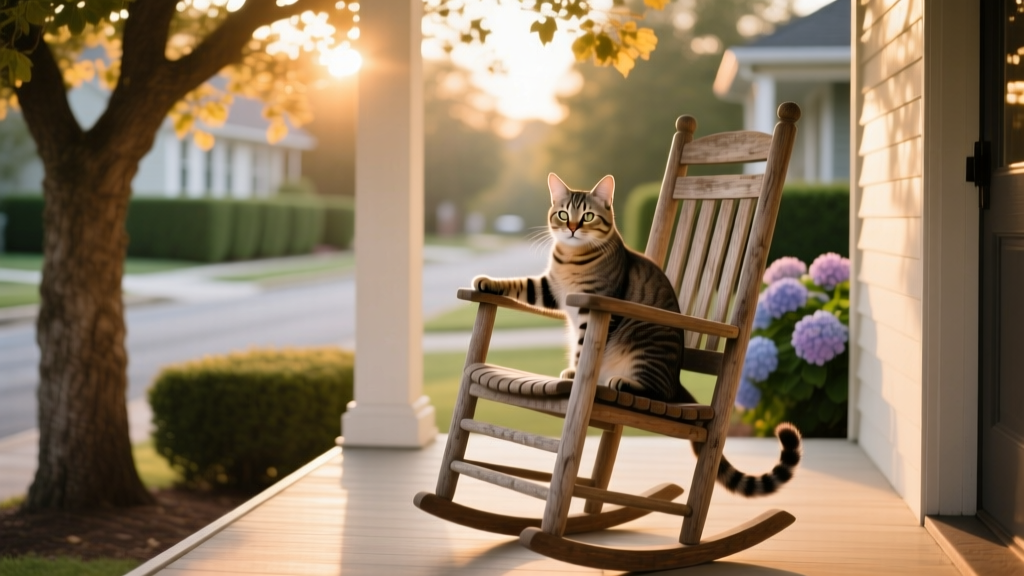
You step outside with your coffee, expecting a quiet morning… and there’s your cat. Not on the porch mat. Not in the sunny patch by the steps. On the rocking chair—like they pay rent and have strong opinions about neighborhood squirrels. Maybe they’re loafed dead center on the seat. Maybe they’re draped along the backrest like a tiny, furry king. If you try to sit down, they blink slowly as if to say, “Oh, were you planning to use my chair?”
This is one of those delightfully specific cat behaviors that feels random until you look at it through a cat’s eyes. Rocking chairs combine everything many cats love: elevation, comfort, scent, a good view, and a little movement they can control. Here’s what’s really going on—and what it can tell you about your cat’s mood, needs, and inner porch philosophy.
The scientific (and evolutionary) reasons cats love rocking chairs
Cats are small predators with a prey-animal nervous system. That mix makes them obsessed with two things: control and information. In nature, survival favors cats who can watch an area without being easily approached, choose a comfortable resting spot that conserves energy, and claim safe territory with scent.
A porch rocking chair checks all those boxes:
- Elevation and vantage point: Even a few inches higher gives a cat a better view of the yard, driveway, street, and any birds that have the audacity to exist.
- Back protection: A chair back creates a “solid wall” behind them. Many cats relax more when they can’t be approached from all angles.
- Comfortable, insulating surface: Wood, fabric cushions, and curved seats can be warmer and softer than porch floors—especially early morning or cool evenings.
- Territory and scent signaling: Cats deposit facial pheromones by rubbing, and they leave scent from paws and body. Sitting in a “favorite human chair” can be social bonding and a territorial statement.
- Movement feedback: The gentle motion of a rocker can be soothing, like a self-induced “purr-worthy” vibration. Some cats enjoy controlling that movement with tiny shifts of weight.
From a behavioral science angle, there’s also a learning component: if sitting on the chair consistently results in good things (sun warmth, attention from you, interesting sights, or fewer disturbances), the behavior gets reinforced. Cats are excellent at repeating what works.
Different contexts: what “rocking chair sitting” can look like and why
Not all rocking-chair cats are doing it for the same reason. The details matter. Here are common scenarios and what’s likely motivating your cat.
1) The “Neighborhood Watch” sit
Your cat sits upright, ears swiveling like satellite dishes. They track movement, head-bobbing at birds, tail tip twitching.
What’s happening: This is prime “survey the territory” behavior. The chair offers an observation post where they can monitor potential threats (dogs, unfamiliar people) and potential prey (squirrels, bugs, leaves that look suspiciously like bugs).
2) The “Sun-Soaked Loaf”
Your cat is in full loaf mode, paws tucked, eyes half-closed, soaking up warmth on the cushion.
What’s happening: Heat conservation and comfort. Cats naturally seek warm spots to support metabolism and relaxation. A porch chair often gets a perfect slice of sun without the hard surface of decking.
3) The “Scent Swap” claim
Your cat rubs their cheeks on the chair arm, kneads the cushion, then settles in like a landlord.
What’s happening: Social and territorial scent mixing. By placing their scent where you sit, they create a shared group scent—think “family uniform,” but invisible. It can also be mild resource claiming: “This is a safe, important spot.”
4) The “Human-Proximity Compromise”
Your cat stays near you but not on your lap. They choose the chair right next to where you stand or sit.
What’s happening: Many cats love closeness on their terms. The rocking chair lets them be near you, watch you, and receive occasional pets—without feeling restrained.
5) The “Movement Enthusiast”
Your cat shifts and the chair rocks. They pause, then deliberately shift again to keep it moving.
What’s happening: Some cats enjoy rhythmic motion. It may be soothing, like purring or kneading. In multi-cat homes, it can also be a tiny “I control this space” demonstration—cats enjoy predictable cause-and-effect.
What this behavior says about your cat’s mood and feelings
Think of the rocking chair as a mood billboard. The same location can mean different things depending on posture, facial expression, and responsiveness.
- Relaxed and content: Soft eyes, slow blinking, loose body, tail resting still. They may even flop onto one side. This is a cat who feels safe.
- Curious and engaged: Upright posture, ears forward, tail tip twitching. They’re mentally “hunting” with their eyes.
- Seeking security: Tucked posture, body pressed into the corner of the chair, ears rotating back and forth. This can show mild uncertainty—like when a new neighbor’s dog appears regularly.
- Possessive or overstimulated: Stiff body, quick tail swishes, dilated pupils, low growl if approached. This can happen if the chair has become a high-value resource, especially in multi-pet homes.
- Social and affectionate (in cat language): Head bunting the chair arm after you touch it, rolling onto their back briefly, slow blinking at you. They’re linking you with the safe spot.
If your cat chooses the rocking chair when you come outside, it’s often a compliment: “I want to be near you, and I want to feel in control while I do it.” That’s very cat.
Related behaviors you might also notice
Cats rarely have just one “porch chair” habit. If your cat loves the rocker, you might see:
- Perching on railings, steps, or outdoor tables for the same vantage point benefits.
- “Claiming” freshly used items (your hoodie, your seat on the couch) because warm + your scent = premium real estate.
- Kneading on cushions which can be comfort behavior and also scent marking via paw glands.
- Face rubbing on chair legs/arms to deposit friendly pheromones and label the area as safe.
- Doorway lounging—cats love thresholds because they can monitor two zones at once (inside and outside).
- Chattering at birds while seated in their “watchtower.”
When it’s normal… and when it might be a concern
Most porch rocking-chair sitting is perfectly normal, even healthy. It can be enrichment: fresh air, mental stimulation, sunlight, and a predictable “safe base.”
Consider a closer look if you notice any of these:
- Sudden change in behavior: A cat who never sits outside suddenly camps on the chair all day, or a social cat becomes withdrawn and hides on the chair.
- Signs of pain or stiffness: Hesitation jumping up, yowling when touched, awkward posture, or grooming less. A chair might be chosen because it’s easier on sore joints than the ground.
- Obsessive vigilance: Constant scanning, inability to settle, overreacting to minor noises. This can suggest anxiety or a new outdoor stressor (stray cats, construction, predators).
- Aggression around the chair: Guarding, swatting, or attacking other pets or people who approach. This can indicate resource guarding or heightened stress.
- Risk factors outdoors: If the porch isn’t enclosed and your cat is unsupervised, the chair becomes a “launchpad” into unsafe territory (traffic, dogs, wildlife, parasites, toxic plants).
If you’re seeing pain signs, a vet check is worth it. If it’s mainly stress or guarding, a behavior plan can help—often without “banning” the chair.
How to respond (and how to encourage it in a cat-friendly way)
If your cat’s rocking-chair habit is safe and peaceful, you don’t need to fix it—you can support it. A few small tweaks can make it better for both of you.
- Create a designated “cat section”: Add a washable blanket or small pet pad to one side of the chair. This helps with fur management and gives them a consistent target.
- Offer an alternative perch: A second chair, sturdy stool, or outdoor cat perch nearby reduces resource guarding and gives you somewhere to sit without negotiations.
- Pair the chair with calm enrichment: Sprinkle a few treats on the chair occasionally, or provide a puzzle feeder outside during supervised porch time.
- Reinforce polite sharing: If you want your seat back, call your cat calmly, lure them with a treat to a nearby mat, and reward. Avoid pushing or startling them off—cats remember “chair drama.”
- Keep it secure: Make sure the chair is stable and won’t pinch tails or toes. Some rocking chairs have gaps that can snag claws, especially if your cat kneads and shifts.
- Make porch time predictable: Cats love routine. A consistent morning or evening “porch hang” can reduce attention-seeking meowing at the door.
If your cat is anxious on the porch, try reducing visual stress: a privacy screen, placing the chair farther from the edge, or providing a covered “hide” (like a weatherproof cat house) can help them feel less exposed.
Fun facts and research-flavored tidbits
- Cats are “sit with support” specialists: Many cats prefer resting with a solid surface behind or beside them. It’s a security preference you’ll also see when they wedge themselves between couch cushions or choose the far end of a bench.
- Scent is social glue: Friendly cats in the same household often share scent by rubbing on common objects. Your chair becomes a community bulletin board: “This is our safe spot.”
- Gentle motion can be self-soothing: While we don’t have “rocking chair studies” specifically for cats, rhythmic movement is widely used across species to downshift arousal. If your cat looks extra blissed-out when the chair rocks, you’re watching a calming feedback loop in action.
- Porches are scent-rich environments: Outdoor air carries more complex smells than indoor air—plants, other animals, weather changes. For cats, that’s like scrolling a very dramatic newsfeed.
FAQ: common questions about cats and rocking chairs
1) Is my cat claiming the rocking chair as “theirs”?
Sometimes, yes—mostly in a harmless way. Cats mark spaces with scent and repeat what feels safe. If they allow you to approach, pet them, or they move with a little encouragement, it’s more “favorite spot” than serious guarding.
2) Why does my cat sit there even when it’s not sunny?
Warmth is only one perk. The chair may offer the best view, the strongest “family scent,” or the most comfortable shape. Also, cats build habits around locations that reliably feel safe.
3) My cat kneads the cushion—are they trying to destroy it?
Kneading is usually comfort behavior and can also spread scent from paw glands. If claws are an issue, add a thick blanket and keep nails trimmed. A nearby scratching post can redirect some of that urge.
4) Should I let my cat sleep on the porch chair overnight?
Only if the porch is fully enclosed and safe (temperature, predators, other animals, and escape routes all controlled). Many cats love nighttime porch time, but unsupervised outdoor access can be risky. A secure “catio” setup is the safest compromise.
5) My cat hisses when I try to sit down—what do I do?
Don’t punish. Hissing is distance-increasing communication. Instead, lure your cat to an alternative spot and reward them there. Add a second perch, increase enrichment, and consider whether another pet or outdoor stressor is raising their tension.
6) Can this be a sign my cat is bored?
It can be the opposite—porch sitting is often great enrichment. But if your cat is obsessively watching, pacing, or vocalizing at outdoor triggers, they may need more indoor enrichment (play sessions, food puzzles, climbing options) and a calmer porch routine.
When a cat chooses the porch rocking chair, they’re not being “weird.” They’re being deeply cat: seeking comfort, control, information, and a little connection with you—all from the best seat in the house.
Does your cat have a favorite porch throne, a specific chair they’ve claimed, or a funny rocking-chair routine (extra points if they rock it themselves)? Share your story with fellow cat people on catloversbase.com—we’d love to hear what your porch supervisor has been up to.