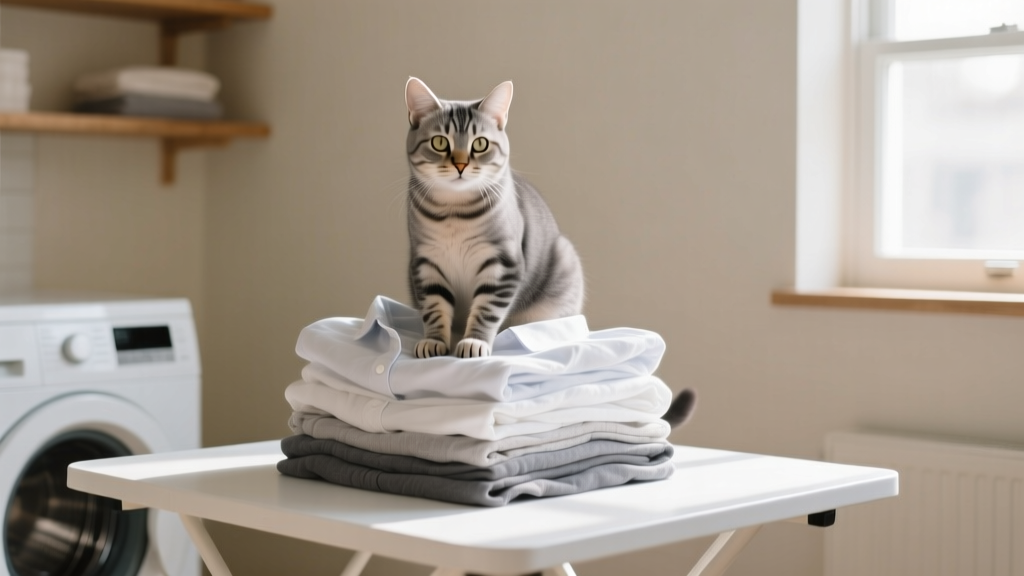
Why Cats Sit on the Laundry Room Sorting Table
You walk into the laundry room with a basket of freshly washed clothes, ready to sort socks like a responsible adult. And there’s your cat—perched smack in the middle of the sorting table as if they’ve been appointed Supervisor of Laundry Operations. You move a towel. They scoot two inches and re-settle. You try the “gentle shoo.” They blink slowly, knead once, and remain exactly where they are. Somehow, the table is now their table.
If this scene feels familiar, you’re not alone. Cats are famously drawn to laundry zones—especially the flat surface you’re trying to use. It can look like stubbornness (or comedy), but there are some very cat-logical reasons behind this choice.
1) The Scientific (and Evolutionary) “Why” Behind the Sorting Table Sit-In
Cats are both predators and prey in the evolutionary sense. Even our pampered house cats retain instincts that say: find a safe vantage point, monitor the environment, conserve energy, and keep tabs on valuable resources (including you). A laundry room sorting table checks several boxes:
- Elevation and visibility: A raised surface gives a cat a better view of entrances, movement, and potential “threats” (like the rumbling washer). Height equals confidence in cat psychology.
- Warmth and comfort: Laundry rooms often contain warm appliances. Even if the table itself isn’t heated, the room may be cozier than other spaces. Plus, fabrics often hold heat.
- Scent concentration: Laundry is a scent buffet—your scent, other family members’ scent, outdoor traces, detergent fragrances. Cats experience the world through smell, and your clothing smells like their social group.
- Territory and resource control: Cats like to claim important “stations” in the home. If you repeatedly go to one spot and do a focused activity there, it becomes meaningful in the cat’s mental map.
In short: the sorting table is high-value real estate. It’s stable, predictable, and filled with information.
2) A Detailed Breakdown: Different Contexts, Different Motivations
Not every laundry-table sit is the same. The details matter—what your cat is doing with their body, what’s happening in the room, and what the table currently holds.
The “Warm Laundry Magnet” Scenario
You’ve just dumped a heap of warm towels on the table. Your cat appears within seconds, circles once, and collapses like a fuzzy pancake.
What’s driving it: warmth-seeking behavior plus the comforting pressure of a soft pile. Many cats adore the gentle resistance of folded (or unfolded) laundry under their paws. The kneading you see is often leftover kitten behavior—an instinct tied to comfort and safety.
The “You’re Doing Something Interesting” Scenario
You’re sorting, folding, pairing socks, making neat stacks. Your cat hops up, watches intently, then sits right on the shirt you were about to fold.
What’s driving it: social attention and participation. Cats are not always “helpful,” but they are relational. If you’re focused on a task, some cats try to insert themselves into the center of that focus. Sitting on the laundry is a very cat-like way of saying, “I’d like to be included.”
The “New Smells Have Arrived” Scenario
You brought home gym clothes, a jacket from a friend’s house, or bedding from a trip. Your cat hops up and starts sniffing like a detective, then settles on top of it.
What’s driving it: information gathering and scent mixing. Cats use scent to understand “who” and “where.” By sitting on items that carry unfamiliar smells, they may be attempting to blend that scent into the home’s familiar odor profile—part curiosity, part territorial housekeeping.
The “This Room Is My Safe Post” Scenario
Your cat routinely retreats to the laundry room even when you’re not folding. They sit on the table at certain times of day, especially during busy household moments.
What’s driving it: a predictable perch. Laundry rooms are often quiet and low-traffic, tucked away from visitors. Your cat may have selected it as a “secure checkpoint” for resting while still staying aware.
The “Block the Work, Control the Humans” Scenario
Your cat sits exactly where your hands need to go and politely refuses to move. When you lift them, they return immediately.
What’s driving it: learned success. If sitting there reliably earns attention—talking, petting, lifting, negotiating—your cat may repeat the behavior because it works. Cats are excellent at training humans with tiny, consistent actions.
3) What This Behavior Suggests About Your Cat’s Mood and Feelings
Think of the sorting-table sit as a “headline,” and your cat’s body language as the “full article.” Here are common emotional states, translated from feline body cues:
- Relaxed and content: Loose posture, paws tucked (“cat loaf”), slow blinking, gentle kneading, tail resting still. The table is a comfort zone.
- Affectionate and socially curious: Cat faces you, rubs cheeks on items, chirps or trills, follows you into the room and stays close. They want connection, not just a nap spot.
- Slightly overstimulated or uncertain: Ears swiveling, body tense, tail flicking, frequent scanning. The table may feel like a safer observation post.
- Possessive or guarding: Cat stiffens when you approach, hovers over the laundry, swats at hands, or blocks access. This can be mild resource guarding, especially if the pile contains a favored blanket or a person’s clothing they’re strongly bonded to.
Most of the time, a cat sitting on the sorting table is a sign they feel safe enough to hang out near you—and confident enough to claim a prime spot.
4) Related Behaviors You Might Also Notice
If your cat loves the laundry sorting table, you may also recognize these classics:
- Sitting on clean clothes (specifically the clean ones): Crisp textures hold scent differently, and the “freshness” can be intriguing—or your cat may simply prefer the fluffiest pile.
- Sleeping in baskets, boxes, or empty hampers: Enclosed spaces feel secure, and cats enjoy boundaries around their body.
- Rubbing on folded stacks: Cheek rubbing deposits friendly pheromones from facial glands. It’s a cat’s way of saying “this belongs to us.”
- Following you into small work zones: Kitchens, bathrooms, closets—cats love being where humans do routine tasks. Predictability is comforting.
- Attacking dangling socks or laundry straps: Movement triggers prey play. Not a moral failing—just a tiny predator being a tiny predator.
5) Normal vs. Concerning: When to Pay Closer Attention
Most laundry-table lounging is harmless. It becomes worth investigating when the behavior changes suddenly or comes with signs of stress.
Likely Normal
- Your cat sits or naps on the table occasionally, especially when laundry is present.
- They move with gentle prompting or accept being picked up without distress.
- Body language is relaxed: soft eyes, neutral ears, calm tail.
Potentially Concerning
- Sudden clinginess or hiding in the laundry room: Could indicate stress, conflict with another pet, or discomfort elsewhere in the home.
- Aggression when approached: If your cat growls, swats, or guards the table intensely, consider resource guarding or anxiety triggers.
- Excessive grooming on laundry or fabric chewing: Some cats over-groom or chew when stressed, or due to medical issues (pain, nausea, dental discomfort).
- New litter box accidents near the laundry area: Sometimes cats associate laundry rooms with past accidents or strong smells; medical causes should be ruled out promptly.
If you see abrupt behavior changes, appetite changes, hiding, or new aggression, it’s smart to check in with your veterinarian first, then consider a behavior consult to identify household stressors.
6) How to Respond (Without Turning It into a Daily Negotiation)
You can respect your cat’s instincts and still get your towels folded. The goal is to meet the need—warmth, height, attention, scent—without reinforcing “I must sit exactly where your hands are.”
Create a “Yes Spot” Right Next to the Table
- Place a small mat, folded blanket, or cat bed on a nearby shelf, stool, or the far end of the table.
- Make it extra appealing: sprinkle a pinch of catnip (if your cat enjoys it) or place a worn T-shirt with your scent.
- Reward use of the yes spot with calm praise or a treat.
Use Strategic Attention
If your cat hops onto the laundry and you immediately pet, chat, and laugh, you may be paying them for the interruption. Try this instead:
- When they sit on the “yes spot,” offer attention.
- When they sit on the active folding zone, quietly lift and place them on the yes spot—minimal conversation, minimal drama.
Offer a “Decoy Pile”
This is not surrender; it’s diplomacy. Set aside a small towel pile or an old blanket on the corner of the table. Many cats will happily choose the softer, warmer mound and ignore the stack you’re trying to fold.
Keep Safety in Mind
- Discourage jumping onto the washer/dryer while in use—vibrations can startle, and hot surfaces can be risky.
- Avoid leaving strings, elastics, or dryer sheets accessible; ingestion hazards are real.
If You Want to Encourage the Behavior (Because It’s Cute)
Encouraging “hang out with me while I do chores” can be a lovely bonding ritual. Just encourage it in a predictable spot. Many cats thrive on routine companionship—your laundry time can become their “together time.”
7) Fun Facts and Research-Adjacent Nuggets Cat People Love
- Cats are heat seekers by design: Domestic cats are comfortable at warmer ambient temperatures than humans often prefer, which helps explain why warm laundry feels irresistible.
- Scent is social glue: Cats maintain a “group scent” in bonded households through rubbing and resting on shared surfaces. When your cat sits on your clothes, it may be both comfort-seeking and subtle scent blending.
- Elevated perches reduce stress for many cats: Environmental enrichment studies and shelter behavior practices consistently emphasize the value of vertical space for feline confidence and calm.
- Kneading is emotional time travel: Adult kneading often appears during contentment, but it can also show up when a cat is self-soothing. Same motion, different inner meaning—context matters.
8) FAQ: Common Questions About Cats and Laundry Room Tables
Why does my cat sit on the laundry I’m folding instead of the empty part of the table?
The laundry is softer, warmer, and smells strongly like you. Also, it’s the center of your attention—cats notice where your hands go. If you’d like to redirect, create a cozy decoy pile or a nearby “yes spot” and reward that choice.
Is my cat claiming me by sitting on my clothes?
In a sense, yes—but it’s usually affectionate rather than possessive. Your clothes smell like you, and your cat finds that scent comforting. Sitting there can also mix their scent with yours, reinforcing a familiar “family smell.”
My cat drools or kneads aggressively on clean laundry. Is that normal?
Light drooling and enthusiastic kneading can be normal signs of deep relaxation, especially in cats that do it during petting too. If it’s sudden, excessive, or paired with paw/skin irritation or fabric chewing, consider a vet check to rule out dental pain or stress-related behaviors.
Why does my cat run to the laundry room when guests come over?
The laundry room may be a quiet, predictable refuge with fewer unpredictable movements. A raised table adds a sense of control. You can support this by ensuring the space is safe, calm, and includes a comfortable bed or mat.
How do I keep my cat off the table without scaring them?
Focus on redirection rather than punishment. Provide an equally appealing perch nearby, reward your cat for using it, and calmly move them off the work zone when needed. Avoid yelling or startling techniques—they can increase anxiety and make the table even more “important.”
Could my cat be doing this because they’re bored?
Sometimes. If the laundry table is the day’s most interesting “event,” your cat may join for stimulation. Adding short play sessions (5–10 minutes) before chores, puzzle feeders, or window perches can reduce “I must supervise everything” intensity.
Cats don’t sit on the laundry sorting table to ruin your productivity (even if it feels personal when they sprawl across the last matching sock). They’re drawn to warmth, scent, height, routine, and you. With a little environmental tweaking and some strategic rewarding, you can turn “laundry interference” into a cozy shared ritual—minus the fur-covered black shirts.
Does your cat have a favorite laundry room throne, a signature folding-time “helping” move, or a hilarious sock obsession? Share your stories with fellow cat people on catloversbase.com—we’d love to hear what your feline laundry supervisor gets up to.