Why Cats Sit on the Kitchen Pantry Step Stool
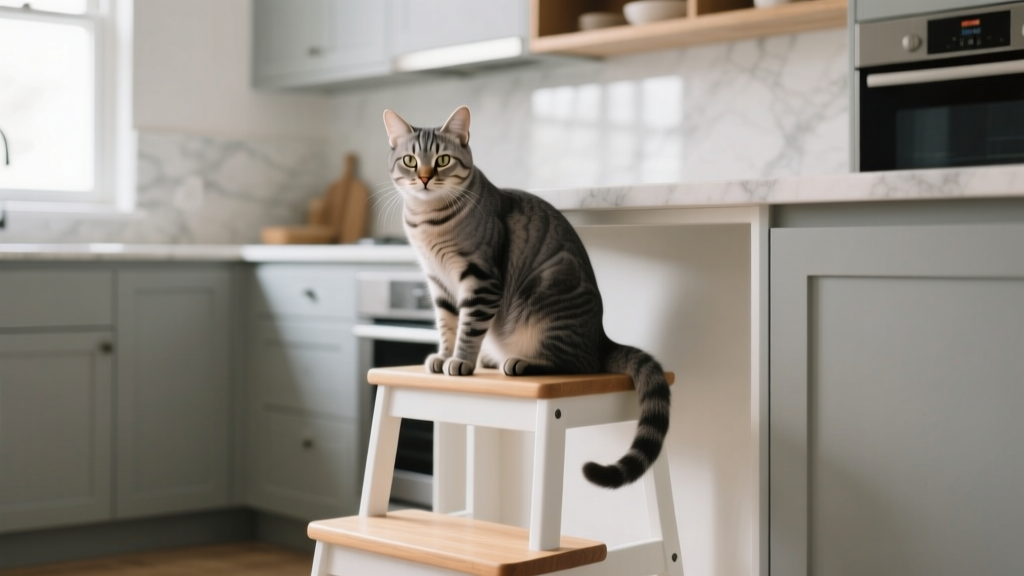
You’re making coffee, half-awake, and there’s your cat—perched on the little step stool you keep by the pantry. Not on the soft cat bed. Not on the couch. On the stool. They’re sitting like a tiny supervisor, eyes half-lidded, tail wrapped neatly around their paws, watching you open cabinets as if you’re about to reveal state secrets.
If you’ve ever wondered, “Why that spot?” you’re in good company. Step stools are one of those strangely magnetic household items for cats—especially in the kitchen, where interesting smells, routines, and human activity collide. The good news: in most homes, a cat choosing the pantry step stool is not random. It’s a very cat-like decision with a few practical (and emotional) reasons behind it.
1) The scientific/evolutionary reason: cats love micro-vantage points
Cats are both predators and, historically, potential prey. Even though your kitchen is not the Serengeti, your cat’s brain is still wired for survival strategies that worked for thousands of years.
One of the biggest strategies: perch and observe. In the wild, a slightly elevated spot helps a cat:
- Survey the area for movement (prey) and surprises (threats).
- Control access to valuable resources—like food, water, and safe routes.
- Rest safely with a good view, reducing the need to constantly check behind them.
A pantry step stool is basically an indoor “mini lookout tower.” It’s not as high as a counter (which may be off-limits in your house), but it’s higher than the floor—often just enough to feel strategically secure.
Add in another feline favorite: cats prefer defined surfaces. A stool has clear edges and a consistent texture. Many cats find that more predictable than, say, a squishy pillow that shifts when they settle.
2) Why the kitchen pantry stool, specifically, feels irresistible
The kitchen is a sensory theme park. Even if you’re not actively cooking, it’s full of scents, sounds, and routines. For cats, routine is comforting—and being close to routine feels safe.
Here’s what makes the pantry step stool a prime piece of feline real estate:
- It’s in the “action zone.” Kitchens are where humans move with purpose. Cats like to be near the center of household activity.
- It’s a predictable human stop. You go to the pantry over and over. Your cat notices patterns and will position themselves where “good things happen.”
- It’s near food-adjacent smells. Even sealed dry food has an aroma. So do treats, bread, cereal, and the lingering ghost of last night’s roast chicken.
- It’s a traffic-control point. Many step stools sit in a corner or near a doorway. Cats often pick spots that allow them to monitor who comes and goes.
- It’s a personal “island.” A stool is just big enough for one cat. That small footprint can feel like a private territory marker: “This is my spot.”
3) A detailed breakdown: different contexts for stool-sitting
Not all pantry-stool lounging means the same thing. The context matters, and cats are masters of subtlety.
They sit there when you’re cooking
This is often social proximity—your cat wants to be near you without being underfoot. Many cats choose a spot that allows them to “hang out” while staying safe from foot traffic, hot pans, or sudden movements.
Classic scenario: You chop vegetables, and your cat sits on the stool, blinking slowly as if they’re emotionally supporting your knife skills.
They sit there when you open the pantry
This can be anticipation. Pantries are where treats live. Even if your cat isn’t getting snacks, the sound of packaging and doors is a learned cue. Cats are excellent at connecting small events with outcomes.
Classic scenario: You reach for pasta, and your cat materializes on the stool like you rang a bell.
They sit there at specific times of day
This suggests routine anchoring. Cats often pick a “time-and-place” station—somewhere they park themselves during predictable household transitions: morning coffee, school drop-off chaos, dinner prep, late-night snack time.
They sit there when guests come over
Now it may be about controlled distance. A stool can serve as a “social buffer”—close enough to observe unfamiliar people, far enough to feel safe. For shy cats, that mild elevation can boost confidence.
They sit there and stare into the pantry like it owes them money
Sometimes it’s scent curiosity. Cats have a powerful sense of smell, and pantries carry layered odors: grains, spices, cardboard, human hands, and sometimes pests (even if you never see them). Your cat might be gathering information: “Who’s been here? What changed?”
4) What it means about your cat’s mood and feelings
Your cat’s body language on the step stool is your best clue. Here’s a quick “mood translator”:
- Relaxed loaf, soft eyes, slow blinks: Comfort and trust. They feel safe in that spot and safe with you nearby.
- Tail wrapped around paws, ears neutral, calm watching: Content curiosity. They’re monitoring the household like a calm security guard.
- Upright posture, ears forward, whiskers slightly forward: Interest/anticipation. Something about the pantry is exciting—often food-related.
- Low crouch, ears swiveling, pupils large: Uncertainty or mild stress. They’re using the stool as a safer observation point.
- Tail flicking sharply, tense shoulders: Overstimulation or frustration—possibly because they want something (like treats) or are annoyed by a nearby noise or pet.
Most of the time, stool-sitting is a sign your cat feels comfortable enough to be in the heart of the home—close to you, but still in control of their space.
5) Related behaviors you might also notice
If your cat loves the pantry step stool, you may recognize a few companion quirks:
- Following you to the kitchen like a furry shadow, then parking in one “station.”
- Sitting on placemats, cutting boards, or closed laptops—cats adore flat, defined surfaces in high-value human zones.
- “Supervising” chores (laundry basket sitting, bathtub watching, bed-making interference).
- Perching on shoes, backpacks, or entryway benches—often a mix of scent comfort and vantage-point preference.
- Meowing when you open cabinets because cabinet sounds predict things they like.
6) When it’s normal vs when it might be a concern
Normal: Your cat sits on the stool calmly, occasionally watches you, occasionally dozes, and hops down easily. They’re simply enjoying a preferred perch and participating in household life.
Worth a closer look if you notice any of these:
- Sudden obsession with the pantry area paired with restlessness or vocalizing—could indicate hunger changes, boredom, or anxiety.
- Staring at a specific spot repeatedly and acting jumpy—could be pests in/near the pantry, or a sound/vibration you can’t hear.
- Difficulty jumping onto or off the stool (hesitation, wobbling, yelping, stiff landing)—possible pain, arthritis, injury, or nail issues.
- Increased food-seeking behavior (raiding, tearing into bags, constant begging) along with weight loss—talk to your vet; it can be medical (thyroid disease, diabetes, parasites) not “just being greedy.”
- Guarding the stool aggressively from other pets—this can signal stress, resource guarding, or a need for more vertical territory elsewhere.
If the stool becomes a “hotspot” for conflict between cats, that’s a sign the environment needs adjustment—more perches, more feeding stations, more escape routes.
7) Tips for responding to (or encouraging) the behavior
If you like your cat’s little pantry post, you can make it safer and even more satisfying—without accidentally creating a treat-demanding supervisor with unrealistic workplace expectations.
Make the stool stable and non-slip
- Add a non-slip mat or rug gripper underneath.
- Place a thin, washable cushion on top for comfort (many cats love fleece).
Use it as a “kitchen station” to prevent counter surfing
If you’d rather your cat not be on counters, a stool can be a compromise: an acceptable spot near you.
- Reward when they choose the stool (a gentle “good,” a pet, or occasional treat).
- Avoid rewarding counter jumps by immediately offering treats right after they hop up—your timing matters.
Pair the stool with enrichment
- Offer a lick mat or a small portion of wet food on the stool occasionally (only if it’s safe and doesn’t create guarding issues).
- Rotate a kicker toy nearby to keep the area positive and interesting.
Respect “watching time”
Some cats sit there simply to be included. If your cat is relaxed, consider it a social moment. Chat with them, slow-blink, and let them supervise your pantry decisions in peace.
If the stool is becoming a begging trigger
- Feed on a consistent schedule.
- Use puzzle feeders to stretch meal time.
- Keep treats in an area your cat can’t “camp” effectively (yes, cats will absolutely optimize their treat-access strategy).
8) Fun facts and research-y tidbits (cat-nerd corner)
- Cats use height to reduce stress. Behavior research and shelter enrichment practices consistently show that vertical space helps cats feel safer and more in control.
- Small elevations can matter. Even a few inches changes how secure a cat feels, especially in busy households or multi-pet homes.
- Cats are routine detectives. They learn “event chains”—if pantry door opens, crinkly bag happens; if crinkly bag happens, treats might appear. Your cat isn’t being manipulative; they’re being an excellent pattern learner.
- Defined edges feel safer. Many cats prefer clear boundaries for resting spots (boxes, baskets, stools) because it provides predictable body support and a sense of territory.
FAQ: Common questions about cats and pantry step stools
1) Is my cat sitting on the stool because they’re hungry?
Sometimes, yes—especially if it happens when you go near the pantry or at treat time. But many cats do it even when they aren’t hungry because the stool is a comfortable perch near your routine. Look for signs like intense staring, vocalizing, and increased food-seeking to confirm hunger-driven behavior.
2) Why not the cat tree? Why choose the stool?
Location beats luxury. A cat tree in the living room is great, but the kitchen is where you are—and where the interesting smells and sounds happen. The stool also may have a height and surface firmness your cat prefers.
3) My cat gets underfoot in the kitchen. Will a step stool help?
Often, yes. Giving your cat a designated “kitchen station” can reduce weaving between ankles. Reward stool use calmly, and consider offering a small mat or bed on the stool so it becomes the obvious “correct” place to hang out.
4) My cat suddenly started sitting on the pantry stool every day. Should I worry?
If they seem otherwise normal—eating, playing, using the litter box, moving comfortably—it’s probably just a new favorite spot. If the change is paired with weight loss, frantic food behavior, unusual vocalizing, hiding, or mobility changes, check in with your vet and also consider whether something changed in the home (new pet, schedule shift, construction noises).
5) Can I discourage this behavior if it’s in the way?
Yes—gently. Move the stool slightly to a safer corner, and offer an alternative nearby (a small cat perch, a chair with a mat, or a window seat). Reward the alternative. Avoid scolding; cats don’t connect punishment with “stool sitting” the way humans hope they will.
6) Is it okay if my cat jumps from the stool to the counter?
If you don’t want counter access, the stool can become a launching pad. Try repositioning it so it doesn’t provide a clean jump route, and give your cat a better “approved” vertical option (like a tall cat tree or wall shelf) in another area.
That pantry step stool may look like a plain household tool to you, but to your cat it’s part lookout post, part social hub, part routine checkpoint, and part “maybe snacks will happen here” strategy.
If your cat has a favorite weird perch—step stool, laundry pile, bathtub ledge, or a single specific kitchen tile—share the story with fellow cat people at catloversbase.com. The only thing cats love as much as a good perch is proving they all have their own very serious opinions about furniture.