Why Cats Sit on the Hallway Coat Hook Area
You’re trying to leave the house. Keys in hand, shoes half-on, brain already in “running late” mode… and there’s your cat. Not on the couch. Not on their cozy bed. Not even on the windowsill where the sun is practically paying rent. They’re perched in the hallway coat hook area like a tiny, furry sentry—sometimes on the bench beneath the hooks, sometimes wedged beside the shoe rack, sometimes even balanced on a narrow shelf like they’re auditioning for a circus act.
If you’ve ever wondered, “Why there?” you’re not alone. That coat-hook zone is one of the most unintentionally fascinating spots in a home from a cat’s perspective: it’s full of scent information, human traffic, height options, interesting textures, and the emotional electricity of arrivals and departures. In other words, it’s a cat behavior buffet.
The evolutionary and scientific “why” behind this hallway obsession
Cats are small predators and potential prey. Even our confident indoor cats are still running ancient software: they’re drawn to places that help them gather information, control access, and feel secure.
The hallway or entry area is a natural “pinch point”—a narrow corridor where everyone must pass. In the wild, controlling a pinch point helps an animal stay aware of changes in its territory. For a domestic cat, the entryway is where:
- New scents enter (other animals, outdoor air, unfamiliar humans).
- Important resources move (you leave, you return, you bring groceries).
- Predictable rituals happen (shoes on, coat off, keys jangling).
From a feline psychology standpoint, sitting near the coat hooks can serve multiple purposes at once: it’s a surveillance post, a scent library, and a social checkpoint.
There’s also a comfort factor in “edges.” Cats often prefer being near walls, corners, and vertical structures. A coat rack area provides built-in cover and an easy escape route—two things cats love. Even if they’re not hiding, their nervous system relaxes when they feel they can’t be approached from all sides.
What’s so special about the coat hook area? Contexts that change the meaning
The same behavior can mean different things depending on what else is happening in the home. Here are the most common “flavors” of hallway coat-hook sitting.
1) The “I’m monitoring my territory” perch
If your cat sits there quietly, alert but calm, they may be doing a routine security check. The entryway is where the outside world tries to sneak in—on soles of shoes, on jackets, on bags. Cats take that personally. You might notice your cat:
- Watching the front door or listening for hallway sounds
- Sniffing coats or rubbing their cheek on a hanging jacket
- Settling with their body tucked, eyes half-open but tracking movement
This is normal, especially in multi-cat homes or apartments where hallway noises are frequent. It’s your cat’s version of checking the neighborhood group chat.
2) The “You’re leaving and I have opinions” station
Some cats learn that the coat area predicts your departure. If your cat starts appearing there when you touch your shoes, grab your bag, or approach the door, they may be:
- Seeking reassurance: “Wait—are we doing the leaving thing?”
- Trying to intervene: sitting in your path is a subtle form of cat negotiation
- Associating the spot with attention: you talk to them there, pet them there, scoop them up there
Watch for body language: a tail held neutrally, slow blinks, relaxed ears suggests calm attachment. A twitchy tail, ears swiveling, or vocalizing can mean mild stress or frustration about the routine.
3) The “Warm, snug, and weirdly comfy” lounge
Hallways often have a different temperature profile than living spaces. There may be a draft under the door in summer that feels cool and pleasant, or a warm patch near a radiator or sunny entry window in winter. Add in soft accessories—scarves, hats, a pile of mittens—and you’ve created a premium cat nest.
Some cats also like the texture of coats and bags: leather, canvas, wool, fluffy linings. If you’ve ever watched your cat knead a puffy jacket like it’s bread dough, you’ve witnessed a deeply satisfying tactile moment.
4) The “Scent soaking” hotspot
Cats are scent-driven. Your coat hook area is loaded with personal and environmental smells: your perfume, your dog’s hair, another cat’s scent from outside, the neighbor’s laundry detergent drifting in from the hallway.
Your cat may sit there to:
- Rub facial pheromones onto coats and bags (cheek rubbing = friendly marking)
- Reclaim the scent profile after you come home smelling “not like the house”
- Gather info by sniffing items that have been outside
In cat terms, this is not “being nosy.” It’s maintaining a coherent scent map of their world.
5) The “I want to greet you” arrival zone
Some cats choose the entryway because it’s the most efficient place to catch you the second you return. If your cat is consistently there around the time you usually come home, it may be anticipation and affection—especially if they:
- chirp or meow when you enter
- roll slightly or present their side (friendly and relaxed)
- weave around your legs (social rubbing)
This isn’t always separation anxiety. It can simply be a well-rehearsed greeting ritual that makes your cat feel connected.
What it says about your cat’s mood and feelings
Use the coat-hook sit as a “mood window.” The location is only half the story; the body language is the real headline.
- Relaxed and content: loaf position, soft eyes, slow blinks, tail still or gently wrapped.
- Curious and alert: upright posture, ears forward or rotating, whiskers neutral-to-forward, quiet watching.
- Social and affectionate: rubbing cheeks on coats, weaving, head-butting your hand, purring when you approach.
- Stressed or conflicted: tail flicking, crouched low with tense shoulders, wide pupils, sudden bolting when you move.
- Guarding or anxious about change: lingering there after visitors leave, sniffing intensely, pacing near the door.
If your cat looks calm, this behavior is typically a sign they feel the hallway is a safe, important place—and that they feel confident enough to “own” it.
Related behaviors you might also notice
Coat-hook sitting rarely happens alone. You may see a cluster of entryway quirks that all come from the same instincts:
- Rubbing on shoes (high-value scent objects—especially if you’ve been outside)
- Sleeping in suitcases or on bags (novelty + scent + “please don’t leave” messaging)
- Door-dashing attempts (curiosity about the outside smell stream)
- Sniffing your hair or hands intensely after you come home (information gathering)
- “Ambush play” in the hallway (a narrow corridor is perfect for pounce practice)
Think of the entryway as a highly stimulating intersection—cats naturally develop routines around it.
When this behavior is normal vs. when it might be a concern
Most of the time, a cat posted up near the coat hooks is simply being a cat. It becomes worth a closer look if you notice any of the following:
- Sudden obsession with the door area after a move, renovation, new pet, or new neighbor (could signal stress or insecurity).
- Blocking or guarding the hallway from another cat in the home (resource control and social tension).
- Excessive vocalizing at the door paired with pacing, panting, or destructive scratching (possible anxiety).
- Elimination issues near the entryway (stress marking, litter box problems, or territorial response to outside cats).
- Over-grooming, hiding, or appetite changes along with the behavior (stress or medical issues).
Also consider physical safety: if your cat is actually climbing the coat hooks or balancing precariously, falls are a real risk—especially for kittens, seniors, or cats with arthritis.
How to respond (and how to encourage it in a healthy way)
If your cat loves the hallway coat hook area, you can support the behavior while keeping it safe and harmonious.
Make a “legal” perch
- Add a small bench with a non-slip mat or a washable blanket.
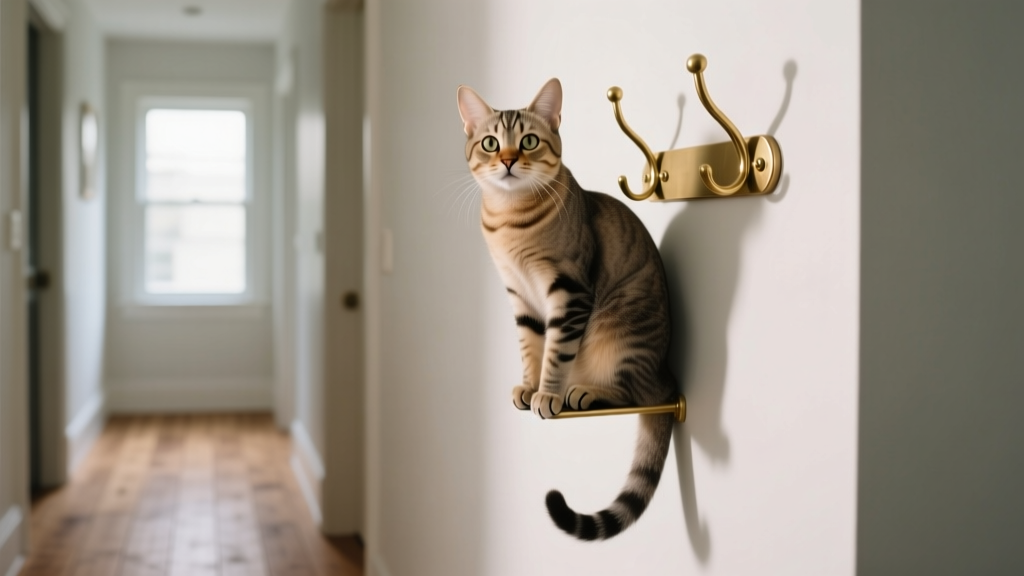
- Use a wall-mounted cat shelf near (not directly over) the coat area for a secure vantage point.
- If space allows, place a cat tree within sight of the front door—cats adore door surveillance from height.
Reduce stress triggers
- If outside cats are visible through a glass panel, consider frosted film on the lower portion of the door.
- Provide a predictable routine when you leave and return (brief calm greeting, then normal activity).
- In multi-cat homes, create multiple pathways so one cat can’t “own” the hallway.
Turn it into positive connection
- Offer a small treat when your cat sits calmly as you put on your coat (reinforces relaxed behavior).
- Practice short “departure drills” (pick up keys, put them down) to make leaving cues less dramatic.
- Give a brief cheek rub or slow blink exchange if your cat seeks attention there.
Keep coats and hooks safe
- Avoid dangling cords or straps that can tangle.
- Don’t store heavy items that could fall if your cat pulls at them.
- If your cat chews fabric or strings, keep scarves and tassels out of reach.
The goal isn’t to stop the behavior—it’s to channel it into a safe “cat-approved” entryway ritual.
Fun facts and research-friendly nuggets
- Cats navigate by scent more than we realize. Their world is layered with odor “messages,” and entryways are scent-rich zones because they connect to the outside environment.
- Cheek rubbing is social and soothing. When your cat rubs their face on coats or the wall, they’re depositing friendly pheromones that help a space feel familiar and safe.
- Predictability reduces feline stress. Cats thrive on patterns. The entryway is a pattern hotspot—shoes, keys, bags, departures—so cats often build routines around it.
- Edges are calming. Many cats prefer resting near vertical surfaces (walls, furniture sides) because it reduces the directions they need to monitor.
FAQ: Common questions about cats and the coat hook area
Why does my cat sit there right when I’m about to leave?
They’ve learned your pre-departure cues and are responding to them—either to get attention, to soothe themselves with proximity, or to “supervise” a change in the territory. If your cat seems relaxed, it’s usually just a routine. If they seem distressed (pacing, yowling), consider building calmer departure habits and adding enrichment while you’re gone.
Is my cat guarding the door?
Sometimes it’s simple observation, sometimes it’s resource control—especially in multi-cat homes. If another cat avoids the hallway or gets chased when approaching, you may be seeing guarding. Add alternate routes, extra perches, and separate resources (litter boxes, feeding stations) to reduce conflict.
My cat rubs on my coat like crazy when I get home. Why?
You smell like “outside,” which is both fascinating and mildly suspicious in cat terms. Rubbing mixes your scent back into the home scent profile and deposits your cat’s friendly pheromones—basically re-labeling you as part of the group again.
Should I let my cat sit on the bench under the hooks?
If it’s stable, non-slip, and not directly beneath heavy items that could fall, yes—it can be a great designated spot. Consider adding a washable cover. If your cat tries to climb the hooks or gets tangled in straps, adjust the setup for safety.
Could this mean my cat has separation anxiety?
Not automatically. Many cats simply like greeting you or monitoring the entryway. Separation-related distress is more about the full picture: excessive vocalizing, destructive behavior, elimination problems, appetite loss, and clinginess that escalates when you prepare to leave.
Why did my cat suddenly start doing this after we moved?
After a move, cats often anchor themselves to key territory zones—especially the entrance—because it’s where unfamiliar scents enter and where “escape routes” seem possible. Offer extra hiding spots, predictable routines, and give your cat time to rebuild a sense of safety.
Your cat isn’t being random when they choose the hallway coat hook area—they’re being a tiny strategist: gathering information, managing scent, predicting your movements, and securing a comfy edge-of-the-world perch.
Does your cat have an entryway ritual—perching by the hooks, rolling on shoes, or acting like a stern little doorman? Share your cat’s funniest (or sweetest) hallway habits with the Cat Lovers Base community at catloversbase.com. We’d love to hear how your home’s “coat hook cat” runs the place.