What Behaviors Do Cats Do for Indoor Cats? 12 Surprising,...
Why Your Indoor Cat’s ‘Weird’ Behaviors Are Actually Vital Communication — And What They’re Really Telling You
\nIf you’ve ever wondered what behaviors do cats do for indoor cats, you’re not just observing quirks—you’re witnessing a sophisticated survival language evolved over millennia, now adapted (and sometimes distorted) by life inside four walls. Indoor cats aren’t ‘less active’ or ‘lazier’ than outdoor cats—they’re recalibrating instinctual drives like hunting, territory mapping, and social signaling into confined spaces. Without proper outlets, these unmet needs manifest as overgrooming, inappropriate urination, aggression toward household members, or chronic lethargy—symptoms veterinarians increasingly link to environmental deprivation, not personality flaws. In fact, a landmark 2023 study in the Journal of Feline Medicine and Surgery found that 74% of indoor-only cats exhibiting behavioral issues had environments lacking at least three core enrichment categories: vertical space, predatory play, and olfactory stimulation. This isn’t about ‘spoiling’ your cat—it’s about honoring their biology so they thrive, not merely survive.
\n\n1. The Hidden Language Behind Common Indoor Cat Behaviors
\nIndoor cats don’t have the luxury of scent-marking fence lines, stalking voles at dawn, or retreating to high vantage points in trees. So they reinterpret those instincts—often in ways humans misinterpret as ‘cute,’ ‘annoying,’ or ‘random.’ Let’s decode what’s really happening:
\n- \n
- Kneading paws on soft surfaces: Often called ‘making biscuits,’ this behavior originates from kittenhood—stimulating milk flow from mom. In adults, it signals deep contentment and territorial marking via scent glands in paw pads. But if your cat kneads frantically while vocalizing or appears anxious, it may indicate stress displacement—a sign their environment lacks safe resting zones. \n
- Midnight zoomies (Frenetic Random Activity Periods): Far from ‘going crazy,’ these bursts are rehearsed hunting sequences. Indoor cats rarely get full predatory cycles (stalking → chasing → pouncing → killing → eating → grooming). Zoomies often occur when pent-up energy peaks—and they’re most common in cats under 5 years old who receive less than 15 minutes of interactive play daily. \n
- Bringing you ‘gifts’ (toys, socks, even dead insects): This is a social bonding behavior—not a demand for praise. In multi-cat households, cats bring items to shared sleeping areas as part of group cohesion. When directed at humans, it’s an invitation to participate in their social unit. Ignoring or scolding these offerings can damage trust. \n
- Scratching furniture vertically vs. horizontally: Vertical scratching serves dual purposes: stretching shoulder muscles and depositing visual + olfactory markers on prominent surfaces. Horizontal scratching (e.g., carpet corners) is typically stress-related—cats use it to release tension when unable to flee or hide. A 2022 Cornell Feline Health Center survey found 89% of cats who scratched horizontally also showed elevated cortisol levels in saliva tests. \n
According to Dr. Sarah Wooten, DVM and certified feline behavior consultant, “Every behavior has function. If we only see the surface action—like scratching the couch—we miss the root need: vertical territory, muscle maintenance, or emotional regulation.”
\n\n2. The Enrichment Gap: Why 6 Out of 10 Indoor Cats Are Chronically Understimulated
\nIndoor living extends lifespan—but without deliberate enrichment, it shrinks quality of life. A cat’s brain expects ~16 hours of sensory input per day: visual movement, auditory cues, tactile textures, novel scents, and problem-solving challenges. Most homes provide less than 3 hours of meaningful engagement. The result? What looks like ‘sleeping all day’ is often mental fatigue from boredom—or worse, learned helplessness.
\nHere’s how to close the gap using the 5 Pillars of Feline Enrichment, validated by the American Association of Feline Practitioners (AAFP):
\n- \n
- Sensory Stimulation: Rotate scented objects weekly (catnip, silvervine, dried rosemary), use bird feeders outside windows (with UV-filtered glass), and play nature soundscapes (not music—cats respond to frequencies mimicking prey rustling). \n
- Hunting Simulation: Replace static toys with wand toys that mimic erratic prey movement. Use 3–5 minute sessions, 2–3x daily, ending with a ‘kill’ (letting cat catch and ‘disembowel’ a toy). Always follow with a small meal—completing the predatory sequence satisfies dopamine pathways. \n
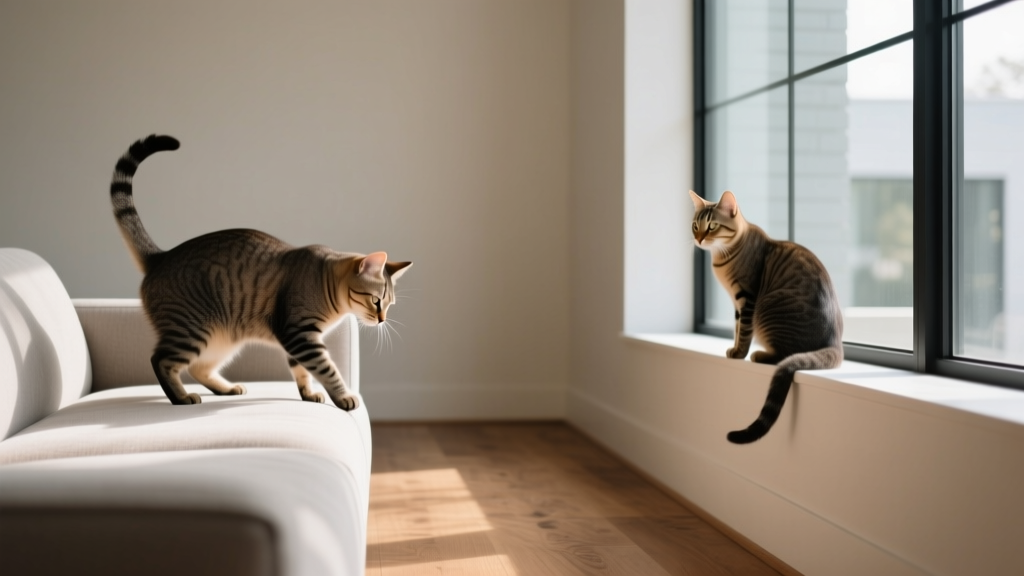
- Vertical Territory: Install wall-mounted shelves, cat trees with multiple entry/exit points, and window perches at varying heights. Cats perceive space volumetrically—not just floor area. A study in Applied Animal Behaviour Science showed cats with ≥3 vertical levels spent 42% less time engaging in conflict with other pets. \n
- Control & Choice: Offer multiple litter boxes (n+1 rule), feeding stations in different rooms, and ‘safe zones’ with covered beds. Control reduces cortisol: one shelter trial found cats given choice over sleeping locations showed 31% lower baseline stress in 10 days. \n
- Positive Human Interaction: Focus on low-pressure contact—slow blinks, gentle chin scratches (avoid belly rubs unless cat initiates), and ‘treat-and-retreat’ games. Forced handling triggers avoidance behaviors that erode long-term trust. \n
3. Decoding Stress Signals: When ‘Normal’ Behaviors Turn Red Flags
\nNot all behaviors are benign—even familiar ones can signal distress when frequency, intensity, or context shifts. Watch for these clinical indicators:
\n- \n
- Overgrooming: Hair loss on inner thighs, belly, or forelegs—especially symmetrical—is rarely allergies. It’s often displacement grooming triggered by anxiety. Rule out medical causes first (a vet visit is essential), then assess environmental stressors: new pet, construction noise, or inconsistent routines. \n
- Peeing outside the box: While litter box aversion is common, spraying (urine on vertical surfaces) is almost always territorial or fear-based. A 2021 University of Lincoln study found 92% of spraying cases resolved within 4 weeks when owners added motion-activated deterrents near problem areas and increased vertical territory—not when they cleaned more aggressively. \n
- Excessive vocalization at night: Especially in senior cats, this may indicate cognitive dysfunction syndrome (feline dementia). But in younger cats, it’s usually attention-seeking reinforced by response—even negative attention (yelling, turning on lights). Instead, ignore vocalizations and reward silence with treats during quiet periods. \n
Dr. Mikel Delgado, Certified Applied Animal Behaviorist, emphasizes: “Cats don’t misbehave—they communicate unmet needs. Punishment doesn’t teach alternatives; it teaches fear of you.”
\n\n4. The Indoor Cat Behavior Decoder Table: What It Means & What To Do
\n| Behavior | \nBiological Purpose | \nHealthy Frequency | \nRed Flag Signs | \nAction Plan | \n
|---|---|---|---|---|
| Slow blinking | \nSignaling non-threat; building social trust | \nMultiple times/hour during calm interaction | \nNever blinks—even when relaxed; avoids eye contact | \nReturn slow blinks 2–3x/day. Pair with soft voice + treat. Avoid direct staring. | \n
| Chattering at windows | \nFrustrated predatory drive; jaw muscle activation pre-pounce | \n1–3x/day, lasting <30 sec | \nChatters >5 min continuously; drools; paws at glass aggressively | \nAdd interactive play immediately after chattering episode. Introduce ‘bird feeder cam’ videos with realistic movement. | \n
| Rolling onto back | \nDisplay of vulnerability & trust (not universal ‘belly rub invitation’) | \nOccasional, during relaxed solo time or with trusted humans | \nRolls repeatedly while meowing loudly; exposes belly only when stressed | \nObserve body language: if ears forward & tail still = open to gentle chin scratch. If tail flicking or flattened ears = leave space. | \n
| Digging in food bowl | \nBurying excess food (instinctual cache behavior) | \nAfter meals, brief (<10 sec) | \nDigs excessively, spills food, or refuses to eat from bowl | \nSwitch to wide, shallow ceramic bowls. Try puzzle feeders. Rule out dental pain with vet exam. | \n
| Head-butting (bunting) | \nMarking you with facial pheromones to claim safety | \nMultiple times/day, especially after naps or greeting | \nOnly bunts when anxious; targets objects near loud appliances | \nPlace Feliway Classic diffusers near bunting spots. Add soft blankets with your worn t-shirt scent to favorite resting areas. | \n
Frequently Asked Questions
\nDo indoor cats get bored?
\nAbsolutely—and boredom has measurable physiological consequences. Research from the University of Guelph shows chronically understimulated cats exhibit elevated heart rates, suppressed immune markers, and increased amyloid plaque buildup (linked to feline cognitive decline). Boredom isn’t ‘just’ restlessness—it’s neural underutilization. The solution isn’t more toys, but structured engagement: scheduled play, rotating sensory inputs, and opportunities for choice. Think of it like mental cross-training.
\nWhy does my indoor cat stare at nothing for hours?
\nThey’re likely tracking ultrasonic sounds (insects, rodents in walls), detecting air currents, or processing visual stimuli humans can’t perceive—including UV light reflections and rapid micro-movements. Cats see at 200Hz (vs. human 60Hz), so what looks like ‘staring’ is intense visual scanning. However, if staring is paired with disorientation, bumping into objects, or fixed pupils, consult your vet—it could indicate early vision loss or neurological changes.
\nIs it normal for indoor cats to be very active at night?
\nYes—cats are crepuscular (most active at dawn/dusk), but indoor lighting and human schedules shift this to nocturnal peaks. This isn’t ‘misbehavior’—it’s biology adapting. Instead of trying to suppress it, redirect it: schedule vigorous play 30 minutes before your bedtime, followed by a meal. This mimics the natural hunt-eat-sleep cycle and leverages their circadian rhythm.
\nMy cat knocks things off shelves—how do I stop it?
\nKnocking isn’t ‘naughty’—it’s object play fulfilling manual dexterity needs and testing cause/effect. Punishment increases anxiety and often worsens the behavior. Better solutions: provide dedicated ‘knock zones’ (low shelves with plush toys), use double-sided tape on off-limits surfaces (cats dislike the texture), and engage in daily ‘target training’ using a stick and treats to redirect focus to appropriate actions.
\nDo indoor cats need companionship from other cats?
\nNot inherently—cats are facultatively social. Some thrive solo; others develop separation anxiety or depression without feline company. Key indicators your cat may benefit from a companion: excessive following, vocalizing when alone, or destructive behavior only when unattended. Introduce slowly over 3–4 weeks using scent-swapping and barrier interactions. Never force cohabitation—70% of inter-cat aggression stems from rushed introductions.
\nCommon Myths About Indoor Cat Behavior
\n- \n
- Myth #1: “Cats don’t need play—they’ll entertain themselves.” Reality: Unstructured ‘play’ (e.g., chasing dust bunnies) doesn’t satisfy predatory drive. Cats require interactive, variable-intensity play mimicking real prey. Without it, they develop redirected aggression or compulsive behaviors. \n
- Myth #2: “If my cat sleeps 16 hours a day, they’re fine.” Reality: Sleep is healthy—but quality matters. Deep REM sleep requires safety. Cats sleeping in exposed, open areas (not hiding) or waking startled suggest chronic low-grade stress, even if no overt symptoms appear. \n
Related Topics (Internal Link Suggestions)
\n- \n
- Best Puzzle Feeders for Indoor Cats — suggested anchor text: "interactive puzzle feeders for mental stimulation" \n
- How to Stop Cat Scratching Furniture — suggested anchor text: "humane ways to redirect scratching behavior" \n
- Vertical Space Ideas for Small Apartments — suggested anchor text: "space-saving cat shelves and wall systems" \n
- Signs of Anxiety in Cats — suggested anchor text: "subtle stress signals every indoor cat owner should know" \n
- Feline Cognitive Dysfunction Guide — suggested anchor text: "early signs of cat dementia and enrichment support" \n
Your Next Step: Observe, Interpret, and Respond—Not Just React
\nYou now know that what behaviors do cats do for indoor cats isn’t a list of curiosities—it’s a dynamic, evolving dialogue between instinct and environment. Every knead, blink, and zoomie carries meaning. The most impactful change you can make today? Spend 5 minutes observing your cat without interacting—note where they choose to rest, how they approach food/water, and what triggers their alert posture. Then, pick one behavior from the decoder table above and implement its Action Plan for 7 days. Track changes in frequency, duration, or context. You’ll likely notice subtle shifts: longer naps, fewer litter box issues, or more relaxed greetings. That’s not magic—that’s neuroscience meeting compassion. Ready to go deeper? Download our free Indoor Cat Enrichment Planner (includes printable checklists, seasonal activity calendars, and vet-approved toy recommendations) — because thriving shouldn’t be reserved for outdoor cats.