Why Cats Sit on the Garden Hose Coil
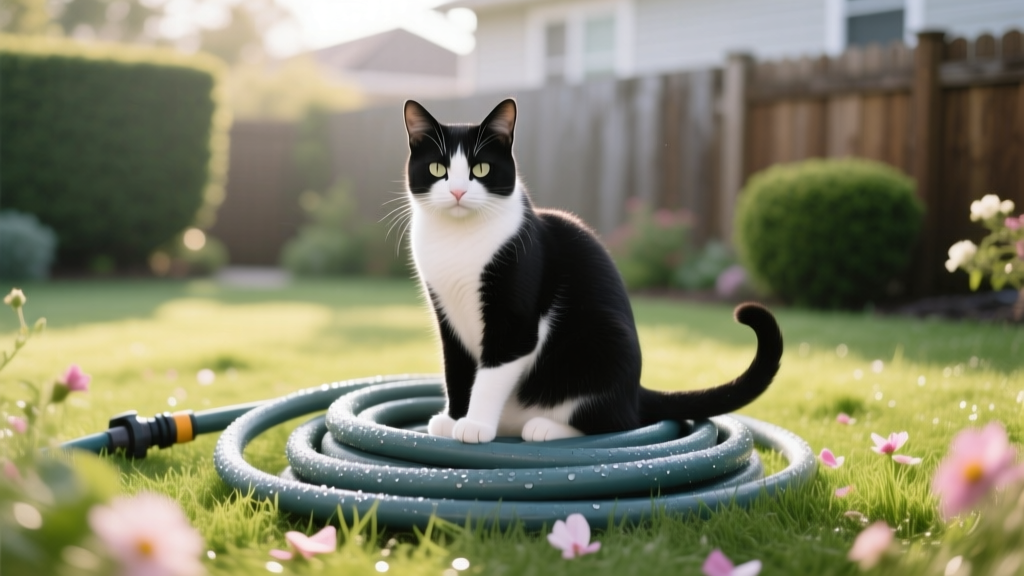
You step outside to water the plants, coffee in hand, feeling productive. The garden hose is neatly coiled—at least it was yesterday. Today, your cat is perched right in the middle of it like a tiny lion on a throne. You tug the hose gently. Your cat tucks in their paws, blinks slowly, and somehow becomes 40% heavier. You try another angle. They don’t budge. And the look you get says, “This is my spot now.”
If you’ve ever wondered why a coiled garden hose—arguably one of the least cozy things in your yard—becomes the hottest seat outdoors, you’re not alone. This little quirk makes perfect sense once you see it through a cat’s eyes.
1) The scientific (and evolutionary) reasons cats love hose coils
Cats are experts at choosing locations that meet three core needs: safety, comfort, and information. A coiled hose looks boring to us, but to a cat it checks surprising boxes.
It’s a “nest” shape (even if it’s rubber)
In nature, cats gravitate toward spaces that create a subtle boundary around the body—think tall grass, shallow depressions in soil, or spots between roots. That gentle “ring” gives a cat two things: a sense of protection and a defined personal zone. A hose coil mimics a shallow nest: a circular boundary with a center that feels claimed.
It holds and carries scent
Cats experience the world through scent like we experience it through headlines. A garden hose often smells like:
- You (hands on the hose, dragging it around)
- Water (a highly meaningful resource)
- Plants, soil, fertilizer, mulch (a whole outdoor news feed)
- Other animals (rodents, birds, neighborhood cats)
Sitting on the hose is a way to “bookmark” that scent hub with their own odor from facial glands, paws, and fur. It’s not just lounging—it’s low-key territory management.
It can be slightly warm (or at least temperature-stable)
Depending on where it’s stored, a hose can warm up in the sun and hold heat longer than surrounding grass. Cats are heat-seekers; warmth helps them conserve energy. Even if it’s not warm, the hose may be more temperature-stable than damp soil or cool concrete.
It offers micro-security and a tactical advantage
Cats like positions that let them observe without feeling exposed. A coiled hose creates a tiny “platform” that’s slightly raised and visually distinct. From there, your cat can monitor the yard, listen for critters, and react quickly—especially if the hose is near a fence line, shrub, or doorway (classic “edge” territory).
2) A detailed breakdown: different contexts, different motives
The same behavior can mean different things depending on what’s happening around it. Here are the most common “hose-sitting” scenarios and what’s likely driving them.
The sunbathing supervisor
Scenario: The hose coil sits in a patch of sun. Your cat sprawls, eyes half-closed, ears occasionally rotating like little radar dishes.
What it’s about: Comfort and thermal joy. The coil provides a defined resting spot with bonus warmth. Your cat may also be choosing it as a lookout point to watch birds, neighbors, or you working in the garden.
The “you’re leaving? absolutely not” sit
Scenario: You pick up the hose and your cat suddenly appears and sits on it, often staring at you or flopping dramatically.
What it’s about: Attention and control of the routine. Cats learn patterns: hose comes out → humans are busy → less petting/interaction. Sitting on it can be a polite (and sometimes not-so-polite) protest. It can also be a bid for engagement: “Before you do chores, acknowledge me.”
The scent-collector
Scenario: Your cat sniffs the coil intensely, rubs their cheeks, kneads lightly, then settles in.
What it’s about: Scent marking and information processing. Cheek rubbing (bunting) deposits friendly pheromones. Settling afterward can be your cat “claiming” a high-value spot that smells like interesting things.
The ambush artist
Scenario: Your cat crouches low inside or beside the coil, eyes focused, tail tip twitching.
What it’s about: Play-hunting. The coil acts like cover. If insects flicker nearby or a lizard darts past, your cat is in prime pounce position. This is especially common in younger cats or high-energy hunters.
The “safe base” near the house
Scenario: The hose is near a door, patio, or familiar corner, and your cat chooses it repeatedly.
What it’s about: Security. Cats like predictable anchor points, especially outdoors. The hose coil can become a “home base” that feels stable and known—particularly for indoor cats who get supervised outdoor time.
3) What sitting on the hose reveals about your cat’s mood
You can learn a lot from the body language your cat pairs with this habit.
- Relaxed and content: Loaf position (paws tucked), slow blinks, soft whiskers, gentle ear swivels. This is a cat who feels safe and comfortable.
- Playful and alert: Crouched body, forward ears, tail tip twitching, intense stare. Your cat is in hunting mode—more “predator practicing” than resting.
- Possessive or mildly annoyed: Stiff posture, ears angled sideways (“airplane ears”), tail thumps, growl if you pull the hose. This can be resource guarding of a prized spot or frustration about being moved.
- Seeking connection: Looking back at you, meowing, rolling, rubbing your legs when you approach. The hose is just the stage; you are the main event.
A helpful rule: the hose isn’t magical—your cat is choosing it because it meets a need in that moment (warmth, safety, stimulation, or attention).
4) Related quirky behaviors you might notice
If your cat is a hose-coil enthusiast, you may also recognize these greatest hits:
- Sitting on your laptop or keyboard: Warmth + attention + “this is where your hands go.”
- Claiming boxes, baskets, and laundry piles: Nest-shaped boundaries that feel secure.
- Parking themselves on the doormat: Scent-rich transition zone; good vantage point for comings and goings.
- Sleeping in the sink or bathtub: Curved surfaces that cradle the body and smell interesting.
- Flopping onto whatever you’re using: Yoga mat, puzzle, paperwork, hose—cats love inserting themselves into your “focused” activities.
5) When hose-sitting is normal… and when it’s a concern
Most of the time, this is harmless and honestly pretty adorable. Still, a few situations deserve extra attention.
Totally normal
- Your cat sits on the coil occasionally, remains relaxed, and moves when gently encouraged.
- Your cat is simply sunbathing or watching the yard.
- Your cat rubs and lounges, showing no stress signals.
Potentially concerning
- Obsessive behavior: Your cat can’t disengage, becomes frantic if the hose is moved, or repeatedly returns in a way that looks compulsive.
- Aggression/resource guarding: Hissing, swatting, or biting when you approach the coil—especially if this is new behavior.
- Sudden behavior change: A cat who never cared about the yard now camps on the hose all day. Sudden shifts can indicate stress (new neighborhood cat, noise) or health changes.
- Safety hazards: The coil is treated with chemicals, has sharp connectors, leaks hot water, or sits where your cat could be startled and bolt into danger.
If you see sudden aggression, unusual clinginess, hiding, reduced appetite, or litter box changes alongside the hose obsession, it’s worth checking in with your vet and also scanning the environment for stressors (new pets, construction, outdoor cats encroaching).
6) Tips: how to respond (and how to encourage it safely)
You don’t need to “fix” this behavior—just shape the environment so it stays safe and keeps your relationship smooth.
1) Don’t turn it into a tug-of-war
If you need the hose, avoid pulling while your cat is sitting on it. Instead, invite a move: call them, toss a treat a few feet away, or use a wand toy to lure them off. When they move, quietly pick up the hose. This prevents the cat from learning that “sitting harder” wins a contest.
2) Provide an equally appealing alternative
Place a weather-safe outdoor cat bed, a flat cushion, or even a shallow box nearby (in a similar sun patch). Many cats just want the “best seat.” Give them one.
3) Make the hose less enticing if needed
- Store it on a wall-mounted hanger (less coil-nest shape).
- Keep it in a bin with a lid (also protects from chewing).
- Move it out of the prime sun spot if your cat is blocking your work daily.
4) Use it as enrichment
If your cat is supervised outdoors, you can turn the area into a mini “cat patio” zone: a perch, a scratching surface, and safe grass to nibble. The hose coil can be part of a familiar “home base” that makes outdoor time calmer.
5) Keep it safe and clean
Avoid leaving chemical residues on hoses (weed killers, insecticides). Rinse if needed. Check for frayed rubber or metal fittings that could scratch or snag. If your cat chews rubber or plastic, store the hose out of reach.
7) Fun facts and research-adjacent nuggets
- Cats love defined edges. Behaviorists often talk about cats feeling safer when their body is partially “outlined” by something—like a box wall, bed rim, or, yes, a coiled hose.
- Scent marking is social. When cats rub on objects you frequently handle, it can be a way of mixing scents—creating a shared “family odor” that feels comforting and familiar.
- Warmth is a biologic priority. Cats naturally seek warm spots to reduce the energy cost of maintaining body temperature, which is one reason sunny patches become premium real estate.
- Small routine interruptions matter to cats. If hose time predicts “human is busy,” a cat may strategically place themselves on the hose to reinsert connection into the routine—cats are excellent pattern learners.
8) FAQ: common questions about cats and garden hoses
Is my cat attracted to the smell of the hose?
Often, yes. The hose carries a mix of outdoor scents plus your scent. For many cats, that’s like sitting on a constantly updated message board.
Why does my cat sit on the hose only when I’m using it?
Because the hose becomes meaningful in context. It predicts your attention shifting away, water moving, interesting sounds, and activity. Your cat may be seeking attention, supervising, or trying to keep the routine under their control.
Is it dangerous if my cat sits on the hose in the sun?
Usually it’s fine, but check temperature. A hose in direct sun can get surprisingly hot. If it feels hot to your hand, encourage your cat to move to shade and provide fresh water nearby.
My cat bites the hose—what should I do?
Chewing can be play, stress relief, or a texture preference. For safety, store the hose out of reach and offer alternatives (chew-safe toys, more play sessions, puzzle feeders). If chewing is persistent or intense, ask your vet—some cats chew more when anxious or if dental discomfort is present.
Does sitting on the hose mean my cat is marking territory?
It can. Sitting, rubbing, and kneading can deposit scent. But it doesn’t necessarily mean “aggressive territory.” Often it’s a comfort mark: “This spot is part of my safe map.”
Should I let my cat keep doing it?
If it’s safe (no chemicals, no overheating, no chewing risk) and your cat isn’t guarding it aggressively, it’s perfectly normal. If it blocks your gardening, redirect with treats or offer a better nearby perch.
That coiled garden hose may look like yard clutter, but to your cat it’s a warm, scent-rich, nicely bounded observation post—and possibly the best seat in the whole backyard. Once you start noticing how often cats choose “defined-edge” spots, you’ll see their logic everywhere.
Does your cat claim the hose like royalty, or do they prefer the watering can, the potting soil, or the exact spot you need to stand? Share your funniest (and most baffling) garden-cat stories with the Cat Lovers Base community at catloversbase.com.