Why Cats Sit on the Garden Gnome Hat
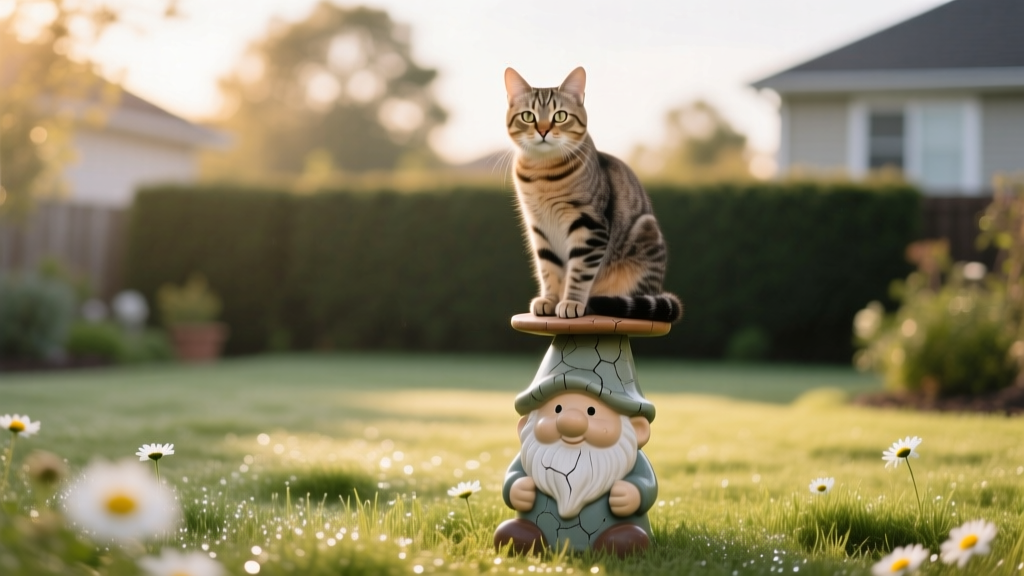
You step outside with your coffee, ready for a calm little garden moment… and there’s your cat. Perched like royalty on the pointy hat of a garden gnome. Tail wrapped neatly around their paws. Eyes half-closed in that “I own this yard” expression. The gnome looks mildly offended. Your cat looks deeply pleased.
If you’ve ever wondered why your cat chooses that spot—of all the shady beds, sunny pavers, and patio chairs—this is one of those wonderfully odd feline choices that actually makes a lot of sense once you look at it through a cat’s eyes (and a cat’s instincts).
Cats don’t sit places “randomly.” They sit where their body feels safe, where their senses get good information, and where their scent can make a point. A garden gnome hat just happens to check a surprising number of boxes.
The scientific (and evolutionary) reasons cats pick weird perches
Domestic cats may live with us, but their brains still run a wild-cat operating system. Their ancestors survived by choosing resting spots that helped them:
- See danger coming (and spot prey).
- Stay warm (or cool down efficiently).
- Feel protected from behind and sides.
- Claim territory through scent.
A gnome hat is often a small elevated platform in an open space. Elevation gives cats a better view and can reduce the chance of being surprised. Even a few extra inches matters to a cat scanning for birds, squirrels, neighborhood cats, or the family dog.
There’s also the “odd object advantage.” Cats are drawn to novel shapes and textures because curiosity is a survival tool. A gnome is stationary, predictable, and usually placed in a spot with decent visibility. To a cat, that’s less “quirky lawn decor” and more “mini lookout post.”
A detailed breakdown: different contexts where the gnome hat becomes irresistible
Not every gnome-hat sitter is doing it for the same reason. Here are the most common scenarios I see (and what your cat may be getting out of it).
1) The lookout tower: “I’m monitoring my kingdom”
If your cat sits tall, ears swiveling, eyes tracking movement, they’re using the gnome hat like a surveillance perch. You’ll often see this in cats who love windowsills, the top of the couch, or the highest cat tree shelf.
Classic scene: Your cat hops onto the gnome hat right as the neighbor’s dog appears, or when birds gather near the feeder. They’re not necessarily going to pounce—they’re gathering information.
2) The comfort perch: “This shape fits my body perfectly”
Some gnome hats are gently sloped or slightly textured. Cats often like a firm surface with a defined edge—it gives them feedback about where their body is in space. A pointy hat can support the chest and keep the cat’s paws tucked, which is a naturally restful posture.
Classic scene: Your cat kneads the hat once or twice, circles, then settles with a slow blink. The gnome is now furniture.
3) The warmth spot: “This thing holds heat”
Depending on the material (resin, concrete, ceramic), a garden ornament can absorb sun and radiate gentle warmth. Cats are little heat-seekers with fur coats designed to trap warmth—so they love anything that acts like a mini heated bed.
Classic scene: Mid-morning sun hits the gnome, and your cat appears as if summoned. They choose the hat because it’s the warmest square inch in the yard.
4) The scent statement: “This belongs to me now”
Cats communicate a lot through scent. When a cat sits on something, rubs it, or repeatedly chooses it, they’re often mixing their scent onto it. Even without obvious cheek-rubbing, sitting transfers scent from paw pads and fur.
Classic scene: A new gnome appears in the garden. Within a day, your cat is sitting on it like a stamp of ownership.
5) The social signal: “I’m comfortable enough to rest here”
If your cat can relax on an exposed perch (instead of hiding under shrubs), that usually means they feel confident and safe in that environment. Choosing a “silly” spot can be a sign your cat is at ease.
Classic scene: Your cat loafs on the hat while you water plants nearby. They aren’t on high alert; they’re hanging out with you, just in a very cat way.
What it means about your cat’s mood and feelings
Your cat’s body language will tell you which emotional “playlist” is playing.
- Relaxed loaf, soft eyes, slow blinks: Contentment. Your cat feels safe and possibly enjoys your presence.
- Upright posture, ears rotating, tail tip twitching: Curious vigilance. Not stressed, but engaged with the environment.
- Low crouch, tense shoulders, wide eyes: Uncertainty. They may be using the perch to assess a perceived threat.
- Rubbing cheeks on the gnome, rolling nearby: Social confidence and scent-marking. “This is my place.”
- Blocking other pets from approaching the gnome: Resource guarding. The gnome hat has become a valued spot.
One of my favorite clues is the exit strategy. A relaxed cat will pick a perch that still offers a clean getaway route. If the gnome is near cover (a bush, a fence line, patio furniture), it can feel safer than a wide-open lawn.
Related behaviors you might also notice
If your cat loves the garden gnome hat, you may also catch them doing these very on-brand cat things:
- Sitting on the highest point of anything (mailbox, step stool, patio table).
- Perching on “uncomfortable” objects like narrow rails or plant pots—because they’re stable, warm, or strategically placed.
- Choosing your most inconvenient surfaces (freshly folded laundry, laptop keyboard) to combine comfort with social influence.
- Rubbing cheeks on corners and edges of outdoor furniture to deposit friendly facial pheromones.
- Guarding a favorite outdoor vantage point and chasing off other cats who approach.
Basically, the gnome hat is just one more chapter in the epic saga of “Cat Finds a Spot.”
When sitting on the gnome is normal… and when it might be a concern
Most of the time, this behavior is delightfully normal. That said, here are a few situations where it’s worth paying closer attention.
Totally normal
- Your cat uses the gnome as a perch occasionally, especially during certain times of day (sunny hours, bird activity).
- They look relaxed and can be redirected easily.
- The behavior appears alongside other healthy routines: eating normally, grooming, playing, using the litter box.
Potential concerns
- Obsessive perching: If your cat sits there for unusually long periods and seems unable to settle elsewhere, it could signal anxiety, boredom, or hypervigilance about outdoor threats.
- Sudden change in behavior: A cat who never perched before but suddenly seeks high points constantly may feel unsafe (new animal nearby, construction noise) or be experiencing discomfort and looking for a position that hurts less.
- Aggression around the gnome: If your cat starts guarding it intensely—hissing, swatting, ambushing—treat it like resource guarding. The spot has become emotionally “important.”
- Risk of injury: Wobbly ornaments can tip. If your cat has slipped, startled, or been scratched by sharp edges, they may develop fear responses or, worse, get hurt.
- Outdoor safety issues: If the gnome is near a road, a gate, or a place where predators can approach, the perch may be putting your cat at risk.
If you notice appetite changes, hiding, overgrooming, litter box issues, or new aggression along with the gnome obsession, consider a vet check and a behavior consult. Sometimes “weird sitting” is the first clue that something else changed.
Tips for responding to (or encouraging) the behavior
You don’t need to stop a harmless gnome-hat perch—unless the gnome is fragile, unsafe, or located in a risky spot. Here are practical options that keep your cat happy and your garden decor intact.
Make it safe
- Stabilize the gnome: Anchor it so it can’t tip. Choose a heavier base or place it in a stable nook.
- Check for sharp edges: Sand rough spots or swap to a smoother ornament.
- Avoid toxic treatments: Don’t coat the gnome with deterrent sprays not designed for pets. Many strong scents can stress cats or irritate airways.
Create a “yes” perch nearby
- Add a cat-approved outdoor perch: A sturdy bench, a low platform, or a catio shelf placed where your cat likes to watch.
- Use height strategically: Cats choose perches for vantage points. Put an alternative perch with an equal or better view.
- Add comfort: A weather-safe mat can make your “yes spot” more appealing than the gnome.
If you want to discourage it (without drama)
- Change the gnome’s location: Move it away from the “best view” and see if the behavior fades.
- Make the hat less sit-friendly: A temporary, harmless cover that removes the flat spot can redirect your cat (think: a small, smooth dome cover when you’re not watching). Avoid sticky surfaces outdoors—debris can cling and create a mess.
- Reinforce alternatives: Praise, treats, or play when your cat chooses the intended perch. Cats repeat what works for them.
Fun facts and research-y tidbits about cats and quirky perches
- Cats prefer vertical space because it supports both hunting instincts (watching) and safety instincts (avoiding surprise). Even small elevation changes can be meaningful in a cat’s mental map.
- Loafing is a security signal: When a cat tucks paws under their body, they’re choosing rest over rapid escape—usually a sign they feel safe enough to “park.”
- Scent is a comfort tool: When cats sit on or rub objects, they aren’t just claiming territory—they’re building a familiar-smelling environment that reduces stress.
- Novelty attracts cats… if it feels safe: Many cats investigate new objects quickly, but only confident cats will use them as furniture. The gnome isn’t just interesting; it’s predictable and non-threatening.
So yes, your cat might be sitting on the gnome hat because they’re funny. But they’re also being brilliantly cat: choosing comfort, information, and control.
FAQ: Common questions about cats and garden gnome hats
Is my cat trying to “dominate” the garden gnome?
Not in the way we think about dominance. It’s more accurate to say your cat is choosing a valued perch and possibly scent-marking it. They’re managing their environment, not bullying the gnome (even if the gnome looks bullied).
Why does my cat sit on the gnome only when I’m outside?
Because your presence changes the meaning of the space. Your cat may be socially resting near you, or they may have learned it gets a reaction. Cats are excellent at repeating behaviors that reliably earn attention.
My cat kneads the gnome hat. What does that mean?
Kneading is a comfort behavior linked to kittenhood and relaxation. Outdoors, it can also be a way of testing texture and settling in. If kneading happens with purring and half-closed eyes, your cat is likely feeling content.
Should I worry about my cat catching fleas or parasites outside?
Any outdoor time can increase exposure risk. If your cat spends time in the yard, talk with your vet about parasite prevention appropriate for your region, and avoid letting your cat lounge in areas frequented by wildlife.
How can I keep my cat from knocking the gnome over?
Stabilize it (heavier base, secure placement) and provide an equally appealing perch nearby. If the gnome is the tallest, warmest, or best-view spot, your cat will keep voting for it with their butt.
Why does my cat suddenly prefer the gnome hat after months of ignoring it?
Look for what changed: a new neighborhood cat, seasonal bird activity, hotter or cooler weather (heat retention matters), or a shift in household routine. Cats are sensitive to small environmental changes and will adjust their “safe spots” accordingly.
If your cat has a favorite outdoor “throne” (gnome hat or otherwise), share the story with the Cat Lovers Base community at catloversbase.com. The weirder the perch, the better—cats have a gift for turning everyday objects into legends.