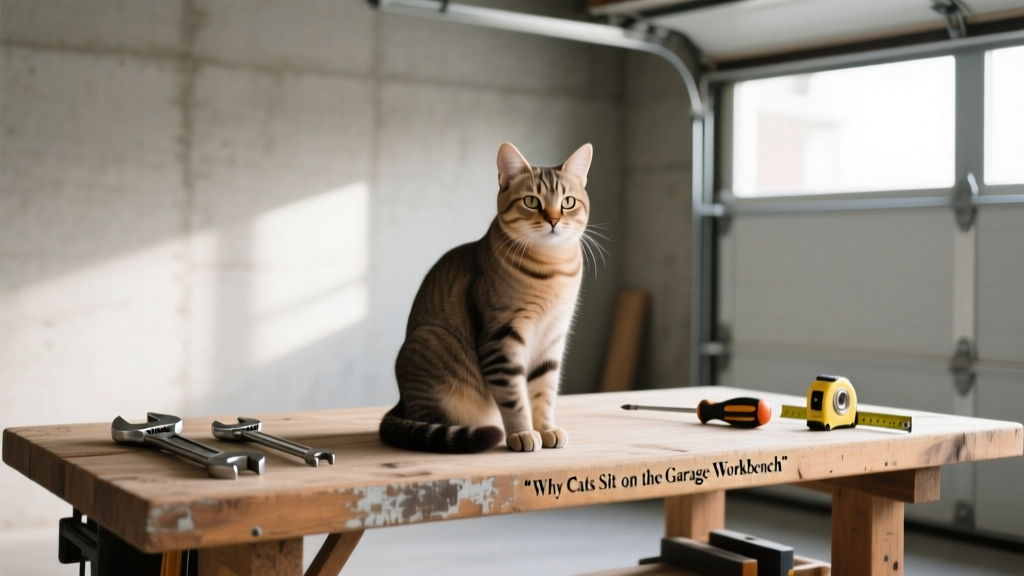
Why Cats Sit on the Garage Workbench
You step into the garage for a quick, peaceful project—tighten a screw, sort a drawer, maybe finally organize that pile of sandpaper. The overhead light flicks on, the air smells faintly of wood dust and metal, and there’s your cat… perched like a tiny supervisor right on the workbench. Not on the floor. Not on the old chair you sacrificed to “cat use.” Right on the spot where you need to measure, drill, or lay out parts.
If you’ve ever muttered, “Why there?” while your cat calmly loafs next to a screwdriver, you’re in excellent company. Cats and workbenches have a funny relationship—one that makes a lot more sense when you look at it through the lens of feline instincts, comfort, and social behavior.
1) The Science (and Evolution) Behind the Workbench Obsession
Cats are both predators and, in the wild, potential prey. That double identity shaped a brain that constantly asks two questions: “Can I hunt from here?” and “Am I safe here?” A garage workbench hits several instinctive “yes” buttons:
- Elevation = safety and control. A raised surface lets a cat monitor the environment and reduces the chances of being surprised. Even indoor cats keep that instinct.
- Edges and corners feel secure. A workbench pushed against a wall gives your cat a protected back and a clear view of the room—prime feline real estate.
- Warmth and texture are appealing. Wood can feel warmer than concrete. Rubber mats or old towels feel cozy. And cats are experts at finding the one surface that’s “just right.”
- Scent is information. Garages are packed with interesting smells—wood, oil, cardboard, your gloves, outdoor air. A cat’s world is built on scent, so the workbench is basically a bulletin board.
- Territory management. Cats map the home into zones. The garage is often a “semi-outdoor” territory, and a central perch helps them claim and oversee it.
So while it looks like your cat is intentionally blocking your project (and sometimes it feels personal), a lot of it is simply: “This is a safe, interesting, strategic spot.”
2) What’s Actually Going On? Different Contexts, Different Reasons
The same behavior—sitting on the workbench—can mean different things depending on the context. Here are the most common workbench “motives” I see, with the kind of scenarios cat owners recognize instantly.
A. You’re in the garage: “I’m here to supervise.”
If your cat hops up as soon as you start tinkering, it’s often social. Cats may not “help” like dogs, but many enjoy being near their favorite human. You’re focused, your hands are moving, interesting objects appear—this is prime enrichment.
What it looks like: Your cat settles a foot away from your tools, slow-blinks, kneads, or watches your hands like they’re a nature documentary.
B. You’re NOT in the garage: “This is my lookout.”
Some cats treat the garage like a border zone. The workbench becomes a lookout point for monitoring door sounds, outdoor scents drifting in, or the “mysterious garage door monster” that roars to life.
What it looks like: Your cat sits upright, ears swiveling, staring toward the garage door or any cracks where air comes in.
C. The workbench smells like you: “Comfort through scent.”
If you store your jacket, gloves, or hat on the bench, your cat may be drawn to the strongest “you” smell. Cats self-soothe with familiar scent—especially if you’ve been away, routines changed, or there’s been household stress.
What it looks like: Curling up on your sweatshirt, rubbing cheeks on corners, or doing that little “face-smush” along the edge.
D. The workbench is sunny or warm: “My heated throne.”
Garages can have odd heat pockets—sunlight from a high window, warmth from a recently used appliance, or residual heat from tools and chargers.
What it looks like: Full-body sprawl, stretched toes, half-closed eyes. The “I live here now” vibe.
E. It’s quiet and predictable: “A break from chaos.”
Compared to the main house, garages can be calmer—fewer footsteps, less noise, fewer sudden interruptions. For some cats, the workbench is a peaceful retreat.
What it looks like: Your cat chooses the bench when guests are over, kids are energetic, or the vacuum exists anywhere in the home.
3) What Sitting on the Workbench Says About Your Cat’s Mood
Your cat’s body language is the difference between “happy hangout” and “please don’t bother me.” Here’s what to watch for:
- Relaxed loaf, slow blinks, soft ears: Content and secure. Your cat feels safe in that spot and may be enjoying your company.
- Upright sit, tail wrapped, alert ears swiveling: Curious and vigilant. Not stressed necessarily—just monitoring.
- Kneading or purring: Comfort and positive association. Often happens if the bench smells like you or has a soft surface.
- Tail flicking, tense shoulders, wide eyes: Overstimulated or uncertain. Maybe the garage sounds are too loud, or your activity feels unpredictable.
- Blocking tools, pushing items off: Seeking interaction (or trying to control the environment). Some cats learn that “bench + disruption = attention.”
One key point: cats choose locations that match their emotional needs. If the garage workbench becomes a regular hangout, your cat is telling you, “This is a place where I feel in control.”
4) Related Behaviors You Might Also Notice
Workbench sitting rarely comes alone. You may see:
- Rubbing cheeks on the bench edges (scent marking with facial pheromones—essentially labeling it “mine/safe”).
- Rolling on your tools or rags (mixing scents; sometimes influenced by interesting odors like oils or outdoorsy smells).
- Sitting on the exact item you just put down (cats are drawn to novelty and to “your focus”).
- Following you into the garage and vocalizing (social contact, attention seeking, or mild worry about being separated).
- Choosing other high perches like shelves, the top of the toolbox, or stacked lumber—classic “cat vantage point” behavior.
5) When Sitting on the Workbench Is Normal… and When It’s a Concern
In most homes, this is normal, even charming. But garages come with risks, so it’s worth a quick safety check.
Normal (and generally harmless) if:
- Your cat is relaxed, responsive, and can be redirected.
- They’re not chewing on dangerous items or licking residue.
- The bench is stable and free of sharp hazards.
Potentially concerning if:
- They’re eating/licking substances (antifreeze, oils, solvents, sawdust from treated wood). Many garage chemicals are dangerously toxic to cats.
- They’re suddenly hiding in the garage or guarding the bench when that’s new for them—could signal stress, pain, or changes in the household.
- You notice increased vocalizing, agitation, or startle responses in the garage—noise sensitivity, anxiety, or negative experiences could be building.
- They appear unsteady jumping up/down or avoid jumping but still want the bench—could indicate arthritis or discomfort.
If anything about the behavior changes abruptly, or your cat seems physically uncomfortable, it’s worth a vet check and a quick look at stressors in the environment.
6) How to Respond (Without Starting a Daily Bench Battle)
You don’t have to banish your cat from the garage workbench—often, it’s better to guide the behavior into a safer, more convenient version.
Create a “cat zone” on the bench
Place a dedicated mat or towel on one end. Cats love clear “approved” spots. Bonus: it collects fur instead of your project.
Offer an even better perch nearby
A sturdy shelf, a wide stool, or a cat tree in the garage (if safe and climate-appropriate) can become the new favorite. Height matters—cats often prefer the highest stable option.
Use gentle redirection, not drama
If your cat keeps sitting exactly where you need to work, calmly move them to the mat or perch and reward with a treat or soft praise. Consistency beats confrontation.
Make the garage safer by default
- Store chemicals in sealed, latched cabinets.
- Wipe surfaces after using oils/solvents.
- Keep blades, drill bits, and small swallowable parts contained.
- Don’t leave string, wire, or rubber bands out (tempting and dangerous).
If your cat is there for your attention, schedule “together time”
A short play session before you start working can reduce tool-interruptions. Wand toys, a few tossed treats, or a puzzle feeder can satisfy that “do something with me” need.
7) Fun Facts and Research-Adjacent Insights
- Cats use height as a stress-management tool. In multi-cat homes, vertical space can reduce tension by giving cats more ways to avoid each other without conflict.
- Scent marking is social, not just territorial. When your cat rubs the workbench after you’ve been there, they may be “blending” scents—building a shared group smell that signals safety.
- Novelty is enriching. Garages change: new boxes arrive, tools move, doors open. Cats are drawn to updated “information,” and scent is a huge part of that.
- Cats often prefer predictable observation posts. A workbench offers a stable platform with consistent sightlines—exactly what many cats seek in a resting spot.
8) FAQ: Common Questions About Cats and Garage Workbenches
Why does my cat sit on the workbench only when I’m working?
Your activity is stimulating, and your cat may enjoy social proximity. Some cats also learn that sitting near your tools reliably gets your attention. Give them an “approved” spot and reward calm settling there.
Is my cat trying to help me?
Not in the “tighten the bolt” sense, but many cats do engage in a kind of companionship behavior—staying close, watching your hands, and participating by being present (and occasionally inconvenient).
How do I keep my cat off the workbench without scaring them?
Use positive alternatives: a nearby perch, a mat on a designated corner, and rewards for choosing those spots. Avoid yelling or startling—cats can associate the garage (or you) with unpredictability and become more anxious.
My cat chews on things in the garage. What should I do?
First, remove access to anything toxic or swallowable. Provide safe chew/lick outlets (some cats like silvervine sticks or dental chews approved by your vet). If chewing is persistent or frantic, talk to a veterinarian to rule out dental issues, nausea, or stress-related behaviors.
Could sitting on the bench mean my cat is anxious?
Sometimes. If the posture is tense and hyper-alert, or if the garage is a retreat from household stress, it may be anxiety management. Add predictable routines, safe hiding spots in the home, and consider pheromone diffusers in main living areas if stress seems ongoing.
Is it safe for cats to hang out in the garage?
It can be, but garages carry extra risks: chemicals, sharp tools, pest traps, open doors, and temperature extremes. Supervised access is safest, and secure storage is essential.
Closing Thoughts
When a cat chooses the garage workbench, they’re usually choosing a combination of elevation, information, comfort, and connection. It’s part lookout tower, part lounge chair, part “I want to be where my human is” statement. With a little planning—safe storage, a designated cat spot, and a better perch option—you can turn “move, I need that space” into a peaceful co-working arrangement.
Does your cat supervise your DIY projects, sprawl across your blueprints, or insist on sitting in the exact center of every task? Share your funniest (or most puzzling) garage workbench stories with the Cat Lovers Base community at catloversbase.com—we’d love to hear what your tiny foreman is up to.