Why Cats Sit on the Attic Ladder Bottom
You’re carrying laundry. Or maybe you’re dragging out the holiday decorations. You pull the attic hatch down, the ladder unfolds with that familiar clunk… and there’s your cat—calm as a tiny security guard—planted right at the bottom rung. Not in the way exactly (though it feels like it), but close enough that you’re suddenly negotiating your next step like it’s a diplomatic mission.
If this sounds familiar, you’re in good company. Cats love “threshold spots” in homes, and the base of an attic ladder is basically the VIP lounge of thresholds: it’s a doorway, a lookout, a bottleneck, and a mystery portal all in one. From your cat’s perspective, it’s not random at all. It’s smart, strategic, and very cat.
1) The scientific (and evolutionary) reason: thresholds are prime real estate
Cats are both predators and prey—an odd combination that shapes almost everything they do. Even the friendliest house cat still has instincts wired for:
- Monitoring movement in their territory
- Choosing safe vantage points with good sightlines
- Controlling access to important resources or routes
- Investigating novelty (new smells, sounds, airflow)
The bottom of an attic ladder checks all those boxes. It’s a natural “choke point” where traffic funnels through one narrow area. In nature, animals often position themselves at pinch points—paths, burrow entrances, narrow ledges—because it’s efficient. You don’t have to patrol the whole territory if you can watch the main doorway.
Add to that: cats are drawn to vertical spaces. The attic ladder is a literal vertical highway. Even if your cat doesn’t climb it, it represents height, and height represents information and safety. The ladder also tends to appear only occasionally, which makes it extra interesting. A rare event is more exciting than an everyday hallway.
2) Why the attic ladder specifically is so fascinating
Attics are full of sensory intrigue: wood, insulation, dust, old fabric, stored items, and the scents of seasons past. When you open the attic hatch, you release a new plume of smells into the home. Cats experience scent like we experience headlines—suddenly there’s fresh “news” in the air.
The ladder itself brings additional sensory cues:
- Sound: the creak, snap, and thud of unfolding steps
- Vibration: reverberations through floor joists
- Air currents: temperature shifts from attic air meeting house air
- Human behavior changes: you move differently, talk differently, carry boxes, look up
Cats notice routine shifts immediately. The attic ladder is a big, obvious “something is happening” signal. Sitting at the bottom is a way to monitor that event—and, in classic cat fashion, to be involved without appearing too eager.
3) A detailed breakdown: different contexts for “ladder sitting”
Not all attic-ladder loitering means the same thing. The context matters. Here are the most common “flavors” of this behavior.
A) The Gatekeeper: “I control this doorway.”
Your cat sits squarely at the base, facing the ladder, eyes alert. They may reposition slightly if you approach, as if to keep the best seat. This is often about territorial supervision. Your cat is monitoring a key access point—especially if the attic is rarely opened and therefore feels “unclaimed” or mysterious.
B) The Curious Investigator: “What’s up there?”
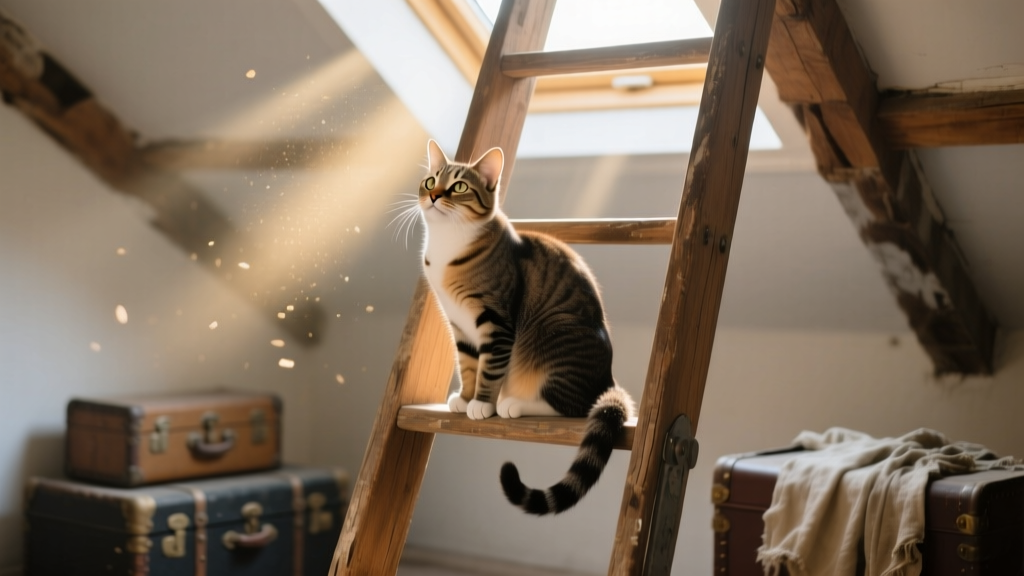
Some cats sit, sniff, and tilt their head upward like they’re watching a nature documentary. If they occasionally reach a paw toward a rung or sniff the edges of the hatch, you’re seeing exploration behavior. They’re gathering data: scents, sounds, and your reaction.
C) The Social Shadow: “You’re doing a thing; I’m part of it.”
If your cat follows you around and “supervises” chores, the attic ladder is simply the newest worksite. Cats often engage in affiliative monitoring—staying nearby not because they’re anxious, but because you’re their favorite moving object. Sitting at the bottom is a way to be close without being underfoot (ironically, it still feels underfoot).
D) The Ambush Artist: “This is a perfect pounce zone.”
If the ladder creates a little tunnel-like space or shadowy nook, it becomes a prime spot for play ambushes—especially in multi-cat homes. A cat may sit at the base and swat at a sibling passing by. It’s not necessarily mean; it’s often play predation using the environment for cover.
E) The Safety-Seeker: “This corner feels secure.”
Sometimes the ladder base is simply a sheltered perch—a spot with a “roof” overhead (the hatch) and a wall nearby. Cats like having something behind them and a clear view ahead. If your home is busy, the attic ladder area might feel like a protected observation post.
4) What it says about your cat’s mood and feelings
Body language tells you whether this is relaxed curiosity or something more intense.
- Relaxed, content: soft eyes, slow blinks, loose tail, sitting with paws tucked (“loaf”), ears swiveling normally
- Curious and engaged: forward ears, sniffing, head tilts, quiet chirps, tail tip twitching lightly
- Overstimulated or conflicted: sharp tail flicks, tense shoulders, dilated pupils, ears pinned or “airplane ears”
- Wary or guarding: body low, frozen posture, direct stare, growl or hiss if approached
Most attic-ladder sitters are in the first two categories: calm curiosity or friendly supervision. Cats often park themselves where they can see what’s happening while still feeling safe.
5) Related behaviors you might also notice
If your cat loves the bottom of the attic ladder, you may spot a few cousin behaviors around the house:
- Sitting in doorways or hall thresholds (classic “I own this hallway” energy)
- Perching on stair landings to watch everyone move
- Hanging out by closets, cabinets, or crawl spaces—any “portal” that opens occasionally
- Inspecting suitcases and storage bins as soon as they appear
- Supervising repairs with intense focus, especially ladders, tools, and open panels
All of these are tied to the same feline themes: novelty, territory monitoring, and strategic observation points.
6) When it’s normal…and when it might be a concern
Normal: Your cat sits at the bottom when the ladder comes down, watches, sniffs, maybe tries a rung or two, then wanders off. They remain approachable and relaxed. They may repeat this every time because it’s part of their “house patrol.”
Potential concern: Consider a closer look if you see:
- Sudden obsession with the area, especially if paired with yowling, pacing, or agitation
- Fear responses (hiding, trembling, refusing to pass that spot afterward)
- Aggression or guarding (swatting people or pets near the ladder)
- Signs of hearing/vision stress (startling intensely at small sounds, disorientation)
- Possible pest-related fixation (staring at the hatch, chattering, pawing persistently, especially at night)
Sometimes a cat is reacting to something you can’t detect easily: rodents in the attic, birds in the eaves, a new draft carrying unfamiliar scents, or even ultrasonic noises from electronics. If the behavior escalates sharply or your cat seems distressed, it’s worth checking the attic for wildlife activity and discussing changes with your vet—especially if there are other behavior shifts (appetite, litter box habits, sleep patterns).
7) How to respond (and how to encourage it safely)
The goal is to respect your cat’s curiosity while keeping everyone safe—especially your shins.
Safety first: manage the “bottom rung bottleneck”
- Create a designated “watch spot” a few feet away (a stool, small cat tree, or a sturdy box with a blanket). Reward your cat for choosing it.
- Use a treat toss to gently move your cat before you climb. Toss away from the ladder base, not toward it.
- Teach a simple station cue like “mat” using positive reinforcement. A small mat near the ladder becomes their job: sit here and get paid.
- Prevent risky climbing if your ladder is steep, slippery, or unstable. Close the hatch promptly if you can’t supervise.
Support their curiosity in cat-approved ways
- Let them sniff the air and ladder before you start moving boxes. That brief investigation can reduce clingy “supervision.”
- Offer a scent enrichment alternative: a paper bag, cardboard box, or a safe “attic-smell” item (like an old clean cloth from storage) placed on the floor for exploration.
- Provide vertical options elsewhere (cat shelves, tall tree). Cats with good vertical outlets often feel less compelled to patrol high-interest areas.
If your cat is doing this to be close to you, a little intentional attention helps: a short play session beforehand, a few treats for calm behavior, or simply talking to them while you work can meet that social need.
8) Fun facts and research-flavored nuggets
- Cats are “edge specialists.” Many cats prefer the perimeter of a space (near walls, corners, and thresholds) because it offers protection from behind and a clear view ahead—an efficient safety strategy.
- Novelty is enriching. Environmental enrichment research consistently supports the idea that new scents, objects, and opportunities to explore can improve a cat’s wellbeing. An attic ladder appearing out of nowhere is basically enrichment delivered by gravity.
- Human attention is a powerful reinforcer. Even “Don’t sit there!” can be rewarding if it reliably earns eye contact, talking, and interaction. Cats are excellent at repeating behaviors that get a big human response.
So yes—your cat may genuinely be curious about the attic. And yes—your cat may also be enjoying the fact that you turn into a very animated actor whenever the ladder comes down.
FAQ: Common questions about cats and attic ladders
1) Is my cat guarding the attic ladder?
Sometimes it looks like guarding, but it’s often just monitoring. If your cat is relaxed and moves away easily, it’s more “security detail” than “resource guarding.” If they growl, swat, or block others consistently, that’s closer to true guarding and may need behavior support.
2) Why does my cat only do this when I open the attic?
Because it’s a rare, high-interest event. The sounds, smells, and your unusual movements make the attic ladder a big environmental change. Cats are drawn to changes—especially ones that suggest a new space has opened.
3) My cat tries to climb the attic ladder. Should I allow it?
In most homes, it’s safer to discourage ladder climbing unless you can fully supervise and the setup is stable and low-risk. Attics can have exposed nails, insulation, gaps, and unsafe surfaces. Offer a safer vertical alternative nearby and reward that choice.
4) Could my cat be hearing animals in the attic?
Yes. If your cat is intensely focused on the hatch, chattering, pawing, or showing nighttime agitation, it’s worth checking for rodents or birds. Cats often detect faint movement and sound long before we do.
5) How do I get my cat to move without scaring them?
Use a treat toss, a wand toy lure, or a “station” mat with rewards. Avoid chasing or picking them up if they dislike handling—it can make the ladder area feel tense and increase the behavior next time.
6) Is this behavior a sign my cat is anxious?
Not usually. For many cats, it’s curiosity and engagement. Look at the full picture: appetite, litter habits, sleep, and overall body language. If your cat seems tense, startles easily, or becomes clingy in other contexts too, anxiety could be part of it.
What this quirky habit can teach you about your cat
A cat sitting at the bottom of the attic ladder is doing what cats do best: gathering information, choosing a strategic viewpoint, and quietly inserting themselves into your business. It’s a reminder that your home isn’t just a layout of rooms to them—it’s a living territory full of routes, thresholds, and storylines.
If you’d like, share your own attic ladder tale—does your cat supervise, investigate, block the steps like a tiny bouncer, or chirp up at the hatch like it’s hiding secrets? Post your story on catloversbase.com so other cat people can compare notes (and feel less alone carrying boxes past a very committed ladder guardian).