Why Cats Cover Their Feces: Instinct, Health & Behavior
Why This Tiny Habit Holds Big Clues About Your Cat’s Mind and Health
The question why cats cover their feces behavior isn’t just about curiosity—it’s one of the most telling windows into your cat’s psychological safety, social hierarchy awareness, and even early-stage illness. Unlike dogs, who often mark territory with waste, cats bury it—yet many guardians misread this as mere fastidiousness. In reality, this instinct is a finely tuned survival script written over 12 million years of evolution—and when it changes, it’s often the first whisper of something deeper: stress, pain, cognitive decline, or environmental discord. Understanding what drives this behavior—and what disrupts it—isn’t just fascinating biology; it’s preventive care disguised as observation.
The Evolutionary Blueprint: From Wild Ancestors to Your Living Room
Cats are obligate predators *and* vulnerable prey—a dual identity that shaped every aspect of their behavior, including elimination habits. In the wild, small felids like the African wildcat (Felis lybica), the direct ancestor of domestic cats, faced constant threats from larger carnivores and scavengers. Leaving feces exposed signaled location, health status, and vulnerability—essentially painting a target on their back. Burying waste minimized scent trails, reduced parasite transmission risk, and helped maintain stealth during hunting or resting. As Dr. Sarah Heath, a European Veterinary Specialist in Behavioural Medicine, explains: “Burying is not about ‘cleanliness’ in the human sense—it’s olfactory camouflage. A cat that doesn’t bury may be signaling dominance—or distress.”
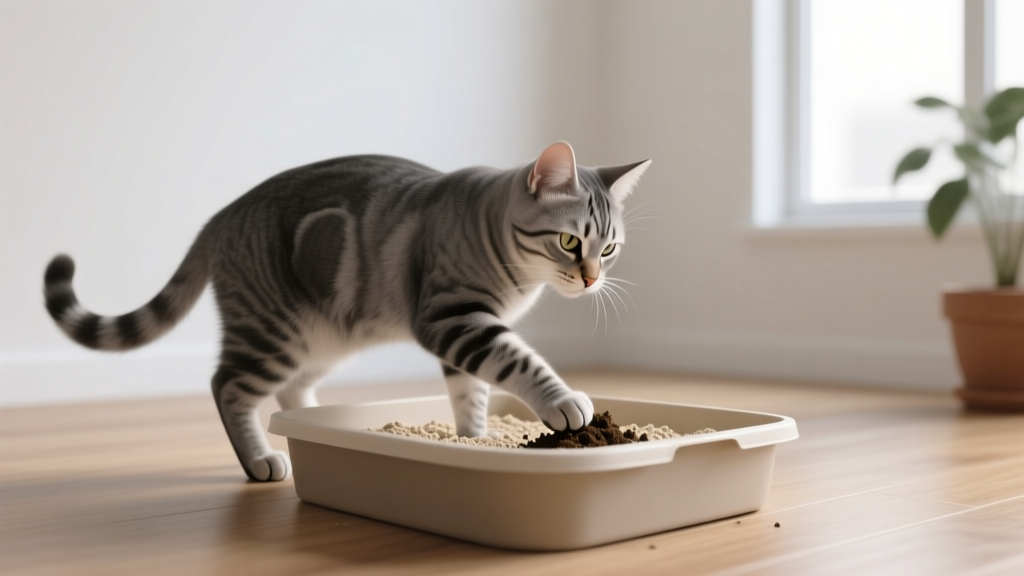
This instinct remains hardwired, but its expression is highly context-dependent. Kittens begin learning burial behavior around 3–4 weeks old, observing their mother and practicing in soft substrates. By 8–10 weeks, most display consistent covering—but the depth, frequency, and even presence of the behavior can shift dramatically based on environment, social dynamics, and physical comfort. For example, a multi-cat household introduces subtle power negotiations: dominant cats may leave feces uncovered as a territorial statement, while subordinates bury meticulously—even excessively—to avoid conflict.
When Instinct Meets Environment: 4 Key Triggers That Alter the Behavior
Your cat’s litter box isn’t just a bathroom—it’s a sensory ecosystem. Even minor mismatches between instinct and environment can suppress or distort natural covering behavior. Here’s what actually matters:
- Litter Texture & Depth: Cats evolved to dig in loose, fine, sandy soils—not coarse clay or scented crystals. Studies published in Applied Animal Behaviour Science (2021) found that 73% of cats showed reduced or absent covering when litter depth was under 2 inches or texture was overly granular. Ideal depth? 3–4 inches of unscented, clumping clay or fine-grain silica.
- Box Placement & Privacy: A litter box tucked beside a noisy washer or in high-traffic hallways violates a core feline need: escape routes and visual security. One shelter case study tracked 19 cats with sudden non-burying behavior; after relocating boxes to quiet, low-traffic corners with at least two exit paths, 16 resumed full covering within 72 hours.
- Cat-to-Box Ratio & Cleanliness: The widely cited “one box per cat + one extra” rule isn’t arbitrary. When resources are scarce, cats prioritize speed and safety over ritual. A 2023 Cornell Feline Health Center survey revealed that households with inadequate boxes saw 4.2x higher rates of partial or no covering—often paired with urination outside the box.
- Substrate Aversion: This is frequently misdiagnosed as “stubbornness.” In reality, cats associate textures with negative experiences. A single painful litter box episode (e.g., urinary discomfort on rough litter) can create lasting aversion. Dr. Tony Buffington, Professor Emeritus at Ohio State’s College of Veterinary Medicine, notes: “Cats don’t ‘hold grudges’—they hold sensory memories. That litter feels like pain. So they skip the digging—and sometimes the box entirely.”
Medical Red Flags: When Non-Covering Isn’t Behavioral—It’s Biological
While environment and stress explain many shifts, sudden or persistent changes in covering behavior demand medical evaluation. Why? Because elimination is physically demanding—and pain alters priorities. Consider these clinical correlations:
A 12-year-old Maine Coon named Jasper stopped burying his stool over three days. His owner assumed he was “getting lazy”—until a vet exam revealed advanced osteoarthritis in his right hip. Digging required weight-bearing flexion he could no longer manage without wincing. Similarly, a 5-year-old Siamese began scattering waste after her third UTI episode; cystoscopy later confirmed chronic interstitial cystitis causing sharp urethral pain during straining. These aren’t rare outliers: a 2022 retrospective analysis of 347 feline behavior referrals found that 38% of cases involving new-onset non-burying had underlying medical conditions—including kidney disease (14%), hyperthyroidism (9%), spinal arthritis (8%), and dental disease severe enough to cause jaw fatigue during prolonged post-defecation grooming.
Key diagnostic clues go beyond the act itself. Watch for:
• Straining or vocalizing during elimination
• Licking the genital/anal area excessively
• Reduced activity or reluctance to jump into the box
• Stool consistency changes (hard, dry, or mucoid)
• Urine spraying *alongside* non-burying (suggests anxiety *and* possible pain)
If any of these co-occur with altered covering, schedule a vet visit *before* assuming it’s “just behavioral.” Bloodwork, urinalysis, and orthopedic assessment should precede behavior modification.
Decoding the Message: What Different Variations Actually Mean
Not all covering looks the same—and each variation carries nuance. Below is a breakdown of common patterns and their likely interpretations:
| Behavior Pattern | Most Likely Meaning | Supporting Evidence / Next Steps |
|---|---|---|
| Complete, deep covering with vigorous scratching | High confidence in environment + strong instinctual drive | Indicates low stress, appropriate litter, and physical ability. Maintain current setup—but monitor for sudden drops in vigor, which may signal early joint pain. |
| Shallow, half-hearted scrape (no real digging) | Mild stress or substrate dissatisfaction | Test litter type/depth first. Also assess box location—try moving it away from appliances or foot traffic for 5 days. |
| No covering at all—feces left fully exposed | Potential dominance display OR medical pain OR severe anxiety | Rule out pain first (vet exam). If cleared, observe social dynamics: Is there a new pet? Renovation? Also check for urine marking nearby—may indicate territorial insecurity. |
| Excessive covering—repeated digging, pacing, or vocalizing near box | Anxiety, OCD-like compulsion, or frustration (e.g., box too small) | Measure box interior: minimum 1.5x cat’s length. Add Feliway diffuser. If persists >2 weeks, consult a veterinary behaviorist—medication (e.g., fluoxetine) may be indicated. |
| Burying only some stools—or alternating with uncovered ones | Inconsistent motivation: often linked to variable pain (e.g., intermittent constipation) or changing stressors | Log timing: Does it happen more on workdays? After visitors? Correlate with diet changes or medication schedules. Keep a 7-day journal. |
Frequently Asked Questions
Why do kittens start covering their feces so young?
Kittens begin mimicking maternal behavior around 3 weeks old—well before full neurological maturity. The mother cat stimulates elimination by licking the anogenital region and then buries the waste herself. Kittens observe and practice in soft bedding or soil. By 5–6 weeks, neural pathways for coordinated digging and covering are established. Early separation from mom (before 8 weeks) can delay or impair this learning, making litter training more challenging.
Do outdoor cats bury their feces too—or is this only a house cat thing?
Yes—wild and feral cats bury consistently, especially in shared territories or near dens. However, dominant males in high-density colonies sometimes leave feces uncovered as a territorial marker, particularly near boundaries. This is rarely seen in solitary rural cats. So it’s not a “house vs. wild” divide—it’s a “safety vs. dominance” calculus.
My cat covers urine but not feces—what does that mean?
This asymmetry is clinically significant. Urine contains volatile pheromones used for communication; covering it is less instinctive than feces-burying. If your cat covers urine but leaves feces exposed, it suggests either targeted discomfort (e.g., anal gland issues, constipation, or tail base pain) or a learned association—perhaps a past painful defecation event. Always investigate medically before attributing it to “preference.”
Will spaying/neutering change my cat’s covering behavior?
Not directly—but it often reduces inter-cat tension in multi-cat homes, which *can* normalize covering behavior. Unaltered cats may use feces exposure as part of mating-related signaling (e.g., intact males leaving scents to attract females). Post-spay/neuter, this diminishes, and burying typically increases as social stress decreases. No hormonal mechanism directly controls the motor pattern itself.
Common Myths
Myth #1: “Cats cover poop because they’re naturally clean—like little housekeepers.”
False. While humans project hygiene motives, cats lack a concept of “cleanliness” as moral or aesthetic. Burying serves survival—not sanitation. In fact, cats will readily track waste through the house if stressed, ignoring “mess” entirely when anxiety overrides instinct.
Myth #2: “If my cat stops covering, it means I’m not cleaning the litter box enough.”
Over-simplification. While extreme soiling *can* deter covering, research shows cats tolerate moderate odor better than humans assume. More often, cessation correlates with pain, anxiety, or substrate mismatch—not frequency of scooping. A 2020 study found that scooping twice daily vs. once daily made no statistical difference in covering rates—whereas switching from clay to pine pellets dropped rates by 61%.
Related Topics (Internal Link Suggestions)
- Cat litter box preferences — suggested anchor text: "how to choose the best litter for your cat"
- Signs of cat stress and anxiety — suggested anchor text: "subtle signs your cat is stressed"
- Feline urinary tract health — suggested anchor text: "early warning signs of UTIs in cats"
- Multi-cat household harmony — suggested anchor text: "reducing tension between cats"
- Senior cat behavior changes — suggested anchor text: "age-related behavior shifts in older cats"
Conclusion & CTA
Understanding why cats cover their feces behavior transforms you from a passive observer into an intuitive guardian—one who reads body language, environment, and subtle shifts as vital data points. This instinct isn’t trivial; it’s a barometer calibrated by evolution, refined by experience, and sensitive to both physical pain and emotional unease. If your cat’s covering habit has changed recently, don’t default to assumptions—start with empathy, then evidence. Observe for 48 hours: note litter type, box placement, vocalizations, mobility, and stool quality. Then, take the next step: schedule a vet visit *if pain is possible*, or adjust one environmental variable (litter depth or box location) and track for 5 days. Small interventions, guided by insight, prevent big problems. Your cat’s buried behavior is speaking volumes—learn to listen.