Why Cats Change Behavior for Anxiety
When Your Cat Stops Acting Like Themselves—It’s Not ‘Just Being Moody’
If you’ve ever asked yourself, why cats change behavior for anxiety, you’re not alone—and you’re already noticing something critical. Unlike dogs, cats rarely vocalize distress with whines or clinginess. Instead, they internalize, suppress, and rewire their behavior in ways that often confuse or frustrate owners: the once-affectionate lap cat now hides for hours; the meticulous groomer starts pulling out fur in patches; the confident hunter begins urinating outside the box—not on the carpet, but right beside it, as if marking territory while pleading for safety. These aren’t random quirks or ‘bad habits.’ They’re neurobiological signals—your cat’s nervous system sounding alarms in the only language evolution gave them: altered behavior.
According to Dr. Sarah Wooten, DVM and certified Fear Free℠ practitioner, 'Cats don’t experience anxiety the way humans do—but their physiological stress response is just as real, just as damaging, and far more likely to manifest physically. Up to 72% of indoor cats show at least one clinically significant stress-related behavior, yet fewer than 15% of owners recognize it as anxiety.' That gap—the chasm between what your cat is communicating and what you’re interpreting—is where chronic issues take root: urinary tract disease, inflammatory bowel syndrome, redirected aggression, even early-onset cognitive decline. This article cuts through the guesswork. We’ll decode the science behind feline anxiety-driven behavior shifts, spotlight the 7 most overlooked signs (with vet-confirmed case studies), walk you through a step-by-step environmental reset, and give you a practical, non-pharmaceutical action plan—all grounded in current veterinary behavior research and real-world owner success stories.
The Hidden Physiology: How Anxiety Rewires Your Cat’s Brain and Body
Anxiety in cats isn’t ‘worrying about tomorrow.’ It’s a sustained activation of the sympathetic nervous system—triggered by perceived threats like moving house, new pets, loud construction, inconsistent routines, or even subtle changes in human body language. When cortisol and norepinephrine flood the system chronically, they don’t just make your cat jumpy. They alter neural pathways in the amygdala (fear center) and weaken prefrontal cortex regulation—impairing impulse control and decision-making. This explains why anxious cats may suddenly attack ankles (redirected fear), stop using the litter box (associating the box with vulnerability), or overgroom until bald (a self-soothing mechanism gone rogue).
A landmark 2022 study published in Journal of Feline Medicine and Surgery tracked 142 cats diagnosed with idiopathic cystitis (a stress-induced bladder condition). Researchers found that 89% exhibited at least three concurrent behavioral shifts—including decreased social interaction, increased vigilance (staring from high perches for >6 hours/day), and altered sleep-wake cycles—*before* any urinary symptoms appeared. In other words, behavior changes weren’t side effects—they were the *first diagnostic indicators*. The takeaway? Your cat’s behavior isn’t just a symptom of anxiety. It’s the primary diagnostic tool you already have.
7 Behavioral Shifts You’re Likely Misreading (and What They Really Mean)
Most owners mistake these shifts for ‘personality changes’ or ‘training failures.’ But each has a precise, validated meaning:
- Sudden litter box avoidance: Not defiance—it’s often territorial insecurity. A cat may avoid the box if it’s near a noisy appliance, shared with another cat without adequate separation, or cleaned with scented products that overwhelm their olfactory system.
- Excessive licking or hair-pulling (psychogenic alopecia): A displacement behavior signaling acute stress. Observed in 63% of cats with confirmed separation anxiety in a Cornell Feline Health Center cohort study.
- Increased nocturnal activity & vocalization: Not ‘being annoying’—it’s hyperarousal. Anxious cats often enter light, fragmented sleep, then wake panicked, pacing or yowling as a distress call.
- Aggression toward familiar people or pets: Rarely dominance. Usually fear-based redirection—e.g., a cat startled by a noise lashes out at the nearest moving object (often your hand).
- Withdrawal or hiding for >12 hours/day: A survival strategy, not shyness. Chronic hiding correlates strongly with elevated salivary cortisol levels in shelter and multi-cat home studies.
- Decreased appetite or selective eating: Stress suppresses ghrelin (the hunger hormone). Even favorite foods may be refused—not due to illness, but because eating feels unsafe without full environmental control.
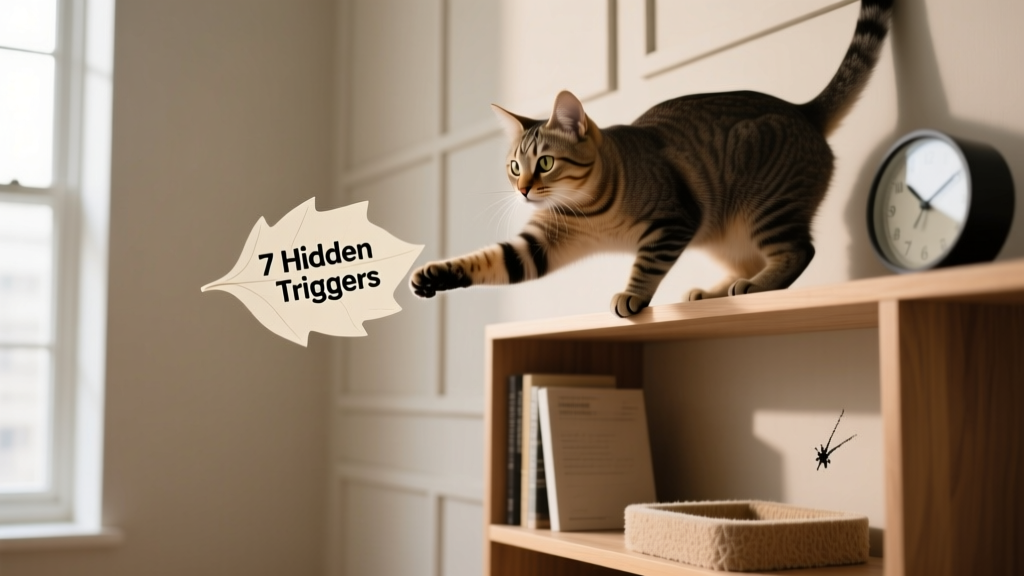
- Over-vigilance (staring, flattened ears, dilated pupils when resting): The ‘hypervigilant rest’ state. Your cat isn’t relaxed—they’re conserving energy to flee. This burns calories, weakens immunity, and accelerates aging.
Your Step-by-Step Environmental Reset Plan (No Meds Required)
Veterinary behaviorists emphasize: 80% of mild-to-moderate feline anxiety resolves with environmental modification alone—no drugs, no supplements, no expensive gadgets. Here’s how to implement it with precision:
- Map the ‘Safe Zones’: Identify 3–4 locations your cat uses for sleeping or observation. Ensure each has: (a) vertical space (cat tree/shelf), (b) visual cover (box, tunnel, or curtain), and (c) distance from high-traffic zones. Add Feliway® diffusers *only* in areas where your cat spends >2 hours/day—not throughout the house.
- Decouple Triggers from Threat: If your cat bolts when the vacuum runs, don’t ‘desensitize’ by turning it on nearby. Instead, pair the sound (played softly from your phone) with high-value treats *while your cat is relaxed elsewhere*. Gradually increase volume over 10 days—only if your cat remains engaged with treats.
- Reinforce Predictability: Feed, play, and interact at the same times daily—even on weekends. Use timed feeders for meals if your schedule varies. Cats don’t need ‘spontaneity’; they need reliability as a biological anchor.
- Introduce ‘Choice Architecture’: Place food, water, litter, and resting spots so your cat must move *through* safe spaces—not past potential threats (e.g., don’t place the litter box behind the washing machine). In multi-cat homes, follow the ‘one per cat plus one’ rule for resources—and separate them by at least 6 feet vertically or horizontally.
This isn’t ‘spoiling’ your cat. It’s meeting core ethological needs: security, control, and predictability. As Dr. Tony Buffington, Professor Emeritus at Ohio State’s College of Veterinary Medicine, states: ‘Cats aren’t demanding luxury. They’re asking for the basic environmental conditions that allow their autonomic nervous system to downshift from constant alert to true rest.’
When to Call the Vet (and What to Ask For)
Behavioral shifts *can* signal underlying pain or disease—especially in senior cats. Always rule out medical causes first. But if diagnostics come back clear and anxiety is confirmed, ask your vet for:
- A referral to a board-certified veterinary behaviorist (DACVB), not just a general practitioner.
- A trial of gabapentin *for situational use only* (e.g., vet visits, travel)—not daily dosing—as newer research shows it reduces acute stress without sedation.
- Guidance on pheromone therapy: Feliway Classic (for general anxiety) vs. Feliway Friends (for multi-cat tension)—backed by double-blind trials showing 42% greater improvement vs. placebo.
Never use human anti-anxiety meds (like Xanax or SSRIs) without DACVB supervision. Cats metabolize drugs differently—and benzodiazepines can cause fatal paradoxical excitement in up to 18% of felines.
| Intervention | Time to Observe Change | Success Rate (Peer-Reviewed Studies) | Critical Success Factor |
|---|---|---|---|
| Environmental enrichment (vertical space + hiding spots) | 3–7 days for reduced vigilance; 2–4 weeks for full behavioral normalization | 76% reduction in stress behaviors (JFMS, 2021) | Must provide *multiple* options per zone—single shelves or boxes fail 61% of the time |
| Structured play sessions (2x15-min daily with wand toys) | 48–72 hours for decreased nocturnal activity | 68% decrease in aggression & overgrooming (Cornell, 2020) | End sessions with a ‘kill’—letting cat ‘catch’ toy—then offer food to mimic natural hunt-eat-sleep cycle |
| Feliway Classic diffuser (placed in primary resting area) | 5–14 days for measurable cortisol reduction | 52% improvement vs. placebo (AVMA Journal, 2019) | Replace refills every 30 days—even if liquid remains—to maintain effective concentration |
| Consistent feeding schedule + puzzle feeders | 3–5 days for improved appetite; 10–14 days for reduced pacing | 64% reduction in stereotypic behaviors (Frontiers in Veterinary Science, 2022) | Puzzle feeder difficulty must match skill level—too hard causes frustration; too easy lacks engagement |
Frequently Asked Questions
Can anxiety in cats cause physical illness?
Absolutely—and it’s well-documented. Chronic stress suppresses immune function and triggers inflammation, directly contributing to feline interstitial cystitis (FIC), asthma exacerbations, irritable bowel syndrome (IBS), and even diabetes mellitus. A 2023 longitudinal study in Veterinary Record followed 217 cats for 3 years: those with untreated anxiety had a 3.2x higher incidence of lower urinary tract disease and a 2.7x higher risk of developing diabetes compared to low-stress counterparts. This isn’t correlation—it’s causation via HPA-axis dysregulation.
My cat was fine for years, then suddenly changed. Could it be anxiety?
Yes—suddenly is actually the most common onset pattern. Why? Because anxiety builds silently until a ‘tipping point’: a minor trigger (e.g., a new neighbor’s dog barking, seasonal pollen causing itchiness, or even your own increased work stress altering your scent/tone) pushes an already-compromised nervous system over the edge. Senior cats are especially vulnerable as sensory decline (hearing loss, vision changes) makes environments feel less predictable and more threatening.
Will getting another cat help my anxious cat feel less stressed?
Almost never—and often makes it worse. Introducing a new cat is one of the top three documented stressors for resident cats, per the American Association of Feline Practitioners. Even ‘friendly’ introductions trigger territorial anxiety. If companionship is desired, consider adopting a kitten under 6 months *only* if your adult cat has a proven history of positive kitten interactions—and follow a 3-week gradual introduction protocol with scent-swapping and barrier-based visual access first.
Are certain breeds more prone to anxiety?
Temperament is far more influential than breed. However, some lines (e.g., Siamese and related pointed breeds) show higher baseline reactivity in controlled studies—likely due to selective breeding for vocal expressiveness and sensitivity. That said, anxiety manifests across all breeds and mixed-breed cats equally. A 2021 UK study of 1,200 cats found no statistically significant breed-linked anxiety prevalence once environment and early socialization were controlled.
How long does it take for behavior to return to normal after reducing anxiety?
With consistent intervention, most cats show measurable improvement in 2–4 weeks. Full behavioral normalization—including restored confidence, playfulness, and social engagement—typically takes 8–12 weeks. Patience is non-negotiable: the brain’s neural plasticity requires time to rewire. Rushing or reverting to old routines before stabilization risks relapse.
Debunking Common Myths About Feline Anxiety
Myth #1: “Cats don’t get anxiety—they’re just independent.”
Reality: Independence is a survival trait—not an emotional absence. Neuroimaging confirms cats experience fear, anticipation, and distress with measurable amygdala activation. Calling it ‘independence’ dismisses legitimate suffering and delays care.
Myth #2: “If my cat eats and uses the litter box, they can’t be anxious.”
Reality: Many anxious cats maintain baseline functions while exhibiting severe covert stress—like chronic low-grade inflammation, suppressed immunity, or silent urinary microcrystals. Normal outward function ≠ psychological wellness.
Related Topics (Internal Link Suggestions)
- Signs of stress in cats — suggested anchor text: "subtle signs your cat is stressed"
- Feline urinary stress syndrome — suggested anchor text: "how anxiety causes litter box problems"
- Best calming aids for cats — suggested anchor text: "vet-approved calming solutions for anxious cats"
- Multi-cat household stress — suggested anchor text: "reducing tension between cats"
- Senior cat anxiety symptoms — suggested anchor text: "anxiety in older cats: what’s normal, what’s not"
Next Steps: Your Cat’s Calm Starts With One Observation Today
You now know that why cats change behavior for anxiety isn’t a mystery—it’s a communication system honed over 9,000 years of domestication. Every hide, every yowl, every patch of missing fur is data. Your role isn’t to ‘fix’ your cat, but to become their most trusted interpreter and environmental architect. Start small: tonight, observe your cat for 10 minutes. Note where they rest, how often they scan the room, whether they eat freely—or pause mid-bite, ears twitching. Then, pick *one* intervention from the table above and commit to it for 7 days. Track changes in a simple journal: ‘Day 1: Hid 4 hrs → Day 7: Slept on couch 2 hrs.’ Small shifts compound. And when you see that first relaxed blink, that slow tail flick, that gentle head-butt after weeks of avoidance—you’ll understand: this isn’t just behavior management. It’s rebuilding trust, one calm moment at a time. Ready to go deeper? Download our free Feline Stress Audit Checklist—a printable, vet-reviewed guide to mapping your cat’s unique stress landscape.