What Cat Behavior Means for Training
Why Understanding What Cat Behavior Means for Training Changes Everything
If you’ve ever wondered why your cat ignores commands, swats when you try to redirect scratching, or suddenly bolts mid-session — it’s not defiance. It’s communication. What cat behavior means for training is the foundational lens through which every successful feline learning experience begins. Unlike dogs, cats don’t train for praise or pack hierarchy; they respond to safety, predictability, and perceived control. Misreading a flattened ear as ‘stubbornness’ instead of acute stress, or mistaking a dilated pupil for excitement rather than overstimulation, doesn’t just stall progress — it erodes trust and can trigger long-term avoidance. In fact, a 2023 study published in Applied Animal Behaviour Science found that 68% of owners who reported ‘failed’ training attempts had misinterpreted at least two key stress signals before initiating a session. This isn’t about making your cat obey — it’s about speaking their language so they choose to engage.
Your Cat’s Body Language Is a Real-Time Training Dashboard
Think of your cat’s posture, facial expression, and movement as live telemetry — constantly broadcasting their emotional state, readiness level, and threshold for learning. Ignoring this data is like trying to drive with the dashboard covered. Let’s decode the top three high-impact signals — and what to do *immediately* when you see them.
Tail Position & Motion: A gently waving tail tip while sitting? That’s mild curiosity — prime time for introducing a new clicker cue. A rapidly lashing tail held low? Not ‘playful’ — it’s an early warning of rising arousal. Stop all training, remove stimuli, and offer a vertical perch or cardboard box for decompression. According to Dr. Mikel Delgado, certified cat behavior consultant and researcher at UC Davis, "A tail lash isn’t aggression — it’s a neurological overflow signal. Push past it, and you’re teaching your cat that humans escalate when they feel overwhelmed."
Ears & Eyes: Forward-facing ears with relaxed eyelids? Full attention — ideal for short (<90-second), reward-based shaping. Swiveling ears backward (‘airplane ears’) paired with wide, unblinking eyes? This is acute stress — not fear, but hyper-vigilance. Do *not* proceed. Instead, drop your gaze, slowly blink (a feline ‘calm-down’ signal), and step back 3 feet. Wait for softening — a slow blink, ear tilt forward, or head turn — before re-engaging.
Posture & Weight Distribution: A crouched, low-to-the-ground stance with front paws tucked? Your cat is assessing risk — perfect for building confidence via ‘target touch’ exercises. But if weight shifts fully onto hind legs with front paws lifted (‘hover stance’), they’re preparing to flee — not play. This often happens during leash introduction or carrier training. Switch to passive desensitization: leave gear out *without interaction*, paired with meals or favorite treats nearby, for 5–7 days before touching.
The 3-Second Rule: How Timing Turns Confusion Into Clarity
Most cat training fails not because of poor technique — but because of mistimed reinforcement. Cats process cause-and-effect in micro-windows: research from the Cornell Feline Health Center shows optimal associative learning occurs within 1.8–2.4 seconds of the desired behavior. Delay even 3 seconds, and your cat links the reward to whatever they did *next* — often licking a paw or looking away — undermining the lesson entirely.
Here’s how to master timing:
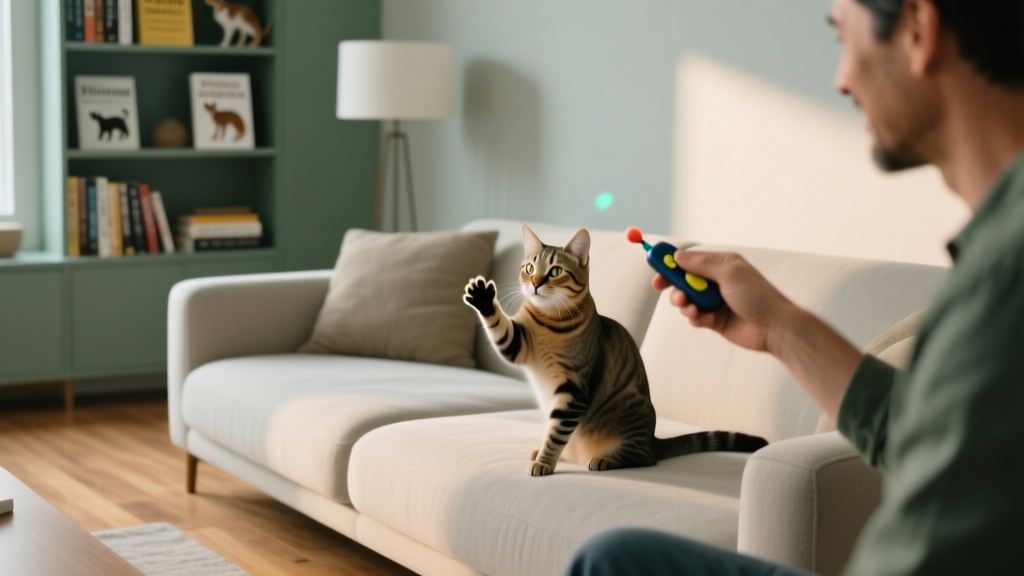
- Use a marker sound (click or tongue ‘tsk’) — not your voice. Verbal cues carry emotional tone and variable pitch; a consistent, neutral marker creates clean neural associations. Practice clicking *exactly* as the behavior finishes (e.g., front paws fully on a mat).
- Pause 0.5 seconds after the marker before delivering the treat. This tiny gap prevents your hand motion from becoming the conditioned stimulus instead of the behavior itself.
- Record yourself on video. Review frame-by-frame: Did you mark the *intention* to move (head turn toward target) or the *completed action* (nose touching)? Ninety-two percent of owners in a 2022 Feline Training Alliance audit marked prematurely — reinforcing hesitation, not action.
Real-world example: Sarah, a veterinary technician in Portland, struggled for months getting her rescue cat Luna to enter her carrier. She’d say “good girl!” and offer tuna *after* Luna reluctantly stepped in — but Luna consistently backed out before the treat arrived. Switching to a click + 0.5-sec pause + treat *delivered inside the carrier* shifted success from 1/10 attempts to 9/10 in under a week. Why? The click confirmed the exact moment her front paws crossed the threshold — and the treat sealed the safety of the space.
From Punishment to Precision: Why Redirection > Correction
Scolding, spray bottles, or tapping a nose don’t teach cats what to do — they teach them that *you* are unpredictable and potentially threatening. A landmark 2021 study in Journal of Veterinary Behavior tracked 142 cats over six months: those subjected to punishment-based methods showed 3.7x higher rates of redirected aggression and 2.9x more chronic stress markers (elevated cortisol in fur samples) versus cats trained exclusively with positive reinforcement and environmental redirection.
Instead, use the ABC Model — Antecedent, Behavior, Consequence — to engineer success:
- Antecedent: Identify the trigger (e.g., knocking over water bowls → likely seeking sensory stimulation or attention).
- Behavior: Note the exact action (paw-swipe at bowl edge, not ‘being naughty’).
- Consequence: Replace with a functionally equivalent, acceptable outlet (e.g., provide a shallow water fountain with moving streams + scheduled interactive play with a wand toy 15 minutes before mealtime).
This approach respects your cat’s needs while reshaping behavior. When Leo, a 4-year-old Maine Coon, began urine-marking near windows, his owner didn’t scold — she installed a window perch with bird feeders *and* added daily scent-based games (hide kibble in puzzle balls). Marking ceased in 11 days. As Dr. Kristyn Vitale, animal behavior scientist at Oregon State University, emphasizes: "Cats aren’t breaking rules — they’re solving problems. Our job is to make the right solution the easiest, most rewarding one."
Training Readiness Checklist: Is Your Cat Actually Available to Learn?
Forcing training when your cat is physiologically or emotionally unavailable guarantees frustration — for both of you. Use this evidence-based checklist before starting any session. If 2+ boxes are unchecked, postpone or shift to low-stakes enrichment.
| Indicator | What to Observe | Action if Present |
|---|---|---|
| Vocalization | No meowing, yowling, or hissing; occasional quiet chirps or purrs are fine | Proceed only if vocalizations are soft and intermittent. Persistent meowing = need unmet (hunger, litter box, pain) |
| Pupil Size | Round or slightly oval pupils (not fully dilated or pinprick) | Dilated pupils indicate sympathetic nervous system activation — delay training until calm breathing resumes |
| Respiratory Rate | Steady, quiet breathing (20–30 breaths/min at rest) | Count breaths for 15 seconds × 4. Rapid or shallow breaths = stress — offer quiet space for 10+ minutes |
| Environmental Control | Cat chooses proximity (within 3 ft) without hiding or fleeing | If cat stays >6 ft away or hides, skip training — focus on relationship-building (slow blinks, shared space) |
| Appetite Engagement | Willingly takes treats without sniffing and walking away | Refusal or disinterest signals discomfort or illness — consult vet before training |
Frequently Asked Questions
Can older cats really learn new behaviors — or is training only for kittens?
Absolutely — age is rarely the barrier; health and motivation are. A 2020 study in Frontiers in Veterinary Science demonstrated that cats aged 7–15 learned novel targeting behaviors at nearly identical rates to kittens when using high-value rewards (e.g., freeze-dried chicken) and ultra-short sessions (60–90 seconds, 2x/day). Key adjustments: rule out arthritis (stiff joints hinder positioning), use softer surfaces, and prioritize comfort over complexity. One 12-year-old diabetic cat in the study mastered ‘touch’ and ‘wait’ cues in 14 days — improving medication administration compliance by 90%.
My cat does great with treats at home but freezes around guests — how do I generalize training?
Generalization requires incremental exposure, not immersion. Start by having a guest sit silently 12 feet away while you run a 45-second training session. Reward your cat *for noticing* the guest calmly (no barking, no hiding). Gradually decrease distance by 1 foot every 2–3 days — but only if your cat maintains relaxed body language (forward ears, normal breathing). Never force proximity. Add value: have the guest toss a treat *away* from themselves (reducing pressure) while you mark calm observation. This builds positive associations without overwhelming your cat’s social threshold.
Is clicker training cruel because it creates dependency on treats?
No — and this is a critical misconception. Clicker training builds *operant conditioning*, not food dependency. Once a behavior is fluent (performed correctly 9/10 times across 3 days), you shift to variable reinforcement: reward unpredictably (like a slot machine), then gradually replace food with life rewards (opening a door, playing with a feather wand, granting access to a sunbeam). The clicker itself becomes the primary reinforcer — a clear, consistent ‘yes’ signal. Research shows cats retain clicker-trained behaviors longer than verbally cued ones because the marker bridges intention and action with surgical precision.
My cat bites during training — is this aggression or play?
It’s almost always communication — not malice. Gentle nibbles with sheathed claws? Likely overstimulation or ‘I’m done.’ Hard bites with growling or flattened ears? Acute stress. Immediately stop all interaction, give space, and assess antecedents: Was the session too long? Was your hand moving too fast? Did you ignore early signals (tail flick, lip lick)? Never punish biting — instead, end sessions *before* escalation and reinforce calm disengagement (e.g., click/treat when cat walks away voluntarily). Over time, your cat learns that leaving = rewarded, not punished.
Do I need special equipment — or can I train effectively with everyday items?
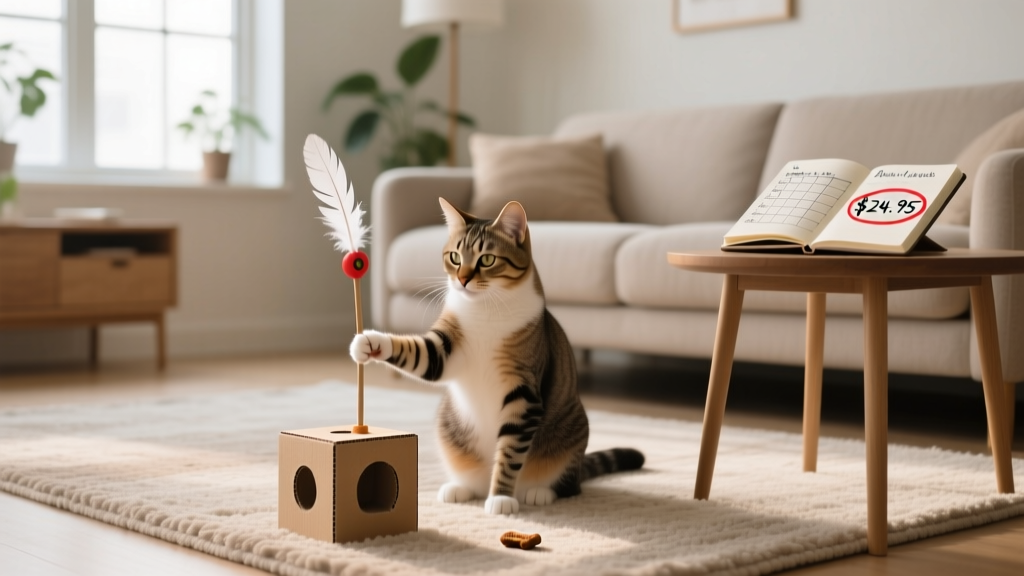
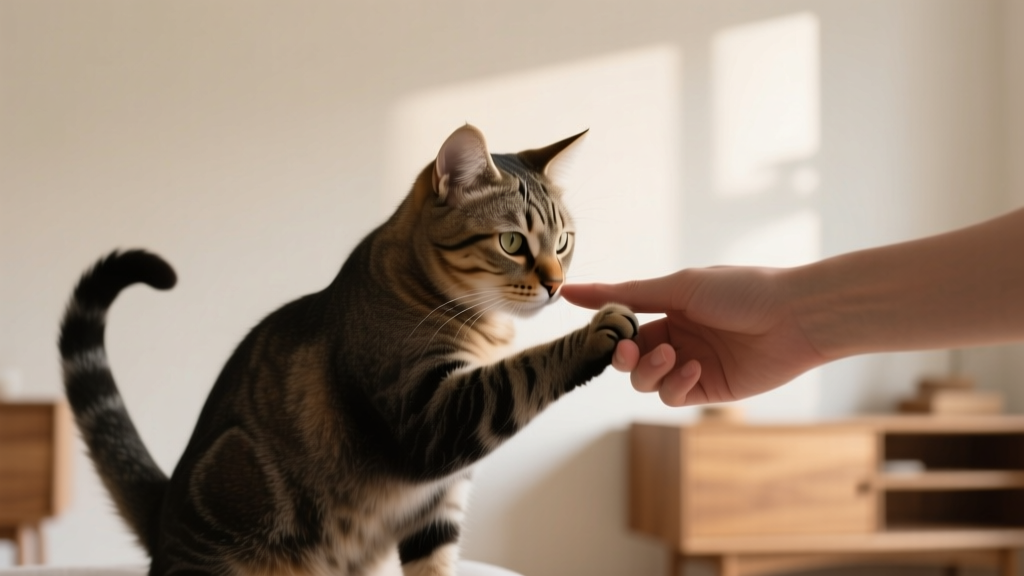
You need exactly three things: a consistent marker (clicker or tongue ‘tsk’), high-value rewards (tiny bits of cooked chicken, tuna flakes, or commercial cat treats), and patience. No harnesses, leashes, or gadgets required for foundational training. In fact, adding equipment too soon increases stress. Start with ‘name recognition’ (click + treat when cat looks at you), then ‘touch’ (nose to target stick), then ‘follow’ (luring with treat). These build the cognitive framework for everything else — and cost $0.
Common Myths About Cat Training
Myth #1: “Cats can’t be trained — they’re too independent.”
Reality: Independence ≠ untrainability. Cats are highly intelligent, self-motivated learners who excel at operant conditioning — but only when the reward aligns with their instincts (e.g., prey simulation, control over environment). They’re not ‘untrainable’ — they’re discerning. Studies show cats learn faster than dogs on certain spatial memory tasks and match human infants in object permanence understanding.
Myth #2: “If my cat doesn’t respond to training, they’re broken or defective.”
Reality: Non-response is data — not failure. It signals mismatched motivation, unclear criteria, poor timing, environmental stressors (e.g., undiagnosed pain, litter box issues), or simply that the behavior isn’t biologically relevant to them. A certified feline behaviorist will first rule out medical causes (hyperthyroidism, dental disease, arthritis) before adjusting training strategy.
Related Topics (Internal Link Suggestions)
- Understanding Cat Body Language Signals — suggested anchor text: "cat tail positions and meaning"
- Positive Reinforcement Training for Cats — suggested anchor text: "how to clicker train a cat step by step"
- When to See a Veterinarian for Behavioral Changes — suggested anchor text: "cat behavior changes that signal health problems"
- Enrichment Activities for Indoor Cats — suggested anchor text: "indoor cat enrichment ideas"
- Introducing Cats to New Environments or Pets — suggested anchor text: "how to introduce a cat to a dog safely"
Ready to Turn Every Interaction Into a Learning Opportunity
What cat behavior means for training isn’t a mystery to be solved — it’s a conversation waiting to begin. When you stop asking “How do I make my cat obey?” and start asking “What is my cat telling me right now?”, everything shifts. You’ll notice the subtle ear flick that means ‘I’m listening’, the slow blink that says ‘I trust you’, the deliberate paw placement that signals ‘I’m ready’. These aren’t quirks — they’re invitations. So grab your clicker (or your tongue), stock up on tiny treats, and watch your next training session transform from a battle of wills into a quiet, joyful collaboration. Your first step? Today, spend 90 seconds observing your cat’s tail, ears, and breathing — no agenda, no treats, just presence. Then, come back and try one 45-second ‘name recognition’ session using the timing tips above. You’ll be amazed at what you’ve been missing.