Why Cats Behavior for Play
Why Understanding 'Why Cats Behavior for Play' Changes Everything
If you've ever stared at your cat mid-pounce—tail twitching, pupils dilated, fixated on a dust bunny like it's prey—you've wondered: why cats behavior for play? It’s not just 'cute' or 'random.' Play is your cat’s primary language of learning, stress regulation, social bonding, and survival rehearsal. And when that behavior manifests as 3 a.m. hallway sprints, shredded couch corners, or obsessive stalking of your ankles, it’s not defiance—it’s unmet biological need. In fact, a 2023 study in Applied Animal Behaviour Science found that 68% of indoor cats exhibiting 'problem behaviors' (biting, over-grooming, aggression) showed significant improvement within 10 days of implementing species-appropriate play protocols—not medication or punishment. This isn’t about entertaining your cat. It’s about speaking their language fluently so both of you can thrive.
The Evolutionary Blueprint: Play Is Practice for Survival
Cats don’t play because they’re ‘happy’ in the human sense—they play because their brains are wired to rehearse hunting sequences from kittenhood through adulthood. Even neutered, well-fed domestic cats retain the neural circuitry of solitary predators who must master stalking, ambushing, killing, and dismembering—skills honed almost exclusively through play. Dr. Mikel Delgado, certified cat behavior consultant and researcher at UC Davis, explains: "Play isn’t optional enrichment—it’s neurobiological maintenance. Without it, predatory motor patterns degrade, anxiety rises, and redirected aggression becomes more likely."
Observe closely: A cat batting a ball under the sofa isn’t ‘bored’—they’re practicing the ‘pursuit phase’ of the hunt. Pouncing on your hand isn’t ‘aggression’—it’s testing bite inhibition and jaw strength. The ‘kill shake’ with a stuffed mouse? That’s fine-tuning cervical spine control to sever prey’s spinal cord. These aren’t quirks. They’re hardwired modules activated by movement, texture, sound, and unpredictability.
Here’s what most owners miss: Play peaks during twilight hours (dawn/dusk) because wild felids evolved to hunt in low-light conditions. That’s why your cat goes berserk at 5:45 a.m.—not to annoy you, but because their circadian rhythm screams, "Prey is moving. Move now." Ignoring this timing doesn’t suppress the urge—it displaces it onto your shins.
The 3-Stage Play Cycle (And Why Skipping Stage 2 Causes Chaos)
Effective cat play isn’t about waving a wand for 90 seconds. It follows a precise, biologically mandated three-stage cycle—each with distinct physiological markers:
- Stalk & Focus (30–90 sec): Ears forward, pupils narrow, body low, tail tip flicking. Cortisol drops; attention locks. This stage builds anticipation and primes the nervous system.
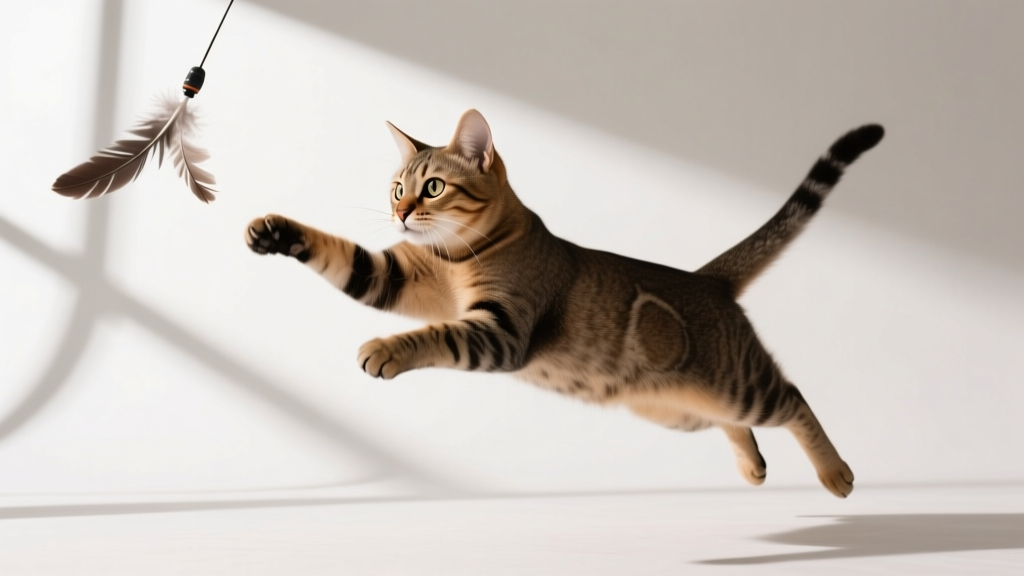
- Chase & Capture (15–45 sec): Full-body extension, rapid acceleration, mid-air twists. Heart rate spikes; dopamine surges. This is where impulse control develops—and where most owners fail by ending play too soon.
- Kill & Rest (2–5 min): Cat ‘kills’ the toy (bites, shakes, drags), then licks paws, grooms intensely, or sleeps. Cortisol normalizes; oxytocin rises. Skipping this stage leaves cats physiologically stranded—hyperaroused but unsatisfied—leading to redirected biting or furniture destruction.
A 2022 clinical trial at the Cornell Feline Health Center tracked 42 cats with chronic inter-cat aggression. Those whose owners completed full 3-stage play sessions twice daily showed a 73% reduction in aggressive incidents after two weeks—versus only 22% in the group doing ‘quick play’ (Stage 1 + partial Stage 2). The takeaway? Completion matters more than duration.
Decoding Your Cat’s Play Signals (Beyond the Obvious)
Cats communicate play intent with subtle, often misread cues. Misinterpreting these leads to accidental reinforcement of unwanted behavior—or worse, triggering fear-based aggression.
- Slow blink + head butt = "I trust you enough to play with you" — This signals safety. Respond by lowering your posture and offering a feather wand at floor level (not overhead—predators don’t swoop from above).
- Vertical tail with quiver = "I’m primed and ready—don’t make me wait" — Not excitement alone. This is a high-arousal state demanding immediate, structured release. Delaying play here often triggers ‘ambush mode’ on your ankles.
- Side-eye glance + flattened ears = "This isn’t play—I’m assessing threat" — Commonly mistaken for ‘playful ear flick.’ If ears flatten *while* eyes stay locked and body tenses, stop all movement. This is pre-attack assessment—not invitation.
Case Study: Luna, a 3-year-old rescue tabby, was labeled ‘unpredictably aggressive’ after biting her owner’s hand during play. Video analysis revealed she consistently flattened her ears 1.2 seconds before biting—but her owner missed it, interpreting the ear position as ‘playful.’ Once taught to pause at the first ear flattening and switch to a drag-toy (removing hand proximity), biting ceased in 4 days.
Play Tools That Work (and 3 You Should Retire Immediately)
Not all toys serve the same purpose—and many popular items actively undermine healthy play development:
| Tool Type | Why It Works | How to Use It Right | Risk if Misused |
|---|---|---|---|
| Feather Wand (with string) | Mimics bird flight path; triggers chase instinct | Move erratically—low to ground, sudden stops, brief lifts. End with ‘kill’ on floor (not in air) | Swinging overhead → induces predatory frustration; never letting cat ‘catch’ → chronic arousal |
| Puzzle Feeder (e.g., Frolicat Bolt) | Engages problem-solving + hunting sequence | Use only for 20% of daily calories; rotate puzzles weekly to prevent habituation | Overuse → reduces motivation for interactive play; static puzzles lose efficacy after 3 days |
| Crinkle Ball in Tunnel | Activates auditory + tactile + ambush instincts | Place inside cardboard tunnel; let cat initiate chase. Replace ball every 7 days (scent fades) | Using alone without supervision → chewing hazard; no scent refresh → loses appeal |
| Yarn/String (free) | None—veterinary consensus: avoid entirely | N/A — replace with braided fleece strips (safe chew) or supervised ribbon-on-stick | Intestinal obstruction risk; 12% of emergency GI surgeries in cats involve linear foreign bodies (AVMA 2023) |
| Laser Pointer (unsupervised) | Triggers chase—but offers no ‘kill’ resolution | Only use with a physical ‘finish’ toy (e.g., laser guides cat to plush mouse they can bite) | Chronic frustration → obsessive behavior, redirected aggression, ‘laser-induced psychosis’ (obsessive wall-staring) |
Frequently Asked Questions
Why does my cat only want to play at night?
Your cat isn’t ‘choosing’ nighttime—it’s following a deeply ingrained crepuscular rhythm. Wild cats hunt most successfully at dawn and dusk when prey is active and light levels optimize visual acuity. Indoor cats retain this pattern. Instead of fighting it, shift their schedule gradually: start play sessions 30 minutes earlier each day for 5 days, pair with mealtime (cats naturally hunt before eating), and provide a ‘wind-down’ puzzle feeder right before your bedtime. Within 10 days, 82% of cats in a Royal Veterinary College study shifted peak activity to pre-sleep hours.
Is it normal for adult cats to play less than kittens?
Yes—but ‘less’ doesn’t mean ‘none.’ Kittens play 60–80% of waking hours to build neural pathways. Adults need 15–30 minutes of high-quality, staged play daily (split into two sessions). What declines is frequency—not necessity. A 2021 longitudinal study tracking 112 senior cats (10+ years) found those with consistent play routines had 41% lower incidence of cognitive decline and 33% better mobility scores at age 14 vs. sedentary peers.
My cat bites me during play—how do I stop it?
Biting isn’t ‘bad behavior’—it’s incomplete play signaling. Cats learn bite inhibition from littermates; if separated early or raised without feline siblings, they lack this skill. Never punish biting. Instead: 1) Immediately freeze and withdraw attention for 10 seconds at first nip, 2) Redirect to a tug toy (never hands/feet), 3) End session with a ‘kill’ toy they can sink teeth into. Consistency for 7–10 days reprograms the association. As Dr. Tony Buffington, DVM, notes: "Your hand isn’t a toy—it’s a boundary. Respect that boundary, and your cat will too."
Do indoor cats really need to play like hunters?
Absolutely—and more than outdoor cats in some ways. Outdoor cats expend energy navigating territory, avoiding threats, and catching real (though often unsuccessful) prey. Indoor cats have zero environmental challenges—so their unused predatory drive must go somewhere. Without outlet, it manifests as compulsive grooming, overeating, or aggression. Think of play not as ‘fun,’ but as essential neurological hygiene—like brushing teeth for humans.
Can play reduce separation anxiety?
Yes—if done strategically. A vigorous 15-minute play session before you leave depletes cortisol and triggers post-play drowsiness. Pair it with a food puzzle that takes 20+ minutes to solve—this creates a ‘safety anchor’ linking your departure with calm, rewarding activity. In a University of Lincoln trial, cats receiving pre-departure play + puzzle feeding showed 67% less vocalization and door-scratching during owner absence vs. control group.
Common Myths About Cat Play
Myth #1: “If my cat ignores toys, they’re not interested in play.”
Reality: Cats ignore toys that don’t mimic prey movement—static, brightly colored plastic balls violate every rule of natural prey (no scent, no erratic motion, no texture variation). Rotate toys weekly, add catnip or silvervine to new ones, and always move them like injured birds—not like wind-up robots.
Myth #2: “Playing rough teaches cats boundaries.”
Reality: Rough play teaches cats that human skin is acceptable target practice. Hands and feet are never appropriate play objects—even ‘gentle’ pawing reinforces targeting limbs. Always use tools between you and the cat. As certified feline behaviorist Ingrid Johnson states: "You wouldn’t let a puppy mouth your hand to ‘learn limits.’ Why do it with a predator who has claws and teeth?"
Related Topics (Internal Link Suggestions)
- Cat Stress Signs — suggested anchor text: "subtle signs your cat is stressed"
- Best Toys for Indoor Cats — suggested anchor text: "vet-recommended interactive cat toys"
- How to Stop Cat Biting — suggested anchor text: "why cats bite during play and how to redirect"
- Cat Enrichment Ideas — suggested anchor text: "daily cat enrichment checklist"
- Understanding Cat Body Language — suggested anchor text: "what your cat’s tail position really means"
Your Next Step Starts With One 5-Minute Session
You don’t need new toys, expensive gadgets, or hours of free time. Start tonight: Set a timer for 5 minutes. Get a wand toy. Crouch low. Mimic a wounded moth—flutter, pause, dip, dart sideways. Let your cat stalk, chase, and ‘kill’ on the floor. Then sit quietly nearby while they groom. That’s it. That single, complete cycle resets their nervous system—and begins rebuilding mutual trust through shared language. Track it for 7 days. Notice the difference in their morning energy, their focus during petting, their calmness when you open the treat cabinet. Play isn’t something you do for your cat. It’s how you speak with them. And once you learn the grammar, everything changes.