Typical Cat Behavior for Indoor Cats: What’s Normal?
Why Understanding What Is Typical Cat Behavior for Indoor Cats Changes Everything
If you’ve ever watched your indoor cat suddenly sprint across the living room at 3 a.m., freeze mid-stride to stare intently at an empty corner, or gently nibble your hand while purring—only to bite when you pet them longer than 7 seconds—you’re not alone. What is typical cat behavior for indoor cats isn’t just curiosity fodder; it’s the foundational language that separates peaceful coexistence from chronic confusion, miscommunication, and preventable stress-related illness. Unlike outdoor or feral cats, indoor cats live in a world stripped of evolutionary outlets—no hunting grounds, no territory patrols beyond the couch, no social hierarchy with conspecifics. Their instincts haven’t vanished—they’ve been compressed, redirected, and often misunderstood. In fact, a 2023 study published in Applied Animal Behaviour Science found that 68% of behavior-related vet visits for indoor cats stemmed not from ‘bad behavior,’ but from owners misinterpreting biologically normal actions as problematic. This article decodes those actions—not as quirks, but as coherent, adaptive responses shaped by 9,000 years of domestication and 20 years of modern confinement.
The Four Pillars of Indoor Cat Behavior: Instinct, Environment, History, and Individuality
‘Typical’ doesn’t mean universal—it means statistically common *within context*. Indoor cats share core behavioral archetypes rooted in their evolutionary biology, but expression varies dramatically based on early life experience (e.g., handled daily vs. raised in a shelter), breed tendencies (e.g., Siamese vocalization vs. Russian Blue reserve), and home environment (e.g., single-cat household vs. multi-pet chaos). Dr. Sarah Wooten, DVM and certified feline specialist with the American Association of Feline Practitioners, emphasizes: ‘There is no “abnormal” cat—only under-supported ones. What looks like aggression may be frustrated play. What looks like aloofness may be anxiety masked as independence.’
Here’s how to read the signs:
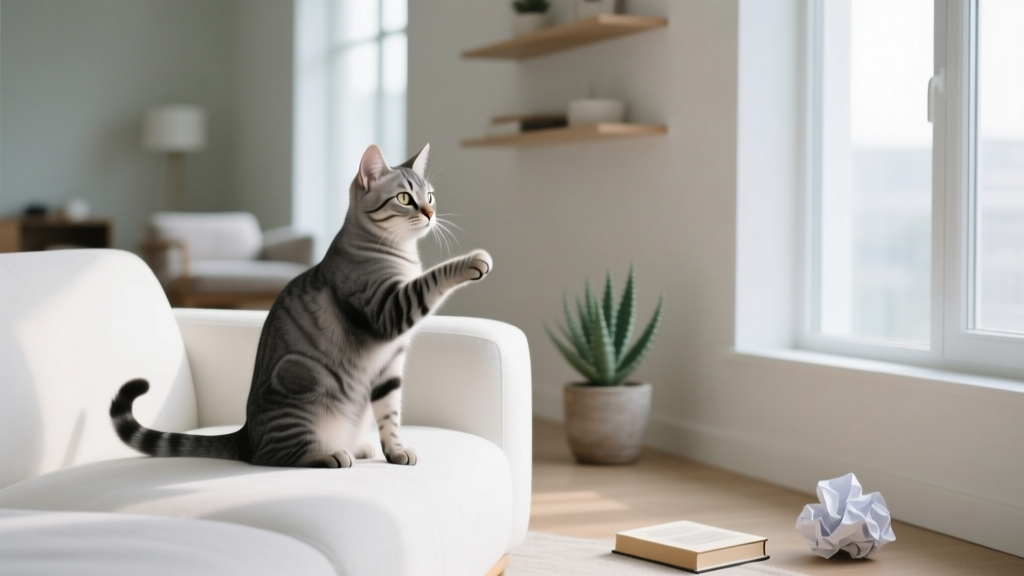
- Hunting & Play Sequencing: Indoor cats rarely kill prey—but they rehearse the full sequence daily: stalk → chase → pounce → bite → ‘kill shake’ (a rapid head toss). If your cat brings you socks, crumpled paper, or plastic wrappers, they’re not gifting—they’re completing the ritual. Suppressing this leads to redirected aggression or obsessive licking.
- Time Budgeting: Wild cats spend ~70% of daylight hours resting to conserve energy for brief, intense hunts. Indoor cats sleep 14–18 hours/day—not from laziness, but metabolic necessity. Their ‘naps’ are light, alert rests; true deep sleep occurs only in perceived safety (e.g., under blankets, inside cardboard boxes).
- Scent-Based Communication: Indoor cats don’t ‘mark’ with urine unless stressed—but they *do* rub cheeks, scratch vertical surfaces, and knead with scent glands on paws and chin. This isn’t ‘claiming’ your sofa; it’s creating a calming, familiar olfactory map in an otherwise human-scented world.
- Micro-Communication: Tail flicks, ear twitches, pupil dilation, and slow blinks aren’t random. A tail held high with a slight quiver = greeting. Rapid side-to-side flick = rising frustration. Slow blink + half-closed eyes = trust. Misreading these cues causes escalation—like petting past the ‘threshold’ and triggering overstimulation biting.
Decoding the Top 7 ‘Weird’ Behaviors—And What They Really Mean
Below are the most frequently Googled indoor cat behaviors—with veterinary interpretation, real-world examples, and immediate action steps:
- The Midnight Zoomies: Sudden bursts of running, leaping, and wall-scaling between 2–4 a.m. Truth: Not ‘crazy’—it’s circadian rhythm alignment. Cats are crepuscular (most active at dawn/dusk), but indoor lighting disrupts melatonin. Without dusk/dawn cues, activity spills into night. Action: Shift interactive play to 30 minutes before bedtime using wand toys to simulate hunting; feed the last meal right after to trigger post-prandial drowsiness.
- Staring at Nothing (or ‘The Wall’): Intense, unblinking focus on blank walls, corners, or ceiling fans. Truth: Likely detecting ultrasonic sounds (e.g., rodent squeaks in walls, HVAC vibrations) or subtle air currents invisible to humans. Also common during light sleep cycles where visual processing remains semi-active. Action: Rule out ocular disease if accompanied by squinting, cloudiness, or bumping into objects—but otherwise, ignore. Offering a window perch with bird feeder view satisfies this instinct safely.
- Bringing You ‘Gifts’ (Toys, Hair Ties, Dead Insects): Truth: Maternal/teaching instinct—even in spayed/neutered cats. They perceive you as an inept hunter who needs tutoring. Or, it’s a displacement behavior signaling unmet play needs. Action: Praise calmly, then immediately redirect with a 5-minute interactive session. Never punish—the behavior is biologically reinforced.
- Kneading + Biting While Purring: Often called ‘making biscuits’—but ends with gentle nips. Truth: Neonatal nursing reflex triggered by comfort, combined with overstimulation. Kneading releases endorphins; biting signals ‘I’m full—stop now.’ Action: Watch for tail-tip twitching or flattened ears—these are early ‘stop’ cues. Withdraw slowly when seen, not after biting.
- Sitting in Boxes, Bags, or Sinks: Truth: Thermoregulation + security. Cardboard insulates heat (cats prefer 86–97°F ambient temps); confined spaces reduce vigilance load. A 2022 University of Utrecht study showed cats in boxes had 23% lower cortisol levels than those in open spaces. Action: Provide 3+ covered hideaways per cat (not just one ‘cat cave’)—rotate locations weekly to maintain novelty.
- Scratching Furniture (Not the Scratcher): Truth: It’s not defiance—it’s stretching, claw maintenance, and scent-marking. Most commercial scratchers fail because they’re too short, unstable, or wrong texture (sisal > carpet > cardboard). Action: Place vertical scratchers *next to* furniture they target (not across the room); rub with catnip; reward use with treats—not after scratching the couch.
- Meowing Excessively at Dawn: Truth: Learned operant conditioning—if meowing once got breakfast, it’ll happen daily. But also hunger-driven: indoor cats lack natural foraging, so stomach growling triggers vocalization. Action: Use timed feeders set for 5:30 a.m.; pair with puzzle feeders to mimic hunt-eat-rest cycles.
When ‘Typical’ Crosses Into ‘Concerning’: The Subtle Red Flags
Most indoor cat behaviors are adaptive—but some signal underlying distress. Veterinarians emphasize that changes in frequency, intensity, or context matter more than the behavior itself. For example: occasional litter box avoidance after moving furniture is normal; consistent avoidance for >48 hours warrants vet visit. Below is a research-backed decision framework:
| Behavior | Typical Frequency/Context | Concern Threshold | First Action Step |
|---|---|---|---|
| Excessive Grooming | 1–2x/day, focused on paws/face | Bald patches, skin redness, or grooming >3x/day lasting >1 week | Rule out fleas/allergies with vet; assess environmental stressors (new pet, construction) |
| Vocalization | Short, low-pitched meows for food/attention | Yowling, howling, or caterwauling >10 min/day, especially at night | Check thyroid panel (hyperthyroidism common in seniors); evaluate cognitive dysfunction |
| Aggression | Play-biting during interactive sessions; gentle swats when overstimulated | Unprovoked lunging, hissing/growling at family members, or attacking ankles | Consult certified feline behaviorist—never use punishment, which worsens fear-based aggression |
| Litter Box Avoidance | Occasional misses due to dirty box or location change | Consistent urination/defecation outside box for >2 days, especially on soft surfaces (beds, rugs) | Urinalysis + abdominal ultrasound—UTIs, crystals, or constipation cause 80% of cases |
| Withdrawal | Temporary hiding after vet visit or storm | Refusing to leave carrier/hidey-hole for >24 hrs, avoiding eye contact, ignoring treats | Monitor appetite/water intake; seek vet if no eating in 24 hrs—cats risk hepatic lipidosis |
Frequently Asked Questions
Why does my indoor cat bring me dead mice—or try to—when I’ve never seen one in the house?
This is deeply ingrained maternal/teaching behavior—even in neutered cats. Your cat perceives you as a socially bonded, but incompetent, hunter who needs instruction. They’re not trying to ‘feed’ you; they’re attempting to demonstrate technique. Studies show cats brought ‘prey’ to owners 3.2x more often when the owner displayed passive or distracted behavior during play. Redirect with vigorous interactive play using feather wands to satisfy the hunting drive.
Is it normal for my indoor cat to suckle on blankets or my arm?
Yes—especially in cats weaned too early (before 8 weeks) or those with high anxiety. Suckling releases oxytocin and endorphins, mimicking kitten comfort. It’s harmless unless causing fabric damage or skin irritation. Provide soft, washable ‘suckle blankets’ (fleece works well) and increase environmental enrichment to reduce stress triggers.
My cat stares at me intensely and blinks slowly. Does that mean love?
Absolutely—it’s called the ‘cat kiss.’ Slow blinking is a deliberate, voluntary signal of trust and relaxation. Wild cats avoid prolonged eye contact as a threat; initiating a slow blink says, ‘I feel safe enough to close my eyes near you.’ Try returning it: hold gaze, then slowly close and open your eyes. Many cats will blink back within seconds—a scientifically documented bonding behavior.
Why does my cat knock things off shelves and tables?
This is object play driven by predatory instinct—not spite. Cats test weight, sound, and movement to assess ‘prey-like’ qualities. It peaks at 2–4 years old and declines with age. Prevention: remove breakables; provide ‘knock-down’ toys (e.g., balls in tracks, dangling pom-poms on strings); reward batting at appropriate targets with treats.
Do indoor cats get bored? Can they become depressed?
Yes—profoundly. A landmark 2021 study in Frontiers in Veterinary Science linked low environmental stimulation to increased cortisol, reduced immune response, and higher incidence of idiopathic cystitis. ‘Boredom’ manifests as stereotypic behaviors (pacing, excessive grooming), apathy, or irritability. Enrichment isn’t optional—it’s physiological necessity. Aim for 3x daily 15-minute interactive sessions, rotating toys weekly, and vertical space (cat trees, shelves).
Common Myths About Indoor Cat Behavior
- Myth #1: ‘Cats are solitary and don’t need interaction.’ Reality: While less pack-oriented than dogs, cats form strong, selective social bonds. A 2020 Oregon State University study found 64% of indoor cats preferred human interaction over food or toys when given free choice—and showed attachment styles identical to human infants in ‘secure base’ tests.
- Myth #2: ‘If my cat isn’t scratching furniture, they’re fine with their scratcher.’ Reality: Over 70% of cats reject commercially available scratchers due to instability, incorrect height, or unsuitable texture. Proper scratching is non-negotiable for physical and psychological health—claw health, muscle stretch, and territorial security depend on it.
Related Topics (Internal Link Suggestions)
- Indoor Cat Enrichment Ideas — suggested anchor text: "indoor cat enrichment ideas that actually work"
- Best Scratching Posts for Indoor Cats — suggested anchor text: "best scratching posts for indoor cats (veterinarian-tested)"
- How to Stop Cat Overgrooming — suggested anchor text: "how to stop cat overgrooming naturally"
- Cat Anxiety Signs and Solutions — suggested anchor text: "cat anxiety signs you're missing"
- Multi-Cat Household Harmony Guide — suggested anchor text: "multi-cat household harmony guide"
Your Next Step: Observe, Interpret, Respond
You now know that what is typical cat behavior for indoor cats isn’t random—it’s a rich, nuanced language shaped by evolution, environment, and emotion. The most transformative shift isn’t changing your cat’s behavior—it’s changing how you *see* it. Start tonight: pick one behavior you’ve labeled ‘annoying’ or ‘confusing,’ and reframe it using the pillars we covered. Is it hunting? Scent-mapping? Thermoregulation? Stress signaling? Then take one small, evidence-backed action—swap the scratcher’s location, add a 5-minute play session before bed, or simply return a slow blink. Consistency compounds: in 21 days, you’ll notice fewer ‘problems’ and more moments of mutual understanding. Ready to go deeper? Download our free Indoor Cat Behavior Decoder Chart—a printable, vet-reviewed guide mapping 27 common actions to meaning and solution.