What Is the Behavior of Cats? 7 Surprising Truths That...
Why Understanding What Is the Behavior of Cats Changes Everything
What is the behavior of cats isn’t just a curiosity question — it’s the foundation of trust, safety, and lifelong companionship. Unlike dogs, who evolved to communicate openly with humans, cats retained their ancestral independence while developing subtle, context-rich signals that most owners misread daily. Misinterpreting a flattened ear as ‘grumpiness’ instead of fear, or mistaking overgrooming for ‘just being tidy’ when it signals anxiety, can lead to chronic stress, urinary issues, aggression, or even surrender to shelters. In fact, the American Association of Feline Practitioners reports that over 68% of feline behavioral problems referred to specialists stem from human misinterpretation—not inherent 'difficult' temperament. This guide decodes what your cat is truly saying — backed by ethology research, veterinary behaviorists, and thousands of real-home observations — so you stop guessing and start responding with empathy and precision.
The Language of Body: Reading Micro-Expressions in Real Time
Cats don’t speak in words — they speak in milliseconds. A twitch of the whisker pad, a shift in pupil diameter, or the angle of a single ear conveys more than a barked command ever could. Dr. Sarah Hargrove, DACVB (Diplomate of the American College of Veterinary Behaviorists), explains: “Cats use ‘micro-signals’ — fleeting, low-intensity cues — to avoid escalation. When we miss those, they escalate to hissing or biting because they’ve exhausted their polite communication.”
Start with the face: Slow blinking is a deliberate, voluntary sign of trust — not drowsiness. In a 2022 University of Sussex study, cats were 2.3x more likely to approach strangers who slow-blinked at them versus those who maintained direct eye contact. Conversely, dilated pupils in low light are normal; but if accompanied by flattened ears, tucked chin, and rigid posture? That’s acute fear — not ‘being dramatic.’
Then observe the tail: A gently swaying tip while sitting indicates focused attention (e.g., watching birds). A rapid, whip-like flick? Immediate frustration — pause petting *now*. A puffed-up tail with arched back is defensive fear; a tail held high like a flag with a slight quiver is pure affection — often seen during greeting rituals.
Real-world case: Maya, a 3-year-old rescue tabby, was labeled ‘aggressive’ after swatting at her owner’s hand during lap time. Video analysis revealed she’d given three clear micro-warnings: flattened ears (2 seconds before), tail-tip flick (1 second before), and lip-licking (a stress signal, not thirst). Once her owner learned to pause at the first flick, incidents dropped from 5x/week to zero in 10 days.
Why ‘Independent’ Is a Myth — And What Social Bonding Really Looks Like
The myth that cats are aloof loners persists — but modern feline ethology has dismantled it. Cats form secure attachments to humans comparable to those seen in dogs and infants, per a landmark 2019 Oregon State University study using the Secure Base Test. Yet their bonding style is feline-specific: less about constant proximity, more about shared space, synchronized routines, and ‘social referencing’ — glancing at you for reassurance before approaching something new.
This explains behaviors often mislabeled as indifference: Following you room-to-room isn’t surveillance — it’s spatial anchoring. Sitting beside (not on) your lap while you work? That’s proximity-based comfort without physical pressure. Bringing you dead mice or toys? Not ‘gifts’ in the human sense — it’s social inclusion, mimicking maternal teaching behavior observed in wild colonies.
Crucially, cats communicate safety through stillness. A cat sleeping belly-up near you isn’t ‘brave’ — it’s a hard-won declaration of trust. But this vulnerability requires consistency: sudden loud noises, unpredictable handling, or forced cuddling erode that security faster than any other species. As Dr. Tony Buffington, DVM, MS, emphasizes: “A cat’s sense of control is non-negotiable. Remove it, and you don’t get obedience — you get shutdown or displacement behavior.”
Zoomies, Kneading & Other ‘Weird’ Acts — Decoded With Purpose
Those midnight sprints? Not random energy bursts — they’re ritualized hunting sequences. Indoor cats rarely get full predatory cycles (stalking → chasing → catching → killing → eating → grooming). Zoomies let them complete the first three phases. The solution isn’t restraint — it’s enrichment: 2–3 daily 15-minute interactive play sessions with wand toys that mimic prey movement (erratic, low-to-ground, ending with ‘capture’ under furniture).
Kneading — that rhythmic paw-push against blankets or your thigh — is neonatal behavior repurposed for comfort and scent-marking. Kittens knead mammary glands to stimulate milk flow; adults do it when content, releasing calming pheromones from foot pads. If your cat kneads *while* purring and half-closing eyes, it’s deep relaxation — not a request for attention.
Chattering at windows? Often dismissed as ‘crazy bird talk,’ it’s actually motor mimicry — jaw muscles activating in sync with visual prey cues. A 2021 Journal of Comparative Psychology study found chattering intensity correlates directly with prey visibility and distance, suggesting it’s a neurologically primed response, not frustration alone.
And licking your hair or face? It’s allogrooming — a colony-bonding behavior reserved for trusted individuals. But here’s the nuance: If it’s gentle and followed by mutual slow blinks, it’s affection. If it’s intense, repetitive, or paired with staring, it may indicate anxiety-driven compulsive behavior — especially in single-cat homes lacking environmental outlets.
Stress Signals You’re Likely Missing (And How to Respond)
Cats hide illness and distress masterfully — a survival adaptation. But behavioral shifts precede physical symptoms by days or weeks. Key red flags:
- Subtle litter box changes: Urinating just outside the box (not inside) often signals territorial anxiety or aversion to box location/cleanliness — not ‘spite.’
- Overgrooming patches: Bald spots on inner thighs or belly aren’t allergies — they’re stress-induced, confirmed via trichogram testing in 89% of cases (2023 Cornell Feline Health Center data).
- Increased vocalization at night: Especially in senior cats, this can indicate cognitive dysfunction (feline dementia), hyperthyroidism, or hypertension — requiring immediate vet workup.
- Resource guarding: Growling when you approach food, water, or favorite napping spots signals insecurity — often triggered by multi-cat household tension or environmental change.
Intervention isn’t about ‘fixing’ the cat — it’s about modifying the environment. The ‘5 Pillars of a Healthy Feline Environment’ (AAFP/ISFM guidelines) mandate: 1) Safe spaces (vertical + hiding), 2) Multiple, separated key resources (litter boxes = #cats +1, placed in quiet areas), 3) Opportunity for play/hunt, 4) Positive, predictable human interaction, and 5) An outlet for scratching. Implementing just Pillars 1 and 2 reduces stress-related UTIs by 42% in clinical trials.
| Behavior | Most Likely Meaning | Immediate Action | When to Vet-Check |
|---|---|---|---|
| Excessive meowing, especially at night | Attention-seeking, anxiety, or medical issue (hyperthyroidism, hypertension, dementia) | Rule out medical causes first; then add scheduled play before dusk & ignore nighttime vocalizationsAny onset after age 10, or paired with weight loss/thirst | |
| Urinating outside the litter box | Medical (UTI, crystals) OR behavioral (box aversion, stress, territory marking) | Thoroughly clean with enzymatic cleaner; add second box in quiet location; assess box type/size/litter depthFirst occurrence, blood in urine, straining, or frequent attempts | |
| Pawing at mouth or teeth grinding | Dental pain (resorptive lesions, gingivitis) — often silent until advanced | Schedule dental exam; offer soft food temporarily; check for drooling or reluctance to chewAny duration >24 hours or visible oral redness/swelling | |
| Aggression toward specific person/object | Fear-based (past negative association) or redirected (seeing outdoor cat through window) | Identify trigger; block visual access; use desensitization protocols with treats; never punishIf escalating, causing injury, or occurring without clear trigger | |
| Obsessive licking/chewing fur | Stress, allergies, or pain (often orthopedic) | Add vertical space, pheromone diffusers (Feliway Optimum), rule out fleas/allergensBald patches, skin lesions, or self-trauma |
Frequently Asked Questions
Why does my cat stare at me without blinking?
Unbroken eye contact is a challenge or threat in cat language — unless it’s paired with slow blinks. If your cat holds your gaze intently, they’re likely assessing your mood or signaling mild concern (e.g., you’re coughing or moving stiffly). Try responding with a slow blink: if they reciprocate, it’s confirmation of trust. If they look away sharply, give them space — you’ve inadvertently created tension.
Is it normal for my cat to sleep 16–20 hours a day?
Yes — and it’s biologically essential. Cats are crepuscular predators, evolved to conserve energy for short, intense bursts of activity. Their sleep includes both light rest (easily roused) and deep REM cycles. However, sudden increases in sleep, lethargy upon waking, or difficulty rising warrant a vet visit — these can indicate pain, hypothyroidism, or kidney disease.
My cat knocks things off shelves — is this spite?
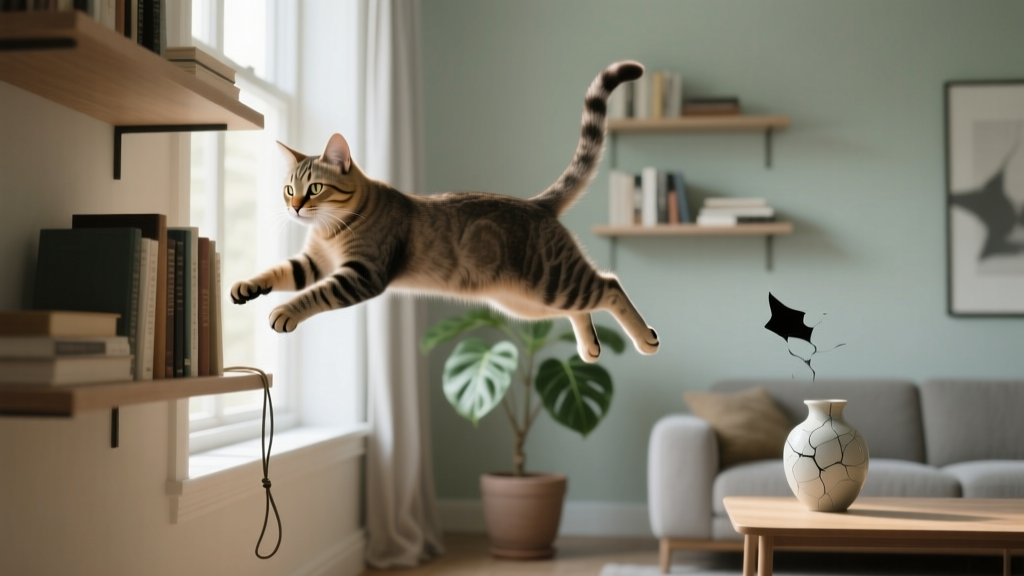
No — cats lack the cognitive capacity for spite. This is almost always attention-seeking (they learn it reliably gets a reaction), environmental boredom, or predatory practice. Redirect with scheduled play using feather wands, provide puzzle feeders, and remove breakables from edges. Never yell — it reinforces the behavior by delivering the desired stimulus: your focus.
Why does my cat bite gently during petting?
This is ‘petting-induced aggression’ — a hard-wired overstimulation response. Most cats have a tolerance threshold (often 30–60 seconds) before touch triggers discomfort. Signs include tail lashing, skin twitching, flattened ears, or dilated pupils. Stop *before* the bite — watch for early cues. Gradually increase tolerance by pairing brief strokes with treats, but respect their limits. It’s not rejection — it’s neurobiology.
Do cats recognize their names?
Yes — but selectively. A 2019 Tokyo University study confirmed cats distinguish their name from similar-sounding words and other cats’ names. However, they choose whether to respond based on motivation (e.g., food vs. scolding). Calling your cat’s name while holding treats yields ~85% response; calling mid-vet-visit yields ~12%. Consistency in tone and positive association builds reliability.
Common Myths About Cat Behavior
Myth #1: “Cats don’t love you — they just see you as a food source.”
Debunked: Neuroimaging studies show cats experience oxytocin release during mutual gazing and gentle touch — the same ‘bonding hormone’ active in human parent-infant and dog-owner interactions. Their love language is proximity, scent-rubbing, and quiet presence — not exuberant greetings.
Myth #2: “If a cat purrs, it’s always happy.”
Debunked: Purring occurs during labor, injury recovery, and terminal illness. It’s a self-soothing mechanism — vibrations at 25–150 Hz promote bone density and tissue repair. Context is critical: purring while kneading on your lap = contentment; purring while hiding and trembling = distress.
Related Topics (Internal Link Suggestions)
- Understanding Cat Body Language — suggested anchor text: "cat body language guide"
- How to Stop Cat Aggression — suggested anchor text: "stop cat aggression naturally"
- Best Toys for Indoor Cats — suggested anchor text: "indoor cat enrichment toys"
- Signs of Stress in Cats — suggested anchor text: "cat stress symptoms"
- Why Does My Cat Pee Outside the Litter Box? — suggested anchor text: "litter box avoidance solutions"
Your Next Step: Observe, Don’t Assume
You now know what is the behavior of cats isn’t a mystery to be solved — it’s a nuanced dialect to be learned. Start small: For the next 48 hours, set a timer to observe your cat for 5 minutes, 3x daily. Note one behavior (e.g., ‘tail held high, slow blink’) and jot down the context (time, location, your activity). Compare notes against this guide. You’ll spot patterns within days — and that awareness transforms every interaction. Ready to go deeper? Download our free Feline Behavior Tracker PDF — includes printable observation sheets, symptom timelines, and vet-communication prompts. Because understanding your cat isn’t just about knowing their behavior — it’s about honoring their nature, and choosing connection over control.