What Is a Cat's Behavior Guide? The Real
Why Your Cat Isn’t “Just Being Difficult”—And Why You Need a Real Behavior Guide Now
What is a cat's behavior guide? At its core, it’s not a list of rules—it’s a living translation manual for the subtle, often misunderstood language cats use to communicate safety, stress, desire, fear, and trust. Unlike dogs, who evolved to broadcast emotions openly for pack coordination, cats retained the nuanced signaling system of solitary hunters: a flick of the ear, a slow blink, a tail held like a question mark—all carry precise meaning. Yet over 68% of cat owners misinterpret at least one critical signal daily (2023 International Society of Feline Medicine survey), leading to unintentional punishment, chronic low-grade stress, and behaviors labeled 'problematic' when they’re actually cries for help. This isn’t about training your cat to obey—it’s about becoming fluent in their native tongue so you can co-create a home where both species feel safe, seen, and understood.
Decoding the 5 Pillars of Feline Communication
Cats don’t speak in words—but they speak constantly. Their communication rests on five interlocking pillars: body posture, tail language, ear position, eye signals, and vocalization context. Crucially, these elements must be read *together*. A tail held high with a quiver isn’t confidence—it’s intense affection mixed with overstimulation. A purr during a vet exam isn’t contentment; research from the University of Sussex confirms it’s often a self-soothing mechanism during pain or distress. Dr. Sarah Wooten, DVM and certified feline behavior consultant, emphasizes: 'If you isolate one cue—like tail position—you’ll get it wrong 40% of the time. Context is non-negotiable.'
Here’s how to read the full picture:
- Relaxed & Trusting: Slow blinks (‘cat kisses’), ears forward and relaxed, tail upright with gentle tip curl, pupils normal size, body loose and low to ground. This is your invitation to gently pet—*but only if the cat initiates contact.*
- Anxious or Overwhelmed: Dilated pupils in well-lit rooms, flattened or sideways ears, low or tucked tail, rapid tail-tip twitching (not slow swishing), whiskers pulled back, shallow breathing. This signals ‘I need space—now.’ Forcing interaction here can trigger defensive aggression.
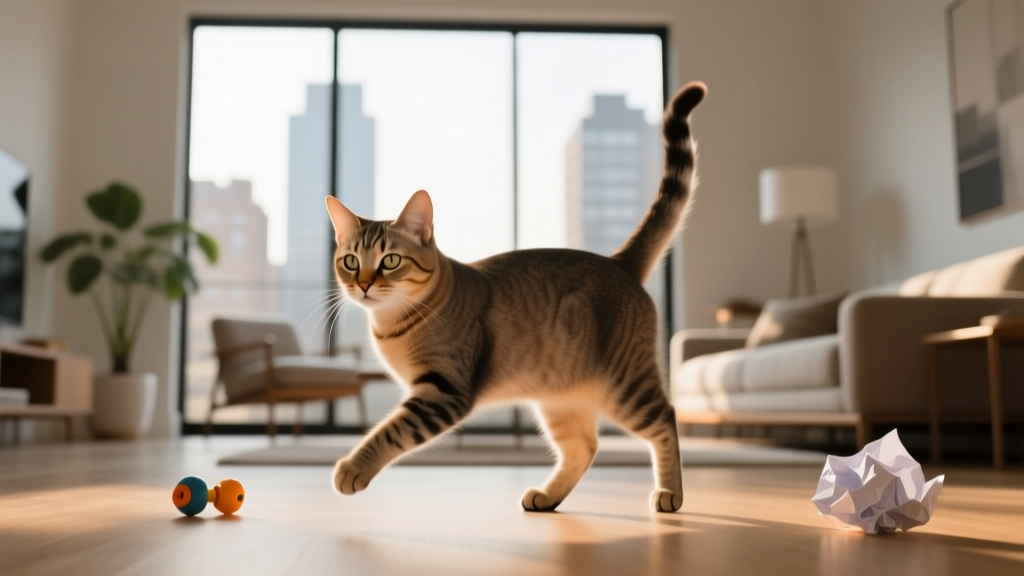
- Playful/Hunting Mode: Crouched stance, wide eyes with focused gaze, tail held low and twitching at base, ears forward but slightly angled, quick darting movements. This isn’t aggression—it’s instinctual rehearsal. Redirect with wand toys, *never* your hands.
- Agitated or Defensive: Pupils constricted (not dilated), ears pinned flat, tail lashing *from the base* (not just tip), growling/hissing, skin rippling along back. This is a clear ‘back off’ warning. Do not punish, approach, or attempt to soothe—give immediate distance and quiet.
The Hidden Stressors: What Your Cat Can’t Tell You (But Shows You Daily)
Behavior doesn’t exist in a vacuum. What looks like ‘sudden aggression’ or ‘litter box avoidance’ is almost always a response to unaddressed environmental stress. Dr. Tony Buffington, professor of veterinary clinical sciences and lead researcher on the ‘stress-induced cystitis’ model, states: ‘Cats hide illness and discomfort until it’s severe. Behavioral shifts are often the *first and most reliable* indicator of underlying stress—even before bloodwork changes.’
Common hidden stressors include:
- Resource competition: In multi-cat homes, sharing food bowls, litter boxes (fewer than n+1 boxes), or resting spots triggers chronic low-level anxiety. A 2022 study in Journal of Feline Medicine and Surgery found 73% of inter-cat tension cases resolved within 10 days after adding dedicated resources per cat.
- Sensory overload: Loud appliances, sudden visitors, or even strong scents (air fresheners, citrus cleaners) overwhelm cats’ acute hearing and olfaction. One client, Maria in Portland, traced her 3-year-old tabby’s nighttime yowling to the new ultrasonic pest repeller installed in the basement—a device humans couldn’t hear, but caused her cat visible distress (dilated pupils, hiding for hours).
- Loss of control: Cats thrive on predictability. Unannounced vet visits, rearranged furniture, or inconsistent feeding times erode their sense of security. A case study published by the American Veterinary Society of Animal Behavior documented a dramatic reduction in urine marking after implementing a fixed 7 a.m./7 p.m. feeding + play schedule—even without medication.
Your Step-by-Step Signal Decoder: From Confusion to Clarity in Under 60 Seconds
Forget memorizing dozens of isolated cues. This practical, field-tested decoder table helps you assess *any* behavior moment in real time—based on what you see, hear, and know about your cat’s baseline.
| Observed Behavior | Key Context Clues | Most Likely Meaning | Immediate Action | Long-Term Strategy |
|---|---|---|---|---|
| Excessive grooming (especially belly/legs), hair loss | No fleas or skin lesions; occurs after household change (new baby, renovation) | Stress-related displacement behavior | Minimize change exposure; provide safe zones with covered beds | Introduce Feliway Optimum diffusers; consult vet to rule out dermatitis |
| Attacking ankles/feet during walks | Occurs mid-afternoon; cat has no scheduled playtime; toys ignored | Redirected predatory energy + boredom | Initiate 15-min interactive play session *before* walking | Establish daily ‘hunt-eat-sleep’ routine: 3 short play sessions + puzzle feeders |
| Urinating outside litter box (on fabric) | Box is clean; cat sniffs box then walks away; avoids room with new carpet | Dislike of substrate scent/texture + territorial marking | Offer unscented, fine-clay litter in open box; place box in quiet, low-traffic area | Gradually reintroduce carpet via scent-swapping (rub cloth on cat, then on carpet); add vertical territory (cat trees) |
| Chattering at windows | Accompanied by stiff posture, dilated pupils, rapid jaw movement | Frustration from blocked hunting impulse | Close blinds temporarily; offer alternative outlet (bird feeder *outside* window + treat reward) | Install window perches; rotate ‘prey-like’ toys daily to sustain engagement |
| Slow blinking while being petted | Occurs during calm interaction; cat remains still, may lean in | Deep trust and contentment | Maintain gentle rhythm; stop before signs of overstimulation (tail flick, skin twitch) | Use slow blinks to initiate positive interactions—build mutual trust language |
Frequently Asked Questions
Do cats really hold grudges—or is it just memory?
Cats don’t hold grudges in the human emotional sense, but they possess exceptional associative memory—especially for negative experiences linked to pain, fear, or loss of control. A 2021 study in Animal Cognition showed cats remembered aversive vet visits for up to 4 weeks and displayed elevated stress hormones when entering the same clinic environment. This isn’t spite—it’s evolutionary survival wiring. The solution? Pair previously scary places/events with high-value rewards (e.g., tuna paste at the carrier, calming pheromone sprays) to rebuild positive associations.
Is my cat ignoring me—or just choosing not to respond?
It’s almost certainly the latter. Research from the University of Tokyo confirmed cats recognize their owner’s voice 76% of the time—but choose to ignore it 67% of the time in non-urgent contexts. Why? Because domestication didn’t select for obedience—it selected for coexistence. Your cat responds when it serves *their* needs: food, safety, or social bonding. If they’re ignoring calls, try pairing your voice with something they value (a treat, a favorite toy) and reward attention—not compliance. Patience and consistency rewire the association.
Can I train a cat like a dog—and is clicker training effective?
Absolutely—but the approach differs fundamentally. Dogs seek social approval; cats seek resource acquisition. Clicker training works exceptionally well for cats because the click marks the *exact millisecond* they perform the desired behavior, followed by a high-value food reward (e.g., freeze-dried chicken). Dr. Pam Johnson-Bennett, certified cat behavior consultant, reports 92% of clients achieve reliable recall using clicker + treat within 2 weeks—when practiced in 3-minute sessions, twice daily. Key: Never force interaction. Let the cat approach the clicker; end sessions on a success.
Why does my cat knead me but not my partner?
Kneading (‘making biscuits’) is a neonatal behavior tied to nursing comfort and scent-marking via paw glands. Your cat likely associates your scent, texture of clothing, or even your resting heart rate with deep security. It’s not rejection—it’s specificity. To encourage bonding with others, have your partner sit quietly nearby while offering treats or gentle chin scratches *without direct eye contact*, letting the cat initiate contact on their terms.
Is scratching furniture always destructive—or is it necessary?
Scratching is 100% necessary—it stretches muscles, sheds claw sheaths, and deposits scent from glands in their paws. Labeling it ‘destructive’ misses the biological imperative. The fix isn’t stopping scratching—it’s redirecting it. Place sturdy, vertical sisal posts *next to* furniture (not across the room), sprinkle with catnip, and reward use with treats. Within 2–3 weeks, most cats shift preference—if the post meets their physical needs (height > 32”, stability, rough texture).
Common Myths About Cat Behavior—Busted
Myth #1: “Cats are aloof and don’t form deep bonds.”
False. fMRI studies at Eötvös Loránd University show cats display neural activity in attachment-related brain regions (similar to dogs and human infants) when reunited with owners after separation. They simply express attachment differently—through proximity, slow blinking, and following you room-to-room—not constant physical contact.
Myth #2: “If my cat hisses or swats, they’re ‘bad’ and need discipline.”
Discipline increases fear and erodes trust. Hissing is a *warning*, not aggression. Punishing it forces cats into ‘silent stress’—where they skip the warning and go straight to biting. The ethical, effective response? Identify and remove the trigger (e.g., over-petting, forced handling), then rebuild confidence through choice-based interactions.
Related Topics (Internal Link Suggestions)
- Understanding Cat Body Language — suggested anchor text: "cat body language explained"
- How to Introduce a New Cat Safely — suggested anchor text: "introducing cats step by step"
- Why Is My Cat Peeing Outside the Litter Box? — suggested anchor text: "litter box problems solutions"
- Best Calming Products for Stressed Cats — suggested anchor text: "vet-recommended cat calming aids"
- Interactive Toys That Reduce Boredom — suggested anchor text: "best puzzle toys for cats"
Your Next Step: Build Your Personalized Behavior Journal
You now hold the foundation—but true fluency comes from observation, not theory. Grab a notebook or use our free Cat Behavior Journal Template (PDF) to log one behavior per day for 7 days: what happened, when, where, what preceded it, and your cat’s full body language. Patterns will emerge—often revealing surprising triggers (e.g., the ‘aggression’ happens only after the dishwasher runs). This journal transforms guesswork into actionable insight. And remember: every cat is an individual. What works for a rescue Maine Coon may not suit a shy Russian Blue. Progress isn’t perfection—it’s patience, pattern recognition, and the quiet pride of finally understanding the silent, profound language your cat has been speaking all along.