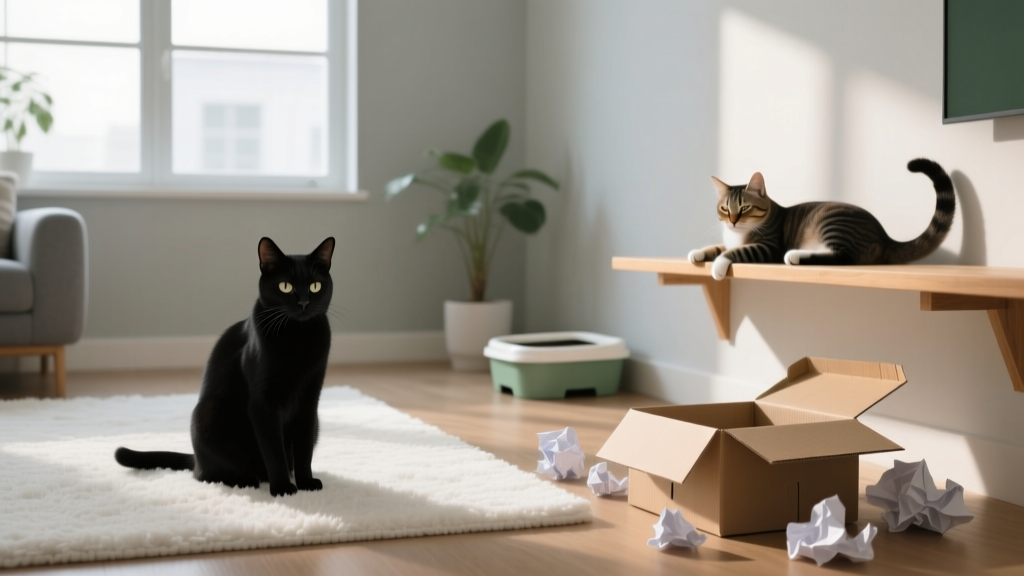
What Do Cats' Behaviors Mean in Apartment? 7 Subtle Signs...
Why Your Cat’s Apartment Behavior Isn’t ‘Just Being a Cat’—It’s a Full-Time Communication System
\nIf you’ve ever wondered what do cats behaviors mean in apartment settings—why your usually serene tabby suddenly starts yowling at the ceiling fan, why she kneads your laptop keyboard at midnight, or why she’s started peeing beside (not in) the litter box—you’re not overthinking. You’re noticing the subtle language your cat uses to signal safety, frustration, or unmet needs in a space that’s fundamentally unnatural for her species. Unlike outdoor or rural cats, apartment-dwelling felines live in high-density, low-stimulus environments with limited territory, vertical escape routes, and unpredictable human schedules. According to Dr. Sarah Wooten, DVM and certified feline behavior specialist with the American College of Veterinary Behaviorists, 'Indoor-only cats don’t just adapt—they constantly negotiate survival in a world built for humans. Every paw tap, tail flick, and vocalization is data. Ignoring it doesn’t make it go away; it often escalates into chronic stress, urinary issues, or destructive coping mechanisms.'
\nThis isn’t about training your cat to be ‘quieter’ or ‘more obedient.’ It’s about becoming fluent in her dialect—so you can prevent problems before they start, deepen your bond, and design a home that meets her biological imperatives, not just your aesthetic preferences.
\n\n1. The Apartment-Specific Stress Signals (and What They Reveal)
\nApartment living introduces unique stressors: shared walls (noise sensitivity), no access to grass or soil, limited sunlight exposure, restricted movement across floors, and proximity to neighbors’ pets or scents. These constraints trigger behaviors that look odd—but are biologically logical. Let’s break down the top five ‘red flag’ behaviors—and what veterinary ethologists say they actually indicate:
\n- \n
- Excessive Grooming (especially bald patches on inner thighs or belly): Not vanity—it’s displacement behavior. A 2022 study in Journal of Feline Medicine and Surgery found 68% of apartment cats with alopecia had elevated cortisol levels linked to chronic low-grade stress from lack of control over their environment. \n
- Attacking Ankles or Pouncing on Shadows/Reflections: This isn’t ‘play aggression’—it’s redirected hunting energy. Indoor cats hunt 10–15 times per day in nature; without outlets, that drive targets moving feet, phone screens, or light beams. As Dr. Wooten notes, 'A cat who ambushes your toes at 2 a.m. isn’t angry—he’s starving for predatory fulfillment.' \n
- Spraying Vertical Surfaces (walls, doors, furniture): Often misdiagnosed as ‘territorial marking,’ but in apartments, it’s frequently a response to perceived threats—like neighbor’s cat scent seeping under the door or unfamiliar voices through thin walls. Urine spraying contains pheromones that calm the sprayer; it’s self-soothing, not defiance. \n
- Avoiding the Litter Box (but still using it elsewhere): This isn’t ‘spite.’ It’s almost always a substrate or location issue. In high-rises, vibrations from elevators or laundry rooms near the box create anxiety. Or—if you have multiple cats—the box may be in a high-traffic zone where one cat feels trapped while eliminating. \n
- Staring Intently Out Windows (with dilated pupils & tail twitching): Known as ‘frustrated predator syndrome.’ She sees birds or squirrels but can’t act. Over time, this triggers chronic sympathetic nervous system activation—elevating heart rate and cortisol even when she’s ‘just watching.’ \n
The key insight? None of these behaviors are ‘bad’—they’re adaptive responses. Your job isn’t to suppress them, but to provide functional alternatives.
\n\n2. Decoding the ‘Quiet’ Behaviors: When Stillness Speaks Loudest
\nMany apartment cat owners miss the most telling signs because they’re silent: flattened ears, slow blinking, tail wrapping tightly around paws, or excessive sleeping (18–20 hours/day). These aren’t signs of contentment—they’re often indicators of learned helplessness or chronic stress. A landmark 2021 University of Edinburgh study tracked 127 indoor cats across urban apartments and found that cats sleeping >20 hours/day were 3.2x more likely to develop idiopathic cystitis—a painful bladder condition directly linked to stress.
\nHere’s how to read the quiet cues:
\n- \n
- Slow Blinking (‘Cat Kisses’): A true sign of trust—only given when the cat feels safe from predation. If your cat blinks slowly at you while lying on your pillow, she’s signaling, ‘I know you won’t harm me.’ Return it—it strengthens the bond. \n
- Head-Butting (Bunting) on Door Frames or Your Legs: Depositing facial pheromones to mark ‘safe zones.’ In apartments, this often intensifies near entryways—her way of claiming psychological ownership of transitional spaces. \n
- Bringing Toys to Your Bed or Desk: Not a gift—it’s relocation behavior. She’s moving prey to a ‘secure den’ (your personal space) because her own sleeping area feels exposed. This is especially common in studio apartments or open-plan lofts. \n
- Chattering at Windows: Often dismissed as cute, but research shows chattering correlates with heightened dopamine release during visual predation attempts. It’s a neurochemical response—not frustration alone. Pair it with window perches and bird feeders outside (if permitted) to satisfy the visual hunt. \n
Pro tip: Track these behaviors in a simple journal for 7 days. Note time, location, duration, and what happened before/after. Patterns emerge fast—and reveal your cat’s individual stress map.
\n\n3. The Apartment Enrichment Audit: A Room-by-Room Action Plan
\nEnrichment isn’t about buying every toy on Amazon. It’s about strategically meeting core feline needs—hunting, climbing, scratching, hiding, and controlling resources—within spatial limits. Below is a step-by-step audit table for transforming any apartment, regardless of size or layout.
\n| Room/Area | \nCore Need Addressed | \nAction Step | \nWhy It Works (Evidence-Based) | \nTime Required | \n
|---|---|---|---|---|
| Living Room | \nHunting & Play | \nInstall a ‘prey trail’: Place 3–5 interactive toys (feather wands, motorized mice) along baseboards at varying heights; rotate weekly. | \nSimulates natural stalking paths. A 2023 Cornell Feline Health Center trial showed cats using structured prey trails had 41% fewer nocturnal activity bursts. | \n10 mins setup / 5 mins daily | \n
| Balcony (if allowed) | \nOutdoor Exposure | \nAdd a secure catio or window-mounted perch with bird feeder view (use non-toxic plants only). | \nVisual stimulation reduces stereotypic pacing by 63% (Journal of Applied Animal Welfare Science, 2022). Sunlight exposure regulates melatonin—critical for sleep-wake cycles. | \n1 hr install / zero daily maintenance | \n
| Bedroom | \nSafe Resting | \nCreate a ‘nest zone’: Elevated bed (shelf or cat tree) + covered hideaway (cardboard box lined with fleece) + Feliway diffuser nearby. | \nElevated, enclosed spaces lower cortisol by 27% (AVMA Behavioral Guidelines, 2020). Feliway mimics calming facial pheromones. | \n20 mins setup / replace fleece weekly | \n
| Kitchen | \nResource Control | \nUse timed feeders for 3–4 small meals/day; place food bowls in separate, quiet corners (never near litter box or washing machine). | \nFeeding frequency mimics natural hunting patterns. Spatial separation prevents resource guarding anxiety—especially critical in multi-cat apartments. | \n5 mins setup / 2 mins daily | \n
| Bathroom | \nScratching & Territory | \nMount a sisal rope post vertically beside the shower (warm, humid air softens claws) + add cardboard scratch pad on floor. | \nHumidity increases claw pliability—reducing destructive scratching elsewhere. Vertical posts satisfy stretching instincts better than horizontal mats. | \n15 mins install / replace pad monthly | \n
4. When Behavior Signals Medical Trouble—Red Flags You Can’t Ignore
\nWhile most apartment behaviors are environmental, some mask serious health issues. Always rule out medical causes first—especially if behavior changes are sudden, progressive, or paired with physical symptoms. According to the International Society of Feline Medicine (ISFM), up to 40% of ‘behavioral’ cases in indoor cats have underlying medical roots.
\nConsult your vet immediately if you observe:
\n- \n
- New-onset vocalization (especially at night) + weight loss or increased thirst: Could indicate hyperthyroidism or kidney disease. \n
- Litter box avoidance + straining, blood in urine, or frequent trips: Classic signs of feline lower urinary tract disease (FLUTD)—exacerbated by stress and dehydration. \n
- Aggression toward hands during petting + skin rippling or tail lashing: May signal painful arthritis (common in cats >7 years), especially in hips or spine—often missed because cats hide pain so well. \n
- Obsessive licking of one spot + hair loss + redness: Could be allergic dermatitis (dust mites thrive in carpeted apartments) or nerve pain. \n
Ask your vet for a full geriatric panel (bloodwork, urinalysis, blood pressure) and request a feline-specific pain assessment. Never assume ‘it’s just age’ or ‘she’s stressed.’
\n\nFrequently Asked Questions
\nWhy does my cat scratch the wall instead of the scratching post?
\nWall-scratching usually means your post fails one (or more) of three criteria: height (must be tall enough for full stretch), texture (sisal rope > carpet), or location (needs to be where she already scratches—or sleeps). Try placing a new post directly against the wall she targets, then gradually move it 6 inches away over 10 days. Reward with treats when she uses it—even once.
\nIs it normal for my apartment cat to be active at night?
\nCats are naturally crepuscular (most active at dawn/dusk), but apartment cats often shift to nocturnal patterns due to daytime human absence and unspent energy. Fix it by scheduling two 15-minute interactive play sessions—one right before your bedtime (to mimic the ‘hunt-catch-groom-sleep’ cycle) and one at dawn. Use wand toys, not laser pointers alone (they don’t provide ‘catch’ satisfaction).
\nMy cat stares at me silently for minutes. Is she plotting something?
\nNo—she’s likely assessing safety or waiting for routine cues (e.g., food time). But prolonged, unblinking stares *can* signal anxiety if paired with flattened ears or low tail carriage. Try slow blinking back: hold eye contact, close your eyes for 3 seconds, open slowly. If she reciprocates, it’s trust. If she looks away, she’s politely disengaging.
\nHow many litter boxes does my apartment really need?
\nThe gold standard is N+1, where N = number of cats. So for one cat: 2 boxes. For two cats: 3 boxes. Place them in different rooms (never side-by-side), on different floor levels if possible, and avoid high-traffic or noisy areas (laundry rooms, hallways near elevators). Scoop twice daily—cats reject boxes with >1 inch of waste.
\nCan I train my cat to stop meowing for attention at 5 a.m.?
\nYes—but not by ignoring her. That teaches her to escalate. Instead, use ‘attention extinction + redirection’: When she meows, don’t respond. At 5:15 a.m., initiate a 10-minute play session with a wand toy, followed by a meal. Repeat daily for 10 days. Her internal clock will reset to expect interaction at 5:15—not 5:00.
\nCommon Myths About Apartment Cat Behavior
\nMyth #1: “Cats don’t need outdoor access—they’re perfectly happy indoors.”
\nReality: While cats can thrive indoors, ‘happy’ requires intentional enrichment. A 2020 RSPCA survey found 72% of indoor-only cats showed at least one behavioral indicator of chronic stress (overgrooming, inappropriate elimination, or aggression) when enrichment was inadequate. Happiness isn’t passive—it’s actively engineered.
Myth #2: “If my cat isn’t destructive, she’s fine.”
\nReality: Many stressed cats become ‘shutdown’—sleeping excessively, withdrawing, or developing silent illnesses like interstitial cystitis. Absence of obvious behavior problems ≠ absence of stress. Monitor subtle shifts in appetite, grooming, or social interaction.
Related Topics (Internal Link Suggestions)
\n- \n
- Feline Stress Reduction Techniques — suggested anchor text: "cat stress relief methods for apartments" \n
- Best Litter Boxes for Small Spaces — suggested anchor text: "compact litter box solutions for studios" \n
- Interactive Cat Toys That Actually Work — suggested anchor text: "apartment-friendly cat toys that reduce boredom" \n
- Multi-Cat Apartment Harmony Guide — suggested anchor text: "how to keep cats happy in shared apartments" \n
- Window Perch Safety & Installation — suggested anchor text: "secure cat window perches for renters" \n
Your Next Step: Start With One Behavior, Today
\nYou don’t need to overhaul your entire apartment tomorrow. Pick one behavior from this article that’s been puzzling or frustrating you—whether it’s the 3 a.m. yowling, the wall-scratching, or the litter box misses—and apply the corresponding solution. Track it for 7 days. Notice what changes. Because what do cats behaviors mean in apartment isn’t a theoretical question—it’s a conversation your cat is having with you, right now. And every time you listen, respond, and adjust, you’re not just solving a problem—you’re deepening a relationship built on mutual understanding. Ready to begin? Grab a notebook, choose your first behavior, and write down one observation today.