What Do Cats Behaviors Mean at Home? (2026)
Why Decoding What Cats Behaviors Mean at Home Is the #1 Skill Every Cat Owner Needs Right Now
If you’ve ever stared at your cat mid-purr while they stare blankly back—or watched them suddenly bolt from the couch for no apparent reason—you’ve felt it: that quiet, persistent uncertainty about what do cats behaviors mean at home. You’re not overthinking. You’re responding to a real communication gap—one that impacts trust, stress levels, and even health outcomes. Unlike dogs, cats evolved as solitary hunters who rely on nuanced body language, not vocal praise, to express need, fear, affection, or discomfort. And yet, most owners misinterpret key signals daily: mistaking anxiety for aloofness, overstimulation for playfulness, or illness for ‘just being grumpy.’ The cost? Delayed vet visits, chronic low-grade stress in your cat (linked to urinary issues and aggression), and a relationship built on assumption instead of understanding. But here’s the good news: with just 15 minutes of focused observation—and the right decoding framework—you can transform confusion into connection.
Decoding the ‘Quiet Language’ of Your Cat’s Body
Cats don’t speak English—but they speak *fluently* in posture, micro-expressions, and rhythm. Dr. Sarah Wooten, DVM and certified feline behaviorist with the American College of Veterinary Behaviorists, explains: ‘Cats communicate 90% through body language and only 10% through vocalization. When we ignore the former, we’re essentially turning off their primary channel of expression.’ That means every flick of an ear, shift in weight, or dilation of pupils carries intentional meaning—especially in the safety of home, where cats drop their guard and reveal their true emotional state.
Let’s start with the most misunderstood signal: purring. Many assume it always equals contentment. Not so. A 2022 study published in Applied Animal Behaviour Science found that 43% of purring episodes in hospitalized cats occurred during pain management procedures—not relaxation. Purring frequency (25–150 Hz) has documented tissue-healing properties, suggesting cats may self-soothe when stressed, injured, or anxious. So before assuming ‘happy cat,’ ask: Is their body relaxed? Are ears forward or flattened? Is tail still or tightly wrapped? If posture is tense, purring is likely a coping mechanism—not joy.
Then there’s the slow blink—the feline equivalent of a warm hug. When your cat locks eyes with you and deliberately closes and reopens their eyes, they’re signaling safety and trust. Researchers at the University of Sussex confirmed this in a landmark 2019 experiment: cats were significantly more likely to approach strangers who slow-blinked at them versus those who maintained direct eye contact. Try it yourself: sit quietly, soften your gaze, and blink slowly. Watch for the return blink—it’s your first real ‘yes’ in the relationship.
The Hidden Meaning Behind Common At-Home Behaviors (With Real Owner Case Studies)
Let’s move beyond theory and into lived experience. Below are three real-world scenarios submitted by readers—and how behavioral decoding changed everything:
- Case Study 1 (Luna, 3-year-old domestic shorthair): Luna began urinating outside her litter box—on her owner’s yoga mat, specifically. Initial assumption: ‘She’s mad at me.’ Reality: Her litter box was placed next to the noisy washing machine. A noise-triggered fear response caused substrate aversion. After relocating the box and adding a covered entrance, accidents stopped in 48 hours.
- Case Study 2 (Mochi, senior cat, age 14): Mochi started staring blankly at walls and vocalizing loudly at night. Owner assumed ‘dementia.’ Vet workup revealed hyperthyroidism—treated with medication, symptoms resolved completely. Key clue? The vocalizations coincided with pacing and increased thirst—classic physiological red flags masked as ‘weird behavior.’
- Case Study 3 (Jasper, 6-month-old rescue): Jasper would gently bite his owner’s hand during petting sessions, then immediately rub his head against the same hand. Owner thought ‘playful love.’ Truth: Petting-induced overstimulation. Jasper’s tail tip twitched 3 seconds before biting—a universal ‘I’m done’ signal. Once owner learned to stop *before* the twitch, biting vanished.
These aren’t anomalies—they’re patterns. And pattern recognition starts with consistency: observe your cat for 5 minutes, twice daily, without interaction. Note baseline rhythms: when they sleep, where they choose to rest, how they enter and exit rooms, how they greet you vs. other people. Over time, deviations become unmistakable—and meaningful.
When ‘Normal’ Behavior Signals Something Deeper
Some behaviors seem harmless until context shifts. Take kneading—the rhythmic pushing of paws into soft surfaces. Most owners smile and call it ‘making biscuits.’ And yes, it often signals comfort—rooted in kittenhood nursing reflexes. But if kneading intensifies, becomes obsessive, or shifts to non-soft surfaces (like your forearm), it may indicate anxiety or displacement behavior. Similarly, ‘zoomies’—those sudden bursts of energy—are usually healthy, especially in young cats. But if they occur exclusively at dawn/dusk *and* include vocalization, circling, or disorientation, consider cognitive dysfunction (in seniors) or sensory decline (e.g., vision loss causing spatial confusion).
One of the most urgent misread signals? Hiding. While occasional retreat is normal, sustained hiding—especially if paired with decreased appetite, reduced grooming, or avoidance of favorite spots—is a validated early indicator of pain or illness. A 2023 Cornell Feline Health Center survey found that 68% of cats diagnosed with early-stage kidney disease showed ‘increased hiding’ as their first observable change—*before* any lab abnormalities appeared. That’s why veterinarians now teach owners: ‘If your cat hides more than usual for >24 hours, it’s not ‘shyness’—it’s a symptom.’
And then there’s the tail. Forget the myth that a raised tail always means friendliness. A high, quivering tail? Affectionate greeting. A high, stiff tail with rapid flicks? Impending aggression. A low, tucked tail? Fear or submission. A puffed tail? Acute stress—often accompanied by flattened ears and dilated pupils. As certified cat behavior consultant Ingrid Johnson notes: ‘Your cat’s tail is their emotional weather vane. Learn its forecast, and you’ll never be caught in a storm again.’
Quick-Reference Behavior Decoder Table
| Behavior | Most Likely Meaning | Key Context Clues | Action to Take |
|---|---|---|---|
| Kneading + Purring | Contentment or self-soothing | Relaxed posture, half-closed eyes, slow breathing | Enjoy the moment—no action needed unless fabric damage occurs (offer soft blanket) |
| Tail Twitching (tip only) | Mild irritation or overstimulation | Occurs during petting; ears remain forward; no vocalization | Stop petting immediately—wait 30 sec, then resume with gentler strokes |
| Sudden Ear Rotation Backward | Defensive readiness or fear | Accompanied by flattened ears, dilated pupils, crouched stance | Remove trigger if possible; offer safe vertical space (cat tree); avoid direct approach |
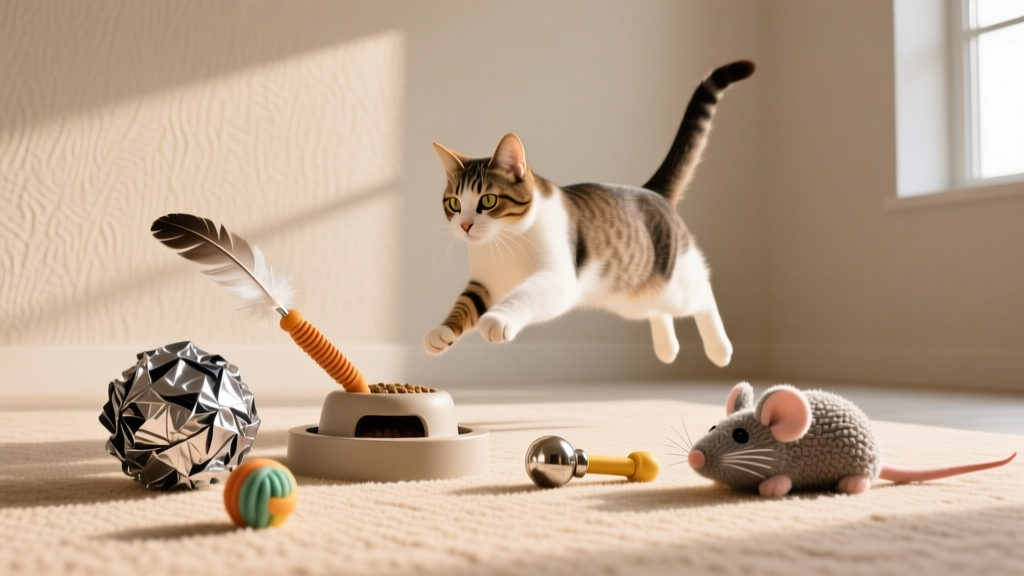
| Chattering at Windows | Frustration + predatory arousal | Fixed gaze, rapid jaw movement, wide eyes, tail thumping | Redirect with interactive play (feather wand) for 5 min—mimics ‘hunt’ completion |
| Rolling Onto Back (with belly exposed) | Trust signal—NOT invitation to rub belly | Relaxed limbs, slow blinks, may roll further toward you | Respect the gesture—pet chin/cheeks instead; avoid belly unless cat initiates contact |
Frequently Asked Questions
Why does my cat stare at me silently—and should I stare back?
No—don’t stare back. Sustained direct eye contact is perceived as a threat in cat language. Your cat’s silent stare is likely a gentle attention-seeking behavior, especially if paired with slow blinks or tail twitches. Instead of reciprocating the stare, try blinking slowly and looking away. If they blink back, you’ve just had a full conversation. According to Dr. Tony Buffington, professor emeritus at Ohio State’s veterinary college, ‘Staring is their way of saying “I see you and I’m choosing to hold your gaze.” It’s intimacy, not challenge.’
My cat brings me dead mice or birds—is this a gift or a complaint?
It’s both—and neither. Ethologically, it’s an instinctive teaching behavior: mother cats bring prey to kittens to demonstrate hunting skills. When your adult cat drops a mouse at your feet, they’re treating you as an inept offspring who needs lessons. But it’s also a sign of deep bonding: they consider you part of their family unit. To discourage the behavior without damaging trust, redirect their hunting drive with daily 15-minute interactive play sessions using wand toys—research shows this reduces ‘gift-giving’ by up to 70% in indoor-only cats.
Is it normal for my cat to sleep 16–20 hours a day?
Yes—biologically normal, but context matters. Cats conserve energy for short, intense bursts of activity (hunting). However, if sleep duration increases *suddenly*, or is accompanied by lethargy upon waking, reluctance to jump, or difficulty rousing, it could signal pain, hypothyroidism, or depression. Track sleep patterns for 3 days: note time awake, activity level, and engagement. If wakeful periods feel ‘flat’ or unresponsive, consult your vet—don’t assume ‘just tired.’
Why does my cat scratch furniture—even with scratching posts available?
Scratching serves four non-negotiable functions: claw maintenance, scent marking (via glands in paw pads), stretching muscles, and visual territory marking. If your cat ignores posts, it’s likely because they don’t meet one of these needs. Posts must be >32 inches tall (to allow full stretch), anchored firmly (wobbly posts feel unsafe), covered in sisal or cardboard (not carpet), and placed near sleeping areas or entryways—not tucked in a corner. Add catnip or silvervine to boost appeal. Never punish—redirect with positive reinforcement when they use the post correctly.
Does my cat recognize my voice—or just respond to tone?
They recognize *both*. A 2013 study at Tokyo University proved cats distinguish their owner’s voice from strangers’—even when played recordings. But they prioritize tone and rhythm over words. High-pitched, soothing tones signal safety; sharp, rising pitches trigger alertness. That’s why whispering ‘good kitty’ works better than shouting ‘no!’—the latter sounds like a predator alarm. Speak calmly, consistently, and pair words with predictable actions (e.g., ‘dinner’ followed by bowl placement) to build verbal association.
Debunking 2 Common Myths About Cat Behavior
- Myth #1: “Cats are aloof and don’t form attachments.” False. A 2019 Oregon State University study using the ‘secure base test’ (adapted from human infant research) found that 64% of cats display secure attachment to their owners—comparable to dogs and human toddlers. Securely attached cats explore freely when owner is present, seek proximity when stressed, and calm quickly upon reunion. Their ‘independence’ is often misread as detachment.
- Myth #2: “If my cat isn’t purring or rubbing, they don’t love me.” False. Love expressions vary wildly by personality and history. Some cats show devotion through vigilance (watching you from doorways), gentle head-butts, or bringing ‘gifts.’ Others express closeness via synchronized sleeping or following you room-to-room. As feline behaviorist Pam Johnson-Bennett states: ‘Love isn’t measured in purrs—it’s measured in choice. If your cat chooses to be near you, that’s love in cat terms.’
Related Topics (Internal Link Suggestions)
- Understanding cat body language cues — suggested anchor text: "cat body language explained"
- How to stop cats from scratching furniture — suggested anchor text: "stop cat scratching naturally"
- Signs of stress in cats at home — suggested anchor text: "cat stress symptoms checklist"
- Best interactive toys for indoor cats — suggested anchor text: "indoor cat enrichment ideas"
- When to take your cat to the vet for behavior changes — suggested anchor text: "cat behavior red flags"
Your Next Step: Build a 7-Day Behavior Journal
You now know what do cats behaviors mean at home—but knowledge becomes power only when applied. Your immediate next step? Launch a simple 7-day Behavior Journal. Each evening, spend 90 seconds logging: (1) One observed behavior, (2) Your interpretation *before* reading this guide, (3) What it likely meant (using our decoder), and (4) One small adjustment you made. Keep it on your phone or a sticky note on your fridge. By Day 7, you’ll spot patterns you never noticed—and your cat will feel seen in a way that deepens trust faster than any treat or toy. Ready to begin? Grab your journal—and watch your relationship transform, one blink, one tail flick, one quiet moment at a time.