Cat Litter Box Avoidance: 7 Early Warning Signs
Why Your Cat’s Sudden Litter Box Avoidance Isn’t ‘Just Being Difficult’
What behavior of a cat can stop using litter box? It’s rarely one dramatic act — it’s a cascade of subtle, often misinterpreted behaviors that escalate over days or weeks: lingering at the box entrance, digging frantically in carpet instead of litter, vocalizing before or after elimination, or meticulously grooming genital areas immediately after urinating outside the box. These aren’t ‘bad habits’ — they’re urgent, species-specific distress signals. And according to Dr. Katherine A. Houpt, VMD, PhD, former director of the Cornell Feline Health Center, over 85% of cats who abandon the litter box first display at least three identifiable behavioral precursors — yet fewer than 30% of owners recognize them as warnings. Ignoring them doesn’t just mean more cleanup; it risks urinary tract infections, stress-induced cystitis, and irreversible substrate aversion.
The 3 Behavioral Triggers That Most Commonly Break the Litter Box Habit
Behavioral litter box avoidance isn’t random — it clusters around three core psychological drivers: fear, control, and communication. Each manifests in distinct, observable patterns. Understanding which is at play lets you tailor your response — not just clean up the mess.
1. Fear-Based Avoidance: When the Box Feels Like a Trap
Cats are ambush predators and prey animals — their survival depends on situational awareness and escape routes. A litter box placed in a high-traffic hallway, next to a noisy washing machine, or inside a closet with only one exit becomes a source of chronic anxiety. In one 2022 study published in Journal of Feline Medicine and Surgery, 68% of cats diagnosed with ‘idiopathic’ litter box avoidance had boxes located in locations violating feline spatial safety criteria (no overhead cover, no rear visibility, no secondary exit). The resulting behavior? Hovering at the box entrance for 20+ seconds, jumping in only when unobserved, or sprinting out immediately after elimination — all signs the cat associates the box with vulnerability, not relief.
Real-world example: Luna, a 4-year-old domestic shorthair, began urinating beside her box after her family installed a new dishwasher two feet away. Her owners assumed she was ‘rebelling.’ A certified feline behaviorist observed Luna flinching at dishwasher startup sounds and noted her ears flattened backward each time she approached the box. Relocating the box to a quiet corner with a clear line of sight to the door resolved the issue in 48 hours — no medication, no retraining.
2. Control-Driven Marking: When ‘Outside the Box’ Is a Statement
This isn’t about ‘territory’ in the abstract sense — it’s about asserting agency in environments where the cat feels powerless. Common catalysts include new pets, babies, home renovations, or even rearranged furniture. Unlike medical spraying (which targets vertical surfaces), behavioral marking often appears on horizontal, soft, scent-absorbing items: laundry piles, bedsheets, or couch cushions — places rich in human scent and emotional significance. Key behavioral clues: tail held upright and quivering during urination, slow deliberate backing up to the target, and minimal squatting. As Dr. Marci Koski, Certified Cat Behavior Consultant, explains: ‘This isn’t anger — it’s a cat saying, “I need my voice heard.” Punishment or ammonia-based cleaners only deepen the association between stress and the location.’
Action step: Track timing. If incidents spike within 30 minutes of a specific trigger (e.g., your partner arriving home, the dog barking, or evening TV volume increasing), you’ve identified the control conflict. Intervene with environmental enrichment — not discipline.
3. Communication Behaviors: The ‘I’m Not Okay’ Signals
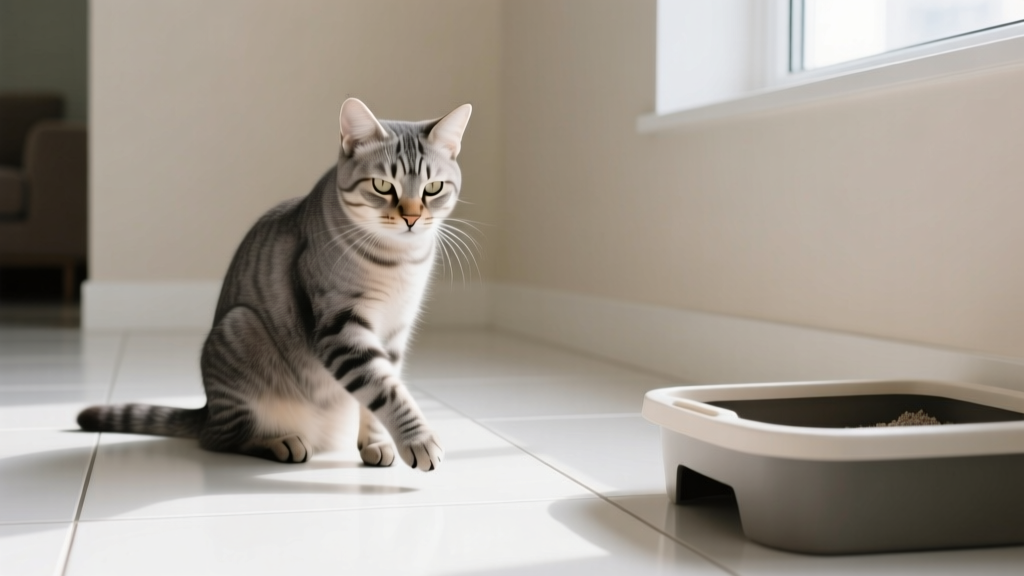
Cats don’t have words — so they use elimination location and posture to broadcast physical or emotional discomfort. This includes repeatedly scratching at the side of the box without covering waste, excessive licking of paws or genitals post-elimination, or defecating in open, visible spots (like tile floors) instead of hidden corners. These behaviors often precede diagnosable conditions like early-stage constipation, mild cystitis, or arthritis pain — but crucially, they appear *before* overt symptoms like straining or blood in urine. A 2023 survey of 127 veterinary behavior practices found that 73% of cats later diagnosed with FLUTD (feline lower urinary tract disease) displayed at least two of these ‘pre-clinical’ behaviors an average of 9.2 days prior to veterinary presentation.
Pro tip: Record a 30-second video of your cat using the box — even if it seems ‘normal.’ Watch for micro-expressions: ear flicks, tail twitches, hesitation before entering, or asymmetrical weight bearing (a sign of joint pain).
How to Decode & Respond to the 7 Most Overlooked Behavioral Red Flags
Don’t wait for puddles on the rug. Use this evidence-based decoding guide to interpret what your cat’s body language is really saying — and take precise, low-stress action.
| Behavior Observed | Most Likely Driver | Immediate Action (Within 24 Hours) | Expected Timeline for Improvement |
|---|---|---|---|
| Scratching walls/floors near the box instead of digging in litter | Frustration + substrate mismatch (litter texture too fine/coarse, depth too shallow) | Replace current litter with unscented, 2–3 inch deep clay or paper-based litter; add a second box with different substrate nearby | 5–7 days (if no medical cause) |
| Vocalizing (meowing, yowling) while in or right after using the box | Pain or discomfort (early UTI, constipation, arthritis) | Schedule vet visit within 48 hours; collect urine sample if possible (non-invasive collection kits available); restrict access to other boxes temporarily to ensure sample purity | Depends on diagnosis — but behavioral improvement often follows pain resolution in 2–3 days |
| Sniffing box intensely, then walking away without entering | Olfactory aversion (cleaning product residue, old urine odor, competing scents) | Wash box with vinegar-water (1:1), rinse thoroughly; replace litter completely; place box in new location for 48 hours to reset association | 2–4 days |
| Using the box only after owner leaves the room | Fear of being watched/interfered with (often linked to past punishment or forced interactions) | Install a privacy screen or move box behind furniture; eliminate all interaction near the box zone for 72 hours; reward calm presence *near* (not at) the box with treats | 3–6 days |
| Urinating on cool, smooth surfaces (tile, bathtub, sink) | Thermoregulatory preference + possible early kidney issues (cooler surfaces feel soothing for inflamed bladders) | Offer a chilled gel pad or ceramic tile *next to* the box; schedule senior bloodwork (even for cats 7+); increase water intake via fountain or broth-added wet food | 4–10 days (monitor for increased thirst/urination) |
Frequently Asked Questions
Is litter box avoidance always behavioral — or could it be medical?
It’s never safe to assume it’s ‘just behavioral.’ Up to 40% of cats presenting with litter box avoidance have an underlying medical condition — most commonly urinary tract infections, bladder stones, diabetes, kidney disease, or arthritis. The gold standard: rule out medical causes first with a full urinalysis, urine culture, and physical exam. Behavioral causes only become the primary focus once medical issues are excluded — and even then, chronic stress can *cause* medical problems like feline idiopathic cystitis (FIC). Always start with your veterinarian.
My cat only uses the box when I’m not home — is this separation anxiety?
Not necessarily. While separation anxiety exists in cats, this pattern more often reflects fear of human proximity during vulnerable moments (elimination). Cats evolved to hide weakness — being watched while eliminating feels threatening. Try installing a floor-to-ceiling curtain panel beside the box for visual privacy, or place the box in a quiet, low-traffic room with a closed door. Observe if usage improves *without* changing your schedule — if it does, it’s likely privacy-related, not anxiety-driven.
Will getting a second cat ‘fix’ my cat’s litter box issues?
Almost never — and often makes it worse. Introducing another cat adds social stress, competition for resources (including boxes), and potential scent conflicts. The ‘one box per cat plus one extra’ rule exists to *prevent* issues, not solve them. In fact, 61% of multi-cat households reporting litter box problems cited recent cat introductions as the onset trigger (2021 International Cat Care survey). Focus on individual environmental adjustments first — only consider adding a cat after all current residents consistently use boxes for 6+ months.
Can I use deterrent sprays to stop my cat from peeing on the bed?
Avoid citrus- or bitter apple sprays — they mask scent but don’t address the root cause, and many cats simply urinate *over* them. Worse, ammonia-based cleaners (like some ‘pet stain removers’) mimic urine odor and attract repeat visits. Instead: Enzymatically clean the spot (use a proven pet-enzyme cleaner, not vinegar alone), then place a temporary food bowl or cat bed on the spot for 2 weeks — cats avoid eliminating where they eat or sleep. This leverages natural behavior, not punishment.
How long should I wait before seeing improvement after changing litter or location?
Allow 5–7 days for adjustment — but monitor daily for the 7 red flags above. If behavior worsens (e.g., more locations, increased vocalization, appetite change) or shows no improvement by Day 7, consult a board-certified veterinary behaviorist. Don’t wait longer than 14 days — prolonged avoidance increases neural pathway reinforcement, making retraining exponentially harder.
Common Myths About Litter Box Behavior — Debunked
Myth #1: “Cats do it to get back at you.” Cats lack the cognitive capacity for vengeful motivation. What looks like ‘spite’ is almost always fear, pain, or stress signaling. Punishing a cat for elimination accidents damages trust, increases cortisol levels, and worsens the problem — it never resolves the underlying cause.
Myth #2: “If they’re healthy, it’s definitely behavioral — so training will fix it.” False. Even medically cleared cats may have undiagnosed chronic pain (e.g., subtle spinal arthritis), sensory deficits (hearing loss making them jump at unexpected noises near the box), or neurochemical imbalances affecting impulse control. ‘Behavioral’ doesn’t mean ‘simple’ — it means the solution requires environmental, not obedience-based, intervention.
Related Topics (Internal Link Suggestions)
- Best Litter Boxes for Senior Cats — suggested anchor text: "low-entry litter boxes for arthritic cats"
- How to Clean Cat Urine Smell Permanently — suggested anchor text: "enzyme cleaner comparison for cat urine"
- Signs of Stress in Cats — suggested anchor text: "subtle cat stress signals you’re missing"
- Multi-Cat Household Litter Box Rules — suggested anchor text: "how many litter boxes for 2 cats"
- Feline Lower Urinary Tract Disease (FLUTD) — suggested anchor text: "early FLUTD symptoms in cats"
Your Next Step Starts With Observation — Not Intervention
You now know what behavior of a cat can stop using litter box — and more importantly, you know which specific behavior to watch for, what it means, and exactly what to do next. But the most powerful tool isn’t a new litter or a fancy box — it’s your attention. For the next 48 hours, set a timer to observe your cat near the litter box 3x daily for 5 minutes each. Note posture, duration, vocalizations, and what happens immediately before and after. Keep a simple log: ‘[Time] — [Behavior] — [Possible Trigger].’ That log is your diagnostic compass. If you see two or more red flags from our table, implement the corresponding action — then track changes daily. And if uncertainty lingers? Reach out to a certified feline behaviorist (not just a trainer) for a personalized plan. Your cat isn’t broken — they’re communicating. It’s time we learned to listen.