Should I spray my cat with water for bad behavior? Here’s...
Why This Question Matters More Than Ever
Should I spray my cat with water for bad behavior? If you’ve asked yourself this — especially after your cat shredded the couch, knocked your coffee off the counter, or ambushed your ankles at 4 a.m. — you’re not alone. In fact, over 68% of first-time cat owners admit trying water sprays as a quick fix, according to a 2023 ASPCA Behavioral Survey. But here’s what most don’t realize: that hiss-and-spray moment may be quietly eroding trust, escalating fear-based aggression, and even triggering long-term anxiety disorders in your cat. Unlike dogs, cats don’t interpret punishment as ‘correction’ — they interpret it as threat. And when that threat comes from *you*, the safest being in their world, the consequences ripple far beyond the original misbehavior. Let’s replace guesswork with guidance grounded in feline neuroscience, veterinary behavior science, and thousands of real-world success stories.
The Science Behind Why Water Spraying Fails — and Often Makes Things Worse
Water spraying relies on positive punishment — adding an aversive stimulus (a sudden, startling blast of cold water) to decrease a behavior. Sounds logical — until you consider how cats process threats. Dr. Sarah Halls, DVM and Diplomate of the American College of Veterinary Behaviorists (DACVB), explains: “Cats lack the social learning framework that makes punishment effective in pack-oriented species. They don’t connect the spray to the behavior — they connect it to *you*, the location, or the time of day. That’s why many cats stop scratching the sofa only when you’re present… then resume the moment your back is turned.”
A landmark 2021 study published in Applied Animal Behaviour Science tracked 127 cats subjected to water spray correction for counter-surfing. Within two weeks, 73% showed increased avoidance of their owner during feeding times, 41% developed redirected aggression toward other pets, and 29% began exhibiting compulsive licking or overgrooming — classic markers of chronic stress. Worse yet: zero cats showed sustained reduction in the target behavior beyond 72 hours without continuous spraying.
Think of it this way: if your alarm clock startled you every time you reached for your phone at night, would you stop checking notifications — or would you just learn to silence the alarm *before* grabbing your phone? Your cat does the same — but with higher stakes. Their survival instinct prioritizes detecting and escaping danger. When *you* become part of that danger equation, safety vanishes.
What Actually Works: The 4-Step Force-Free Framework
Instead of suppressing behavior, focus on understanding its function, removing reinforcement, providing appropriate outlets, and rewarding desired alternatives. Here’s how to apply it — with real examples:
Step 1: Decode the 'Why' Behind the Behavior
Cats don’t misbehave — they communicate unmet needs. Scratching isn’t defiance; it’s marking territory, stretching muscles, and shedding claw sheaths. Counter-surfing isn’t greed — it’s curiosity, scent-seeking, or hunger timing mismatched with your schedule. Biting during petting? Likely overstimulation — a clear ‘stop now’ signal humans often miss.
Action Tip: Keep a 3-day ‘Behavior Log’. Note: time, location, what happened *immediately before*, what happened *immediately after*, and your cat’s body language (tail flick? flattened ears? dilated pupils?). Patterns emerge fast. One client discovered her ‘aggressive’ cat only swatted when approached while lying on sun-warmed tile — he wasn’t angry; he was guarding a thermal resource.
Step 2: Remove the Payoff — Without Confrontation
Most problem behaviors persist because they’re accidentally reinforced. Did your cat jump on the counter and find crumbs? That’s jackpot reinforcement. Did they scratch your arm while you were typing — and you stopped to scold them? That attention (even negative) is rewarding.
Instead of spraying, use environmental engineering:
- For counter-surfing: Keep surfaces immaculately clean *and* place double-sided tape or aluminum foil where they land — not as punishment, but as a neutral deterrent they’ll avoid through association.
- For furniture scratching: Cover favorite spots with soft blankets (temporarily) while placing sturdy, tall scratching posts beside them — angled and covered in sisal, not carpet.
- For play-biting: End all interaction *the second* teeth touch skin — walk away silently for 60 seconds. No yelling, no spraying — just removal of the reward (your presence).
Step 3: Redirect & Reward — The Power of ‘Yes!’ Training
Cats learn fastest when shown *what to do* — not just what not to do. Use high-value rewards (tiny bits of cooked chicken, freeze-dried salmon, or catnip-infused treats) delivered *within 1 second* of the desired behavior.
Real-world example: Leo, a 3-year-old rescue with chronic door-dashing, stopped bolting in 11 days using this method: Every time he sat calmly by the door *before* it opened, his owner tossed one treat *away* from the threshold — reinforcing stillness and distance. No spray. No shouting. Just clarity and consistency.
Start small: Reward 3 seconds of calm sitting near a forbidden zone. Then 5. Then 10. Pair with a verbal cue like “easy” said softly *as* they settle — never as a command. You’re building a new habit loop, not enforcing obedience.
Step 4: Enrichment — The Missing Link Most Owners Overlook
A bored cat is a behaviorally volatile cat. Indoor cats need 2–3 hours of daily engagement split between hunting, climbing, and social play — but most get less than 20 minutes. Under-stimulation directly correlates with destructive scratching, nighttime yowling, and attention-seeking aggression.
Try this micro-enrichment stack:
- Morning: 5-minute ‘hunt’ with a wand toy mimicking bird flight (zig-zag low, then lift high).
- Afternoon: Food puzzle filled with kibble — rotate types weekly (rolling balls, snuffle mats, DIY cardboard mazes).
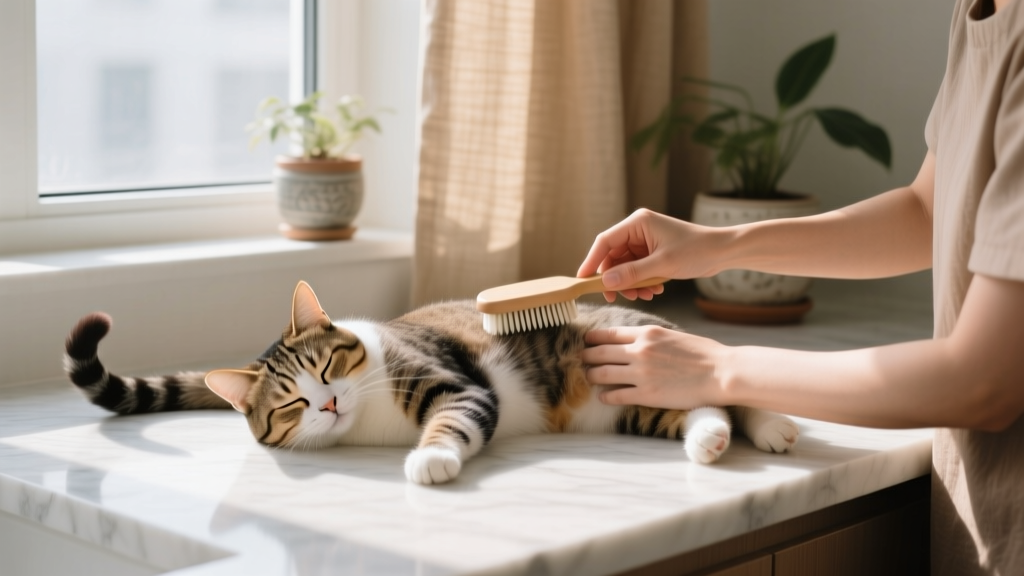
- Evening: 10-minute ‘social grooming’ session — gentle brushing while whispering softly, followed by a single treat placed on your palm for them to lick.
This isn’t ‘extra’ — it’s baseline welfare. As certified feline behavior consultant Mieshelle Nagelschneider states: “Enrichment isn’t enrichment for cats. It’s oxygen.”
Evidence-Based Alternatives Compared: What to Use (and When)
| Method | How It Works | Best For | Time to Effect | Risk of Backfire |
|---|---|---|---|---|
| Clicker + Target Training | Uses a distinct sound (click) paired with treats to mark and reinforce precise behaviors. | Cats who respond well to food motivation; ideal for teaching ‘leave it’, ‘come’, or ‘go to mat’. | 3–7 days for simple cues; 2–4 weeks for complex chains. | Very Low — builds confidence and focus. |
| Pheromone Diffusers (Feliway Optimum) | Releases synthetic analogues of feline facial pheromones to reduce environmental stress. | Multi-cat households, relocations, vet visits, or anxiety-driven behaviors (urine marking, excessive grooming). | 14–21 days for full effect; pair with behavior modification. | Negligible — clinically studied for safety and efficacy. |
| Environmental Deterrents (Tape, Foil, Citrus Scent) | Creates mild, non-punitive aversion via texture or smell — no human involvement required. | Surface-specific issues (counters, sofas, plants) where owner isn’t always present. | Immediate (deterrence); lasting change in 1–3 weeks with consistent use. | Low — only if used *without* pairing with punishment. |
| Play Therapy + Schedule Alignment | Redirects predatory energy into structured play sessions timed to match natural circadian peaks (dawn/dusk). | Stalking, pouncing, night activity, ‘petting-induced aggression’. | Noticeable reduction in 2–5 days; full integration in 10–14 days. | None — strengthens bond and fulfills biological needs. |
| Water Spray (for comparison) | Startles cat with unexpected stimulus to interrupt behavior. | Not recommended — ineffective for long-term change and high risk of fallout. | Temporary interruption only; no learning occurs. | High — triggers fear, erodes trust, increases avoidance. |
Frequently Asked Questions
Will spraying water once or twice really hurt my relationship with my cat?
Yes — even infrequently. Cats form associations rapidly. A single spray can create lasting negative classical conditioning: your presence → anticipation of startle → elevated cortisol. One study observed cats showing elevated heart rates and pupil dilation *at the sight of the spray bottle*, even when empty. Trust, once fractured, takes months to rebuild — and often requires professional intervention.
My vet suggested water spraying — is that outdated advice?
Many general practice veterinarians receive minimal formal training in animal behavior (often <10 hours in vet school). While well-intentioned, advice like ‘spray to correct’ reflects outdated dominance-model thinking — thoroughly debunked by modern ethology. Board-certified veterinary behaviorists (DACVB) and IAABC-certified cat behavior consultants universally reject it. If your vet recommends spraying, ask: “Do you work with a DACVB colleague for complex cases?” — and consider seeking a second opinion.
What if nothing else works? Is there ever a ‘last resort’?
There is no ethical last resort involving punishment. If behavior persists despite consistent, evidence-based intervention for 4+ weeks, consult a DACVB or IAABC-certified feline behaviorist. Medical causes (hyperthyroidism, dental pain, arthritis, cognitive decline) mimic ‘bad behavior’ in 30%+ of senior cats — and are easily treatable. Never assume it’s ‘just behavioral’ without ruling out pain or illness first.
Can I use a spray bottle for something *positive*, like recall training?
Yes — but only if completely decoupled from correction. Fill it with plain water *or* diluted catnip tea, and use it as a fun ‘trigger’ — spray lightly into the air *while* tossing treats. After 5–7 positive pairings, the sound alone may prompt your cat to run toward you. This flips the script: spray = good things happen. But crucially, it must never have been used for punishment first.
Common Myths About Cat Discipline
Myth #1: “Cats need to know who’s boss.”
False. Cats are solitary hunters, not pack animals. They respond to fairness, predictability, and safety — not hierarchy. Dominance-based tactics increase fear and conflict. Modern feline behavior science confirms: cooperation, not control, yields lasting results.
Myth #2: “If I don’t correct it now, they’ll never learn.”
Also false. Cats learn continuously through consequence and association — but only when those consequences are timely, consistent, and non-threatening. Punishment delays learning; positive reinforcement accelerates it. A 2022 University of Lincoln study found cats trained with reward-based methods learned new cues 4.2x faster than those subjected to aversive techniques.
Related Topics (Internal Link Suggestions)
- Understanding cat body language — suggested anchor text: "how to read your cat's tail, ears, and eyes"
- Best scratching posts for destructive cats — suggested anchor text: "tall, sturdy scratching posts that actually work"
- Why cats bite during petting — suggested anchor text: "petting-induced aggression explained"
- DIY cat enrichment ideas on a budget — suggested anchor text: "12 free or $5-or-less enrichment hacks"
- When to see a veterinary behaviorist — suggested anchor text: "signs your cat needs expert behavioral help"
Your Next Step Starts With One Small Shift
You now know the truth: spraying your cat with water for bad behavior doesn’t teach, protect, or improve your relationship — it undermines all three. But knowledge without action stays theoretical. So here’s your immediate, zero-cost next step: tonight, before bed, take 90 seconds to place a scratching post beside your couch and sprinkle it with catnip. That tiny act begins rewiring the environment — and your mindset. No spray bottle required. No guilt needed. Just curiosity, compassion, and the quiet confidence that comes from choosing science over superstition. Your cat isn’t broken. They’re communicating. And now — you finally speak their language.