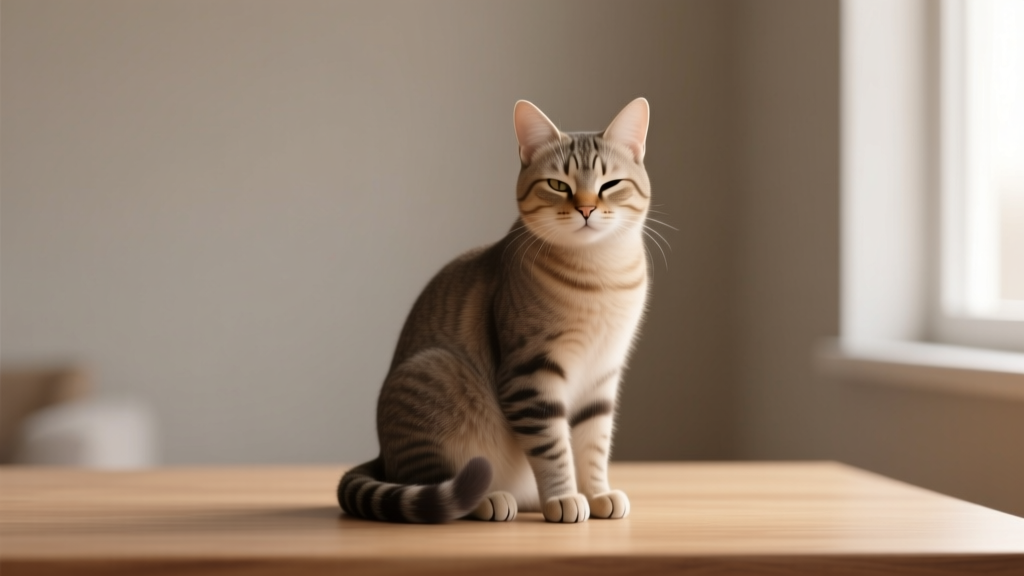
How to Understand Your Cat's Behavior
Why Understanding Your Cat’s Behavior Isn’t Just ‘Nice to Know’—It’s Essential for Their Well-Being
\nIf you’ve ever wondered, how to understand your cat's behavior, you’re not alone—and you’re asking the right question at a critical time. Unlike dogs, cats evolved as solitary hunters who rely on nuanced, low-intensity communication to avoid conflict. When we misread their signals—mistaking fear for aloofness, overstimulation for affection, or pain for 'grumpiness'—we risk escalating stress, triggering aggression, damaging the human-cat bond, and even overlooking serious medical issues hiding behind behavioral changes. In fact, a 2023 study published in Frontiers in Veterinary Science found that 68% of cats referred to behavior specialists had undiagnosed underlying pain or illness masked by 'acting out'—from inappropriate urination to sudden hissing. The truth? Your cat isn’t being 'difficult.' They’re speaking a language you weren’t taught. This guide bridges that gap—not with guesswork, but with veterinary ethology, decades of feline cognition research, and real-world case studies from certified cat behavior consultants.
\n\nDecoding the Silent Language: What Every Tail Flick, Ear Turn, and Blink Really Means
\nCats don’t bark, whine, or wag tails in obvious ways. Instead, they communicate through micro-expressions—subtle shifts in posture, pupil size, whisker angle, and muscle tension. Dr. Mikel Delgado, certified cat behavior consultant and researcher at the University of California, Davis, emphasizes: “Cats are masters of understatement. A single twitch of the tail tip can signal rising frustration, while slow blinking isn’t just ‘relaxation’—it’s a deliberate social gesture meaning ‘I trust you enough to be vulnerable.’”
\nStart with the three most revealing zones:
\n- \n
- Ears: Forward and relaxed = calm curiosity. Swiveling independently = intense environmental scanning. Flattened sideways or backward (‘airplane ears’) = acute fear, anxiety, or defensive readiness—even if your cat appears still. \n
- Tail: Upright with a gentle curve at the tip = friendly greeting. Low and tucked = insecurity or submission. Rapid, whip-like side-to-side movement = high arousal—often frustration or impending aggression (not ‘happy wagging’). A puffed-up tail = fear-based defense. \n
- Eyes & Blinking: Dilated pupils in normal light = heightened emotion (fear, excitement, pain). Slow, deliberate blinks (‘cat kisses’) = trust and non-threat signaling. Staring without blinking = challenge or vigilance—especially if paired with stiff posture. \n
Real-world example: Maya, a 4-year-old rescue tabby, began swatting at her owner’s hand during petting sessions. Her owner assumed she was ‘moody.’ But observing closely revealed her tail tip flicked rapidly after 12 seconds of stroking—and her ears rotated back just before striking. This wasn’t aggression; it was a clear, consistent ‘overstimulation threshold’ signal. Once her owner learned to stop petting *before* the flick—not after—the swatting stopped entirely within 5 days.
\n\nThe Purring Paradox: Why ‘Happy Sound’ Is Often a Lie (and What to Listen For Instead)
\nPurring is the most misunderstood feline vocalization. While it *can* indicate contentment (e.g., kneading while curled on your lap), research confirms cats also purr when injured, in labor, or facing terminal illness. A landmark 2021 study in Animal Cognition analyzed purr frequencies across contexts and found that purrs emitted during pain or distress contain higher-frequency vibrational components (22–24 Hz) linked to tissue regeneration and pain modulation—suggesting purring may be a self-soothing, healing mechanism.
\nSo how do you distinguish?
\n- \n
- Context is king: Is your cat purring while lying on a warm blanket, kneading softly, and making slow blinks? Likely content. Is she purring while hunched in the corner, avoiding touch, with shallow breathing? That’s a red flag. \n
- Vocal quality matters: Contented purrs are typically rhythmic, low-pitched, and steady. Distress purrs often sound strained, inconsistent, or layered with other sounds (e.g., faint yowling, chirps). \n
- Body language overrides sound: If purring accompanies flattened ears, dilated pupils, or rigid muscles, trust the body—not the noise. \n
Dr. Tony Buffington, DVM and professor of veterinary clinical sciences, warns: “We’ve pathologized ‘purr-only’ cats for decades. Many owners delay vet visits because ‘my cat is purring, so she must be fine.’ That assumption costs lives.” Always cross-reference purring with posture, appetite, litter box habits, and activity level.
\n\nStress Signals Most Owners Miss (And How to Spot Them Early)
\nCats hide stress masterfully—a survival trait. By the time they’re hiding, overgrooming, or urinating outside the box, chronic stress has likely been brewing for weeks. Early indicators are far subtler—and far more actionable. Here’s what to watch for daily:
\n- \n
- Overgrooming: Not just licking, but focused, repetitive licking that causes bald patches (especially on inner thighs, belly, or forelegs)—a displacement behavior indicating anxiety. \n
- Changes in sleep patterns: Sleeping significantly more *or less*, especially if accompanied by restlessness at night or excessive daytime napping. \n
- ‘Ghosting’ behaviors: Sudden avoidance of favorite spots (e.g., no longer sleeping on your bed), reluctance to use certain rooms, or increased vigilance near windows/doors. \n
- Subtle vocal shifts: Increased frequency of meows (especially at odd hours), or new, low-pitched yowls—not necessarily loud, but persistent and tonally different. \n
A 2022 survey by the International Society of Feline Medicine (ISFM) found that 73% of owners reported noticing *no* stress signs until their cat developed a urinary tract issue—yet retrospective video analysis revealed early indicators like lip-licking (a stress-related oral behavior) and half-blinking had been present for an average of 19 days prior.
\n\nBuilding Trust Through Predictable Communication (Not Just ‘More Love’)
\nMany owners think ‘more attention’ fixes behavioral issues. But cats don’t crave constant interaction—they crave predictability, control, and respectful boundaries. The most effective strategy isn’t forcing affection; it’s creating a communication loop where your cat feels safe initiating and ending interactions.
\nTry this 3-step protocol used by certified feline behaviorists:
\n- \n
- Observe first: Spend 5 minutes daily watching your cat *without interacting*. Note where they choose to rest, how they approach food/water/litter, and what triggers head-butting vs. avoidance. \n
- Offer choice: When petting, extend your hand palm-down (not fingers-first) and let them rub against it. If they lean in, continue. If they turn away, stop immediately—even mid-stroke. Reward withdrawal with space, not pursuit. \n
- Use species-appropriate rewards: Cats value play, not just treats. Use wand toys to mimic hunting sequences (stalking → pouncing → ‘killing’ → chewing). End every session with a treat *only after* the ‘kill,’ reinforcing the full natural sequence. \n
This method builds what Dr. Sarah Heath, European Veterinary Specialist in Behavioural Medicine, calls ‘consent-based handling’—reducing fear-based reactions and transforming vet visits, nail trims, and medication administration from battles into cooperative moments.
\n\n| Behavioral Cue | \nMost Likely Meaning | \nWhat to Do Immediately | \nWhen to Consult a Professional | \n
|---|---|---|---|
| Low, rapid tail swish + flattened ears | \nImpending overstimulation or fear response | \nStop all physical contact. Give 3+ feet of space. Avoid eye contact. | \nIf occurs >3x/day during routine interactions for >2 weeks | \n
| Excessive licking of one area (bald patch) | \nChronic stress or medical issue (e.g., allergy, pain) | \nRule out fleas/skin infection. Add vertical space (cat trees) and interactive feeding puzzles. | \nWithin 72 hours if bald patch grows or skin becomes red/inflamed | \n
| Urine marking on vertical surfaces | \nPerceived territorial threat (new pet, person, or change in routine) | \nThoroughly clean with enzymatic cleaner. Identify and reduce stressors (e.g., block window views of outdoor cats). | \nIf marking persists >10 days despite environmental changes | \n
| Uncharacteristic hiding + loss of appetite | \nAcute pain, illness, or severe anxiety | \nMinimize noise/light. Offer strong-smelling food (tuna, chicken broth). Monitor litter box output. | \nWithin 24 hours—requires urgent vet assessment | \n
| Slow blink + head butt + purring | \nDeep trust and comfort | \nReturn the slow blink. Gently stroke preferred areas (cheeks, base of ears) for 5–10 seconds max. | \nNone—celebrate and reinforce! | \n
Frequently Asked Questions
\nWhy does my cat stare at me without blinking?
\nDirect, unblinking staring is rarely affectionate—it’s a sign of vigilance or mild challenge. In cat-to-cat communication, sustained eye contact is threatening. If your cat stares while holding still, they’re likely assessing safety or waiting for you to move. To diffuse tension, slowly blink at them (a ‘cat kiss’). If they return it, trust is building. If they look away, they’ve accepted your non-threatening signal.
\nIs it true that cats ‘don’t feel love’ like dogs do?
\nNo—this is a harmful myth rooted in outdated anthropomorphism. Neuroimaging studies (e.g., 2020 fMRI research at Kyoto University) show cats activate the same brain regions associated with attachment and reward when hearing their owner’s voice. Their love is quieter and more conditional: built on consistency, respect for autonomy, and reliable care—not obedience or exuberant displays. They form secure attachments—but express them through proximity, grooming, and bringing you ‘gifts’ (even if it’s a toy mouse).
\nMy cat suddenly started biting me gently during petting—is that aggression?
\nUsually not. This is called ‘petting-induced aggression’ and stems from sensory overload—not anger. Cats have a finite tolerance for tactile stimulation, often signaled by tail flicks, skin twitching, or ear rotation. The gentle bite is a polite ‘stop now’—akin to a human saying ‘enough.’ Respect the signal immediately. Never punish; instead, end sessions *before* the cue appears, gradually increasing duration over weeks.
\nHow long does it take to truly understand my cat’s unique behavior?
\nThere’s no universal timeline—but significant progress is typical within 2–4 weeks of consistent observation and responsive interaction. Key milestones: recognizing 3+ individual stress signals, predicting their reaction to common triggers (e.g., vacuum noise), and seeing voluntary engagement increase (e.g., seeking your lap, following you room-to-room). Remember: understanding deepens with patience, not speed. As certified behaviorist Pam Johnson-Bennett notes, “You’re not learning a language—you’re co-creating one, with your cat as the fluent speaker.”
\nCan I train my cat to behave ‘better’ using treats?
\nYes—but only for behaviors aligned with their instincts (e.g., coming when called, using a scratching post, entering a carrier). Force-based training (punishment, spray bottles) damages trust and increases fear-based aggression. Positive reinforcement works best when tied to natural drives: use food rewards for targeting exercises, play rewards for recall, and environmental enrichment (tunnels, perches) for reducing destructive behavior. Always pair training with stress reduction—no amount of treats fixes chronic anxiety.
\nCommon Myths About Cat Behavior
\nMyth #1: “Cats are aloof and don’t bond with humans.”
False. Decades of attachment research (including the 2019 Oregon State University ‘Secure Base Test’) prove cats form secure, insecure, or disorganized attachments to caregivers—just like human infants. Their independence reflects evolutionary adaptation, not emotional detachment.
Myth #2: “If my cat scratches furniture, they’re being spiteful.”
Completely false. Scratching serves vital functions: marking territory (via scent glands in paws), stretching muscles, and shedding claw sheaths. It’s instinctual—not malicious. Providing appropriate, appealing alternatives (sisal posts, cardboard angles) and trimming nails regularly solves 90% of scratching issues.
Related Topics (Internal Link Suggestions)
\n- \n
- Signs of Pain in Cats — suggested anchor text: "subtle signs your cat is in pain" \n
- Best Cat Litter for Behavioral Issues — suggested anchor text: "litter choices that reduce stress-related urination" \n
- How to Introduce a New Cat Safely — suggested anchor text: "step-by-step cat introduction guide" \n
- Cat Enrichment Ideas for Indoor Cats — suggested anchor text: "indoor cat enrichment activities" \n
- When to See a Veterinary Behaviorist — suggested anchor text: "signs you need a cat behavior specialist" \n
Your Next Step Starts With One Observation
\nYou now hold the foundational framework to decode your cat’s silent language—not as a puzzle to solve, but as a relationship to deepen. Understanding your cat’s behavior isn’t about achieving perfection; it’s about replacing assumptions with awareness, fear with empathy, and confusion with quiet confidence. So tonight, before bed, spend just 3 minutes watching your cat without touching or talking. Notice where they settle, how they blink, whether their tail rests still or twitches. Jot down one observation in a notes app. That tiny act—curious, patient, and grounded in respect—is where true understanding begins. And if you notice persistent signs of stress, pain, or sudden behavioral shifts? Don’t wait. Contact your veterinarian or a board-certified feline behaviorist. Your cat’s well-being depends not on reading their mind—but on finally learning to listen.