How to Stop Destructive Behavior in Cats
Why Your Cat Is Destroying Your Home—and What It’s Really Trying to Tell You
If you're searching for how to stop destructive behavior in cats, you're likely exhausted: shredded couches, clawed doorframes, chewed cords, or midnight zoomies that feel like sabotage. But here’s the truth most pet parents miss—destructive behavior isn’t ‘bad’ or ‘spiteful.’ It’s your cat’s only fluent language for unmet needs: boredom, anxiety, pain, or instinctual drives gone unchanneled. According to Dr. Sarah Wooten, DVM and certified feline behavior consultant with over 15 years of clinical experience, 'Over 83% of cats labeled “destructive” are actually exhibiting normal feline behaviors—like scratching, hunting, or territory marking—in inappropriate contexts. The fix isn’t suppression; it’s redirection, enrichment, and detective work.'
This isn’t about quick fixes or spray bottles. It’s about decoding your cat’s silent communication—and responding with empathy, precision, and proven strategies. In this guide, we’ll walk through root-cause diagnostics, vet-approved interventions, real-world case studies (including a 9-year-old senior cat who stopped shredding curtains after just 4 days), and a step-by-step action plan you can start tonight.
Step 1: Rule Out Medical Causes—Before You Blame Behavior
Never assume destruction is purely behavioral. Pain, dental disease, hyperthyroidism, arthritis, or even early-stage cognitive dysfunction can manifest as agitation, restlessness, or compulsive chewing or scratching. A 2022 study published in the Journal of Feline Medicine and Surgery found that 31% of cats referred for 'aggressive or destructive behavior' had underlying medical conditions—including oral lesions undetected by owners and subtle joint discomfort mistaken for 'grumpiness.'
Start with a full veterinary exam—including bloodwork, urinalysis, dental assessment, and orthopedic evaluation—even if your cat seems otherwise healthy. Ask specifically: 'Could this behavior be pain-related?' and 'Have you ruled out sensory decline (e.g., vision/hearing loss) that might increase anxiety?'
One real-life example: Luna, a 6-year-old tabby, began biting baseboards and digging at carpet corners. Her owner assumed boredom—until her vet discovered a painful ear infection causing head-shaking and disorientation. Once treated, the behavior vanished in 72 hours. This underscores a critical principle: no behavior modification works until physical discomfort is addressed.
Step 2: Decode the 'Why'—Not Just the 'What'
Destructive acts fall into four primary functional categories—each requiring a different solution:
- Scratching furniture? Likely territorial marking (scent glands in paws) + nail maintenance + stretching—not 'disobedience.'
- Chewing cords, plastic, or wool? May signal pica—a condition linked to nutritional deficiencies, stress, or early weaning trauma.
- Attacking ankles or furniture at dawn/dusk? Classic predatory drive misfiring—especially in indoor-only cats with no outlet for hunting sequences.
- Urine spraying or excessive grooming near damaged items? Often a sign of environmental stress: new pets, moving, construction noise, or even an unclean litter box location.
Keep a 7-day behavior log (we’ve included a printable version in our free resource library). Note: time of day, location, duration, your cat’s body language before/after, and any household changes (e.g., guests, appliance noise, schedule shifts). Patterns emerge fast—like your cat only chewing cords when left alone >4 hours, or scratching the sofa right after you return from work (a greeting ritual gone awry).
Step 3: Build a 'Destructive-Proof' Enrichment Ecosystem
Cats don’t need more toys—they need purposeful engagement. Enrichment must satisfy five core needs: hunting, eating, playing, scratching, and resting—ideally in ways that mimic natural feline rhythms. Here’s how top-tier feline behaviorists structure it:
- Hunting Simulation: Use interactive wand toys (never hands!) for 3–5 minute sessions, 2x daily—mimicking prey movement (dart, freeze, retreat). End each session with a 'kill'—letting your cat catch a treat-stuffed toy or crinkle ball.
- Food-Based Foraging: Replace 50% of kibble with puzzle feeders (e.g., Trixie Flip Board, Outward Hound Fun Feeder). Studies show cats using food puzzles spend 47% less time engaging in stereotypic behaviors (like over-grooming or chewing).
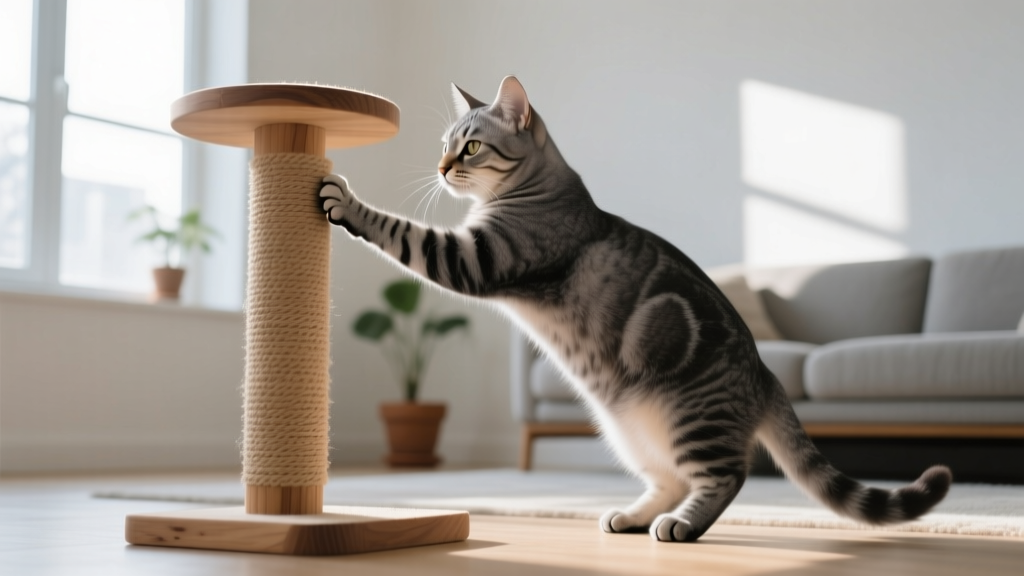
- Scratching Architecture: Provide multiple types: vertical sisal posts (≥32” tall), horizontal cardboard ramps, and angled corrugated boards. Place them near sleeping areas and entryways—not tucked in corners. Spray with silvervine or catnip every 3–4 days to renew interest.
- Sensory Safe Zones: Create low-stimulus retreats: covered beds near windows (with bird feeder view), elevated perches with soft fleece, and Feliway diffusers in high-traffic rooms.
Crucially: never punish scratching or chewing. Yelling, clapping, or spraying water increases fear-based reactivity and damages your bond. Instead, interrupt gently (a soft 'psst'), then redirect immediately to an approved alternative—and reward the replacement behavior with praise or a treat within 2 seconds.
Step 4: Strategic Intervention & Timeline-Based Progress Tracking
Behavior change follows predictable neurobiological timelines. Expect: Days 1–3 = increased testing (your cat may escalate briefly); Days 4–10 = noticeable reduction in target behavior; Days 11–21 = consistent alternative behavior use. Consistency is non-negotiable—every family member must follow the same protocol.
| Step | Action | Tools Needed | Expected Outcome (by Day) |
|---|---|---|---|
| 1 | Complete medical workup + 7-day behavior log | Vet visit, notebook/app, camera | Clear medical green light or treatment plan (Day 3) |
| 2 | Install 3+ scratching surfaces + remove temptation (double-sided tape on couch arms, cord covers) | Sisal post, cardboard scratcher, Sticky Paws tape, braided cord protectors | 80% reduction in furniture scratching (Day 7) |
| 3 | Implement structured play sessions + food puzzles (AM/PM) | Wand toy, treat balls, slow-feeder bowl | Decreased 'zoomies' and redirected energy (Day 10) |
| 4 | Introduce calming pheromones + identify & reduce stressors (e.g., cover windows during stray cat sightings) | Feliway Optimum diffuser, opaque window film, white noise machine | Reduced vocalization, hiding, or over-grooming (Day 14) |
| 5 | Reinforce alternative behaviors with clicker training or marker words ('Yes!') | Clicker or consistent verbal marker, high-value treats (chicken, tuna) | Cat chooses scratch post over couch 90% of time (Day 21) |
Frequently Asked Questions
Will neutering/spaying stop destructive behavior?
Neutering or spaying can reduce hormonally driven behaviors like spraying or roaming—but it rarely resolves established destructive habits rooted in stress, boredom, or medical issues. A 2023 review in Applied Animal Behaviour Science concluded that while intact males were 3.2x more likely to urine-mark, post-spay/neuter destructive chewing or scratching showed no statistically significant decline without concurrent environmental enrichment. So yes—it helps prevent some issues, but it’s not a cure-all.
Is my cat 'vandalizing' because it's angry at me?
No—cats don’t hold grudges or act out of spite. Their brains lack the neural architecture for complex human emotions like revenge. What looks like 'anger' is almost always fear, frustration, or confusion. If your cat scratches your pillow right after you scold it, that’s not retaliation—it’s displacement behavior (redirecting stress onto a safe object). Responding with punishment only deepens their anxiety and erodes trust.
Can I use citrus sprays or bitter apple to deter chewing?
While generally safe in small amounts, aversive sprays are unreliable and can backfire. Many cats habituate quickly—or worse, associate the smell with you or their favorite spot, creating negative associations. The American Association of Feline Practitioners (AAFP) recommends positive reinforcement over aversion: make the desired behavior easier and more rewarding than the unwanted one. For cords, try wrapping them in flexible PVC conduit and placing a treat-dispensing toy nearby instead.
My kitten is destroying everything—will it grow out of it?
Kittens have intense developmental needs: teething (up to 6 months), motor skill refinement, and social learning. Unstructured destruction often peaks between 12–24 weeks. But without guidance, those habits become hardwired. Start enrichment early: provide chew-safe alternatives (freeze-dried salmon strips, hemp rope toys), supervise play, and gently redirect biting to toys—not fingers. Kittens who learn appropriate outlets before 16 weeks are 68% less likely to develop chronic destructive patterns as adults (per Cornell Feline Health Center data).
Should I get a second cat to keep my destructive cat busy?
Adding a companion cat is rarely a solution—and can worsen stress. Cats are facultatively social; forced cohabitation without proper introduction (which takes 3–6 weeks minimum) often triggers territorial aggression, redirected scratching, or urine marking. Instead, invest in human-led enrichment first. Only consider adoption after consulting a certified cat behaviorist—and never as a 'band-aid' for unaddressed needs.
Debunking Common Myths
Myth #1: “Cats need discipline to learn boundaries.”
Truth: Cats learn through association—not authority. They link outcomes to actions (e.g., scratching post → treat; couch → nothing). Punishment creates fear, not understanding—and often suppresses warning signs (like hissing) before aggression escalates.
Myth #2: “If I ignore bad behavior, it will go away.”
Truth: Ignoring doesn’t erase the underlying driver. A cat chewing cords due to anxiety won’t ‘outgrow’ that stress—it may shift to over-grooming or vomiting. Passive neglect allows problems to deepen neurologically. Proactive, compassionate intervention rewires behavior safely.
Related Topics (Internal Link Suggestions)
- Cat Scratching Solutions — suggested anchor text: "how to stop cats from scratching furniture"
- Feline Anxiety Signs — suggested anchor text: "cat anxiety symptoms and calming solutions"
- Best Puzzle Feeders for Cats — suggested anchor text: "top-rated slow feeders and food puzzles"
- Senior Cat Behavior Changes — suggested anchor text: "why older cats become destructive or confused"
- Multi-Cat Household Harmony — suggested anchor text: "reducing tension and resource guarding between cats"
Your Next Step Starts Tonight—And It Takes 5 Minutes
You now know that how to stop destructive behavior in cats isn’t about control—it’s about compassion, curiosity, and consistency. Your cat isn’t broken. They’re communicating, and you’re now equipped to listen. Tonight, do just three things: (1) Block access to one high-value destructive zone (e.g., cover the couch arm with foil or tape), (2) place a sisal post directly beside it with a sprinkle of silvervine, and (3) schedule tomorrow’s first 5-minute play session before breakfast. Small actions compound. Within days, you’ll see shifts—not just in behavior, but in your relationship.
For personalized support, download our free Destructive Behavior Tracker & Enrichment Planner (includes vet-approved checklists, printable logs, and video demos of proper play technique). And if your cat’s behavior includes sudden onset, aggression toward people, or self-injury—reach out to a board-certified veterinary behaviorist (find one at dacvb.org). You’ve got this—and your cat is counting on you to lead with kindness, not correction.